
For years, fast internet meant one thing – living in the right place. Cities had options, rural areas usually did not. That gap is exactly where Starlink stepped in, promising high-speed internet almost anywhere with a clear view of the sky. It sounds bold, and in many cases, it is.
But “worth it” depends on context. Starlink is not trying to replace fiber in downtown apartments, and it is not priced like a budget ISP either. Backed by SpaceX, the service focuses on reliability in places where traditional providers fall short. The real question is whether its performance, cost, and trade-offs make sense for how and where you actually live. This article breaks that down without hype, starting with what Starlink does well, where it struggles, and who it realistically makes sense for.
What Makes Starlink Fundamentally Different
Starlink is operated by SpaceX, and its technical approach is the reason it stands apart from older satellite internet services. Instead of relying on a small number of satellites positioned far from Earth, Starlink uses thousands of low Earth orbit satellites that continuously move overhead.
This matters for two reasons. First, signals travel a much shorter distance, which significantly reduces latency. Second, the system can dynamically route connections between satellites and ground stations, improving responsiveness and reliability.
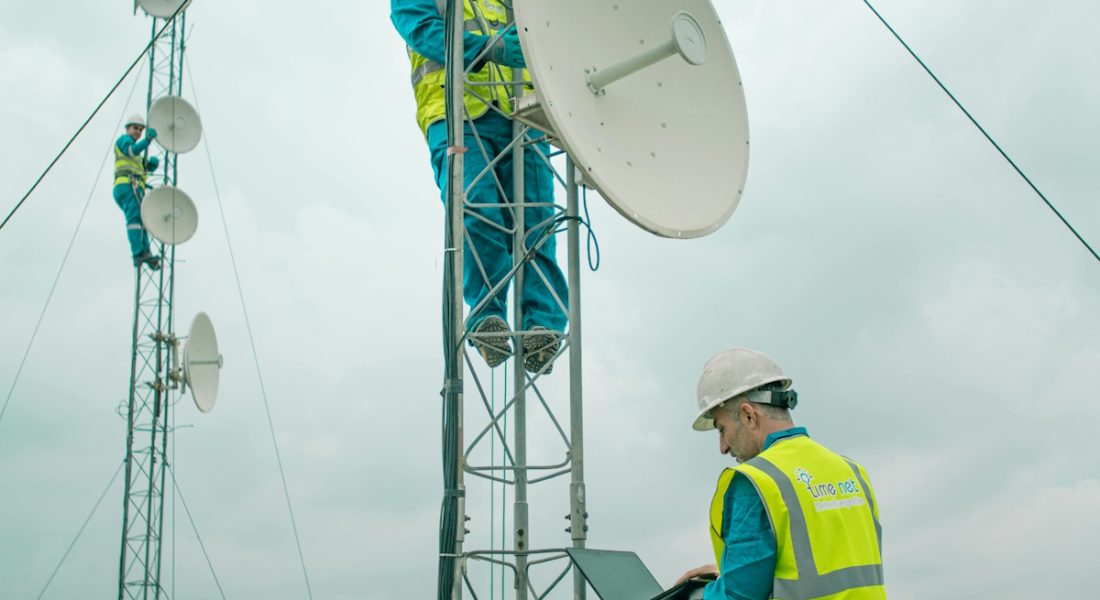
From a user perspective, the setup is refreshingly simple. You receive a dish, connect it to power, place it where it has a clear sky view, and let the system handle the rest. There is no technician visit, no scheduling, and no local infrastructure dependency beyond electricity.

How FlyPix AI Fits Into the Bigger Connectivity Picture
When we talk about whether Starlink is worth it, the conversation often comes back to access. Reliable internet changes what people and organizations can actually do with data, especially when that data comes from satellites, drones, or remote locations. That is exactly where we come in. At FlyPix AI, we work with geospatial imagery every day, and we see firsthand how critical stable, high-quality connectivity is for turning raw imagery into something useful. Whether teams are working in rural areas, construction sites, agricultural land, or disaster-affected regions, having dependable internet makes advanced geospatial analysis practical instead of theoretical.
Our platform is built to extract insights from satellite and aerial imagery using AI, but none of that matters if teams cannot reliably upload data, collaborate, or review results in real time. Solutions like Starlink help close that gap by bringing usable internet to places where traditional infrastructure falls short. In that sense, Starlink and FlyPix AI solve different parts of the same problem. One provides access, the other turns geospatial data into decisions. Together, they make it possible for teams to work smarter in places where connectivity used to be the limiting factor.
Coverage That Actually Changes the Equation
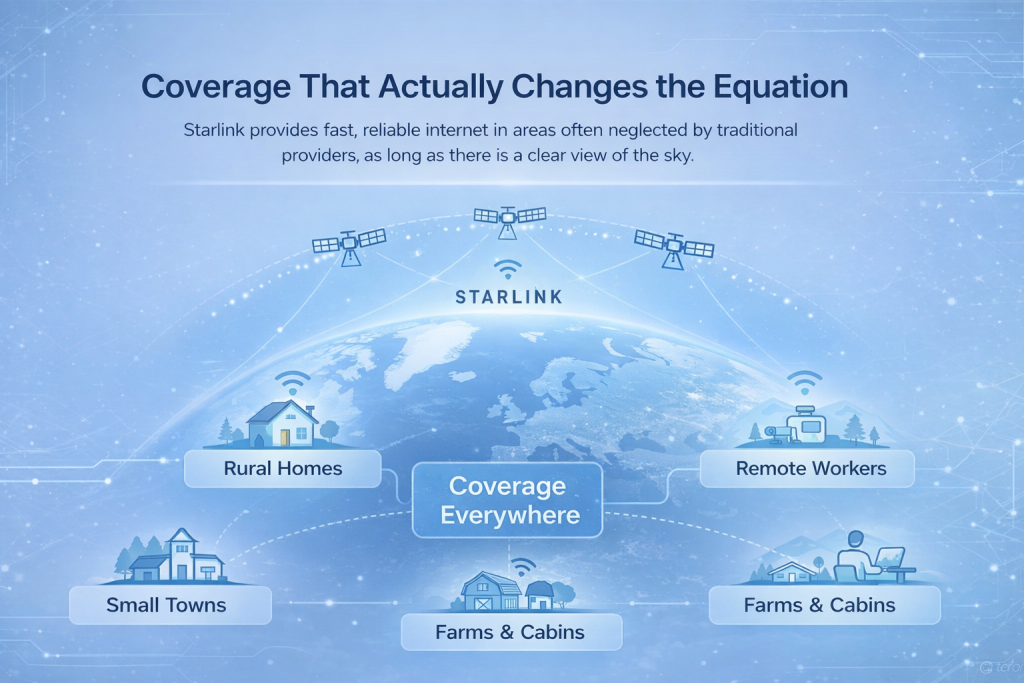
Coverage is where Starlink delivers its strongest value. In many regions, internet availability is dictated by outdated maps, delayed expansion plans, or simple economic disinterest from providers. Even homes technically within city limits can be excluded from fiber or cable rollouts.
Starlink bypasses all of that. As long as you have a clear view of the sky, location becomes almost irrelevant. This has made a meaningful difference for:
- Rural homeowners with no wired broadband options
- Small towns stuck with slow DSL
- Farms, cabins, and off-grid properties
- Remote workers living outside metro areas
For users coming from connections that barely reached 5 Mbps, Starlink does not feel like an upgrade. It feels like entering a different decade entirely.
Performance Over Time, Not Just on Paper
Speed claims mean little without context. What matters is how those speeds hold up over months and years.
Long-term users consistently report that Starlink performance has improved, not degraded, as the satellite network has expanded. Early users were often happy to see 50 to 100 Mbps. Today, speeds well over 200 Mbps are common, with some users regularly seeing peaks above 300 Mbps.
More important than raw speed is latency. Traditional satellite internet often sits in the 600 to 700 ms range, which makes real-time applications painful. Starlink typically operates in the 25 to 60 ms range, which is significantly lower than legacy satellite services and closer to the performance of DSL or cable.
This has real-world consequences:
- Video calls feel natural, not delayed
- Online gaming becomes viable
- Cloud tools and remote desktops respond properly
For many users, this is the first satellite connection that feels like normal internet.
Reliability in Everyday Conditions
Reliability is one of the areas where expectations often clash with reality. Satellite services have historically struggled during storms, wind, or cloud cover. Starlink behaves differently.
In normal weather, including clouds, wind, and light rain, performance remains stable. Heavy rain or snow can cause brief interruptions, but these are usually short and infrequent. The dish actively heats itself to prevent snow and ice buildup, which helps maintain uptime in cold climates.
Over long periods of use, many users report near-continuous availability, with outages measured in seconds rather than hours. For people accustomed to unstable wireless or cellular-based internet, this consistency is a major improvement.
Unlimited Data Without Hidden Limits
Data limits are one of those things you do not think about until they start shaping how you use the internet. For many rural households, caps are not just an inconvenience. They quietly dictate what is possible online, forcing people to choose between work, entertainment, and basic updates. This is one of the areas where Starlink feels genuinely different from most rural and satellite internet options.
How Data Caps Affect Real Internet Use
Traditional satellite and wireless providers often advertise decent speeds, but those numbers come with strings attached. Once a monthly threshold is crossed, performance can drop sharply or usage becomes restricted in subtle ways that are easy to miss until it happens.
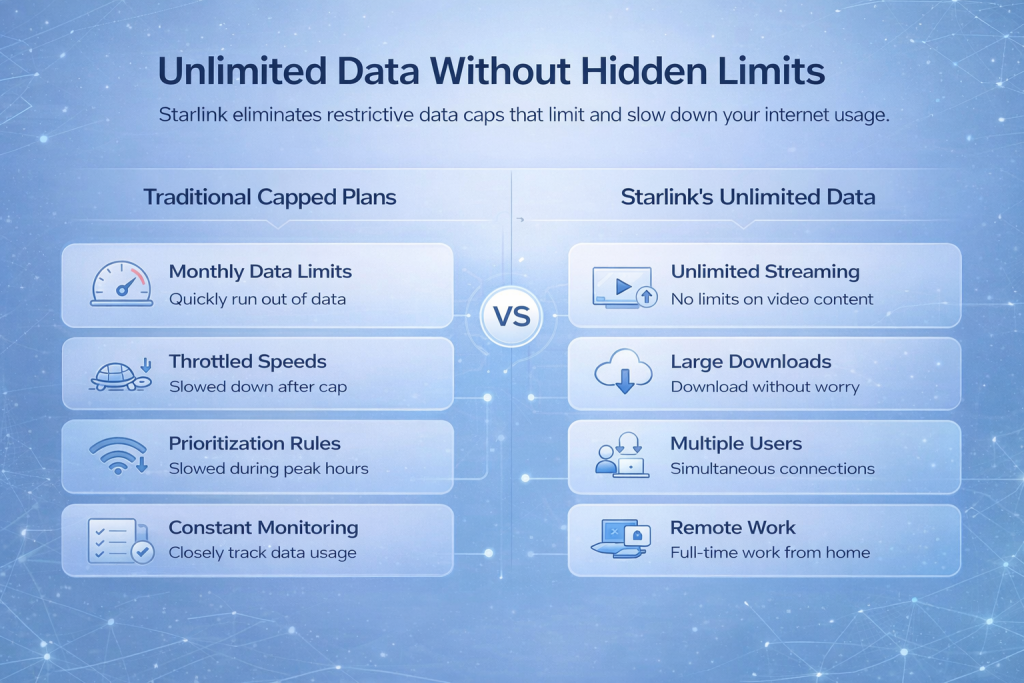
Common Limitations With Capped Plans
- Monthly data allowances that run out quickly with streaming or video calls
- Throttled speeds after a usage threshold is reached
- Prioritization rules that slow traffic during peak hours
- Constant need to monitor usage to avoid slowdowns
For households that work remotely, stream regularly, or share a connection between multiple people, these limits turn the internet into something you manage rather than use.
How Starlink Handles Data Differently
Starlink’s residential plan takes a simpler approach. There is no monthly data cap that forces you to stop or slow down once you hit an arbitrary number. Usage is not metered in a way that punishes normal behavior, and there is no automatic throttling just because you stream a lot or download large files.
This means the connection behaves more like traditional home broadband than satellite internet. You can use it heavily without second guessing every click or update.
What Unlimited Data Looks Like In Practice
- Streaming video without worrying about monthly limits
- Large downloads and system updates happening in the background
- Multiple people using the internet at the same time
- Full-time remote work without monitoring data usage
For many users, this is the first time their internet feels unrestricted, especially if they are coming from older satellite services with strict caps.
Gaming on Starlink, Realistically Explained
Gaming is often used as a stress test for internet quality, and for good reason. It exposes latency issues quickly.
Starlink performs surprisingly well for online gaming. Latency typically stays below 50 ms, which is more than adequate for most competitive and real-time games. Fast-paced titles are playable, and many users report stable sessions with minimal lag.
That said, it is not identical to fiber. In rare cases of heavy precipitation or network congestion, brief interruptions can occur. For professional or tournament-level gaming, a wired connection will always be preferable. For everyday gaming, Starlink is far more capable than most people expect from satellite internet.
The Reality of Customer Support
Customer support is where Starlink feels the least like a traditional internet provider, and that difference catches many people off guard. There is no phone number to call, no live chat window, and no sales team to walk you through options before you buy. Everything, from billing questions to technical issues, is handled through an online ticket system inside the app or account dashboard. For some users, that approach feels modern and efficient. For others, it feels distant and limiting.
Response times depend heavily on the type of issue and how busy support happens to be. Straightforward questions about billing or account changes are often answered within a couple of days. More complex problems, especially those involving hardware or connectivity, can take longer. When your internet is down and work is waiting, that delay can feel much longer than it actually is. Starlink clearly prioritizes scale and automation over speed of human interaction, and that tradeoff is not always easy to accept.
Once support does respond, the experience usually improves. Replies tend to be direct, practical, and focused on fixing the problem rather than deflecting it. In cases of extended outages or faulty equipment, Starlink has been known to issue service credits or replacements without much back and forth. That does not erase the frustration of waiting, but it does show an effort to be fair once someone is actively engaged with your issue.
Cost, Broken Down Honestly
Starlink’s price is often the first thing people hesitate over, and that reaction is understandable. It is not positioned as a budget service, and it does ask for a bigger commitment upfront than most internet plans. The key is understanding where the money goes, how predictable the costs are, and what you may be replacing along the way.
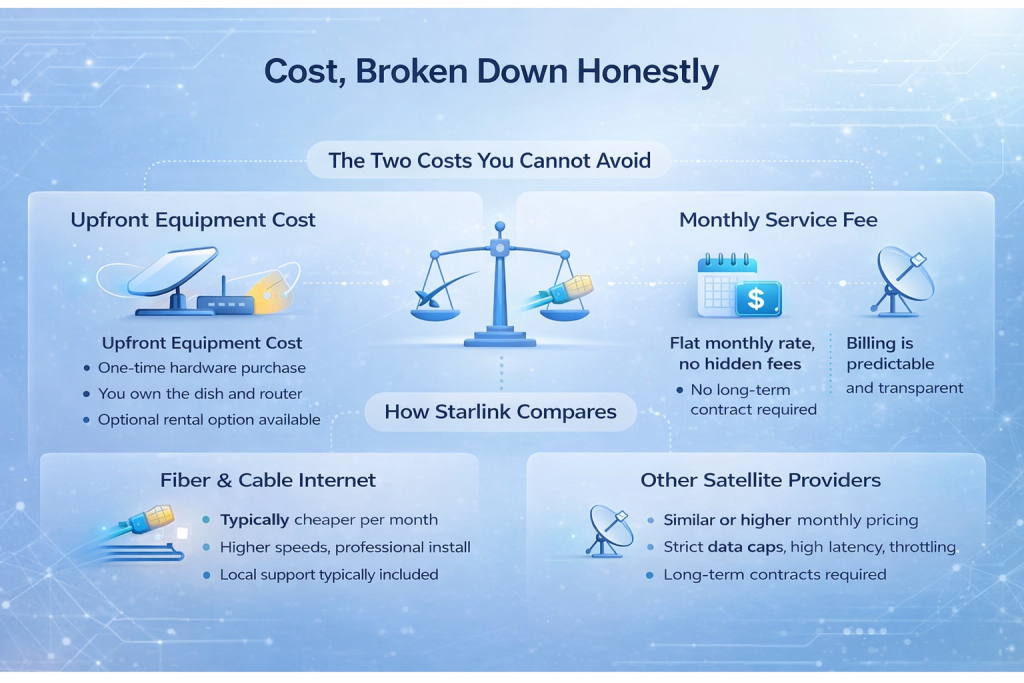
The Two Costs You Cannot Avoid
When you sign up, you typically purchase the hardware outright, which includes the dish, router, and cabling.
- One-time payment, usually a few hundred dollars (prices vary by region and kit type)
- You own the equipment outright, with no ongoing hardware fees
- Hardware prices have significantly dropped compared to earlier years
- Occasional regional discounts, promotions, or third-party retailer options may apply
In many regions, Starlink now offers a rental option for the equipment, allowing users to avoid a large upfront cost. Rental is often at no additional monthly fee beyond the service plan (just shipping/activation in some cases), but you must return the kit in good condition upon cancellation or be charged the full purchase price. Availability depends on your location—check at checkout on starlink.com to see if rental is offered for your address.
This upfront cost can feel steep, especially if you are used to free installs or leased routers. On the flip side, owning the equipment means no rental fees and the option to resell it later if you cancel.
Monthly service fee
The second cost is the monthly subscription, which is higher than many wired options.
- Flat monthly rate with no hidden fees
- No long-term contract or cancellation penalty
- Price increases have happened in the past
- Billing is predictable and transparent
This is where Starlink tends to lose to fiber and cable on pure price, but the comparison is not always fair if those options are not available where you live.
How Starlink Compares to Other Internet Options
Cost makes more sense when you compare it to realistic alternatives, not ideal ones.
Compared to fiber or cable
If you have access to fiber or reliable cable internet, Starlink is usually the more expensive choice.
- Fiber and cable often cost less per month
- Higher peak speeds are common with fiber
- Professional installation and local support are included
In these cases, Starlink is paying a premium for coverage you may not need.
Compared to other satellite providers
This is where Starlink starts to look more reasonable.
- Similar or lower monthly pricing than legacy satellite services
- No strict data caps or severe throttling
- Much better latency and real-world performance
- No long-term contracts
When performance is factored in, Starlink often feels like better value than older satellite options, even if the sticker price looks similar.
DIY Installation, For Better or Worse
Starlink is designed as a self-install service. That works well for people comfortable with basic setup and mounting. For others, especially those unable or unwilling to work on roofs or poles, installation can be intimidating.
Third-party installers have stepped in to fill this gap, offering professional installation for an added cost. This makes Starlink accessible to more people but increases upfront expenses.Once installed, the system requires very little maintenance. Software updates happen automatically, and hardware failures are rare based on long-term reports.
The Starlink Mini and Mobile Use
The arrival of the Starlink Mini shifts the conversation from fixed home internet to something far more flexible. This version is clearly built for movement. It is compact, light enough to carry in a backpack, and quick to set up in places where running a cable or scheduling an install would never be realistic. For people who live on the road, split time between locations, or work from places that change week to week, that portability is the entire point.
In real use, the Mini does not feel like a stripped-down backup device. When it has a clear view of the sky, performance is closer to the standard Starlink dish than most people expect. Speeds regularly cross the 100 Mbps mark, latency stays low, and everyday tasks like streaming, browsing, and video calls work without friction. The built-in Wi-Fi router also removes one more thing to carry or configure, which matters when you are setting up in a campsite, vehicle, or temporary stop.
To make the differences clearer, here is how the Starlink Mini compares to the standard Starlink dish in practical terms:
| Feature | Starlink Mini | Starlink Standard |
| Primary use | Travel and mobile internet | Fixed home internet |
| Size and weight | Very compact and lightweight | Larger and heavier |
| Typical speeds | 100 to 200 Mbps in good conditions | 100 to 300+ Mbps |
| Latency | Low, suitable for calls and streaming | Low, suitable for gaming and work |
| Wi-Fi | Built-in router | Separate router |
| Power needs | Requires portable or vehicle power | Simple wall power |
| Best fit for | Travelers, nomads, mobile workers | Homes, cabins, permanent setups |
The Mini makes the most sense when flexibility matters more than simplicity. If you are often on the move, it can unlock reliable internet in places where hotspots and mobile data fall apart. If your internet use is tied to one address, the standard dish is usually the better value and the easier long-term solution.
Is Starlink the Right Fit for You?
Whether Starlink is worth it depends less on the technology itself and more on the situation you are in. It solves very specific problems, especially around access and reliability, but it also comes with costs and tradeoffs that do not make sense for everyone. Before looking at who benefits most and who should probably look elsewhere, it helps to be honest about your current internet options and what actually frustrates you about them. Starlink works best when it replaces a clear limitation, not when it competes with a service that already does the job well.
Who Starlink Is Clearly Worth It For
Starlink delivers the most value when it replaces a real limitation, not when it is just another option in a crowded market. If your current internet is slow, capped, or unreliable simply because of where you live or how you travel, Starlink can feel like stepping into normal modern internet for the first time. The biggest difference is not just speed. It is the freedom to use the internet without planning around it – calls that do not drop, streaming that does not stall every evening, uploads that do not take all night.
Starlink makes the most sense for people in these situations:
- Rural households without fiber or cable
- Remote workers who need stable, fast internet for calls and cloud tools
- People replacing older satellite services with high latency or strict data caps
- Travelers or mobile users who need reliable connectivity in different locations
In these scenarios, Starlink is not just worth it. It can genuinely change what is possible day to day, especially if you have been stuck in “good enough” internet for years and quietly built your life around the limitations.
Who Should Probably Skip It
Starlink starts to make less sense once you already have solid internet choices on the table. If your home can get fiber or a dependable cable connection, those options will usually be faster, cheaper, and more predictable day to day. Even strong 5G home internet can outperform Starlink in urban and suburban areas, especially during peak hours, without the upfront hardware cost. In those situations, Starlink is not solving a real problem. It is simply competing with services that are already doing the job well.
It may also be the wrong fit if your work or lifestyle depends on absolute consistency and fast human support. Starlink is reliable, but it is not designed with service-level guarantees or immediate troubleshooting in mind. Brief interruptions can happen, and when something does go wrong, support is handled through an online system that can take time. For businesses that need guaranteed uptime, or for users who expect to call someone the moment their connection hiccups, that can be a deal breaker.
Final Thoughts: So, Is Starlink Worth It?
Starlink is worth it when it solves a problem you cannot fix any other way. It is not trying to be the cheapest internet option or the most polished service experience. What it does exceptionally well is remove geography from the equation. For people who have spent years working around slow speeds, data caps, or unreliable connections simply because of where they live or travel, Starlink can feel like a reset button.
That does not mean it is the right answer for everyone. If you already have solid fiber or cable at a fair price, Starlink will likely feel expensive and unnecessary. But if your current internet limits your work, your household, or your ability to stay connected at all, the value becomes much clearer. In those cases, Starlink is not about chasing better speeds. It is about finally having an internet connection you can rely on without constant compromise.
FAQ
In terms of raw performance and price, cable and fiber usually win. They are faster, cheaper, and supported locally. Starlink is not designed to replace them. It is designed for places where those options do not exist or do not work well. In that context, Starlink often feels dramatically better.
Yes, for most users it does. Low latency makes video calls, cloud tools, and screen sharing feel natural. While brief interruptions can happen, many remote workers use Starlink full time without issue, especially in areas where other options are unreliable.
For most people, yes. It handles normal weather well and maintains a stable connection day to day. Heavy rain or snow can cause short dropouts, but these are usually brief. Compared to older satellite services, reliability is a major improvement.
For most people, yes. It handles normal weather well and maintains a stable connection day to day. Heavy rain or snow can cause short dropouts, but these are usually brief. Compared to older satellite services, reliability is a major improvement.
Installation is straightforward but hands-on. You are responsible for placing the dish, mounting it, and running cables if needed. Once set up, maintenance is minimal. If you prefer a fully managed install with local support, this is something to consider.