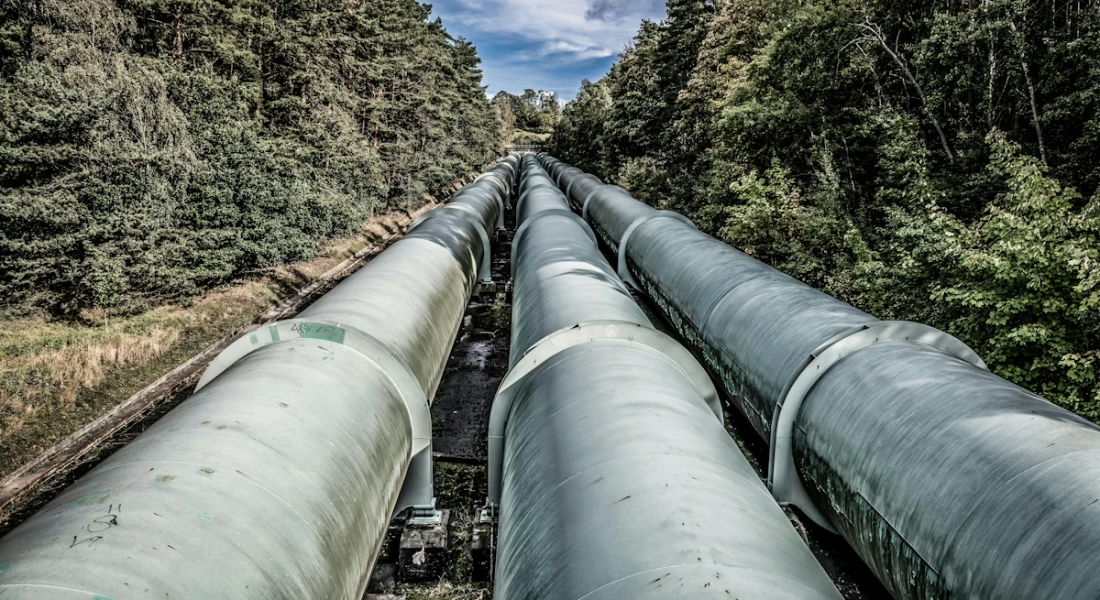
Pipelines carry essential resources like oil, natural gas, and water across vast distances every day, but even small issues-leaks, corrosion, or external damage-can lead to serious environmental harm, safety risks, and costly repairs. That’s where modern pipeline monitoring solutions come in. The best platforms today go far beyond basic checks, using a mix of real-time sensors, advanced analytics, and smart algorithms to spot problems early and keep everything running smoothly.
Top options stand out by offering continuous oversight, precise leak localization, and integration with existing systems like SCADA. Whether it’s fiber-optic sensing for distributed monitoring along the entire line, pressure-wave analysis for quick anomaly detection, or AI-driven predictive tools that forecast potential failures, these solutions help operators stay ahead of threats. They cut response times, reduce false alarms, and support compliance with strict regulations, making them essential for anyone managing high-stakes pipeline networks in today’s demanding environment.
Core Tools for Effective Pipeline Monitoring
Pipeline monitoring solutions rely on a range of tools that help operators keep track of pipeline health in real time. These tools typically combine data from sensors, imagery, or flow measurements with analytics to spot leaks, corrosion, third-party interference, or other anomalies before they escalate. Some focus on direct physical monitoring through pressure, acoustic, or fiber-optic sensing, while others use overhead imagery and AI to watch large sections of infrastructure from above. The choice often comes down to pipeline type, terrain, regulatory needs, and whether the priority is instant detection, long-term trend analysis, or cost-effective coverage over vast distances. Here are several tools commonly considered in this space.

1. FlyPix AI
At FlyPix AI, we built our platform to make geospatial analysis faster and more practical when dealing with satellite, aerial, or drone imagery. We let users upload images or connect their data sources, then train custom AI models simply by adding annotations to a few examples-no coding or advanced AI knowledge required. The agents detect and outline objects in complex, crowded scenes that would normally take hours or days to process manually, often reducing that time to just minutes through automated annotation and analysis.
Our approach stays flexible across different industries. Users define exactly what they need to find-whether it’s specific infrastructure parts, crop conditions, environmental shifts, or anything visible in the imagery-and the system adapts by learning from the annotations they provide. Once the model is ready, it can run one-time inspections or continuous monitoring, delivering precise outlines and insights that plug into reports or other tools. Everything happens in the cloud, so setup remains straightforward, and the platform improves over time as users give feedback to fine-tune results. We designed it this way because we know how frustrating it can be to sift through massive image volumes manually, and we wanted to give people a reliable way to stay on top of changes without getting buried in the work.
Key Highlights:
- AI agent-based image analysis
- Custom model training via annotations
- Object detection and outlining in dense scenes
- Support for satellite, aerial, and drone data
- Continuous monitoring capabilities
Services:
- Pipeline monitoring solutions
- Automated object detection
- Custom AI model creation
- Geospatial annotation
- Image-based monitoring
- Industry-specific analysis adaptation
Contact Information:
- Website: flypix.ai
- Email: [email protected]
- Phone: +49 6151 2776497
- Address: Robert-Bosch-Str. 7, 64293 Darmstadt, Germany
- LinkedIn: www.linkedin.com/company/flypix-ai
2. ROSEN Group
ROSEN Group focuses on pipeline inspection and integrity management for the energy sector, particularly oil and gas pipelines. It offers inline inspection tools along with non-intrusive methods for unpiggable lines, using technologies like magnetic flux leakage, ultrasonic sensors, and robotic crawlers to collect data on metal loss, cracks, deformations, and corrosion. The approach includes above-ground assessments that integrate operational records, cathodic protection data, and GIS for threat identification without internal access.
Integrity work extends to holistic risk management with data analytics, predictive modeling, and software like NIMA for decision support and visualization of inspection results. They handle challenges in offshore assets, future fuels like hydrogen readiness, and geohazard monitoring. It’s a hands-on, technology-heavy setup that feels quite engineering-oriented – sometimes a bit heavy on the hardware side for operators who prefer lighter software-only solutions, but solid when you need detailed physical condition data from tough pipelines.
Key Highlights:
- Inline and robotic pipeline inspection
- Non-intrusive assessment for unpiggable lines
- Data analytics and predictive integrity modeling
- Integrity management software support
- Geohazard and corrosion monitoring
Services:
- Pipeline inspection data collection
- Integrity assessment and risk management
- Robotic in-line inspection
- Above-ground pipeline evaluation
- Predictive analytics for threats
Contact Information:
- Website: www.rosen-group.com
- Phone: +49-591-9136-0
- Email: [email protected]
- Address: Edisonstraße 2, 49811 Lingen (Ems)
- Facebook: www.facebook.com/ROSENGroupGlobal
- Linkedin: www.linkedin.com/company/rosen
3. KROHNE
KROHNE provides PipePatrol as a leak detection and localisation system for pipelines. It relies on an Extended Real Time Transient Model (E-RTTM) that combines real-time transient modelling with a patented leak pattern recognition module. The setup handles both steady and transient conditions while distinguishing actual leaks from normal variations like linefill changes or separation effects. It meets various standards including API 1130, API 1175, AB 864, German TRFL, and CSA Z662.
PipePatrol works independently or integrates with existing instrumentation and SCADA systems. It supports multiple protocols like OPC, Modbus TCP/IP, Modbus Serial, HART, and Profibus. Retrofitting onto older pipelines remains possible using available sensors, and the company supplies full packages with flow measurement devices and remote communications when needed. It’s one of those solutions that feels quite precise for operators who want reliable detection without constant false alarms, though it leans heavily on good instrumentation quality to perform at its sharpest.
Key Highlights:
- E-RTTM-based leak detection
- Leak pattern recognition module
- Multi-method detection for transient conditions
- Protocol support for SCADA integration
- Retrofitting capability
Services:
- Pipeline leak detection
- Leak localisation
- Transient condition monitoring
- Instrumentation package supply
- System integration support
Contact Information:
- Website: www.krohne.com
- Phone: +38 (044) 494 33 55
- Address: Ludwig-Krohne-Str. 5, 47058 Duisburg, Germany
- LinkedIn: www.linkedin.com/company/krohnegroup
- Facebook: www.facebook.com/krohnegroup
4. Atmos International
Atmos International develops Atmos Pipe as a statistical volume balance leak detection system. It applies the Sequential Probability Ratio Test (SPRT) along with pressure and flow data analysis to spot leaks. The software tunes specifically to each pipeline’s characteristics, handling issues like instrument faults, operational shifts during start-up or shut-in, fluid property variations, seasonal changes, and instrument drift.
Atmos Pipe detects leaks under all operating conditions without increasing minimum detectable size during transients. A draining and filling module helps reduce false alarms in those phases. It pulls data from SCADA, DCS, PLC, or RTU systems and supports compliance with standards such as API 1130, API 1175, API 1155, API 1149, CSA Z662, German TRFL, and Shell recommendations. It’s a mature software-only approach that many operators stick with because it avoids hardware overhauls, though tuning it right takes some initial effort.
Key Highlights:
- SPRT-based volume balance
- Pipeline-specific tuning
- Transient condition reliability
- False alarm reduction module
- SCADA data integration
Services:
- Leak detection software
- Pressure and flow analysis
- Transient leak monitoring
- Compliance support
- Data override for faults
Contact Information:
- Website: www.atmosi.com
- Phone: +44 161 445 8080
- Address: St Paul’s 781 Wilmslow Road, Manchester M20 2RW UK
- LinkedIn: www.linkedin.com/company/atmos-international
- Twitter: x.com/AtmosInt
5. ABB
ABB supplies pipeline management and automation solutions for hydrocarbon transport. It combines subsystems for telecommunications, remote data acquisition, control, process measurement, fieldbus, information management, leak detection, and safety protection. Solutions get tailored to specific needs with modular technology, parameter control, and object-oriented libraries for reliability and affordability.
Project execution follows a task force management principle with development, delivery, service, installation, maintenance, and upgrades. Compressor and pumping station automation includes engineering tools, IEC 1131-3 functions, and compressor optimization modules. Hardware covers medium to large I/O setups, redundant CPUs, remote I/O, and integration via MODBUS or PROFIBUS.
Communication supports LAN, WAN, ISDN, and IEC 870-5 protocols with redundant lines. It’s a full-system integrator style that suits operators wanting everything coordinated under one vendor, though it can feel a bit traditional compared to newer software-first options.
Key Highlights:
- Tailored pipeline subsystems
- Compressor and pump automation
- Redundant hardware setups
- Protocol and communication support
- Project lifecycle services
Services:
- Pipeline management solutions
- Automation for stations
- Remote data acquisition
- Leak detection integration
- Safety protection systems
Contact Information:
- Website: new.abb.com
- Phone: +41 43 317 7111
- Email: [email protected]
- Address: Affolternstrasse 44, 8050 Zurich, Switzerland
- LinkedIn: www.linkedin.com/company/abb
- Facebook: www.facebook.com/ABB
- Twitter: x.com/ABBgroupnews
- Instagram: www.instagram.com/abbgroup

6. Emerson
Emerson offers pipeline management solutions focused on measurement and control for integrity and operations. It addresses leak detection, corrosion and erosion monitoring, pressure control, surge protection, pipeline isolation, and pigging. Real-time corrosion and erosion progression tracking happens remotely to allow proactive fixes instead of reactive shutdowns.
The approach combines smart measurement devices with monitoring and control systems to manage threats like undetected degradation or right-of-way intrusions. Solutions aim to maintain operational certainty while reducing environmental risks and supporting efficient pipeline performance. It’s practical for operators dealing with aging infrastructure or high-stakes fluids, though it often pairs best with existing Emerson hardware for full effect – standalone software feels less emphasized here.
Key Highlights:
- Leak detection capabilities
- Corrosion and erosion monitoring
- Pressure and surge control
- Pipeline isolation support
- Pigging management
Services:
- Integrity monitoring
- Leak and event detection
- Corrosion progression tracking
- Pressure protection
- Operational control solutions
Contact Information:
- Website: www.emerson.com
- Phone: +1 888 889 9170
- Email: [email protected]
- Address: 8027 Forsyth Boulevard, St. Louis, MO 63105, United States
- LinkedIn: www.linkedin.com/company/emerson
- Facebook: www.facebook.com/EmersonCorporate
- Twitter: x.com/Emerson_News
7. Baker Hughes
Baker Hughes delivers in-line inspection and integrity services for pipelines, focusing on corrosion, cracks, metal loss, and mechanical damage detection. It uses various inspection technologies to examine emerging issues and remove pipeline debris like wax, liquids, black powder, rust, or millscale to restore throughput and prevent further problems. The services support pipeline lifecycle management from startup through daily operations to decommissioning.
Integrity efforts center on managing corrosion threats and crack-like features with detection, location, and sizing capabilities for different crack types. The company provides tailored solutions to minimize risks and costs associated with pipeline degradation. It’s a hardware-intensive approach that works well when you need detailed internal views of the pipe, though it can involve more downtime for inspections compared to non-intrusive methods – still, it’s reliable for operators who prioritize thorough physical assessments.
Key Highlights:
- In-line pipeline inspection
- Debris removal technologies
- Corrosion and metal loss management
- Crack detection and sizing
- Lifecycle integrity support
Services:
- Pipeline inspection services
- Debris cleaning
- Corrosion threat mitigation
- Crack feature analysis
- Integrity risk reduction
Contact Information:
- Website: www.bakerhughes.com
- Phone: 800 819 9630
- Email: [email protected]
- LinkedIn: www.linkedin.com/company/bakerhughes
- Twitter: x.com/bakerhughesco
- Instagram: www.instagram.com/bakerhughesco
8. SuperVision Pipeline
SuperVision Pipeline combines satellite imagery with optional high-resolution drone surveillance for pipeline monitoring. Data gets processed through advanced AI algorithms to identify anomalies and potential hazards in real time. The system alerts monitoring experts via a web app for proper analysis.
An interactive GIS display shows the pipeline network visually for easier oversight. It’s a modern overhead approach that suits large or remote pipelines where ground access stays limited, though drone coverage adds detail only when you opt in – satellite alone keeps things broad but consistent, and the AI spotting feels handy for catching things early without constant patrols.
Key Highlights:
- Satellite and drone imagery integration
- AI anomaly detection
- Real-time threat alerts
- Interactive GIS visualization
- Web app reporting
Services:
- Pipeline security monitoring
- Hazard identification
- Anomaly analysis
- Visual network display
- Alert delivery to experts
Contact Information:
- Website: www.supervision.earth
- Phone: +49 6151 6678892
- Email: [email protected]
- Address: Otto-Hesse-Straße 19/T2, 64293 Darmstadt
- LinkedIn: www.linkedin.com/company/supervisionearth
- Facebook: www.facebook.com/SuperVisionEarth
- Twitter: x.com/SuperVisionLive
9. AVEVA
AVEVA supplies pipeline software and solutions including SCADA, operational data management, and leak detection applications for liquids, natural gas, petrochemicals, CO2, and hydrogen operations. It integrates SCADA with the PI System for contextualized field data from control and non-control sources, allowing custom dashboards and streaming analytics. Solutions aim at secure, reliable operations with alarm handling, no/low-code automation, and defense-in-depth security.
The platform supports asset-based configuration for data hierarchy, event notifications, and secure sharing with partners. It’s built for control rooms with compliance-focused HMIs and scalable templates across sites. Many operators find it flexible for exception-based workflows once set up, though the full power shows when you already use PI System – otherwise it can feel like a bigger commitment to get everything humming.
Key Highlights:
- Pipeline SCADA integration
- Operational data contextualization
- Leak detection applications
- Custom dashboards and analytics
- Secure data sharing
Services:
- Intelligent pipeline operations
- SCADA and PI System integration
- Data aggregation and visualization
- Alarm and HMI management
- Compliance-focused control rooms
Contact Information:
- Website: www.aveva.com
- Email: [email protected]
- Address: High Cross, Madingley Road, Cambridge, CB3 0HB, UK
- LinkedIn: www.linkedin.com/company/aveva
- Facebook: www.facebook.com/avevasolutions
- Twitter: x.com/AVEVAGroup
- Instagram: www.instagram.com/avevagroup
10. DNV
DNV offers Leakfinder as a leak detection module built on state estimation technology from Statefinder. It analyzes pipeline state in real time using two concurrent techniques for detection, sizing, and location. The system handles poor or missing telemetered data with redundancy management and minimizes false alarms through dynamic threshold updates and data error compensation.
A leak sensitivity study estimates performance upfront and suggests cost-effective improvements before implementation. It supports compliance with API RP 1174 and compensates for SCADA uncertainties by adjusting inputs to hydraulic validity. It’s a model-based method that stays effective in tricky conditions, though it requires solid hydraulic modeling to shine – when tuned right, false alarms drop noticeably compared to simpler volume balance setups.
Key Highlights:
- State estimation-based detection
- Dual concurrent techniques
- Data uncertainty compensation
- Dynamic threshold adjustment
- Leak sensitivity study support
Services:
- Real-time leak detection
- Leak sizing and location
- Anomaly analysis in pipeline state
- False alarm minimization
- Compliance and performance studies
Contact Information:
- Website: www.dnv.com
- Phone: +44 2038165702
- E-mail: [email protected]
- Address: Ashby Road Holywell Park, LE11 3GR Loughborough, United Kingdom
Key Companies in Pipeline Monitoring
Pipeline monitoring companies create systems and platforms to keep oil, gas, water and other critical pipelines safe and running smoothly. They use technologies such as real-time sensors, acoustic or fiber-optic detection, pressure-wave analysis, satellite/drone imagery, and AI-based anomaly spotting. Some focus on hardware attached directly to pipelines, others on software that handles overhead imagery or combines different data feeds for wider coverage. The main priorities usually include fast leak detection, long-term integrity checks, regulatory compliance, or affordable monitoring over large or remote areas. Here are several companies working in this space.
1. AI Superior
AI Superior is a German-based company that specializes in end-to-end AI application development and consulting. They build custom web, mobile, and software solutions powered by machine learning models and algorithms – things like computer vision for object detection or image segmentation, natural language processing for text analysis and sentiment, predictive models for forecasting trends or spotting failures, and big data processing from logs, sensors, or transactions. Sectors they work in include oil and gas alongside finance, government, tech startups, media, construction, pharma, real estate, space, NGOs, and insurance.
The company offers consulting to spot AI opportunities, training programs for individuals and teams, R&D to integrate AI into processes, and full-cycle development from discovery to MVP scaling and evaluation. They follow a structured process with transparency and collaboration in mind. It’s more hands-on custom work than ready-made products – you describe the problem, they craft a tailored AI solution, sometimes kicking off with proof-of-concept before going bigger. Many clients seem to value the PhD-level expertise in data science and engineering for complex challenges.
Key Highlights:
- End-to-end AI application development
- Computer vision and image processing
- Natural language processing
- Predictive analytics
- Big data analytics
Services:
- AI consulting
- Custom AI software building
- AI training programs
- Data-driven R&D
- AI integration support
Contact Information:
- Website: aisuperior.com
- Phone: +49 6151 3943489
- Email: [email protected]
- Address: Robert-Bosch-Str. 7, 64293 Darmstadt, Germany
- LinkedIn: www.linkedin.com/company/ai-superior
- Facebook: www.facebook.com/aisuperior
- Twitter: x.com/aisuperior
- Instagram: www.instagram.com/ai_superior
2. MISTRAS Group
MISTRAS Group offers pipeline integrity services and software through an integrated approach combining inspection, risk assessment, geospatial data, and management tools. It uses inline inspection (ILI), non-destructive testing (NDT), magnetic flux leakage pigs, geometry tools, TriStream MFL, and ART Crawler to detect metal loss, deformation, and corrosion. Data management includes GIS modeling, field verification, TVC analysis, migration, custom dashboards, alignment sheets, and risk models.
Integrity and risk services cover threat evaluation, prioritization, modeling, consequence analysis, ILI validation, and regulatory consulting for PHMSA compliance. Software from New Century includes InTrack for ILI analysis, Gas HCA Analyst for high-consequence areas, and SheetCutter Pro for alignment sheets. It’s a broad ecosystem that ties inspection data to risk and compliance workflows, handy for operators wanting everything connected in one place, though the full setup can involve coordinating multiple service layers.
Key Highlights:
- Inline inspection and NDT
- GIS data modeling
- Risk and consequence analysis
- Integrity software suite
- Regulatory compliance support
Services:
- Pipeline inspection
- Data and GIS management
- Integrity and risk assessment
- Compliance consulting
- Software for data analysis
Contact Information:
- Website: www.mistrasgroup.com
- Phoen: +1 (609) 716-4150
- LinkedIn: www.linkedin.com/company/mistras-group.
- Facebook: www.facebook.com/MISTRASgroup
- Twitter: x.com/MistrasGroup
- Instagram: www.instagram.com/mistrasgroup
3. AP Sensing
AP Sensing develops distributed fiber optic sensing systems for pipeline monitoring using fiber optic cables as continuous sensors. Distributed Acoustic Sensing (DAS), Distributed Temperature Sensing (DTS), and Distributed Temperature & Strain Sensing (DTSS) detect events like leaks, third-party intrusions, geohazards, PIG tracking, liquid accumulations, slugs, flow constrictions, and hot/cold spots along the entire pipeline length. The solution covers theft prevention, malicious interference, unauthorized digging, and rupture/ignition risks in remote or farmland areas.
The systems operate continuously to minimize downtimes, support safety, and meet regulatory needs while monitoring block valve stations, refineries, processing plants, and storage facilities. Different pipeline types get tailored combinations of DAS, DTS, and DTSS depending on operational conditions. It’s a cable-based approach that gives full coverage without point sensors, though it requires existing or new fiber along the line – once in place, the event localization within meters makes it straightforward for operators who deal with long, exposed routes.
Key Highlights:
- Distributed Acoustic Sensing (DAS)
- Distributed Temperature Sensing (DTS)
- Distributed Temperature & Strain Sensing (DTSS)
- Leak and intrusion detection
- Real-time PIG tracking
Services:
- Pipeline leak detection
- Third-party intrusion monitoring
- Geohazard and flow assurance monitoring
- Event localization
- System design and commissioning
Contact Information:
- Website: www.apsensing.com
- Phone: +49 7031 309 6610
- Email: [email protected]
- Address: Herrenberger Str. 130, 71034 Böblingen, Germany
- LinkedIn: www.linkedin.com/company/ap-sensing
- Facebook: www.facebook.com/APSensing
4. OptaSense
OptaSense offers a pipeline monitoring system based on distributed fiber optic sensing that detects and locates threats in real time. The single system handles leak detection, third-party interference, ground movement, geohazards, theft, critical infrastructure protection, and inline pigging tool tracking. It uses one operating platform to monitor multiple threat types simultaneously.
The setup aims to overcome limitations of separate systems by providing flexibility for different pipeline environments while reducing redundant hardware needs. It’s designed for oil and gas transport where preventing leaks through early external threat detection matters as much as spotting actual leaks. Many operators like the multi-threat coverage from fiber, though performance ties closely to fiber quality and placement – when that’s sorted, it consolidates what used to need several tools.
Key Highlights:
- Multi-threat real-time detection
- Leak detection capabilities
- Third-party interference monitoring
- Ground movement tracking
- Inline tool tracking
Services:
- Pipeline leak detection
- Intrusion and interference monitoring
- Geohazard detection
- Pigging device tracking
- Critical infrastructure protection
Contact Information:
- Website: www.optasense.com
- Phone: +1 540 769 8400
- Address: 301 1st Street SW, Suite 200, Roanoke, VA 24011, USA
- LinkedIn: www.linkedin.com/company/optasense
- Facebook: www.facebook.com/lunainnovations
- Twitter: x.com/optasense

5. Hifi Engineering
Hifi Engineering provides High-fidelity Distributed Sensing (HDS) as a fiber optic monitoring platform for pipelines and infrastructure. It combines custom-engineered fiber optic cables with machine learning algorithms to sense acoustics, strain, vibration, and temperature in real time. The technology gets validated for pinhole leak detection in liquids and gas pipelines with minimal false positives.
Services include turnkey sensing systems, AI/ML data analytics, 24/7 monitoring support, engineering, installation, validation, and reporting. It’s built for smart, safe operation in energy infrastructure. The platform stands out for its high-fidelity approach that catches subtle changes others might miss, though it demands proper fiber deployment – once running, the ML-driven alerts make ongoing oversight feel more proactive than reactive.
Key Highlights:
- High-fidelity distributed sensing
- Acoustic, strain, vibration, temperature monitoring
- Pinhole leak detection
- AI/ML data analytics
- 24/7 monitoring support
Services:
- Turnkey sensing systems
- Fiber optic installation
- Real-time data analytics
- Leak and event validation
- Engineering and reporting
Contact Information:
- Website: hifieng.com
- Phone: +1 403 264 8930
- Email: [email protected]
- Address: #2, 816 – 46th Avenue SE, Calgary, AB, Canada, T2G 2A6
6. Inno (Fuzhou Inno)
Inno manufactures fiber optic temperature sensors and distributed measurement systems. It produces sensors for applications like transformer windings, busbar connections, switchgear, and dry-type transformers. Systems include multi-channel monitoring devices, integrated display hosts, and BOTDR/A for temperature and strain sensing.
The company handles custom development of fiber optic modules and distributed pipeline leakage temperature monitoring systems. Production follows international standards with a focus on quality control. It’s a manufacturing-oriented setup that suits operators needing specific temperature-focused fiber solutions, though it’s more component/supply-side than full end-to-end monitoring platforms – good for integrating into existing setups where precise thermal data matters most.
Key Highlights:
- Fiber optic temperature sensors
- Distributed temperature measurement
- BOTDR/A strain and temperature sensing
- Custom module development
- Pipeline leakage temperature monitoring
Services:
- Fiber optic sensor manufacturing
- Temperature monitoring systems
- Custom fiber development
- Distributed sensing for pipelines
- Transformer and switchgear monitoring
Contact Information:
- Website: www.fjinno.net
- Phone: +8613599070393
- Email: [email protected]
- Address: Liandong U Grain Networking Industrial Park, No.12 Xingye West Road, Fuzhou, Fujian, China
- LinkedIn: www.linkedin.com/company/fjinno
- Facebook: www.facebook.com/fjinnocom
- Twitter: x.com/fjinnonet
- Instagram: www.instagram.com/fjinnocom
7. GeoWGS84
GeoWGS84 is a company that carries out oil and gas pipeline inspection and monitoring using drone-based methods. It performs integrity checks, leak detection, overall health reports, and visual plus thermal imaging across upstream, midstream, and downstream pipelines. Services also cover remote MOV inspection, pipeline network planning surveys, and project progress or handover documentation.
Drone intelligence tackles challenges in vast networks and varied terrain with sensors like RGB, IR, LiDAR, or SWIR payloads that capture close-up views of hard-to-reach spots. Benefits show up in safety from non-intrusive flights, better coverage of inaccessible areas, time savings through multi-sensor data in one pass, increased uptime from quick fixes, optimized planning via AI and AR insights, longer asset life with preventive maintenance, cost savings versus helicopter surveys, eco-friendly operations that minimize ground disturbance, and high-quality accurate issue location. It’s a drone-centric outfit that feels practical for operators who want frequent detailed checks without heavy ground access, though results depend a lot on weather and the right payload choice for each job.
Key Highlights:
- Drone visual and thermal inspection
- Leak detection surveys
- Pipeline integrity reporting
- MOV remote checks
- Network planning surveys
Services:
- Oil and gas pipeline inspection
- Leak detection monitoring
- Health assessment reports
- Visual/thermal imaging
- Project progress documentation
Contact Information:
- Website: www.geowgs84.com
- Phone: 519-590-9999
- Email: [email protected]
- Address: Point of Interest Aerial, 244 Colton Circle, Kitchener, Ontario N2A 4K2
- LinkedIn: www.linkedin.com/company/geowgs84-corp
- Facebook: www.facebook.com/Geowgs84-Corp-103523805309889
- Instagram: www.instagram.com/geowgs84

8. Percepto
Percepto builds autonomous drone inspection systems for oil and gas with integrated optical gas imaging (OGI) payloads. The drone-in-a-box setup runs remote surveys from operations centers, using AI for on-board real-time emission detection, liquid leak spotting via change detection, sensor/alert response dispatching, thermal analysis for heat loss or insulation issues, and compliance data storage in a centralized repository. It supports frequent automated OGI surveys to meet regulatory standards.
The solution fits emission monitoring needs by scaling autonomous flights and AI-driven detection for upstream sites. It’s geared toward reducing manual surveys while catching leaks or emissions early, though the full value comes from integrating with existing sensors or satellite alerts – once set up, the remote operation cuts site visits noticeably.
Key Highlights:
- Autonomous drone OGI
- On-board AI emission detection
- Liquid leak change detection
- Thermal insulation analysis
- Centralized data repository
Services:
- Automated gas emission monitoring
- Liquid leak detection
- Sensor-triggered drone dispatch
- Thermal imaging surveys
- Compliance auditing support
Contact Information:
- Website: percepto.co
- Address: Dam Hamacabim 38, Modi’in, 7178604, Israel
- LinkedIn: www.linkedin.com/company/perceptoautonomousdrones
- Facebook: www.facebook.com/perceptodrones
- Twitter: x.com/perceptodrones
- Instagram: www.instagram.com/perceptodrones
9. Bandweaver
Bandweaver is a company that supplies pipeline monitoring and security solutions based on Distributed Temperature Sensing (DTS) and Distributed Acoustic Sensing (DAS). It detects leaks in gas or liquid pipelines, third-party interference such as digging or tapping, seismic activity, landslides, rockfalls, and PIG tracking with accurate location pinpointing. The systems leverage existing telecom fiber infrastructure whenever possible for deployment without additional field electronics or power requirements.
Features cover rapid localization of incidents to accelerate repairs, lower false alarm rates via advanced signal processing, early warnings to prevent damage, and real-time insights to support operational decisions. It’s a fiber-optic centered approach that handles long-distance or urban pipelines effectively, though success hinges on having fiber along the route – when that’s in place, the ability to catch multiple event types (leaks, intrusions, geohazards) in one system feels quite versatile compared to running separate tools for each threat.
Key Highlights:
- DTS for leak detection
- DAS for interference monitoring
- PIG tracking capability
- Geohazard event detection
- Location-accurate alerts
Services:
- Pipeline leak monitoring
- Third-party interference prevention
- Seismic and landslide detection
- PIG movement tracking
- Fiber optic condition monitoring
Contact Information:
- Website: www.bandweaver.com
- Phone: +44 20 3287 4416
- Email: [email protected]
- Address: Unit 22, Clasford Farm Business Park, Aldershot Road, Guildford, GU3 3HQ
- LinkedIn: www.linkedin.com/company/bandweaver-ltd-uk-
- Twitter: x.com/BandweaverTech
10. Satelytics
Satelytics is a company that provides satellite-based analytics for monitoring pipeline rights-of-way and adjacent areas. It analyzes imagery to detect hydrocarbon leaks or produced water leaks on gathering pipelines, track land movement, erosion, exposure events, and other asset risks. The company also identifies changes in high-consequence areas such as population growth, new structures, waterway erosion, land classification shifts, and vegetation patterns while monitoring vegetation growth, speciation, and health near infrastructure.
The approach extends to spotting biological and chemical constituents in soil and water, including hydrocarbons, salinity, chlorides, or chlorophyll-a. Satelytics supports reduced field exposure in hazardous zones through early alerts, ongoing compliance documentation, remediation program tracking, and historical data for filings, audits, or litigation. It’s a satellite-focused outfit that covers wide areas without boots on the ground, though clear sky conditions matter for consistent results – when they cooperate, the broad environmental and encroachment visibility helps operators stay ahead of issues across large or sensitive networks.
Key Highlights:
- Right-of-way encroachment detection
- Hydrocarbon and water leak identification
- Land movement and erosion tracking
- Vegetation and HCA change monitoring
- Soil/water constituent analysis
Services:
- Pipeline leak monitoring
- Land and erosion assessment
- Vegetation management analytics
- Regulatory compliance documentation
- Remediation tracking
- Litigation data support
Contact Information:
- Website: www.satelytics.com
- Phone: 419-728-0060
- Email: [email protected]
- Address: 6330 Levis Commons Blvd., Perrysburg, Ohio 43551
- LinkedIn: www.linkedin.com/company/satelytics
- Twitter: x.com/satelytics
Conclusion
Wrapping up, pipeline monitoring isn’t just about slapping sensors on pipes and calling it a day – it’s evolved into something way more layered, where real-time data from pressure waves, acoustics, fiber optics, or even overhead drone shots meets smarter analytics to catch problems before they turn into disasters. Whether you’re dealing with oil lines crossing remote deserts, gas networks under busy cities, or water mains in aging infrastructure, the common thread is that no single approach fits every situation perfectly. Some setups shine at instant leak pinpointing, others at long-term trend spotting or keeping compliance auditors happy without constant manual reporting.
At the end of the day, the right monitoring mix comes down to what keeps you up at night most – catastrophic failures, creeping corrosion, third-party damage, environmental fines, or simply runaway operational costs. The good news is the space keeps moving fast; AI agents are starting to handle more of the grunt work, thresholds adapt on their own, and integration between different data streams gets less painful every year. Pick tools that match your pipeline’s quirks, your team’s bandwidth, and your budget reality – test small if you can, because nothing beats seeing how something actually behaves in your environment. Stay vigilant, keep iterating, and those pipes will thank you by staying quiet and doing their job.