
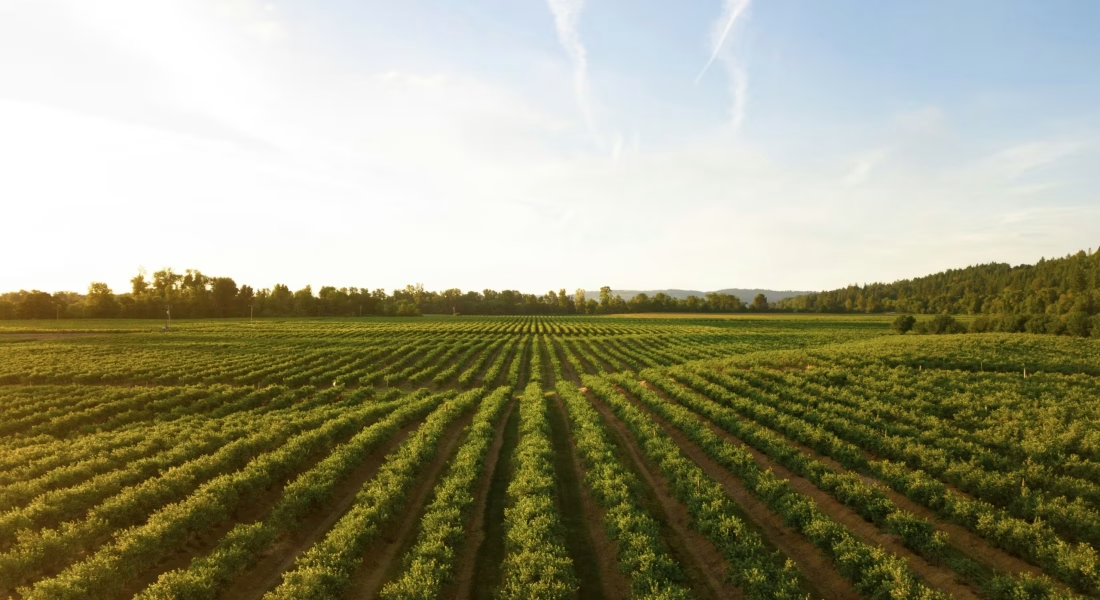
Leading precision farming geospatial solutions are changing how agriculture works by making smart use of satellite, aerial, and drone imagery. These tools bring real speed and accuracy, turning complicated visual data into straightforward, usable insights even in dense fields or areas with changing conditions.
Automating tasks that used to take hours or sometimes months of manual work, these solutions help farmers monitor crop health more effectively and manage resources with greater precision. The outcome goes beyond just saving time – it leads to clearer decisions that support better yields while cutting down on unnecessary waste.
Top Geospatial Tools for Precision Farming
Before diving into the specific tools, it’s worth noting how far geospatial technology has come in agriculture. These powerful apps and tools make it incredibly easy to process satellite, aerial, and drone images at scale, delivering fast and precise insights that help farmers make smarter decisions every single day. From detecting crop stress to mapping field variability, the right tool can save enormous amounts of time while boosting accuracy and productivity.

1. FlyPix AI
FlyPix AI analyzes satellite, aerial, and drone images for precision farming. Our tool automatically detects and outlines individual plants even in dense fields while spotting changes in growth patterns. It maps weeds and identifies early signs of disease or pest issues so farmers can respond in specific areas instead of treating everything the same.
Our platform also tracks livestock by recognizing animals and their grazing behavior across pastures. Soil moisture and nutrient differences show up in the images, which helps adjust fertilizer and irrigation more precisely. Users train custom AI models with their own annotations to detect exactly what they need for their fields without any coding.
Key Highlights:
- Detects individual plants in complex scenes
- Maps weeds from above
- Spots early disease and pest signs
- Tracks livestock and grazing patterns
- Reveals soil variations in fields
Capabilities:
- Precision farming solutions
- Crop counting
- Weed mapping
- Pest and disease detection
- Livestock monitoring
- Soil condition assessment
Contact Information:
- Website: flypix.ai
- Email: [email protected]
- Phone: +49 6151 3943470
- Address: Robert-Bosch-Str. 7, 64293 Darmstadt, Germany
- LinkedIn: www.linkedin.com/company/flypix-ai

2. xFarm
xFarm integrates satellite and sensor data to support precision farming decisions on irrigation, crop protection, and fertilization. The tool monitors field conditions in real time and helps create maps for variable-rate seeding or fertilizer application that connect directly to machinery. It also logs activities and provides custom alerts for different tasks around the farm.
Users sometimes mention that combining satellite views with on-ground sensor readings takes a short while to get comfortable with, yet it gives a clearer picture of variability across fields. The system tracks weather alongside crop data and includes features for sustainability calculations like water use or nutrient balance.
Key Highlights:
- Uses satellite and sensor data for field monitoring
- Creates fertilization and seeding maps
- Logs activities and scouting observations
- Sends custom task alerts
- Integrates machinery data
- Supports sustainability tracking
Capabilities:
- Crop health monitoring
- Irrigation advisory
- Fertilization planning
- Field mapping
- Activity logging
Contact Information:
- Website: www.xfarm.ag
- Phone: +41 912 083 200
- Address: Via Cantonale 18, Manno 6928
- LinkedIn: www.linkedin.com/company/xfarm-technologies
- Facebook: www.facebook.com/helloxfarm
- Twitter: x.com/helloxfarm
- Instagram: www.instagram.com/helloxfarm

3. Agrinavia
Agrinavia offers field management software that works with high-resolution orthophotos for precise mapping in crop production. The tool includes a dedicated mapping module optimized for agricultural use and helps digitize old paper maps such as drainage layouts so they become visible on both computer and mobile devices. It also supports job planning and assignment to keep field operations organized.
The mobile app allows straightforward data entry while out in the fields, which some users find convenient for quick scouting notes. Integration with machinery systems lets job sheets flow directly to equipment like John Deere tractors without extra manual steps.
Key Highlights:
- Works with high-resolution orthophotos for mapping
- Digitizes old drainage and field maps
- Supports job planning and assignment
- Enables mobile data registration
- Integrates with machinery data formats
Capabilities:
- Field mapping
- Job sheet management
- Drainage map digitization
- Mobile scouting support
- Data exchange with equipment
Contact Information:
- Website: agrinavia.com
- Phone: +45 70203311
- Email: [email protected]
- Address: Stubbekøbingvej 41, DK-4840 Nørre Alslev, Denmark
4. AgriPilot.ai
AgriPilot.ai combines satellite imagery, drone data, and IoT sensors to monitor crops and provide real-time agronomic suggestions. The tool tracks field conditions and offers insights for irrigation, pest control, and nutrient management across both open fields and controlled environments. It includes scenario simulation features that let users test different management options before applying them.
Some find the mix of aerial views with ground sensor readings particularly useful for seeing both broad patterns and specific problem spots. The system also supports livestock monitoring and includes a marketplace component that connects different parts of the supply chain.
Key Highlights:
- Integrates satellite and drone imagery for monitoring
- Tracks soil moisture and plant stress
- Generates irrigation and pest control insights
- Supports scenario simulation for decisions
- Includes livestock health monitoring
- Provides centralized field management
Capabilities:
- Crop health monitoring
- Smart irrigation support
- Pest and nutrient management
- Soil analysis advisory
- Livestock management
Contact Information:
- Website: agripilot.ai
- Phone: +91 7263975000
- Email: [email protected]
- Address: Plot no 33 , Borkute Layout, Behind, BSNL tower Narendra Layout, Nagpur 440015
- LinkedIn: www.linkedin.com/in/agripilot-ai-2421952ab
- Facebook: www.facebook.com/people/AgriPilotAI/61555553557407
- Twitter: x.com/agripilotai
- Instagram: www.instagram.com/agripilotai

5. Cropin
Cropin applies AI to satellite imagery and other data sources for crop monitoring and advisory support. The tool tracks field conditions throughout the season and identifies risks or opportunities in crop development. It helps translate imagery insights into practical recommendations for farm operations.
The system brings together multiple data streams so users get a more complete picture without switching between separate sources. Some mention that the risk alerts feel particularly practical once the models adjust to local crop cycles.
Key Highlights:
- Analyzes satellite imagery for crop insights
- Tracks seasonal field conditions
- Identifies crop risks and opportunities
- Integrates multiple data sources
- Supports advisory recommendations
Capabilities:
- Satellite-based crop monitoring
- Risk assessment from imagery
- Seasonal performance tracking
- Data integration for farm decisions
Contact Information:
- Website: www.cropin.com
- Email: [email protected]
- Address: #1021, 3rd Floor, 16th Main, BTM Layout 1st Stage Bangalore, Karnataka – 560029
- LinkedIn: www.linkedin.com/company/cropin-technology
- Facebook: www.facebook.com/CropinTech
- Twitter: x.com/CropInTech
6. Farmonaut
Farmonaut delivers satellite-based insights for crop health, soil moisture, and weather conditions in farming operations. The tool monitors fields from space and combines data with AI-powered advisory features that offer suggestions from planting through harvest. It also includes wildfire detection alerts and carbon tracking capabilities for broader land management.
Users can access geospatial views that cover large areas along with supply chain traceability through blockchain integration. Fleet monitoring and plantation management features sit alongside the core crop insights. The combination of satellite views with other data layers can feel a bit dense at first but helps when comparing conditions across different fields or seasons.
Key Highlights:
- Uses satellite imagery for crop health monitoring
- Tracks real-time soil moisture levels
- Provides weather insights for decision making
- Includes wildfire detection alerts
- Supports carbon footprint monitoring
- Enables supply chain traceability
Capabilities:
- Precision crop monitoring
- Soil and weather analysis
- AI-based farm advisory
- Wildfire and risk alerts
- Fleet and plantation management
Contact Information:
- Website: farmonaut.com
- Phone: +1 (669)666-6882
- Email: [email protected]
- Address: 2810 N Church St PMB 87609, Wilmington Delaware, USA
- LinkedIn: www.linkedin.com/company/farmonaut
- Facebook: www.facebook.com/farmonaut
- Twitter: x.com/farmonaut
- Instagram: www.instagram.com/farmonaut

7. OneSoil
OneSoil uses satellite imagery to monitor crops and support precision farming decisions. The tool automatically detects field boundaries with a single click and tracks vegetation health through the NDVI index so users can spot problem areas quickly. It also creates maps for variable-rate applications and helps compare crop performance across different fields from a distance.
The mobile app makes scouting easier by letting users add notes and photos directly from the field while checking weather forecasts and growing degree-days. Some users say the NDVI maps feel surprisingly straightforward for identifying frost damage or other stress points once they get used to the color coding. Charts for accumulated precipitation and fieldwork analysis from on-board computers add another layer when planning seeding rates or fertilizer adjustments.
Key Highlights:
- Automatically detects field boundaries from satellite images
- Tracks vegetation with NDVI index over time
- Creates variable-rate application maps
- Supports field scouting with notes and photos
- Integrates weather forecasts and growing degree-days
- Analyzes fieldwork results for input optimization
Capabilities:
- Crop monitoring via satellite
- NDVI map generation
- Scouting report creation
- Variable-rate technology support
- Weather and precipitation tracking
Contact Information:
- Website: onesoil.ai
- Email: [email protected]
- Address: Churerstrasse 54, Pfäffikon, Schwyz 8808, CH
- Linkedin: www.linkedin.com/company/onesoil
- Twitter: x.com/onesoilplatform
- Instagram: www.instagram.com/onesoil.ai

8. Fasal Smart Irrigation
Fasal Smart Irrigation combines satellite imagery with on-farm sensors to monitor crop conditions in real time. The tool tracks key parameters like soil moisture, weather, and plant stress to generate actionable alerts for farmers. It focuses on helping with irrigation scheduling and overall crop management through integrated data layers.
The system processes imagery alongside ground-level readings, which some find useful for seeing both broad patterns and specific field spots. Alerts arrive based on the combined data so decisions about water or other inputs can happen at the right moment.
Key Highlights:
- Uses satellite imagery for crop monitoring
- Integrates sensor data with imagery
- Tracks soil moisture and plant stress
- Generates irrigation scheduling insights
- Sends alerts based on field conditions
Capabilities:
- Real-time crop monitoring
- Irrigation management support
- Sensor and imagery data integration
- Stress detection and alerts
Contact Information:
- Website: fasal.co
- Phone: +91 8855086087
- Email: [email protected]
- LinkedIn: www.linkedin.com/company/fasal
- Facebook: www.facebook.com/FasalApp
- Twitter: x.com/FasalOfficial
- Instagram: www.instagram.com/fasalapp

9. Agremo
Agremo processes drone imagery to deliver detailed plant-level analysis for agriculture. The tool creates maps and reports from aerial data, including plant counting, health assessment, and field variability detection. It turns raw drone flights into structured insights that support scouting and management decisions.
Users apply the outputs when they need accurate counts or clear visuals of crop performance across large areas. The processing workflow handles multispectral or RGB imagery depending on the flight setup.
Key Highlights:
- Processes drone-captured aerial imagery
- Performs plant counting from above
- Assesses crop health and variability
- Generates detailed field maps and reports
- Supports scouting with visual data
Capabilities:
- Drone imagery analysis
- Plant population counting
- Crop health mapping
- Field variability detection
Contact Information:
- Website: www.agremo.com
- Email: [email protected]
- Address: 8 The Green Suite # 12076 Dover, DE 19901, USA
- LinkedIn: www.linkedin.com/company/agremoapp
- Facebook: www.facebook.com/AgremoApp
- Twitter: x.com/AgremoApp
- Instagram: www.instagram.com/agremoapp
Leading Geospatial Companies for Precision Farming
Several companies now offer practical geospatial solutions that help turn satellite, aerial, and drone imagery into useful insights for precision farming. These providers focus on crop monitoring, field variability, and smarter resource decisions, making complex visual data easier to work with on a daily basis. Many farmers and agronomists find that working with the right company noticeably reduces manual effort while delivering clear, actionable information tailored to real field conditions.

1. AI Superior
AI Superior provides artificial intelligence consulting with a focus on geospatial data and precision farming applications. The company develops solutions that process drone and satellite imagery to support crop monitoring and field-level decision making. It helps interpret complex spatial data gathered from drones, offering an alternative approach to traditional satellite data sources in agriculture.
AI Superior works on computer vision tasks for agriculture, such as analyzing imagery to detect plant conditions or support resource optimization. The company builds custom AI models for clients managing drone operations and precision agriculture workflows. It integrates deep learning techniques for remote sensing analysis, including insights into soil health and crop conditions to assist with precision farming practices.
Key Highlights:
- Processes drone and satellite imagery for agriculture
- Applies computer vision to crop monitoring
- Interprets complex spatial data from drones
- Supports precision agriculture workflows
- Uses deep learning for remote sensing tasks
Services:
- AI consulting for geospatial projects
- Drone imagery analysis
- Crop condition detection
- Spatial data interpretation
- Precision farming support
Contact Information:
- Website: aisuperior.com
- Phone: +49 6151 3943489
- Email: [email protected]
- Address: Robert-Bosch-Str. 7, 64293 Darmstadt, Germany
- LinkedIn: www.linkedin.com/company/ai-superior
- Facebook: www.facebook.com/aisuperior
- Twitter: x.com/aisuperior
- Instagram: www.instagram.com/ai_superior

2. Taranis
Taranis captures and processes very high-definition drone imagery to examine crops closely throughout the entire growing season. The company uses AI to identify weed pressure, disease symptoms, insect activity, and signs of nutrient deficiencies, often down to the individual leaf level. Growers receive clear visual summaries along with practical suggestions for what to do next in the field.
Scouts and advisors often turn to Taranis when they need to cover many fields quickly while still catching smaller problems that are difficult to spot from the ground. The company gradually builds a large collection of crop images that helps improve detection accuracy for future scans in similar conditions.
Key Highlights:
- Processes high-definition drone imagery with fine detail
- Identifies weed pressure at leaf level
- Detects disease symptoms and insect damage
- Highlights signs of nutrient deficiencies
- Delivers visual summaries and action suggestions
Services:
- Crop threat identification
- Seasonal imagery analysis
- Data-driven scouting support
Contact Information:
- Website: www.taranis.com
- Phone: +1 (317) 804-2031
- Email: [email protected]
- Address: 725 E. Main St., Westfield, IN 46074
- LinkedIn: www.linkedin.com/company/taranis-visual
- Facebook: www.facebook.com/taranisvisual
- Twitter: x.com/TaranisAg
- Instagram: www.instagram.com/taranis_ag
3. EOS Data Analytics
EOS Data Analytics combines satellite imagery from its own EOS SAT-1 satellite and multiple partner sources to support precision farming. The company converts raw satellite data into clear maps and analytical reports that track crop development through the season. Users can search and analyze images directly in the browser using the LandViewer feature without complicated setup.
Field boundaries are mapped automatically and different crop types get identified from space. Soil health indicators along with climate and weather effects appear in the visuals, giving farmers a more complete view so they can make decisions about irrigation, fertilizer use, or harvest timing based on actual conditions rather than estimates.
Key Highlights:
- Works with optical, SAR, and thermal satellite data
- Generates visual analytical reports from imagery
- Tracks crop development across the season
- Maps field boundaries and identifies crop types
- Shows soil health and climate influences on fields
Services:
- Crop health monitoring
- Soil health evaluation
- Crop type classification
- Field boundary mapping
- Yield-related analysis support
Contact Information:
- Website: eos.com
- Email: [email protected]
- Address: 800 W. El Camino Real, Suite 180, Mountain View, CA 94040, USA
- LinkedIn: www.linkedin.com/company/eos-data-analytics
- Facebook: www.facebook.com/eosda
- Twitter: x.com/eos_da
- Instagram: www.instagram.com/eosdataanalytics

4. Ceres AI
Ceres AI examines aerial imagery to turn visual data into practical risk insights for crop management. The company looks at conditions from above and highlights specific areas in the field that may need attention. Farmers then use these insights to adjust their daily management practices and address potential problems before they grow larger.
The company focuses on delivering usable information that fits into regular farm operations and supports more sustainable approaches to resource use. Many find the aerial perspective particularly helpful for seeing patterns that are hard to notice when working only at ground level.
Key Highlights:
- Analyzes aerial imagery for crop condition insights
- Highlights specific risk zones within fields
- Supports adjustments in daily crop management
- Helps address potential problems early
Services:
- Crop risk assessment
- Aerial imagery interpretation for field decisions
Contact Information:
- Website: ceres.ai
- Phone: (888) 313-3705
- Email: [email protected]
- Address: 409 13th St, Fl 1000, Oakland CA 94612
- LinkedIn: www.linkedin.com/company/ceres-imaging
- Facebook: www.facebook.com/ceresimaging
- Twitter: x.com/ceresimaging
- Instagram: www.instagram.com/ceresimaging

5. PTx Trimble
PTx Trimble delivers precision agriculture capabilities that focus on field operations and bringing together different data sources. The company helps connect spatial information for mapping and variable rate applications across farms. Imagery and geospatial data feed into daily workflows to support decisions on crop management and resource use.
Users often mention that aligning the various data layers with existing equipment takes some initial effort but then fits reasonably well into regular operations. The approach allows for site-specific adjustments without requiring complete overhauls of how fields are managed.
Key Highlights:
- Supports field mapping operations
- Integrates spatial data layers
- Assists with variable rate applications
- Connects equipment and data sources
Services:
- Precision field mapping
- Data layer visualization
- Crop management support
Contact Information:
- Website: www.ptxag.com
- Phone: (309) 925-5050
- Email: [email protected]
- Address: 23207 Townline Rd, Tremont, IL 61568
- Facebook: www.facebook.com/ptx.ag
- Twitter: x.com/PTx_Ag
- Instagram: www.instagram.com/ptx.ag

6. FarmQA
FarmQA provides solutions that agronomists use for scouting fields and pulling in information from multiple sources. The company offers a mobile app that replaces paper notes during crop scouting while the web side brings in daily satellite imagery from Planet to show current crop and soil conditions. Spatial layers and maps make it easier to spot patterns that might be missed during regular field walks.
Journals keep crop and soil records in one place, and weather data helps flag possible issues ahead of time. Some users say the number of available layers feels a bit much when first starting out, yet it settles into a useful routine after regular use. Soil sampling records and variable rate prescriptions come together within the same system.
Key Highlights:
- Mobile app for field scouting
- Integrates daily satellite imagery
- Creates spatial layer visualizations
- Maintains crop and soil journals
- Captures weather data for forecasts
- Supports variable rate prescriptions
Services:
- Crop scouting
- Satellite-based field monitoring
- Soil sampling management
- Treatment recommendations
- Task and plan scheduling
Contact Information:
- Website: farmqa.com
- Phone: +1 701-941-2046
- Address: 1213 NP Ave N, Suite 200, Fargo, North Dakota 58102, USA
- Facebook: www.facebook.com/farmqa
- Twitter: x.com/farm_qa

7. Sentera
Sentera specializes in capturing high-resolution aerial imagery using drone sensors and cameras. The company develops multispectral sensors that record different wavebands to analyze vegetation in greater detail. Aerial data gets processed to produce plant-level insights that help with crop monitoring decisions.
Growers and advisors turn to the outputs when they want clearer pictures of how plants are performing across different parts of a field. The combination of hardware and analysis can feel somewhat technical in the beginning, but it yields usable information once the flights are completed and the data moves through the system.
Key Highlights:
- Captures high-resolution aerial imagery
- Uses multispectral sensors for vegetation analysis
- Processes drone-based waveband data
- Delivers plant-level crop insights
Services:
- Drone imagery collection
- Multispectral vegetation analysis
- Aerial crop monitoring
Contact Information:
- Website: sentera.com
- Address: 767 N. Eustis St., Ste 120, St. Paul, MN 55114
- Phone: 844-736-8372
- Facebook: www.facebook.com/senteraofficial
- Twitter: x.com/senteraofficial
- Linkedin: www.linkedin.com/company/sentera

8. Gamaya
Gamaya applies AI to satellite imagery, especially for sugarcane crop monitoring and yield-related insights. The company combines remote sensing with climate data and crop-specific models to create weekly projections on maturation, flowering, and harvest timing. Soil moisture and temperature insights appear without the need for physical sensors in the field.
Harvest recommendations often feel quite specific once the models adapt to local growing conditions. The company also supports deforestation tracking and certification needs through automated reports. Irrigation planning includes tailored schedules aimed at reducing unnecessary water use in sugarcane fields.
Key Highlights:
- Uses satellite imagery for weekly crop projections
- Provides maturation and flowering insights
- Predicts optimal harvest timing and sugar content
- Monitors soil moisture and temperature
- Generates deforestation and compliance reports
- Creates tailored irrigation schedules
Services:
- Sugarcane yield optimization
- Harvest planning support
- Soil and climate data integration
- Irrigation management
- Certification data analysis
Contact Information:
- Website: www.gamaya.com
- Email: [email protected]
- Address: Technoparkstrasse 2, 8406 Winterthur, Switzerland
- LinkedIn: www.linkedin.com/company/gamaya
- Facebook: www.facebook.com/GamayaAgriculture
- Twitter: x.com/Gamaya_ag
9. Crop Quest
Crop Quest delivers precision agriculture services by combining different types of field data with practical agronomic advice. The company works with crop health imagery, yield maps, and soil texture information gathered through EC and EM mapping methods. Management zones come together from soil samples and field boundaries to guide more targeted decisions across the farm.
Advisors rely on these combined layers when developing variable rate plans for seeding rates or irrigation amounts. Grid sampling or zone-based soil sampling fits into the process, along with pH mapping done with Veris equipment. All the information flows into recommendations that adjust according to conditions in each part of the field rather than treating everything the same.
Key Highlights:
- Incorporates crop health imagery for plant assessment
- Creates yield maps and soil texture maps
- Builds management zones from field data
- Supports grid and zone soil sampling
- Includes Veris pH mapping
- Generates variable rate recommendations from multiple data sources
Services:
- Crop monitoring through imagery
- Yield map analysis
- Soil mapping and sampling
- Field management zone creation
- Variable rate planning support
Contact Information:
- Website: www.cropquest.com
- Phone: 620-685-8212
- Email: [email protected]
- Facebook: www.facebook.com/cropquest
- Twitter: x.com/cropquestinc
- Instagram: www.instagram.com/cropquest

10. Farm21
Farm21 brings together data from soil sensors, satellite imagery, weather, and scouting into one place for field monitoring. The company offers affordable soil sensors that measure moisture, temperature, and other values right under the crop canopy. Satellite data helps cover larger or more remote areas while digital scouting journals keep observations organized.
Alerts trigger when certain thresholds are crossed so potential problems can be spotted earlier. Users get a broader view of what is happening across fields, which helps with decisions on irrigation, disease control, or where to send people next. Some find the amount of incoming data a little busy at the start, but it usually settles into a routine that makes daily planning clearer.
Key Highlights:
- Collects real-time data from soil sensors
- Integrates satellite imagery for field overview
- Supports digital scouting and journaling
- Provides weather data alongside sensor readings
- Generates alerts based on set thresholds
- Centralizes information from multiple sources
Services:
- Sensor-based crop monitoring
- Satellite field monitoring
- Scouting data management
- Irrigation and disease support
- Action prioritization across fields
Contact Information:
- Website: www.farm21.com
- Email: [email protected]
- Address: Danzigerbocht 39G 1013AM, Amsterdam, The Netherlands
- LinkedIn: www.linkedin.com/company/farm21
- Facebook: www.facebook.com/farm21.tech
- Instagram: www.instagram.com/farmtwentyone

11. Intellias
Intellias develops custom solutions for precision agriculture with a focus on aerial and imaging analytics. The company processes high-resolution imagery from satellites and drones to assess crop health and irrigation efficiency across fields. It integrates geospatial data into farm management systems to help with operational decisions and resource optimization.
Users often note that combining machinery data with imagery analysis takes some setup but then provides clearer insights for daily planning. The approach supports both economic and ecological aspects of farming through data-driven mapping and monitoring features.
Key Highlights:
- Analyzes high-resolution aerial and satellite imagery
- Assesses crop health from imagery
- Evaluates irrigation efficiency
- Integrates geospatial data into farm systems
- Derives insights from machinery and imagery
Services:
- Aerial imaging analytics
- Crop health monitoring
- Irrigation analysis support
- Geospatial farm management integration
Contact Information:
- Website: intellias.com
- Phone: +1 857 444 0442
- Email: [email protected]
- Address: 500 West Madison Street 60661 Chicago, IL
- LinkedIn: www.linkedin.com/company/intellias
- Facebook: www.facebook.com/Intellias.GlobalPage
- Instagram: www.instagram.com/intellias_global
Conclusion
Geospatial solutions have quietly changed how precision farming actually works on the ground. Instead of walking endless rows or guessing based on a few spot checks, farmers can now see clear patterns in crop health, soil differences, and potential trouble spots from satellite and drone views. The shift feels practical rather than flashy – it simply cuts out a lot of guesswork and wasted effort in large or uneven fields.
What stands out is how these approaches turn complicated imagery into something usable day to day. Decisions about water, fertilizer, or pest control become more targeted, which helps stretch resources further without extra hassle. As the technology keeps settling into everyday farm routines, it opens up space for steadier yields and fewer surprises, all while keeping things manageable even in dense or variable conditions. In the end, it’s less about chasing perfection and more about making smarter calls with the view from above.