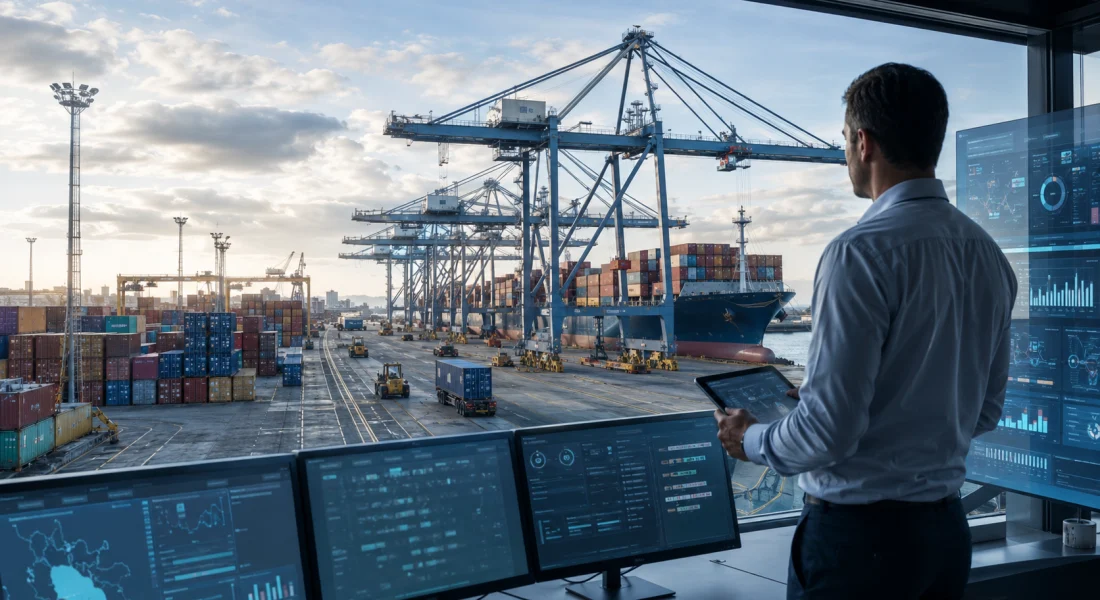
Ports don’t really slow down anymore. Containers arrive, stack up, move out, and the whole thing keeps going whether the system is ready or not. When something slips – a delay in yard planning, a missed handoff, a small miscommunication – it doesn’t stay small for long.
That’s where container terminal software comes in, but not in a flashy way. It’s more about keeping everything connected behind the scenes. Planning where containers go, tracking movements across the yard, coordinating cranes and trucks so they’re not working against each other. When it works well, you barely notice it. Things just move the way they should.
What’s interesting is how different these systems can feel depending on the port. Some are built around tight, high-volume operations where every second matters. Others are more focused on flexibility, where conditions change constantly and the system has to adjust without slowing things down. Either way, the goal stays pretty simple – fewer bottlenecks, better visibility, and less guessing in day-to-day operations.
Practical Container Terminal Software Tools Worth Exploring
Container terminal software tools are quietly reshaping how ports handle everyday operations. Instead of juggling spreadsheets, manual logs, and disconnected systems, these platforms bring everything into one place – from yard planning and container tracking to bookings and reporting. The difference is not dramatic at first glance, but over time it changes how smoothly things run.
What stands out is how these tools reduce the need for constant coordination. Movements get tracked automatically, tasks are planned with fewer gaps, and teams spend less time figuring out what is happening right now. Some systems focus on modular setups, others lean into automation or real-time visibility, but the goal is pretty consistent – keep cargo flowing without unnecessary delays or guesswork.
1. FlyPix AI
At FlyPix AI, our platform is built for working with geospatial imagery using AI agents that detect, monitor, and outline objects in satellite, aerial, and drone data. Instead of relying on manual annotation, we process visual data in a more automated way, which changes how quickly teams can move from raw images to usable information. It is less about replacing human input completely and more about reducing the amount of repetitive work involved.
Our system also supports training custom AI models based on specific needs. Users can define what they want to detect and adapt the platform to different types of projects, whether it is port operations, infrastructure monitoring, or environmental work. The setup stays relatively simple, so teams can start working with data without spending too much time on preparation or configuration.
Key Highlights:
- AI-based detection and monitoring in geospatial images
- Support for satellite, aerial, and drone data
- Custom AI model training with user-defined annotations
- Reduced reliance on manual image processing
- Cloud-based platform with accessible setup
- Applicable across industries including port operations
Capabilities:
- Container terminal software solutions
- Terminal operating system (TOS) implementation and support
- Yard, gate, and quay operations management
- Container tracking and inventory control
- Workflow automation and operational optimization
Contact Information:
- Website: flypix.ai
- Email: [email protected]
- Phone: +49 6151 3943470
- Address: Robert-Bosch-Str. 7, 64293 Darmstadt, Germany
- LinkedIn: www.linkedin.com/company/flypix-ai
2. ContPark
ContPark is presented as a cloud-based terminal operating system designed to handle container and equipment management across different types of facilities. The platform focuses on keeping operations accessible from anywhere, which changes how teams interact with terminal data and coordinate daily work. A lot of attention is placed on tracking cargo movement, managing yard space, and keeping operational data centralized instead of scattered across separate tools.
The platform approaches automation in a gradual way, embedding it into everyday workflows rather than treating it as a separate layer. Features like container recognition, reporting, and booking management are built directly into the system. Integration also plays a noticeable role, with support for external systems like ERP and EDI, which suggests the platform is meant to fit into existing logistics environments without forcing major changes.
Key Highlights:
- Built-in invoicing and automated reporting
- Integration with external systems via API and EDI
- Multi-platform support across devices and operating systems
- Cloud-based terminal operating system with remote access
- Real-time container tracking and yard planning tools
- AI-based container number recognition
Capabilities:
- Equipment maintenance and repair tracking
- Customs control and EDI integration
- Container terminal management system
- Yard management system
- Railway and intermodal management
- Warehouse management system
Contact Information:
- Website: contpark.com
- Address: 010000, Dostyk Street 5, Office 301, Astana, Kazakhstan
- Phone: +447520640207
- E-mail: [email protected]
- LinkedIn: www.linkedin.com/company/contpark
- Facebook: www.facebook.com/contpark
3. MarineBerth
MarineBerth is built around the idea that terminal software does not need to be complicated to be effective. The system positions their system as something straightforward and usable from the start, avoiding heavy setups or complex configurations. The tone of their platform leans more toward practicality, focusing on making everyday port tasks easier to manage without adding unnecessary layers.
At the same time, the system still covers the main operational areas. Vessel scheduling, cargo tracking, and movement coordination are handled in a way that does not require long onboarding. The addition of a desktop overview tool suggests they also consider users who need a quick operational snapshot rather than deep system control.
Key Highlights:
- Focus on simple and intuitive terminal operation workflows
- Tools for vessel scheduling and cargo tracking
- Real-time information sharing across port stakeholders
- Optional desktop application for operational overview
- Flexible pricing based on port size and usage
Capabilities:
- Terminal operating system software
- Vessel movement scheduling
- Cargo operation recording
- Crew and transit tracking
- Real-time port activity monitoring
Contact Information:
- Website: marineberth.com
- LinkedIn: www.linkedin.com/company/marineberth
- Facebook: www.facebook.com/harbour.nz
4. iPortman
iPortman is structured as a web-based port management solution that works across different devices and locations. The platform approaches terminal software as part of a broader system, where multiple ports, users, and workflows can be managed within a single environment. This makes sense for operations that are not limited to one site or one type of cargo handling.
Their focus leans toward flexibility and adaptability. The platform is designed to support different setups without requiring major changes to infrastructure. Alongside the system itself, they also provide services related to deployment, integration, and process improvement, which suggests the software is often introduced as part of a wider operational change rather than just a standalone tool.
Key Highlights:
- Designed for integration with external systems and tools
- Flexible deployment across different technical environments
- Web-based platform accessible across multiple devices
- Supports multi-port and multi-location operations
- Focus on process optimization and operational improvement
Capabilities:
- Legacy system migration
- Process optimization consulting
- Integrated port management solutions
- System integration and deployment
- Support for greenfield and brownfield port projects
Contact Information:
- Website: www.iportman.com
- Address: 123 5th Ave, New York, NY 10003, USA
- Phone: (123) 456-7890
5. Tideworks
Tideworks builds its terminal software as a set of connected systems rather than a single fixed product. The tool focuses on giving terminals the ability to scale and adjust over time, which is important in environments where workflows and volumes keep changing. Instead of locking everything into one structure, the platform is designed to evolve alongside operations.
Another noticeable part is their focus on data handling. The system is structured to make operational data more accessible across planning, billing, and execution processes. By separating certain functions, like billing, from the main system, they allow different parts of terminal operations to function independently while still staying connected.
Key Highlights:
- Modular terminal operating system platform
- Support for marine, rail, and intermodal operations
- Strong focus on data access and operational visibility
- Integration with third-party systems and automation tools
- Centralized billing and reporting capabilities
Capabilities:
- Marine terminal operating systems
- Rail terminal operating systems
- Equipment control and planning systems
- Traffic and terminal visibility tools
- Consulting and implementation support
Contact Information:
- Website: tideworks.com
- Address: 1131 SW Klickitat Way, Seattle, Washington 98134
- Phone: 206.382.4470
- LinkedIn: www.linkedin.com/company/tideworks-technology
6. TBA Group
TBA Group focuses on terminal software together with automation, rather than treating them as separate layers. The tool solutions are designed for both container and bulk cargo environments, which suggests they work with terminals that handle different types of operations at the same time. This makes their approach more about coordination across systems than just managing individual tasks.
The tools connect planning, execution, and physical operations, reflecting how terminals function in practice. Instead of isolating software from equipment, they position it as part of a broader operational setup where data, machines, and processes are linked together.
Key Highlights:
- Terminal operating systems for both container and bulk cargo
- Integration between software and automation systems
- Focus on improving operational visibility
- Solutions designed for different types of terminal environments
- Part of a larger industrial and logistics group
Capabilities:
- Container terminal operating systems
- Bulk and general cargo terminal systems
- Industrial automation solutions
- Process optimization tools
- Integration with terminal equipment and infrastructure
Contact Information:
- Website: tba.group
- Address: Railway Ct, Ten Pound Walk, Doncaster DN4 5FB, UK
- Phone: +44 (0)1302 330837
- E-mail: [email protected]
- LinkedIn: www.linkedin.com/company/tbagroup
7. CyberLogitec
CyberLogitec develops solutions that extend beyond terminal operations into the wider logistics and shipping environment. The system connects different parts of the supply chain, which means terminal operations are handled as one piece of a larger structure rather than in isolation. This approach allows data and processes to move between systems more smoothly.
Within terminal operations, they focus on planning, coordination, and real-time management. Their solutions also include simulation and digital modeling tools, which help test and adjust operations before they are executed. This suggests a shift toward more predictive and data-driven workflows rather than relying only on reactive decisions.
Key Highlights:
- Integrated solutions across shipping, ports, and logistics
- Real-time terminal operation management and planning
- Use of simulation and digital twin technologies
- Support for automation and equipment integration
- Data-driven approach to operational decision-making
Capabilities:
- Container terminal operating systems
- Shipping and logistics management solutions
- Data integration platforms
- Simulation and optimization tools
- IT outsourcing and system support
Contact Information:
- Website: www.cyberlogitec.com
- Address: 16th Floor, Nuritkum Square R&D Tower, Mapo-gu, Seoul, Republic of Korea
- Phone: +82-2-6350-2000
- E-mail: [email protected]
- LinkedIn: www.linkedin.com/company/cyberlogitec
- Facebook: www.facebook.com/cyberlogitec

8. Intermodal Manager
Intermodal Manager is a web-based terminal operating system built around a modular structure, where operators choose only the parts they need. The platform keeps the system flexible across different terminal sizes, which makes it easier to adapt without building everything from scratch. Since it runs in the cloud, it removes the need for local infrastructure, and most of the interaction happens through a browser or mobile device.
The platform organizes around day-to-day operational tasks rather than one central control layer. Yard management, maintenance, bookings, and reporting are handled through separate modules that connect with each other. There is also a clear focus on reducing manual input, especially through EDI and customer-facing tools like the portal, which shifts some of the workload away from terminal staff.
Key Highlights:
- Modular terminal operating system structure
- Web-based platform with cloud access
- Yard management with automated decision support
- EDI integration for data exchange
- Customer portal for self-service operations
- Mobile-friendly tools for yard and repair work
Capabilities:
- Yard management system
- Maintenance and repair management
- Rail operation management
- Vehicle booking system
- Container sales and leasing tools
- Order and inventory management
Contact Information:
- Website: www.intermodalmanager.com
- Address: Bankside Systems Ltd., Palace Chambers 41 London Road, Stroud Gloucestershire, GL5 2AJ, UK
- Phone: +44 (0)330 223 3615
9. Realtime Business Solutions
Realtime Business Solutions develops terminal operating systems that are structured around real-time data handling and operational coordination. Their systems connect different parts of terminal activity into a single environment, where planning, execution, and monitoring happen at the same time. This setup is meant to reduce delays between decision-making and actual operations on the ground.
The system also focuses on automation and system responsiveness. Instead of relying only on manual planning, their platform supports automated workflows and equipment coordination. At the same time, it is designed to handle different terminal sizes, which suggests it can be applied both in smaller facilities and in larger, more complex operations without major structural changes.
Key Highlights:
- Integration with terminal equipment and devices
- Centralized tracking of container movements
- Real-time data architecture for operational decisions
- Support for automation in terminal workflows
- Scalable system for different terminal sizes
Capabilities:
- Terminal operating system solutions
- Container management software
- Automation and optimization tools
- Performance monitoring and reporting
- System integration and support
Contact Information:
- Website: rbs-tops.com
- Address: Level 5, 85 George Street, Parramatta, NSW 2150, Australia
- Phone: +61 2 9893 9255
- E-mail: [email protected]
- LinkedIn: www.linkedin.com/company/realtime-business-solutions
10. Hogia
Hogia works within a broader transport and logistics environment, where terminal systems are only one part of a larger digital setup. Their solutions are built to connect different types of transport operations, which means terminal management is handled alongside other activities like freight movement and traffic coordination. This creates a more connected system where data flows between different parts of the logistics chain.
The terminal-related tool focuses on digitizing everyday processes, such as inventory handling and cargo tracking. Instead of introducing completely new workflows, they tend to replace manual steps with digital ones, like scanning or automated data entry. This approach makes the transition more gradual, especially for terminals moving from paper-based processes to digital systems.
Key Highlights:
- Integration of terminal systems within a broader logistics ecosystem
- Focus on real-time data flow across transport operations
- Support for digital inventory and cargo handling
- Gradual transition from manual to digital workflows
- Adaptability to different transport and terminal environments
Capabilities:
- Inventory and cargo handling tools
- Terminal management systems
- Logistics and transport software solutions
- Data integration across transport systems
- Digital process automation
Contact Information:
- Website: www.hogia.se
- Address: Hakenäs 101, 444 47 Stenungsund
- Phone: +46 (0)0303-666 00
- E-mail: [email protected]
- LinkedIn: www.linkedin.com/company/hogiagruppen
- Facebook: www.facebook.com/Hogiagruppen
- Instagram: www.instagram.com/hogiagruppen
Container Terminal Software Companies to Know
Container terminal software companies don’t all approach the problem the same way. Some focus on automation, others on flexibility or connecting systems that already exist. But in the end, they are all trying to solve a pretty practical issue – how to keep terminal operations running without constant manual coordination.
What makes them different usually comes down to how they handle data, workflows, and integration. Some build around real-time visibility, others around modular systems or AI-driven analysis. Looking at companies side by side helps to see how these approaches actually play out in real operations, not just on paper.

1. AI Superior
AI Superior focuses on building AI-based systems that can be applied across different industries, including logistics and operations where data handling and automation matter. Their work is usually centered around developing custom software that uses machine learning models to process information, identify patterns, and support decision-making. Instead of offering a fixed product, they approach projects as something that needs to be shaped around a specific use case.
They also work across the full lifecycle of AI adoption – from early discovery and testing ideas to integrating solutions into existing systems. A lot of their effort goes into helping teams understand whether AI is even the right fit before building anything. This includes working with data, setting up prototypes, and gradually scaling once things start working in practice.
Key Highlights:
- Focus on custom AI-based software development
- Work with machine learning, computer vision, and data analysis
- Project-based approach from idea validation to deployment
- Experience across multiple industries
- Emphasis on data-driven decision support
Services:
- AI software development
- Artificial intelligence consulting
- AI research and development
- Training and education programs
- Data analysis and predictive modeling
Contact Information:
- Website: aisuperior.com
- Phone: +49 6151 3943489
- Email: [email protected]
- Address: Robert-Bosch-Str. 7, 64293 Darmstadt, Germany
- LinkedIn: www.linkedin.com/company/ai-superior
- Facebook: www.facebook.com/aisuperior
- Twitter: x.com/aisuperior
- Instagram: www.instagram.com/ai_superior
2. Kaleris
Kaleris works on software that connects different parts of the supply chain, including terminal operations, yard management, and transportation flows. Their platform is built around the idea of keeping operations visible and coordinated, so teams can react without switching between disconnected systems. The tools are used to manage how goods move across terminals and other logistics points.
The company relies on real-time data and coordination between different stakeholders. Instead of focusing only on one part of the process, they link terminals, carriers, and inland operations into a shared workflow. This helps reduce delays and makes it easier to keep operations aligned even when conditions change.
Key Highlights:
- Integration between terminals and logistics systems
- Tools for operational coordination
- Focus on connected supply chain workflows
- Real-time visibility across operations
- Used in marine terminal environments
Services:
- Transportation management solutions
- Execution and visibility platforms
- Terminal operating solutions
- Yard management systems
- Maintenance and repair systems
Contact Information:
- Website: kaleris.com
- Address: 3460 Preston Ridge Rd. Suite 600. Alpharetta, GA 30005, USA
- LinkedIn: www.linkedin.com/company/kaleris
- Twitter: x.com/KalerisOfficial

3. TMEIC Ports
TMEIC Ports focuses on combining automation and electrification across different parts of terminal operations, including gate, yard, quay, and rail. Their approach is built around modular systems that can work on their own or be connected into a broader setup. This allows terminals to introduce changes gradually without having to rebuild everything at once.
They also work on improving how equipment and energy systems function together. That includes crane automation, process control, and power infrastructure like substations and charging systems. The goal seems to be creating a more stable and predictable operational environment while keeping compatibility with existing terminal setups.
Key Highlights:
- Focus on automation and electrification in terminals
- Modular systems that can be deployed independently or together
- Coverage across gate, yard, quay, and rail operations
- Integration with existing infrastructure
- Emphasis on operational predictability and control
Services:
- Crane automation
- Process automation systems
- Energy management and electrification
- Power distribution and charging infrastructure
- Integration with terminal systems
Contact Information:
- Website: tmeicports.com
- Address: Tokyo Square Garden 3-1-1 Kyobashi, Chuo-ku, Tokyo 104-0031, Japan
- Phone: +1-540-283-2010

4. Portchain
Portchain develops software focused on berth planning and coordination between terminals and shipping lines. Their tools are designed to replace manual processes like spreadsheets and email communication with a more structured system for aligning schedules and sharing updates. The platform is centered around improving how terminals plan vessel arrivals and manage quay operations.
They also rely on data integration and predictive analytics to support planning decisions. By connecting different stakeholders through shared data, their system helps reduce uncertainty around vessel timing and resource allocation. The overall approach leans toward making planning more transparent and easier to coordinate across multiple parties.
Key Highlights:
- Integration with shipping lines and terminal systems
- Focus on berth planning and alignment
- Tools designed to replace manual coordination workflows
- Data-driven planning with predictive insights
- Emphasis on collaboration and shared visibility
Services:
- Data integration solutions
- Berth planning platforms
- Scheduling and alignment tools
- Predictive analytics for operations
- Collaboration and communication tools
Contact Information:
- Website: portchain.com
- Address: Pilestræde 52, 1st floor, 1112 Copenhagen, Denmark
- LinkedIn: www.linkedin.com/company/portchain
- Twitter: x.com/portchain

5. Omoqo
Omoqo develops a cloud-based terminal operating system with a focus on simplicity and usability. Their platform is built as a set of modules that can be activated depending on the needs of a terminal, which makes it easier to adjust the system without adding unnecessary complexity. The idea is to keep the interface clear and focused on day-to-day operations.
They also address common operational issues like scattered data, manual tasks, and lack of visibility. By keeping everything in one system with role-based views, their platform helps teams track activities without switching between multiple tools. The system is designed to run in a browser, which reduces the need for local infrastructure.
Key Highlights:
- Cloud-based terminal operating system
- Modular structure with flexible feature setup
- Focus on simplicity and clear user experience
- Real-time visibility into terminal operations
- Reduced reliance on local IT infrastructure
Services:
- Terminal operating system (TOS)
- Yard and cargo management
- Reporting and data visibility tools
- Role-based operational dashboards
- System onboarding and integration
Contact Information:
- Website: www.omoqo.com
- Address: Bei St. Annen 1, 20457 Hamburg, Germany
- Phone: +49-40-74008-0
- E-Mail: [email protected]
6. INFORM
INFORM develops software focused on improving decision-making and operational processes using what they describe as Process AI. They work across different industries, including logistics and supply chain environments, where planning and coordination tend to get complicated quickly. Their systems are built around combining mathematical models with real operational data, which helps teams understand what is happening and adjust decisions without relying only on manual input.
They approach software as a way to support people rather than replace them. In practice, this shows up in tools that help identify bottlenecks, simulate different scenarios, and guide planning decisions step by step. Instead of forcing one fixed workflow, their solutions are usually adapted to specific operational conditions, which makes them relevant for environments like terminals where processes rarely follow a perfect pattern.
Key Highlights:
- Long-term experience in handling complex logistics processes
- Emphasis on combining data analysis with human decision-making
- Focus on decision intelligence and process optimization
- Use of AI and mathematical models for operational planning
- Solutions adapted to different industries and workflows
Services:
- Container terminal software solutions
- Decision support systems for logistics operations
- Process optimization using AI models
- Supply chain and workflow planning tools
- Data analysis and operational scenario simulation
Contact Information:
- Website: www.inform-software.com
- Address: Pascalstr. 35, 52076 Aachen
- Phone: +49 (0) 24 08 / 94 56 – 0
- E-mail: [email protected]
- LinkedIn: www.linkedin.com/company/inform
- Twitter: x.com/inform_software
- Facebook: www.facebook.com/INFORMGmbH
- Instagram: www.instagram.com/inform_software

7. NextPort
NextPort builds software that focuses on how data flows through port and terminal operations. Their approach is centered around connecting different parts of the operation and turning that data into something teams can actually use during daily work. They rely on real-time inputs combined with machine learning to give operators a clearer picture of what is happening, especially in situations where timing and coordination matter.
Their products are structured around specific operational needs, like berth planning, terminal monitoring, and overall workflow visibility. A noticeable part of their approach is the use of a digital twin, which helps teams see operations in a more visual and connected way. Instead of reacting after issues appear, their systems are designed to highlight patterns early and support more consistent decision-making across teams.
Key Highlights:
- Real-time data integration across port and terminal operations
- Use of digital twin technology for operational visibility
- Focus on collaboration between different stakeholders
- Predictive insights based on machine learning
- Tools designed for both daily operations and planning
Services:
- Predictive analytics for port operations
- Workflow and process optimization tools
- Container terminal software solutions
- Berth planning and scheduling tools
- Real-time operational monitoring systems
Contact Information:
- Website: www.nextport.ai
- LinkedIn: www.linkedin.com/company/nextport-ai
- Twitter: x.com/Nextport_ai

8. IDENTEC SOLUTIONS
IDENTEC SOLUTIONS develops systems focused on real-time tracking and visibility, especially in environments where assets, equipment, and people are constantly moving. In port terminals, this usually means tracking containers, vehicles, and operations across the yard, gate, and quay. Their technology is built around location systems that provide continuous updates without requiring manual input.
They tend to focus on practical operational gaps, like lack of visibility or delays caused by missing information. Their solutions are designed to work in real conditions where processes are not always predictable. Instead of adding more layers of complexity, they aim to provide clear, usable data that helps operators understand what is happening and react without guesswork.
Key Highlights:
- Integration of tracking with operational workflows
- Real-time location and tracking systems for terminals
- Focus on visibility across yard, gate, and quay operations
- Solutions designed for complex and dynamic environments
- Emphasis on reducing delays and manual processes
Services:
- Yard and gate monitoring systems
- Reefer container management solutions
- Container terminal software solutions
- Real-time asset and container tracking
- Operational visibility and workflow support
Contact Information:
- Website: www.identecsolutions.com
- Address: Millennium Park 2, 6890 Lustenau, Austria
- Phone: +43 5577 87387-0
- E-mail: [email protected]
- LinkedIn: www.linkedin.com/company/identecsolutions
- Twitter: x.com/IDENTECSOLUTION
Conclusion
Container terminal software is no longer just something that sits in the background and tracks moves. It is slowly becoming the place where decisions actually happen. You can see it in how different systems are built – some focus on automation, others on planning, others on data sharing. But they all point in the same direction: less guesswork, more clarity in how terminals run day to day.
At the same time, there is no single setup that fits everyone. A smaller inland terminal will care about different things than a large port dealing with constant vessel congestion. Some teams need better visibility first. Others are already there and want tighter control or more automation. That is why a lot of these solutions are modular or flexible. It is not about replacing everything at once. It is more about fixing what slows things down and building from there.
One thing that stands out across all of them is the shift away from manual coordination. Spreadsheets, calls, fragmented systems – they still exist, but they are slowly getting pushed out. Not because they are impossible to use, but because they do not scale well when things get busy or unpredictable.
In the end, choosing the right system comes down to understanding how a terminal actually operates, not just what features look good on paper. The tools are there. The real difference is how well they fit into the way people already work, and whether they make things simpler instead of adding another layer to manage.