
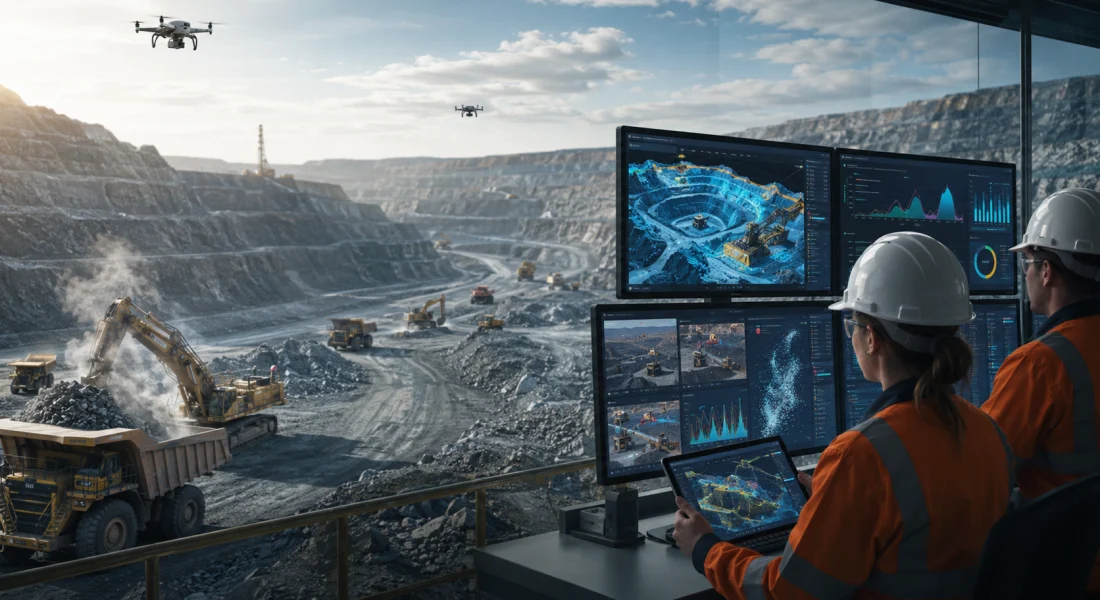
Mining has never really been short on data. Sensors track equipment, drones capture site images, systems log every movement underground and on the surface. The problem is that most of it just sits there, scattered across tools and reports, not doing much in real time.
That’s where AI data solutions start to change things a bit. Instead of adding another dashboard, they focus on turning raw data into something usable while work is still happening. Spotting equipment issues before they slow things down, mapping terrain from aerial images without manual processing, or just helping teams react faster when something looks off. It’s less about complexity and more about keeping operations moving without constant guesswork.
Mining Data Tools That Deliver Speed and Practical Insight
AI-driven data tools are starting to reshape how mining teams handle daily operations on site. Instead of relying on slow reporting cycles or manual checks, these systems process data from sensors, drones, and satellite imagery as it comes in, helping teams see what is actually happening across the operation.
They can detect changes in terrain, track equipment performance, and flag potential issues early without adding extra workload. What used to take hours of review can now be handled in minutes, with results that are easier to act on. Below are some of the tools that are currently being used to make mining data more useful in real conditions.

1. FlyPix AI
FlyPix AI builds a platform for working with geospatial data where visual inputs can be processed without manual effort. Our platform uses AI agents to detect, monitor, and inspect objects in satellite, aerial, and drone imagery, so teams do not have to go through large datasets image by image. It shifts the work from manual annotation to automated analysis that can run as data comes in.
Our tools are designed to adapt to different use cases rather than follow a fixed setup. We make it possible to train custom AI models based on specific tasks, which helps when working with varied environments like mining sites. The focus stays on turning raw visual data into something usable without adding extra steps to the workflow.
Key Highlights:
- Works with satellite, aerial, and drone imagery
- Uses AI agents for automated detection and monitoring
- Supports custom model training
- Reduces manual image processing
Capabilities:
- AI data solution for mining operations
- Object detection and site monitoring from aerial data
- Custom AI model training for mining use cases
- Automated processing of geospatial and operational data
Contact Information:
- Website: flypix.ai
- Email: [email protected]
- Phone: +49 6151 3943470
- Address: Robert-Bosch-Str. 7, 64293 Darmstadt, Germany
- LinkedIn: www.linkedin.com/company/flypix-ai
2. MinersAI
MinersAI focuses on helping geologists work with data that is often messy, incomplete, or spread across different formats. Instead of treating AI as a standalone solution, they approach it as part of a broader workflow where data preparation plays a central role. A large portion of the effort goes into structuring, cleaning, and standardizing geological data before any models are applied, which reflects how exploration actually works in practice.
Their tools are designed to support hypothesis testing rather than replace decision-making. Geologists remain involved throughout the process, using AI outputs as an additional layer of analysis rather than a final answer. This setup makes it possible to explore patterns in geological data while keeping interpretation grounded in domain expertise.
Key Highlights:
- Focus on geoscience data structuring and preparation
- Combines AI analysis with geologist input
- Supports hypothesis-driven exploration workflows
- Emphasis on data quality, cleaning, and standardization
Capabilities:
- Geological data structuring and standardization
- AI-assisted exploration analysis
- Hypothesis testing tools for geoscience workflows
- Data preparation and quality control processes
Contact Information:
- Website: www.minersai.com
- Address: 748 Snowbird Lane, Lafayette, CO, USA 80026
- E-mail: [email protected]
- LinkedIn: www.linkedin.com/company/minersai

3. Strayos
Strayos works with visual and geospatial data collected across mining sites and turns it into usable insights through AI models. The platform brings together drone imagery, sensor data, and site measurements to create digital representations of operations. This allows teams to look at site conditions, track changes, and plan activities with a clearer view of what is happening on the ground.
A big part of their approach is connecting different stages of the mining process, from drilling and blasting to material analysis. Instead of keeping data in separate systems, they try to unify it into a single workflow where updates can be processed continuously. This makes it easier to adjust plans based on current site conditions rather than relying on delayed reports.
Key Highlights:
- Covers multiple stages of mining operations
- Works with drone, sensor, and geospatial data
- Creates digital site models for analysis
- Focus on connecting previously siloed data
Capabilities:
- Fragmentation and ore size analysis
- Digital twin creation and site modeling
- Drill and blast analysis tools
- Environmental and site monitoring tools
Contact Information:
- Website: strayos.com
- Address: 1 West Seneca Street, 24th Floor, Buffalo, New York, 14203, USA
- E-mail: [email protected]
- LinkedIn: www.linkedin.com/company/strayos
- Twitter: x.com/StrayosAI
- Facebook: www.facebook.com/strayos

4. VRIFY
VRIFY builds software for mineral exploration teams that need to make sense of large and often inconsistent datasets. The platform combines different types of geological and geospatial data into a unified structure, which allows machine learning models to be applied more effectively. Instead of relying on a single dataset, they work with layered inputs to improve how exploration targets are defined.
The workflow is structured around iterative analysis. Data is assembled, refined, and then used to generate predictions that can be tested and adjusted over time. They also place importance on how results are shared, using visualization tools to help communicate findings to stakeholders who may not have technical backgrounds.
Key Highlights:
- Focus on mineral exploration data analysis
- Combines multiple datasets into unified models
- Supports iterative hypothesis testing
- Includes tools for data visualization and communication
Capabilities:
- Data integration and standardization
- Exploration planning and analysis tools
- AI-based prospectivity mapping
- Visualization and stakeholder communication tools
Contact Information:
- Website: vrify.com
- Address: 1075 W Georgia St #2360, Vancouver, BC, V6E 3C9, Canada
- Phone: (604) 669-4227
- E-mail: [email protected]
- LinkedIn: www.linkedin.com/company/vrify
- Apple Store: apps.apple.com/us/app/vrify/id1235301790

5. Trimble
Trimble provides connected hardware and software solutions that link physical operations with digital data. In mining and related industries, their tools are used to capture positioning data, build 3D models, and analyze workflows across large-scale operations. The focus is less on a single platform and more on creating a connected system where data flows between different parts of a project.
Their approach is centered around improving coordination between teams and systems. By combining mapping, modeling, and analytics, they help organizations maintain a consistent view of operations, which can be useful when managing complex environments where conditions change frequently.
Key Highlights:
- Applies across multiple industries including mining
- Focus on integrated data environments
- Connects physical and digital workflows
- Uses positioning, modeling, and analytics tools
Capabilities:
- Geospatial data collection and analysis
- 3D modeling and mapping solutions
- Workflow and data integration tools
- Analytics for operational decision-making
Contact Information:
- Website: www.trimble.com
- Address: 10368 Westmoor Drive, Westminster, CO 80021, USA
- Phone: +1 (720) 887-6100
- LinkedIn: www.linkedin.com/company/trimble
- Twitter: x.com/TrimbleCorpNews
- Facebook: www.facebook.com/TrimbleCorporate
- Instagram: www.instagram.com/trimble_official

6. EYEMINE
EYEMINE focuses on operational data within mining fleets, especially in load and haul processes. The system collects and processes data from different sources to track weight, volume, and equipment performance in real time. This allows teams to understand how materials are being moved and where inefficiencies might be happening during daily operations.
The platform brings together production, maintenance, and environmental data into a single view. By doing this, they help teams monitor asset performance, manage loading accuracy, and track emissions without switching between multiple systems. The emphasis is on practical metrics that can be used directly on site.
Key Highlights:
- Provides operational performance insights
- Focus on load and haul data analysis
- Real-time tracking of weight and volume
- Combines production and environmental data
Capabilities:
- Fleet performance monitoring
- Load and haul analytics
- Weight and volume measurement tools
- Emissions tracking and reporting
Contact Information:
- Website: eyemine.com
- Address: 345 Queen Street, Brisbane, QLD 4000, Australia
- Phone: 1300 750 740
- E-mail: [email protected]
- LinkedIn: www.linkedin.com/company/eyemine

7. KNIME
KNIME focuses on helping teams work with data without relying too much on coding or separate tools. The platform is built around visual workflows where users can connect data sources, prepare datasets, and run analysis in one place. It is often used in environments where data comes from multiple systems and needs to be combined before it becomes useful.
The platform also puts attention on how models are managed after they are created. Instead of stopping at analysis, the platform supports validation, monitoring, and ongoing use of models in real workflows. This makes it easier for both technical and non-technical users to stay involved, especially when decisions depend on consistent and explainable results.
Key Highlights:
- Focus on model validation and monitoring
- Visual workflow approach to data analysis
- Works with multiple data sources and systems
- Supports both technical and non-technical users
Capabilities:
- Workflow automation for data processes
- Data preparation and transformation
- Predictive analytics and model building
- Model deployment and monitoring
Contact Information:
- Website: www.knime.com
- Address: Landesbeauftragter für Datenschutz und Informationsfreiheit, Baden-Württemberg, Postfach 102932, DE-70025 Stuttgart
- Phone: 0711 / 61 55 41-0
- E-mail: [email protected]
- LinkedIn: www.linkedin.com/company/knime
- Instagram: www.instagram.com/knimesoftware

8. IBM SPSS Modeler
IBM SPSS Modeler focuses on making data science workflows easier to manage through a visual interface. The approach is based on drag-and-drop tools that allow users to prepare data, build predictive models, and run analysis without needing to write code for every step. This can be useful in environments where teams need to move quickly from raw data to usable insights.
The platform also supports the full cycle of working with data, from initial preparation to model deployment. Instead of separating these steps across different systems, everything can be handled within a single environment. This helps reduce delays between analysis and decision-making, especially when models need to be updated or reused over time.
Key Highlights:
- Visual interface for data science workflows
- Supports data preparation and predictive modeling
- Reduces reliance on coding for analysis
- Covers full workflow from data to deployment
Capabilities:
- Automated data processing
- Data preparation and transformation
- Predictive analytics and machine learning
- Model management and deployment
Contact Information:
- Website: www.ibm.com
- Address: 1 New Orchard Road, Armonk, New York 10504-1722, United States
- Phone: 1-800-426-4968
- LinkedIn: www.linkedin.com/company/ibm
- Twitter: x.com/ibm
- Instagram: www.instagram.com/ibm
AI Data Solution Companies Supporting Modern Mining Operations
Mining data is rarely clean or easy to use. It comes from different systems, in different formats, and usually needs a fair amount of work before it becomes useful. That is where these companies come in. They are not just building tools, they are trying to make sense of how data flows across exploration, operations, and decision-making.
Some of them focus more on structuring geological data, others work on analytics or model building. In practice, it often comes down to the same thing – helping teams spend less time preparing data and more time actually using it. Below are a few companies that approach this problem from slightly different angles.

1. AI Superior
AI Superior focuses on building AI systems around real business problems rather than starting from the technology itself. Their work usually begins with figuring out how data is structured, what is missing, and whether AI actually makes sense for the task. From there, they design custom solutions that fit into existing workflows instead of replacing them entirely.
They tend to move step by step, starting with smaller prototypes and only scaling once the idea proves useful. This helps avoid overbuilding systems that do not match real conditions. Their approach combines technical development with ongoing collaboration, so the solution keeps evolving alongside the data and the way it is used.
Key Highlights:
- Focus on custom AI development
- Step-by-step approach from idea to integration
- Combines consulting with technical work
- Works with different data types and systems
Services:
- AI software development
- AI consulting and strategy
- Predictive analytics and data analysis
- AI training and research
Contact Information:
- Website: aisuperior.com
- Phone: +49 6151 3943489
- Email: [email protected]
- Address: Robert-Bosch-Str. 7, 64293 Darmstadt, Germany
- LinkedIn: www.linkedin.com/company/ai-superior
- Facebook: www.facebook.com/aisuperior
- Twitter: x.com/aisuperior
- Instagram: www.instagram.com/ai_superior

2. Seequent
Seequent works with subsurface data, which tends to be complex and not always easy to interpret. Their software is built to connect different geological datasets and turn them into models that teams can actually use for planning and analysis. In mining, this usually means having a clearer understanding of what lies below the surface before making decisions.
A noticeable part of their approach is how they bring collaboration into the process. Instead of data sitting with individual specialists, their tools make it easier to share models and insights across teams. This reduces the time spent managing files and increases the focus on interpretation and decision-making.
Key Highlights:
- Focus on subsurface and geological data
- Connects multiple data sources into unified models
- Supports collaboration across teams
- Helps reduce time spent on data management
Services:
- Subsurface modeling and analysis
- Geological data management
- Collaboration and data integration tools
- Geotechnical software solutions
Contact Information:
- Website: www.seequent.com
- Address: 20 Moorhouse Avenue, Addington, Christchurch, Canterbury, 8011
- Phone: +64 3 961 1031
- E-mail: [email protected]
- LinkedIn: www.linkedin.com/company/seequent
- Twitter: x.com/seequentglobal
- Facebook: www.facebook.com/seequent.software
3. MineSense
MineSense focuses on what happens right at the extraction point, where decisions about ore and waste are made. Their system collects data in real time and provides immediate insight into material characteristics. This changes how decisions are made, since teams do not have to wait for delayed analysis.
Instead of relying only on historical or averaged data, they work with highly detailed information captured during operations. This allows adjustments to happen earlier in the process, which can affect how material is handled, routed, and processed further downstream.
Key Highlights:
- Provides detailed material insights
- Supports immediate decision-making
- Real-time data at the extraction point
- Focus on ore and waste classification
Services:
- Operational data systems for mining
- Hardware and software integration
- Real-time ore grade measurement
- Material classification and analysis
Contact Information:
- Website: minesense.com
- Address: 8508 Ash Street, Vancouver BC V6P 3M2, Canada
- Phone: +1.604.449.3780
- E-mail: [email protected]
- LinkedIn: www.linkedin.com/company/minesense-technologies-ltd-
- Twitter: x.com/minesensetech

4. Earth AI
Earth AI approaches exploration from a data-first perspective, working with large collections of geological information gathered over time. Their system looks for patterns that might not be obvious through manual analysis, helping identify areas that could be worth exploring further.
They do not stop at analysis. Once potential targets are identified, the process continues with drilling and validation. Each step adds new data back into the system, which gradually improves how future exploration decisions are made.
Key Highlights:
- Focus on AI-based mineral exploration
- Uses large historical datasets
- Combines analysis with field validation
- Iterative learning from new data
Services:
- Exploration data analysis
- AI-based target identification
- Geological hypothesis development
- Drilling and validation workflows
Contact Information:
- Website: earth-ai.com
- Address: 312 Arizona Ave, Santa Monica, CA 90401, USA
- LinkedIn: www.linkedin.com/company/earth-ai
- Twitter: x.com/earthaiexplore
- Instagram: www.instagram.com/earthaiexplore
5. KoBold Metals
KoBold Metals focuses on making mineral exploration more structured by combining data science with geology. Their work is based on analyzing large datasets to identify patterns that could indicate the presence of critical minerals. This shifts exploration from intuition-driven to more data-informed processes.
They also rely on collaboration between different specialists. Geologists, engineers, and data scientists work together to interpret results and guide exploration. This mix of perspectives helps balance data insights with practical field knowledge.
Key Highlights:
- Combines data science with geology
- Focus on critical mineral exploration
- Uses large datasets for pattern detection
- Interdisciplinary team approach
Services:
- AI-driven exploration analysis
- Geological data interpretation
- Exploration project development
- Integration of data and field expertise
Contact Information:
- Website: koboldmetals.com
- E-mail: [email protected]
- LinkedIn: www.linkedin.com/company/koboldmetals
- Twitter: x.com/kobold_metals

6. Datamine
Datamine focuses on connecting different parts of the mining workflow, which are often handled separately. Their software covers exploration, planning, and production, bringing these stages into a more consistent data environment. This helps teams work with the same information instead of switching between disconnected systems.
They also put effort into reducing manual processes. By automating data handling and improving how information flows between tools, they make it easier to keep plans aligned with actual site conditions. This becomes important when operations need to react quickly to changes.
Key Highlights:
- Covers full mining workflow
- Connects exploration, planning, and production
- Focus on data consistency
- Reduces manual data processes
Services:
- Mining planning and scheduling
- Geological data analysis and modeling
- Production data management
- Sustainability and reporting tools
Contact Information:
- Website: dataminesoftware.com
- Address: 7900 E. Union Ave. Ste. 1007, Denver, Colorado, 80237
- Phone: 1 (888) 520-5191
- LinkedIn: www.linkedin.com/company/dataminesw

7. Hexagon Mining
Hexagon Mining brings together different parts of mining operations by working with data across the entire workflow. Hexagon Mining connects planning, production, and safety systems so that information does not stay isolated in separate tools. This makes it easier for teams to understand what is happening across the site without switching between multiple systems.
Their approach leans on real-time data and automation. Instead of waiting for reports, teams can monitor conditions as they change and respond faster. This is especially noticeable in areas like equipment use and operator safety, where small delays in information can have a bigger impact on daily operations.
Key Highlights:
- Connects planning, production, and safety workflows
- Works with real-time operational data
- Supports automation across mining processes
- Helps reduce data silos
Services:
- Workflow integration and data management
- Real-time monitoring systems
- Safety and operator awareness solutions
- Mining analytics tools
Contact Information:
- Website: hexagon.com
- Phone: +46 8 601 26 20
- Address: Lilla Bantorget 15, SE-111 23 Stockholm, Sweden
- LinkedIn: www.linkedin.com/company/hexagon-ab
- Facebook: www.facebook.com/HexagonAB
- Twitter: x.com/HexagonAB
- Instagram: www.instagram.com/hexagon_ab

8. Deswik
Deswik combines mining software with consulting support, which shapes how their tools are used in real conditions. Deswik connects mine design, scheduling, and planning into a single environment, so teams can move between these stages without losing track of data or context.
Another part of their work is handling complex planning problems. Their tools use optimization and simulation to test different scenarios, which helps teams adjust plans when conditions change. This is useful in operations where timing and resource allocation need to stay aligned across multiple steps.
Key Highlights:
- Combines software with consulting support
- Connects design, planning, and scheduling
- Uses optimization and simulation tools
- Supports complex operational workflows
Services:
- Mine design and planning solutions
- Scheduling and optimization tools
- Data integration across workflows
- Consulting and implementation support
Contact Information:
- Website: www.deswik.com
- Address: Level 9, 348 Edward St, Brisbane, QLD, 4000, AUSTRALIA
- Phone: +61 7 3292 2700
- E-mail: [email protected]
- LinkedIn: www.linkedin.com/company/deswik-mining
- Facebook: www.facebook.com/deswik

9. Micromine
Micromine covers different stages of mining, from early exploration to ongoing operations, within a connected system. Micromine links geological data, planning, and production workflows so that teams can work with consistent information as projects develop.
The platform is built around how mining teams actually work on site. Instead of separating data handling from operations, it keeps everything in one environment, which makes it easier to adjust plans as conditions shift. This reduces the need to move data between disconnected tools.
Key Highlights:
- Connects exploration, planning, and operations
- Maintains consistent data across workflows
- Supports real-time adjustments
- Built around practical mining processes
Services:
- Geological data management and modeling
- Mine design and planning tools
- Fleet management and operational systems
- Data integration and collaboration
Contact Information:
- Website: www.micromine.com
- Address: Quadrant House, 4 Thomas More Square, London E1W 1YW
- Phone: +44 203 011 0552
- E-mail: [email protected]
- LinkedIn: www.linkedin.com/company/micromine

10. ABB
ABB combines automation, electrification, and digital systems to support large-scale industrial operations, including mining. ABB works on connecting equipment, control systems, and data so that processes can be monitored and adjusted without delays.
Their role in mining often comes down to improving how systems run day to day. By applying control technologies and analytics, they help manage energy use, equipment performance, and overall efficiency. This is especially relevant in operations where small improvements can scale across the entire site.
Key Highlights:
- Combines automation and digital systems
- Focus on efficiency and process control
- Supports real-time monitoring
- Works across large industrial operations
Services:
- Industrial automation solutions
- Data analytics and monitoring systems
- Electrification and energy management
- Control systems for mining operations
Contact Information:
- Website: www.abb.com
- Address: Bruggerstrasse 66, 68, 5400 Baden, Aargau
- Phone: +41 58 585 81 61
- LinkedIn: www.linkedin.com/company/abb
- Twitter: x.com/ABBgroupnews
- Facebook: www.facebook.com/ABBPolska
- Instagram: www.instagram.com/abbgroup
Conclusion
AI in mining is not really about adding more technology. There is already plenty of that. The real shift is in how data gets used once it is collected. Instead of sitting in separate systems or waiting for someone to clean it up later, it starts to move through operations while things are still happening.
What stands out across these solutions is that they approach the same problem from different sides. Some focus on geology and exploration, others on planning or real-time operations. But they all circle back to one thing – making data usable without slowing people down. That usually means less manual work, fewer gaps between teams, and decisions that are based on what is actually happening, not what was reported yesterday.
It is also pretty clear that none of this replaces human input. If anything, it leans on it more. The tools handle scale and speed, but interpretation still matters, especially in environments where conditions change quickly and not everything fits into a clean model.
So the value is not in the AI itself, but in how it fits into everyday work. When it works well, it is not something teams have to think about much. It just helps things run a bit smoother, with fewer surprises along the way.