Résumé rapide : aquaManager est une plateforme logicielle complète de gestion aquacole qui combine l'analyse de données, l'intelligence artificielle et le suivi en temps réel pour optimiser les opérations d'élevage de poissons. Cet outil est spécialisé dans l'optimisation de l'alimentation, la planification de la croissance et l'analyse de la production. Des innovations récentes, comme le module d'alimentation OptiFeeSH, ont démontré des améliorations mesurables en aquaculture commerciale.
L'élevage de poissons a considérablement évolué, dépassant largement la simple gestion des étangs et l'alimentation manuelle. L'aquaculture moderne génère d'énormes quantités de données : paramètres de qualité de l'eau, mesures de biomasse, habitudes alimentaires, taux de croissance, niveaux d'oxygène et variables environnementales qui influent directement sur la rentabilité de l'exploitation.
Mais voilà : la collecte de données n’est plus le problème. Transformer ces données en informations exploitables qui améliorent réellement les performances de l’exploitation ? C’est là qu’aquaManager entre en jeu.
Cette analyse examine les fonctionnalités d'aquaManager, ses innovations récentes et ses performances concrètes dans les exploitations piscicoles commerciales. Nous verrons ce que la plateforme apporte réellement, comment elle se compare aux autres outils de suivi et si elle justifie l'investissement pour les exploitations aquacoles de différentes tailles.
Qu'est-ce qu'aquaManager ?
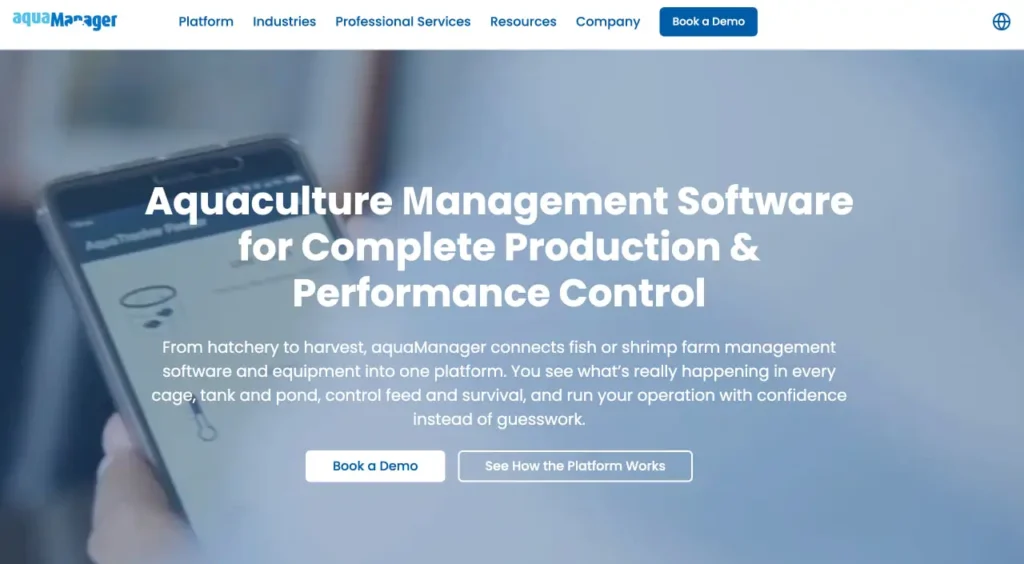
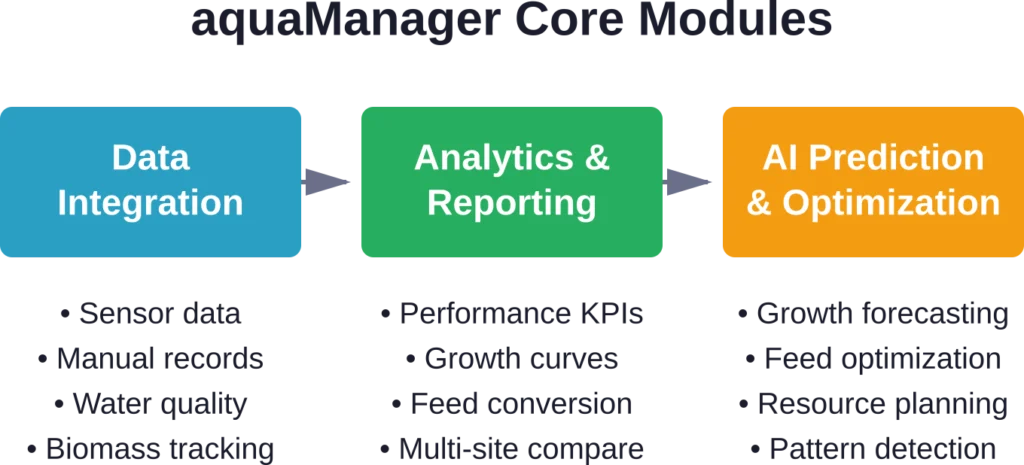
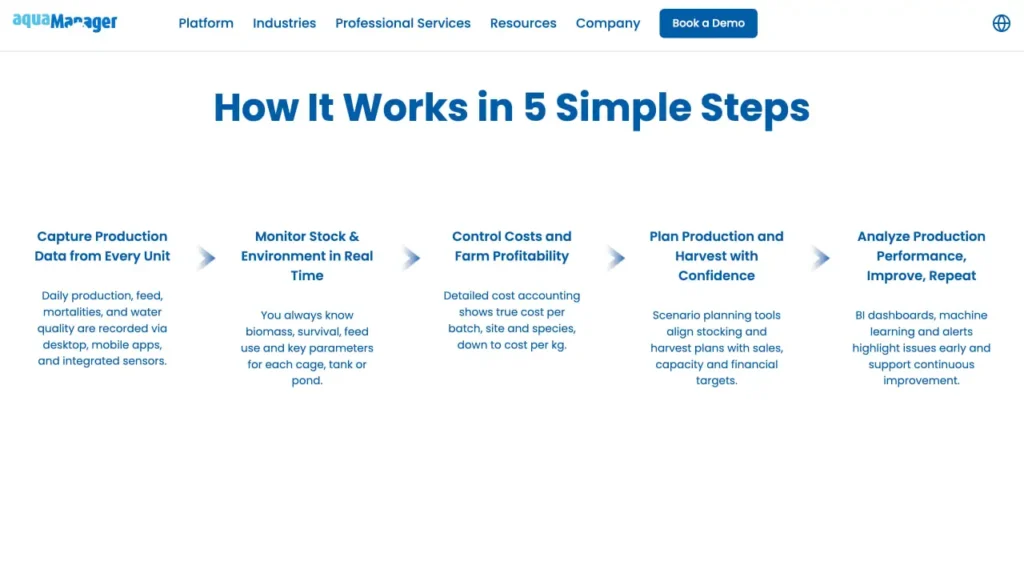
aquaManager est une plateforme d'analyse et de veille stratégique dédiée à l'aquaculture, conçue spécifiquement pour les exploitations piscicoles. Ce logiciel centralise les données issues de multiples sources (systèmes d'alimentation, capteurs de biomasse, moniteurs de qualité de l'eau et relevés manuels) dans un tableau de bord unique offrant des informations en temps réel et des analyses prédictives.
La plateforme se positionne comme une solution de gestion axée sur les données, et non comme un simple outil d'archivage. De nombreuses exploitations aquacoles collectent déjà des données sur l'alimentation, la biomasse et l'environnement, mais ces informations sont généralement stockées dans des systèmes non centralisés ou des tableurs. La proposition de valeur d'aquaManager repose sur l'intégration de ces flux de données et l'application d'analyses pour optimiser les décisions opérationnelles.
L'entreprise a activement mené des recherches et mis en œuvre l'intégration de l'IA, allant au-delà de la simple visualisation des données pour accéder à la modélisation prédictive en vue de la planification de la croissance, de l'optimisation de l'alimentation et de l'allocation des ressources.
Caractéristiques et capacités principales
Pour comprendre ce que fait réellement aquaManager, il faut examiner ses modules fonctionnels et la manière dont ils répondent aux défis spécifiques de l'aquaculture.
Intégration des données et tableau de bord
La plateforme centralise les données provenant de différents systèmes agricoles au sein d'une interface unique. Les paramètres de qualité de l'eau, les données d'alimentation, les estimations de biomasse, le suivi de la mortalité et les conditions environnementales alimentent un même cadre analytique.
Cette consolidation est essentielle car la gestion des élevages piscicoles repose sur la compréhension des relations entre les variables : l’influence de la température de l’eau sur l’indice de conversion alimentaire, la corrélation entre les niveaux d’oxygène et les taux de croissance, et l’impact du calendrier d’alimentation sur le développement de la biomasse. Des données dispersées ne permettent pas de révéler ces tendances. Seules des données intégrées le peuvent.
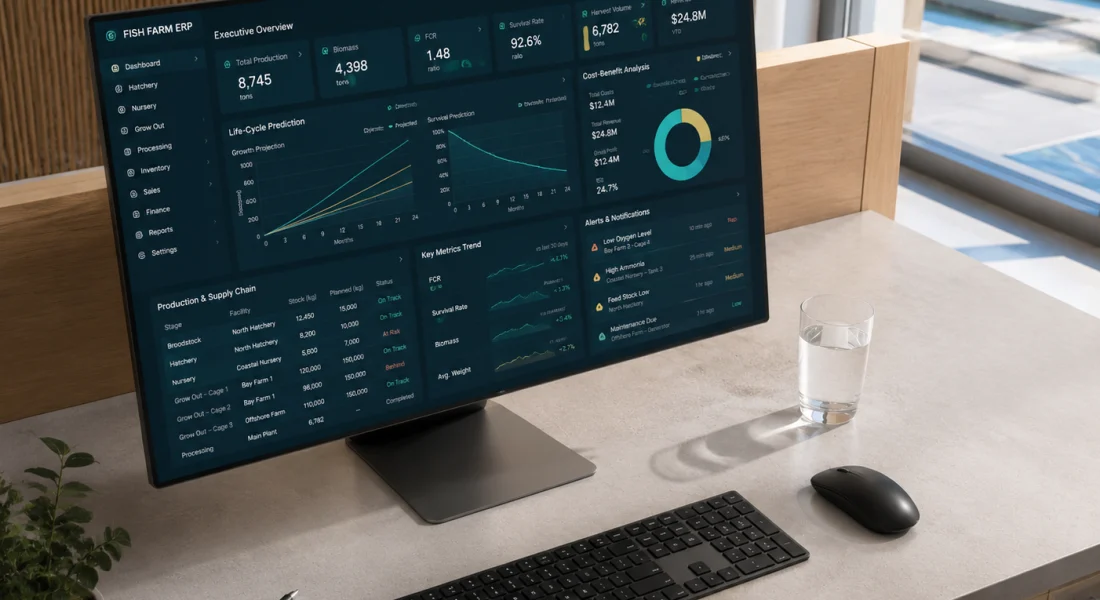
Le tableau de bord fournit des outils de visualisation permettant de suivre les indicateurs clés de performance sur différentes échelles de temps, sites agricoles et cycles de production.
Analyse et rapports
aquaManager traite les données historiques et en temps réel pour générer des analyses sur les performances de l'exploitation. Les taux de conversion alimentaire, les courbes de croissance, les taux de survie et les indicateurs d'efficacité de production sont calculés automatiquement à partir des données intégrées au système.
La fonctionnalité de reporting permet aux responsables d'exploitations agricoles de suivre les performances par rapport aux objectifs, de comparer différentes cohortes de production et d'identifier les tendances opérationnelles susceptibles d'indiquer des problèmes émergents ou des opportunités d'optimisation.
Pour les exploitations commerciales gérant plusieurs sites, l'analyse comparative s'avère particulièrement précieuse. Identifier les fermes ou les étangs qui affichent des performances supérieures aux autres permet de révéler des pratiques exemplaires à reproduire à l'échelle de l'exploitation.
Intégration de l'IA et capacités prédictives
aquaManager développe activement des fonctionnalités basées sur l'IA qui vont au-delà de l'analyse descriptive pour proposer une modélisation prédictive. L'entreprise a publié un livre blanc expliquant comment les technologies axées sur les données transforment l'aquaculture et permettent d'améliorer concrètement l'exploitation des fermes.
L'IA traite d'immenses ensembles de données pour identifier des tendances et effectuer des prédictions. On peut la comparer à l'agriculture de précision appliquée aux milieux aquatiques : elle analyse les conditions et prédit les interventions optimales avec une grande précision.
Les discussions au sein de la communauté des professionnels de l'aquaculture mettent en lumière l'intérêt croissant pour ces capacités d'IA, notamment parce que les exploitations agricoles génèrent des volumes de données de plus en plus importants qui dépassent les capacités d'analyse humaines.
Analysez les données agricoles et environnementales avec FlyPix AI
L'imagerie satellitaire, aérienne et par drone offre des informations précieuses pour les projets agricoles et environnementaux, mais l'analyse manuelle de ces données est chronophage. FlyPix AI automatise l'analyse d'images, facilitant ainsi l'identification des tendances, la surveillance des terres et le suivi des évolutions au fil du temps.
Vous travaillez avec des données agricoles ou environnementales ?
FlyPix AI peut vous aider avec :
- analyse d'images satellites et drones
- classification de l'utilisation des terres
- détection et surveillance d'objets
- modèles d'IA géospatiale personnalisés
👉 Essayez FlyPix AI pour explorer l'analyse géospatiale pour vos projets.
OptiFeeSH : L'innovation en matière d'alimentation basée sur les données
L'une des nouveautés les plus importantes d'aquaManager est OptiFeeSH, un outil d'alimentation basé sur les données et développé en partenariat avec SPAROS, spécialiste en nutrition aquacole. Ce module cible spécifiquement la planification de la croissance et l'optimisation de l'alimentation dans les élevages de poissons.
L'alimentation représente l'un des postes de dépenses les plus importants en aquaculture. Même de petites améliorations de l'efficacité de conversion alimentaire ou de la courbe de croissance peuvent avoir un impact financier considérable à l'échelle commerciale.
Comment fonctionne OptiFeeSH
OptiFeeSH analyse les données d'alimentation, les mesures de croissance, les paramètres de l'eau et d'autres variables afin d'optimiser les programmes et les quantités d'alimentation. Au lieu de s'appuyer sur des tableaux d'alimentation statiques ou des estimations manuelles, cet outil utilise des modèles prédictifs pour recommander des stratégies d'alimentation adaptées aux conditions actuelles de l'exploitation et aux objectifs de croissance.
Le système prend en compte des facteurs tels que la température de l'eau, les niveaux d'oxygène dissous, la densité de la biomasse, les tendances de croissance historiques et les taux de conversion alimentaire pour calculer les taux et le calendrier d'alimentation optimaux.
Résultats des pilotes commerciaux
Selon SPAROS et aquaManager, les essais menés pendant les phases de pré-croissance ont permis d'obtenir des gains de croissance de biomasse allant jusqu'à 50% par rapport aux performances de référence.
Le passage des essais pilotes à la mise en œuvre commerciale constitue une étape de validation importante. Les exploitations aquacoles se montrent généralement réticentes à adopter de nouvelles technologies à moins qu'elles ne démontrent des avantages opérationnels ou financiers clairs par rapport aux pratiques établies.
Soyons francs : tout outil d’optimisation de l’alimentation doit prouver son efficacité pour améliorer les résultats dans les conditions variables et imprévisibles de l’élevage piscicole commercial. Les résultats en laboratoire ne se traduisent pas toujours par des performances en bassin. Le succès commercial d’OptiFeeSH indique qu’il a rempli cette condition.
aquaManager vs. Outils de surveillance alternatifs
Le paysage technologique de l'aquaculture comprend de nombreux outils de surveillance et de gestion, chacun présentant des fonctionnalités et des domaines d'application différents. Pour comprendre la place d'aquaManager, il est nécessaire de le comparer à d'autres solutions.
| Catégorie d'outils | Objectif principal | Étendue des données | Profondeur analytique |
|---|---|---|---|
| aquaManager | Veille stratégique et optimisation | Opérations agricoles complètes | Analyse prédictive avancée basée sur l'IA |
| Moniteurs de qualité de l'eau | Suivi des paramètres environnementaux | Conditions chimiques et physiques de l'eau | Visualisation de tendance de base |
| Systèmes basés sur des caméras | surveillance visuelle et estimation de la biomasse | Comportement des poissons, comptage, répartition des tailles | Analyse par vision par ordinateur, prédiction limitée |
| Contrôleurs d'alimentation | Automatisation de la distribution d'aliments pour animaux | Moment des repas, quantités, réponse | Algorithmes d'optimisation de base |
| Logiciel de tenue de registres | Enregistrement des données et conformité | Saisie manuelle, rapports réglementaires | Minimal — principalement stockage et récupération |
De nombreux outils de suivi en aquaculture excellent dans des tâches spécifiques, mais fonctionnent de manière isolée. Les systèmes de surveillance de la qualité de l'eau proposés par des entreprises comme YSI ou NexSens fournissent d'excellentes données environnementales, mais n'intègrent pas les informations sur l'alimentation ni les analyses de croissance. Les systèmes de caméras de fournisseurs tels qu'Aquabyte ou CageEye offrent une estimation précise de la biomasse, mais ne prennent pas en charge les fonctions de gestion globale de l'exploitation.
aquaManager se positionne comme une plateforme intégrée qui rassemble ces flux de données disparates. Cette intégration permet une analyse transversale : comprendre comment la qualité de l’eau influe sur l’efficacité de l’alimentation, comment les conditions environnementales affectent les taux de croissance et comment les décisions relatives au calendrier des interventions impactent la performance globale de l’exploitation.
L'avantage de l'intégration
Assurer le bon fonctionnement d'une pisciculture ne se limite pas à nourrir les poissons ; il s'agit aussi de surveiller la qualité de l'eau, les niveaux d'oxygène et l'état général de l'exploitation, en tenant compte de ces différents paramètres. Des outils de surveillance isolés ne permettent pas de mettre en évidence ces interactions.
Pour les exploitations agricoles qui investissent déjà dans plusieurs technologies de surveillance, aquaManager sert de couche analytique permettant d'interpréter les données combinées. Pour les exploitations qui débutent leur transformation numérique, il offre un cadre pour la construction d'un système d'aquaculture intelligent et intégré, de A à Z.
Intégration de l'aquaculture intelligente et de l'IA
Le concept d'aquaculture intelligente — qui utilise des capteurs connectés, l'analyse de données et des systèmes automatisés pour optimiser l'élevage de poissons — a connu un essor considérable ces dernières années. L'intégration de l'IA dans aquaManager constitue une application concrète de cette tendance sectorielle plus large.
Les technologies basées sur les données transforment l'aquaculture en permettant des approches de gestion de précision auparavant impossibles. Des transformations similaires ont eu lieu dans l'agriculture terrestre, où l'IA traite d'immenses ensembles de données pour prédire avec une grande précision les besoins en irrigation et en fertilisation.
L'agriculture terrestre démontre que la gestion agricole pilotée par l'IA peut améliorer les rendements tout en réduisant le gaspillage et en optimisant l'utilisation des ressources. Ces mêmes principes s'appliquent à l'aquaculture, où l'alimentation de précision, la prédiction de la croissance et le suivi de l'état des animaux peuvent améliorer les résultats tout en contribuant à la durabilité environnementale.
AquaManager ne se contente pas de parler d'innovation : l'entreprise recherche, promeut et met en œuvre activement des solutions d'IA, transformant ainsi le potentiel en impact concret pour les exploitations aquacoles. Cette approche axée sur la mise en pratique plutôt que sur des possibilités théoriques distingue les plateformes technologiques agricoles sérieuses des solutions purement marketing.
Qui devrait envisager d'utiliser aquaManager ?
Chaque exploitation piscicole a des besoins technologiques différents et ne peut justifier le même niveau d'investissement logiciel. Pour déterminer si aquaManager est adapté, il est nécessaire de prendre en compte la taille de l'exploitation, le niveau d'adoption des technologies actuelles et la complexité opérationnelle.
Opérations les plus adaptées
Les exploitations à l'échelle commerciale gérant d'importants volumes de production sont celles qui tireront le plus grand profit des fonctionnalités d'aquaManager. Les fermes qui collectent déjà un volume considérable de données grâce à des systèmes automatisés ou à une surveillance manuelle peuvent exploiter immédiatement les fonctionnalités d'intégration et d'analyse de la plateforme.
Les exploitations multisites tirent un avantage considérable des analyses comparatives et du tableau de bord centralisé. La gestion de plusieurs exploitations ou groupes de production engendre une complexité qui dépasse les capacités d'un simple tableur. La possibilité de comparer les performances entre les sites, d'identifier les meilleures pratiques et de standardiser les approches performantes devient de plus en plus précieuse à mesure que les opérations se développent.
Les opérations axées sur l'optimisation et l'amélioration continue, plutôt que sur le simple maintien des pratiques actuelles, correspondent parfaitement à l'approche analytique d'aquaManager. La plateforme fournit des outils permettant de tester les interventions, de mesurer les résultats et d'affiner les stratégies en se basant sur des données et non sur des hypothèses.
Opérations qui pourraient chercher ailleurs
Les petites exploitations aquacoles ou les élevages de loisir pourraient trouver les fonctionnalités d'aquaManager supérieures à leurs besoins. La plateforme répond aux défis de la production commerciale qui ne concernent pas nécessairement les petites exploitations aux exigences de gestion plus simples.
Les exploitations agricoles ne disposant pas d'infrastructure de collecte de données devront investir dans des capteurs et des équipements de surveillance avant que les capacités d'analyse d'aquaManager ne deviennent utiles. Ce logiciel ne remplace pas les outils de surveillance ; il en optimise l'efficacité grâce à l'intégration et à l'analyse.
Les exploitations satisfaites de leurs performances actuelles et qui ne recherchent pas activement l'optimisation risquent de ne pas exploiter pleinement les capacités de la plateforme. aquaManager apporte une réelle valeur ajoutée aux exploitations qui s'engagent dans une démarche d'amélioration continue basée sur les données.
Considérations relatives à la mise en œuvre
L'adoption d'aquaManager ne se limite pas à l'achat du logiciel. Sa mise en œuvre réussie nécessite une planification rigoureuse de l'intégration des données, de la formation du personnel et de l'adaptation des flux de travail.
Exigences d'intégration des données
La plateforme a besoin de données pour l'analyse. Les exploitations agricoles doivent mettre en place un système de collecte de données fiable provenant des systèmes d'alimentation, des moniteurs de qualité de l'eau, des mesures de biomasse et des capteurs environnementaux. De nombreuses exploitations commerciales disposent déjà de ces systèmes, mais garantir un flux de données constant vers aquaManager nécessite une configuration technique.
La saisie manuelle des données reste possible pour les paramètres non pris en charge par les systèmes automatisés, mais la plateforme offre une valeur maximale lorsqu'elle est alimentée par des flux de données automatisés continus.
Adoption et formation du personnel
Les responsables et le personnel des exploitations agricoles doivent savoir interpréter les données analytiques et appliquer ces connaissances aux décisions opérationnelles. Ce n'est pas forcément intuitif. Passer d'une gestion traditionnelle basée sur l'expérience à une prise de décision fondée sur les données représente un changement autant culturel que technique.
Les mises en œuvre réussies impliquent généralement des périodes de formation durant lesquelles le personnel apprend à naviguer sur la plateforme, à comprendre les analyses et à intégrer progressivement les informations issues des données dans son flux de travail standard.
Intégration du flux de travail
AquaManager est plus efficace lorsqu'il est intégré aux opérations quotidiennes de l'exploitation plutôt que considéré comme un simple outil de reporting. Cela implique de mettre en place des routines pour consulter les tableaux de bord, examiner les alertes, mettre à jour les données et prendre des décisions en fonction des recommandations de la plateforme.
Certaines exploitations agricoles désignent des rôles spécifiques pour la gestion et l'analyse des données. D'autres répartissent les responsabilités analytiques entre les différents postes de direction. La méthode la plus adaptée dépend de la taille de l'exploitation et de sa structure organisationnelle.
Considérations relatives à la tarification et à l'investissement
La grille tarifaire d'aquaManager n'est pas aussi détaillée publiquement que celle de certains outils de suivi en aquaculture. Pour connaître les tarifs et les options d'abonnement, consultez le site web officiel ou contactez directement l'entreprise.
Lors de l'évaluation de cet investissement, les exploitations agricoles doivent prendre en compte le coût total de possession, y compris les mises à niveau matérielles nécessaires, l'assistance à la mise en œuvre, la formation et les frais d'abonnement continus.
Le calcul du retour sur investissement dépend fortement de la taille de l'exploitation et de son efficacité actuelle. L'optimisation de l'alimentation à elle seule peut générer des économies substantielles à l'échelle commerciale. Si OptiFeeSH améliore, même légèrement, les taux de conversion alimentaire, la réduction des coûts d'alimentation pourrait compenser assez rapidement les dépenses logicielles pour les grandes exploitations.
Une meilleure planification de la croissance réduit l'incertitude quant au calendrier des récoltes et aux engagements de livraison aux marchés, ce qui représente une valeur financière parfois plus difficile à quantifier, mais néanmoins bien réelle.
Outils alternatifs dans la pile technologique de l'aquaculture
Comprendre le paysage technologique plus large de l'aquaculture permet de contextualiser la place d'aquaManager au sein de l'infrastructure globale de surveillance et de gestion d'une ferme.
Technologies complémentaires
Plusieurs outils de surveillance fonctionnent en parallèle plutôt qu'en concurrence avec aquaManager :
- FlyPix AI propose un système de surveillance de l'aquaculture par drone permettant d'identifier les proliférations d'algues, de cartographier les exploitations et de suivre la qualité de l'eau grâce à l'imagerie aérienne. Les données visuelles de FlyPix pourraient être intégrées à la plateforme analytique d'aquaManager afin d'apporter un éclairage environnemental supplémentaire.
- NexSens Technology et YSI fournissent des équipements de surveillance de la qualité de l'eau qui génèrent les données environnementales analysées par aquaManager. Ces équipements constituent la couche de capteurs alimentant la plateforme de gestion.
- CageEye et Aquabyte permettent d'estimer la biomasse et de surveiller le comportement des poissons grâce à l'utilisation de caméras. Ces systèmes génèrent des données de croissance et de comportement qu'aquaManager peut intégrer à ses modèles analytiques.
- UMITRON et FishFarmFeeder sont spécialisés dans les systèmes d'alimentation automatisés dotés d'algorithmes d'optimisation intégrés. Le module OptiFeeSH d'aquaManager peut potentiellement concurrencer ou s'intégrer à ces systèmes selon l'approche de mise en œuvre.
La tendance émergente en aquaculture intelligente repose sur des outils de surveillance spécialisés qui capturent des types de données spécifiques, intégrés via des plateformes comme aquaManager qui effectuent des analyses interdomaines et une modélisation prédictive.
Forces et limites
Aucune solution technologique n'offre d'avantages universels sans compromis. L'évaluation d'aquaManager nécessite de prendre en compte à la fois ses capacités et ses limites.
| Points forts | Limites |
|---|---|
| Intégration complète des données à travers les systèmes agricoles | Nécessite une infrastructure de données existante pour apporter de la valeur |
| Analyse prédictive avancée basée sur l'IA | La qualité des analyses dépend de la qualité et de la cohérence des données. |
| Optimisation de l'alimentation OptiFeeSH avec validation commerciale | La structure tarifaire n'est pas publiée de manière transparente. |
| Analyse comparative multisite | La mise en œuvre nécessite une formation du personnel et des modifications des flux de travail. |
| Développement actif de nouvelles capacités | Peut être surdimensionné pour les opérations à petite échelle |
La plateforme excelle dans son domaine de prédilection : l’analyse décisionnelle et l’optimisation des processus en aquaculture commerciale. Elle ne prétend pas être un système de surveillance de la qualité de l’eau, un système de caméras ou un contrôleur d’alimentation. Elle intègre plutôt les données issues de ces outils spécialisés et y ajoute une analyse plus approfondie qu’ils ne fournissent individuellement.
Cette approche axée sur l'intégration apporte une valeur substantielle lorsque l'infrastructure de données sous-jacente existe, mais elle offre moins d'avantages immédiats aux exploitations agricoles qui débutent avec une numérisation minimale.
Contexte plus large : L’aquaculture sous pression
L'aquaculture est confrontée à des pressions croissantes qui rendent l'optimisation de son efficacité de plus en plus cruciale. La hausse des coûts, les difficultés de main-d'œuvre, les réglementations environnementales et la concurrence sur le marché réduisent les marges, tandis que la demande de produits de la mer issus d'une production durable ne cesse de croître.
Des outils comme aquaManager permettent de répondre à ces enjeux en aidant les exploitations agricoles à optimiser l'utilisation de leurs ressources existantes. Une meilleure conversion alimentaire réduit simultanément les coûts et l'impact environnemental. Des prévisions de croissance plus précises permettent une meilleure planification de la main-d'œuvre et des ressources. La détection précoce des problèmes grâce à l'analyse des tendances évite des pertes qui, autrement, s'accumuleraient.
Le passage à une gestion de l'aquaculture axée sur les données ne se résume pas à l'adoption de nouvelles technologies ; il s'agit de rester compétitif et durable dans un secteur où les marges sont faibles et où l'inefficacité engendre des coûts financiers et environnementaux.
Développements futurs et tendances industrielles
Au vu de la trajectoire récente d'aquaManager et des tendances plus générales en matière de technologies aquacoles, plusieurs pistes de développement semblent probables.
- L'intégration plus poussée de l'IA va probablement se poursuivre. L'optimisation de l'alimentation OptiFeeSH illustre une application de l'apprentissage automatique aux défis de l'aquaculture. Des approches similaires pourraient être étendues à la surveillance sanitaire, à la gestion environnementale, à l'optimisation des récoltes et à la gestion du calendrier des marchés.
- Une meilleure interopérabilité avec les équipements de surveillance tiers et les systèmes de gestion des exploitations agricoles permettrait d'étendre les capacités d'intégration de la plateforme. La normalisation des protocoles d'échange de données en aquaculture pourrait accélérer cette évolution.
- L'accessibilité mobile et la saisie de données sur le terrain devraient s'améliorer à mesure que le personnel agricole s'attendra de plus en plus à accéder aux systèmes de gestion depuis des téléphones et des tablettes plutôt que uniquement depuis des ordinateurs de bureau.
- La précision des modèles prédictifs devrait s'améliorer à mesure que la plateforme accumule des données provenant de diverses conditions d'élevage et espèces. Les modèles d'apprentissage automatique s'améliorent avec le volume de données d'entraînement, et chaque exploitation utilisant aquaManager contribue potentiellement à cet ensemble de données.
Questions fréquemment posées
aquaManager centralise les données issues de différents systèmes d'élevage (matériel d'alimentation, capteurs de qualité de l'eau, capteurs de biomasse, relevés manuels) au sein d'une plateforme d'analyse unifiée. Elle propose des tableaux de bord décisionnels, un suivi des performances, des analyses prédictives basées sur l'IA et des recommandations d'optimisation pour l'alimentation, la planification de la croissance et l'allocation des ressources. La plateforme transforme ainsi des données éparses en informations exploitables pour améliorer l'efficacité et la rentabilité de l'exploitation.
OptiFeeSH analyse les données d'alimentation, les mesures de croissance, les paramètres de l'eau et d'autres variables afin d'optimiser les programmes et les quantités d'alimentation grâce à des modèles prédictifs. Au lieu de se baser sur des tableaux d'alimentation statiques, il recommande des stratégies d'alimentation adaptées aux conditions actuelles et aux objectifs de croissance. L'outil prend en compte des facteurs tels que la température de l'eau, l'oxygène dissous, la densité de biomasse et les tendances historiques pour calculer les taux et le calendrier d'alimentation optimaux, réduisant ainsi le gaspillage tout en améliorant la croissance.
aquaManager offre une valeur ajoutée maximale aux exploitations commerciales gérant d'importants volumes de production et disposant d'une infrastructure de collecte de données existante. Les petites exploitations ou les élevages amateurs pourraient trouver les fonctionnalités de la plateforme trop complexes pour leurs besoins et leur budget. Le logiciel prend en compte les complexités de la production commerciale qui ne s'appliquent pas nécessairement aux petites exploitations. Ces dernières devraient évaluer si elles génèrent un volume de données suffisant et si leurs objectifs d'optimisation de la croissance justifient cet investissement.
Les exploitations agricoles ont besoin d'une infrastructure de collecte de données comprenant des systèmes d'alimentation automatisés, des moniteurs de qualité de l'eau, des outils de mesure de la biomasse et des capteurs environnementaux. aquaManager ne remplace pas ces dispositifs de surveillance ; il intègre et analyse les données qu'ils génèrent. La saisie manuelle des données convient pour les paramètres non enregistrés automatiquement, mais les flux de données automatisés et continus optimisent l'utilisation de la plateforme. De nombreuses exploitations commerciales possèdent déjà cet équipement ; celles qui n'en disposent pas doivent investir dans une infrastructure de surveillance avant que les analyses d'aquaManager ne soient pleinement exploitables.
aquaManager privilégie l'intelligence d'affaires et l'analyse prédictive à la simple surveillance. Contrairement aux systèmes de surveillance de la qualité de l'eau qui se contentent de suivre les paramètres environnementaux, ou aux systèmes de caméras qui estiment uniquement la biomasse, aquaManager intègre les données de l'ensemble des opérations agricoles pour permettre une analyse transversale. Il se positionne davantage en concurrence avec les logiciels de gestion agricole généralistes et complète les outils de surveillance spécialisés. La force de la plateforme réside dans sa capacité à transformer des flux de données disparates en informations cohérentes révélant les relations entre les variables influençant la performance de l'exploitation.
SPAROS et aquaManager ont indiqué que le module d'alimentation OptiFeeSH a démontré des avantages mesurables lors de projets pilotes en aquaculture commerciale, ce qui a favorisé son adoption à plus grande échelle. Les indicateurs de performance précis de ces essais n'ont pas été rendus publics. Le passage des essais pilotes à la commercialisation témoigne de la valeur opérationnelle et financière suffisante de cette technologie pour inciter les exploitations à l'adopter. Les résultats dépendent fortement de facteurs propres à chaque exploitation, notamment son niveau d'efficacité actuel, les espèces cultivées, l'échelle de production et le degré d'intégration de la plateforme dans les opérations quotidiennes.
La grille tarifaire détaillée d'aquaManager n'est pas publique. Pour connaître les formules d'abonnement, les coûts et les frais de mise en œuvre en vigueur, les exploitations agricoles sont invitées à contacter directement l'entreprise ou à consulter son site web officiel. Lors de l'évaluation d'un investissement, il convient de prendre en compte le coût total de possession, incluant les mises à niveau matérielles nécessaires, l'assistance à la mise en œuvre, la formation du personnel et les frais d'abonnement. Le retour sur investissement dépend de la taille de l'exploitation et des gains d'efficacité potentiels. À l'échelle commerciale, même de modestes améliorations du taux de conversion alimentaire ou des taux de croissance peuvent générer des économies substantielles compensant le coût du logiciel.
Conclusion : AquaManager vaut-il le coup ?
aquaManager est une plateforme de veille stratégique performante conçue pour les exploitations aquacoles commerciales qui misent sur l'optimisation par les données. Bien plus qu'un simple outil de gestion des données ou un système de surveillance basique, il s'agit d'un cadre analytique permettant d'améliorer les performances des élevages grâce à l'analyse intégrée des données et aux informations fournies par l'intelligence artificielle.
Pour les exploitations agricoles commerciales gérant plusieurs sites, confrontées à des variables de production complexes et soucieuses d'améliorer leur efficacité, la plateforme apporte une valeur ajoutée concrète. L'optimisation de l'alimentation grâce à OptiFeeSH pourrait à elle seule justifier l'investissement pour les exploitations où les coûts d'alimentation représentent une part importante des dépenses. Les fonctionnalités analytiques étendues – prévision de la croissance, suivi des performances, comparaison multisite – ajoutent des niveaux d'intelligence opérationnelle que les tableurs et les outils de surveillance isolés ne peuvent fournir.
Cependant, aquaManager n'est pas la solution idéale pour toutes les exploitations aquacoles. Les petites fermes sans infrastructure de données conséquente n'en tireront pas immédiatement profit. Celles qui se contentent de leurs performances actuelles et ne cherchent pas à les optimiser risquent de ne pas exploiter pleinement les capacités de la plateforme. Les exploitations doivent évaluer honnêtement si elles disposent des données, de la taille et de l'engagement nécessaires à une gestion axée sur les données pour que l'investissement soit rentable.
L'industrie aquacole poursuit son évolution vers des approches d'agriculture intelligente qui optimisent l'utilisation des ressources, améliorent la durabilité et maintiennent la compétitivité dans un contexte de marché difficile. aquaManager se positionne au cœur de cette transformation, non pas comme un concept théorique, mais comme une plateforme opérationnelle permettant d'obtenir des améliorations concrètes dans les opérations commerciales.
Pour les exploitations aquacoles prêtes à adopter une gestion basée sur les données, aquaManager propose l'une des plateformes analytiques les plus complètes du marché. Consultez le site web officiel pour découvrir les fonctionnalités, les tarifs et les options de mise en œuvre adaptés aux besoins de votre exploitation.