
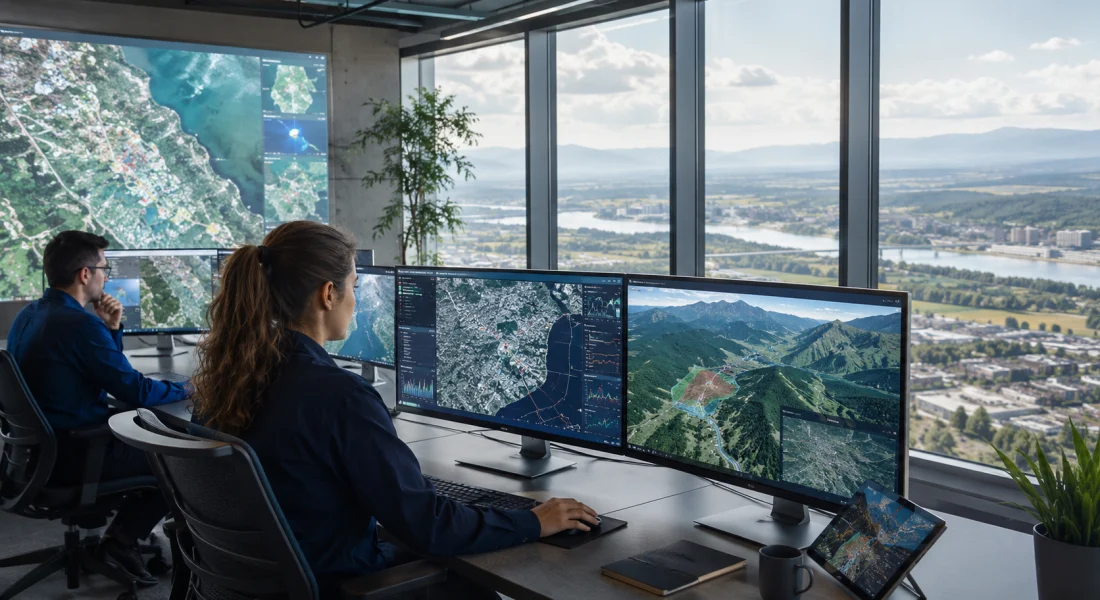
In today’s fast-moving world, top companies are turning to advanced geospatial management solutions to handle vast amounts of imagery from satellites, planes, and drones. These solutions go far beyond basic mapping-they automatically detect, monitor, and inspect objects at scale with impressive speed and accuracy. Whether it’s tracking changes in construction sites, optimizing port operations, or supporting precision agriculture, these tools make complex analysis feel almost effortless.
What really sets the best geospatial management solutions apart is how they combine powerful AI with easy-to-use interfaces. Leading agencies and specialized companies now let teams train custom models without needing coding skills or deep technical backgrounds. The result? Dramatic time savings-often cutting hours or even days of manual work down to minutes-while delivering reliable, high-precision results that drive better decisions across industries.
Leading Geospatial Management Tools
Several powerful geospatial management tools now make it possible to process and analyze satellite, aerial, and drone imagery at scale with remarkable speed and precision. These tools stand out by combining advanced AI automation with intuitive interfaces, helping teams detect objects, monitor changes, and extract actionable insights without getting buried in manual work. Here are some of the strongest options available today.

1. FlyPix AI
FlyPix AI serves as an AI-powered tool for geospatial image analysis that works with satellite, aerial, and drone imagery. Our tool automatically detects, outlines, and monitors different objects in complex scenes while cutting down manual work significantly. It adapts well to various project types through custom model training that does not require deep programming knowledge.
Our tool makes it straightforward to process dense imagery and turn it into actionable results. FlyPix handles annotation tasks quickly compared to traditional methods and supports multiple industries that rely on regular spatial data review. The interface keeps things simple so users can focus on insights rather than technical setup.
Key Highlights:
- AI-based object detection
- Satellite and drone imagery support
- Custom model training
- Automated annotation
- Time-saving workflows
Capabilities:
- Geospatial management solutions
- Object identification and outlining
- Change monitoring
- Geospatial data processing
- Custom AI model creation
- Image analysis automation
- Multi-source data integration
Contact Information:
- Website: flypix.ai
- Email: [email protected]
- Phone:+49 6151 3943470
- Address: Robert-Bosch-Str. 7, 64293 Darmstadt, Germany
- LinkedIn: www.linkedin.com/company/flypix-ai

2. QGIS
QGIS serves as a full-featured desktop GIS application for viewing, editing, analyzing, and managing spatial data. It runs on Windows, Mac, and Linux and gives users solid tools for creating maps and editing layers. The software handles points, lines, polygons and meshes quite well during digitizing work.
QGIS brings analysis functions right into the main interface and supports automated processing workflows. Its wide format support and standards compliance make connecting to different data sources straightforward. The layout designer works nicely for print outputs while custom form tools simplify data entry.
Key Highlights:
- Full desktop GIS application
- Cartographic tools
- Layer editing and digitizing
- Built-in analysis functions
- Multi-platform support
Capabilities:
- Map creation
- Geometry editing
- Data processing workflows
- Layout and report generation
- Web and mobile sharing options
Contact Information:
- Website: qgis.org
- Email: [email protected]
- Facebook: www.facebook.com/people/QGIS/100057434859831

3. GRASS GIS
GRASS GIS works as a powerful computational tool for raster, vector, and general geospatial processing. It handles terrain analysis, ecosystem modeling, and hydrology tasks effectively. Users often turn to its temporal framework when working with time-based imagery and data.
The Python API gives good flexibility for scripting and time series work. GRASS GIS runs on various systems and manages larger computational jobs without much trouble. As an open source project it keeps improving through ongoing community efforts.
Key Highlights:
- Raster and vector engine
- Terrain modeling
- Hydrology tools
- Temporal data support
- Python integration
Capabilities:
- Geospatial data management
- Ecosystem modeling
- Imagery processing
- Time series analysis
- Large dataset computations
Contact Information:
- Website: grass.osgeo.org
- Email: [email protected]
- Address: 14525 SW Millikan #42523, Beaverton, Oregon, United States
- Linkedin: www.linkedin.com/company/grass-gis
- Twitter: x.com/grassgis

4. GeoServer
GeoServer functions as an open source server for publishing and sharing geospatial data. It takes data from common spatial sources and makes it available using standard web services. Many users rely on it when they need to expose maps and features over the web.
The server follows OGC standards such as WMS, WFS, and WCS for better compatibility. Additional modules allow people to extend its features when required. Regular updates and community involvement keep the project active.
Key Highlights:
- Open source data server
- OGC standards support
- Web service publishing
- Data sharing focus
- Modular design
Capabilities:
- Web map services
- Feature data access
- Coverage publishing
- Standards-based sharing
- Tile service generation
Contact Information:
- Website: geoserver.org

5. PostGIS
PostGIS adds spatial capabilities to PostgreSQL for storing, indexing, and querying geospatial data. It supports various geometry types including two and three dimensional objects. The extension provides a rich set of functions for spatial operations.
Users can perform geometry processing and work with raster data inside the database. Standard database connections make it easy to link with other GIS tools. PostGIS brings spatial functionality directly into a relational database setup.
Key Highlights:
- PostgreSQL extension
- Spatial data storage
- Geometry indexing
- Function library
- Raster support
Capabilities:
- Spatial querying
- Geometry calculations
- Data manipulation
- Raster operations
- Database integration
Contact Information:
- Website: postgis.net

6. GDAL/OGR
GDAL/OGR serves as a translator library for raster and vector geospatial formats. It provides consistent data models so applications can work with many different file types. The package includes command line utilities for format conversion and basic processing.
Developers integrate GDAL into various geospatial software projects. It supports an extensive list of raster and vector drivers. The library stays actively maintained with steady improvements over time.
Key Highlights:
- Format translation library
- Raster and vector support
- Command line utilities
- Abstract data models
- Wide driver collection
Capabilities:
- Data format conversion
- Raster handling
- Vector processing
- Data abstraction
- Utility operations
Contact Information:
- Website: gdal.org

7. MapServer
MapServer handles the publishing of spatial data and interactive maps directly on the web. It works well for serving map layers through standard web protocols and makes spatial information available to different applications. Some people find the initial setup requires attention to detail, yet it becomes straightforward after the first few tries.
The tool supports multiple data formats and lets users adjust how maps look and function online. MapServer stays focused on reliable delivery of geospatial content without adding extra layers of complexity that some other options bring. Many choose it when they need consistent performance for web mapping projects that involve regular data updates.
Key Highlights:
- Web map publishing tool
- Spatial data serving
- Interactive map support
- Standards compliance
- Configuration options
- Format flexibility
Capabilities:
- Map layer publishing
- Data format handling
- Web service creation
- Map styling options
- Performance adjustments
- Interactive feature display
Contact Information:
- Website: mapserver.org

8. OpenLayers
OpenLayers functions as a JavaScript library for building interactive web maps and managing geospatial layers. It gives developers control over how maps behave in the browser and supports different kinds of data display. The library sometimes feels detailed when starting out, but that same depth helps when fine-tuning map behavior.
OpenLayers works with various data sources and handles multiple layer types at once. Users often turn to it when they want custom map interfaces that respond well to clicks, zooms, and other interactions. The code structure encourages building exactly what the project needs rather than forcing a fixed workflow.
Key Highlights:
- JavaScript mapping library
- Interactive web maps
- Layer management
- Data source support
- Browser integration
- Custom controls
Capabilities:
- Map creation
- Layer control
- User interaction handling
- Data visualization
- Custom map interfaces
- Event management
Contact Information:
- Website: openlayers.org

9. SAGA GIS
SAGA GIS focuses on automated geoscientific analyses and spatial data processing. The system comes with many modules specifically built for terrain work, hydrology, and scientific calculations. Some users mention the interface takes time to learn, but the tools inside offer real depth once familiar.
SAGA GIS manages both raster and vector data in the same environment. The modular approach allows building step-by-step processing chains for more complex geospatial tasks. It continues to serve well in academic and research settings where detailed analysis matters.
Key Highlights:
- Automated analysis system
- Geoscientific focus
- Spatial data processing
- Module-based design
- Raster and vector tools
- Scientific workflows
Capabilities:
- Terrain analysis
- Hydrology modeling
- Data management
- Scientific calculations
- Processing chain creation
- Grid and vector operations
Contact Information:
- Website: saga-gis.sourceforge.io
- Phone: +1 (858) 422-6466
- Address: 1320 Columbia Street Suite 310, San Diego, CA 92101
- Linkedin: www.linkedin.com/company/sourceforge.net
- Facebook: www.facebook.com/sourceforgenet
- Twitter: x.com/sourceforge
10. WhiteboxTools
WhiteboxTools serves as an open-source geospatial analysis toolbox for data processing and management. It includes a wide collection of tools aimed at raster and vector operations used in scientific and practical work. The command-line focus feels efficient when running repeated tasks or batch operations.
Whitebox GAT adds a graphical interface on top of the core library, which helps users who prefer clicking through options. Together the tools cover many standard geospatial workflows while staying independent of heavy external software. The project keeps a practical approach that suits both developers and end users.
Key Highlights:
- Open-source analysis toolbox
- Geospatial data processing
- Raster and vector tools
- Command line utilities
- Graphical interface option
- Workflow support
Capabilities:
- Data format conversion
- Spatial analysis operations
- Terrain processing
- Hydrological tools
- Batch processing
- Image analysis
Contact Information:
- Website: www.whiteboxgeo.com
- Email: [email protected]
- LinkedIn: www.linkedin.com/in/john-lindsay-phd
- Facebook: www.facebook.com/Whitebox-Geospatial-108678944764778
- Twitter: x.com/whiteboxgeo
Notable Companies in Geospatial Management Solutions
Several established companies deliver practical geospatial management solutions that help organizations handle satellite, aerial, and drone imagery along with other spatial data. These companies focus on different aspects – from data storage and analysis to publishing and collaboration – giving users a range of options depending on project needs. Here are some of the well-known ones worth considering.

1. AI Superior
AI Superior is a German-based AI services and development company that offers solutions in geospatial artificial intelligence. The company applies deep learning techniques to detect, extract, and classify information from satellite imagery, drone data, and other spatial sources. Many clients note that their custom approach works well when standard tools feel too rigid for specific project requirements.
AI Superior focuses on computer vision and image analysis for geospatial tasks. The company helps organizations turn raw spatial data into practical insights through tailored models and consulting. It all depends on the use case, but their services often fit projects that need automation in monitoring or data processing.
Key Highlights:
- AI services company
- Geospatial artificial intelligence focus
- Custom model development
- Computer vision applications
- Data consulting
- Image analysis expertise
Services:
- GeoAI implementation
- Satellite imagery analysis
- Spatial data processing
- Custom AI model training
- Geospatial consulting
- Object detection in imagery
Contact Information:
- Website: aisuperior.com
- Phone: +49 6151 3943489
- Email: [email protected]
- Address: Robert-Bosch-Str. 7, 64293 Darmstadt, Germany
- LinkedIn: www.linkedin.com/company/ai-superior
- Facebook: www.facebook.com/aisuperior
- Twitter: x.com/aisuperior
- Instagram: www.instagram.com/ai_superior

2. Esri
Esri is a company that specializes in GIS software for data management, analytics, and enterprise geospatial projects. The company developed the ArcGIS suite, which many organizations rely on to work with spatial information and turn it into practical insights. Some people note that it takes time to get comfortable with the system, but it supports a broad range of tasks once familiar.
Esri regularly updates its offerings to match the needs of different sectors, from local government work to large corporate environments. The company focuses on bringing together mapping, analysis, and data sharing within a single connected system. This integrated approach helps users maintain consistency across various work environments.
Key Highlights:
- GIS software developer
- Enterprise geospatial focus
- Data management capabilities
- Multi-environment support
Services:
- Spatial data management
- Geospatial analytics
- Map creation and visualization
- Enterprise system integration
- Data sharing solutions
Contact Information:
- Website: www.esri.com
- Phone: +19097932853
- Address: 380 New York Street, Redlands, California, United States of America
- LinkedIn: www.linkedin.com/company/esri
- Facebook: www.facebook.com/esrigis
- Twitter: x.com/Esri

3. Hexagon
Hexagon is a company with a dedicated geospatial division that provides solutions for geospatial information management, GIS, remote sensing, and data production. The company works with various types of spatial data to support different operational requirements across industries. Some users mention that the variety of available options can take a while to navigate depending on the project.
Hexagon focuses on delivering practical applications where accurate geospatial information is essential. The company supports the full cycle from data collection and processing to final delivery in formats that help with decision-making. Its geospatial division maintains a consistent emphasis on both software and supporting services.
Key Highlights:
- Geospatial information management
- GIS solutions
- Remote sensing capabilities
- Integrated workflows
Services:
- Geospatial data management
- Remote sensing analysis
- GIS implementation
- Data processing
- Information delivery
Contact Information:
- Website: hexagon.com
- Phone: +46 8 601 26 20
- Address: Lilla Bantorget 15, SE-111 23 Stockholm, Sweden
- LinkedIn: www.linkedin.com/company/hexagon-ab
- Facebook: www.facebook.com/HexagonAB
- Twitter: x.com/HexagonAB
- Instagram: www.instagram.com/hexagon_ab

4. Trimble
Trimble provides geospatial technology solutions for surveying, data capture, and management. The company develops hardware and software combinations that support field data collection and office processing. Some professionals appreciate how the components work together, though setup details vary by project type.
Trimble focuses on accuracy and efficiency in data handling across different environments. Its solutions appear in surveying, construction, and agriculture where reliable spatial information matters. The product line covers both hardware devices and supporting software.
Key Highlights:
- Geospatial technology provider
- Surveying solutions
- Management systems
- Hardware-software integration
Services:
- Survey data management
- Field data capture
- Geospatial processing
- Mapping solutions
- Precision positioning
Contact Information:
- Website: geospatial.trimble.com
- LinkedIn: www.linkedin.com/showcase/trimble-geospatial
- Facebook: www.facebook.com/TrimbleSurvey
- Instagram: www.instagram.com/trimblegeospatial

5. Bentley Systems
Bentley Systems is a company that specializes in infrastructure engineering with a strong focus on geospatial management. The company develops ProjectWise and iTwin systems that help connect design data with real-world location information inside larger infrastructure projects. Engineers frequently use these solutions when they need to link engineering designs to accurate spatial context.
Bentley Systems concentrates its work on the infrastructure sector, where precise geospatial information plays an important role. The company builds systems that support collaboration and help maintain data consistency across the entire project lifecycle. This approach proves particularly useful for complex projects that combine engineering and location-based information.
Key Highlights:
- Infrastructure engineering company
- Project data systems
- Digital twin technology
- Engineering integration
Services:
- Geospatial data management
- Infrastructure modeling
- Project collaboration
- Digital twin creation
- Spatial analysis for engineering
Contact Information:
- Website: bentley.com
- Address: 685 Stockton Drive, Exton, PA 19341, United States
- Phone: +1 610 458 5000
- Linkedin: www.linkedin.com/company/bentley-systems
- Facebook: www.facebook.com/BentleySystems
- Instagram: www.instagram.com/bentleysystems
- Twitter: x.com/bentleysystems

6. Vantor
Vantor specializes in satellite imagery, geospatial intelligence, and data management services. The company collects and processes high-resolution imagery from space to support various analytical needs. Some users mention that the volume of available data can be quite large, so selecting the right datasets usually requires careful planning.
Vantor delivers imagery along with derived products that assist with monitoring and assessment work. The company combines satellite data with analytical capabilities to produce usable geospatial information. Its focus remains on delivering clear and practical spatial data for different applications.
Key Highlights:
- Satellite imagery provider
- Geospatial intelligence specialist
- Data management services
- High-resolution imagery
- Analytical processing
Services:
- Satellite imagery delivery
- Geospatial intelligence
- Data processing
- Change detection
- Imagery analysis
Contact Information:
- Website: vantor.com
- Phone: 800.496.1225
- Email: [email protected]
- Facebook: www.facebook.com/VantorTech
- LinkedIn: www.linkedin.com/company/vantortech
- Twitter: x.com/vantortech
- Instagram: www.instagram.com/vantor_tech

7. Planet Labs
Planet Labs specializes in daily satellite imagery and geospatial data for monitoring and management purposes. The company operates a large constellation of satellites that capture frequent imagery of the Earth. Some users find the daily revisit rate particularly useful for tracking changes over time, though handling the volume of data requires some planning.
Planet Labs focuses on making satellite imagery accessible for enterprise needs. Its systems help organizations monitor areas of interest and integrate the imagery into their existing workflows. The approach works well for applications that benefit from regular, up-to-date views.
Key Highlights:
- Satellite imagery provider
- Daily data collection
- Geospatial monitoring
- Enterprise data delivery
- Change detection support
Services:
- Satellite imagery access
- Geospatial data management
- Monitoring solutions
- Analytics integration
- Data visualization
Contact Information:
- Website: www.planet.com
- Address: 645 Harrison Street, 4th Floor, San Francisco, CA 94107
- LinkedIn: www.linkedin.com/company/planet-labs
- Facebook: www.facebook.com/PlanetLabs
- Twitter: x.com/planet
- Instagram: www.instagram.com/planetlabs

8. CARTO
CARTO is a company that develops location intelligence solutions for spatial data management and analytics. The company creates systems that help organizations turn location-based data into practical insights for everyday decision making. Some users mention the interface feels quite intuitive for basic spatial work, though certain advanced features require time to fully understand.
CARTO supports multiple data sources and simplifies the process of combining them for mapping and analysis. The company’s solutions often appear in business and urban planning projects where location patterns play a key role. CARTO puts more emphasis on usable analytics rather than purely technical mapping functions.
Key Highlights:
- Location intelligence company
- Spatial data management
- Data integration
- Visualization options
Services:
- Spatial analytics
- Data management
- Location intelligence
- Map creation
- Business insights
Contact Information:
- Website: carto.com
- Email: [email protected]
- Facebook: www.facebook.com/CartoDB
- LinkedIn: www.linkedin.com/company/carto
- Twitter: x.com/CARTO

9. HERE Technologies
HERE Technologies offers a location data platform for mapping, routing, and geospatial asset management. The company maintains detailed map data and related services used across different industries. Some professionals like how the routing capabilities integrate with real-time information, though customization options vary by use case.
HERE Technologies focuses on reliable location data that supports navigation and asset tracking. Its platform handles both mapping and the management of location-based assets in one environment. Users often apply it when they need consistent data for operational decisions.
Key Highlights:
- Location data provider
- Mapping services
- Routing capabilities
- Asset management
- Geospatial platform
Services:
- Digital mapping
- Routing and navigation
- Asset tracking
- Location data management
- Geospatial analytics
Contact Information:
- Website: www.here.com
- Address: Suite 240, 280 N Old Woodward Ave, Birmingham, Michigan 48009-5300, United States
- LinkedIn: www.linkedin.com/company/here
- Facebook: www.facebook.com/here
- Twitter: x.com/HERE
- Instagram: www.instagram.com/here
10. Cesium
Cesium is a company that specializes in 3D geospatial tools for visualization and data management. The company developed CesiumJS for web-based 3D mapping and offers ion for hosting and streaming geospatial data. Some developers mention that working in 3D environments brings extra complexity, but it opens up new possibilities for certain types of projects.
Cesium focuses on creating realistic 3D representations of geospatial information. The company helps users see and interact with large datasets in a more immersive way than traditional methods allow. Its solutions are often chosen for cases where standard flat maps simply do not provide enough detail or context.
Key Highlights:
- 3D geospatial company
- Data management
- Web-based rendering
- Data streaming
Services:
- 3D map visualization
- Geospatial data hosting
- Interactive 3D displays
- Data integration
- Terrain rendering
Contact Information:
- Website: cesium.com
- Email: [email protected]
- Address: 601 Walnut Street, Suite 250 S, Philadelphia, PA 19106
- LinkedIn: www.linkedin.com/company/cesium-gs
- Twitter: x.com/CesiumJS
Conclusion
Choosing the right geospatial management solutions can genuinely shift how organizations handle complex spatial data. Whether someone needs fast object detection in drone footage or reliable systems for long-term monitoring, the options available today make previously time-consuming tasks feel far more manageable. The field keeps evolving quickly, and the tools keep getting better at turning raw imagery into clear, usable insights.
At the end of the day, success often comes down to finding solutions that fit specific workflows instead of forcing a one-size-fits-all approach. The most practical setups combine automation with enough flexibility to adapt as needs change. As geospatial data continues to grow in volume and importance, having solid management solutions in place is becoming less of a luxury and more of a practical necessity for staying efficient.