
I’ve been using Starlink for a couple of years now, and honestly, the conversation around it has shifted. Back in 2022, it felt like magic. Now, in early 2026, it’s just another utility bill – but one that I still have a love-hate relationship with.
If you’re reading this, you’re probably stuck between a rock and a hard place: either your local DSL provider is a joke, or you’re tired of living life through a 5G hotspot that dies when it rains. Here is an unfiltered take on where Starlink actually sits right now.
The Reality of the “10,000 Satellite” Network
The marketing says there are nearly 10,000 satellites up there now. That sounds great on paper, and in fact, the speeds are more stable than they were a year ago. Many people are consistently seeing about 180 Mbps down, which is plenty for a household to stream 4K while I’m on a Zoom call.
But here is the catch: Congestion is still a thing. If you’re in a crowded area (think suburban outskirts), those “median speeds” can take a hit during the 7 PM Netflix rush. It’s lightyears better than HughesNet, but it’s not the “unlimited speed pipe” the fanboys claim it is.
Breaking Down the Costs
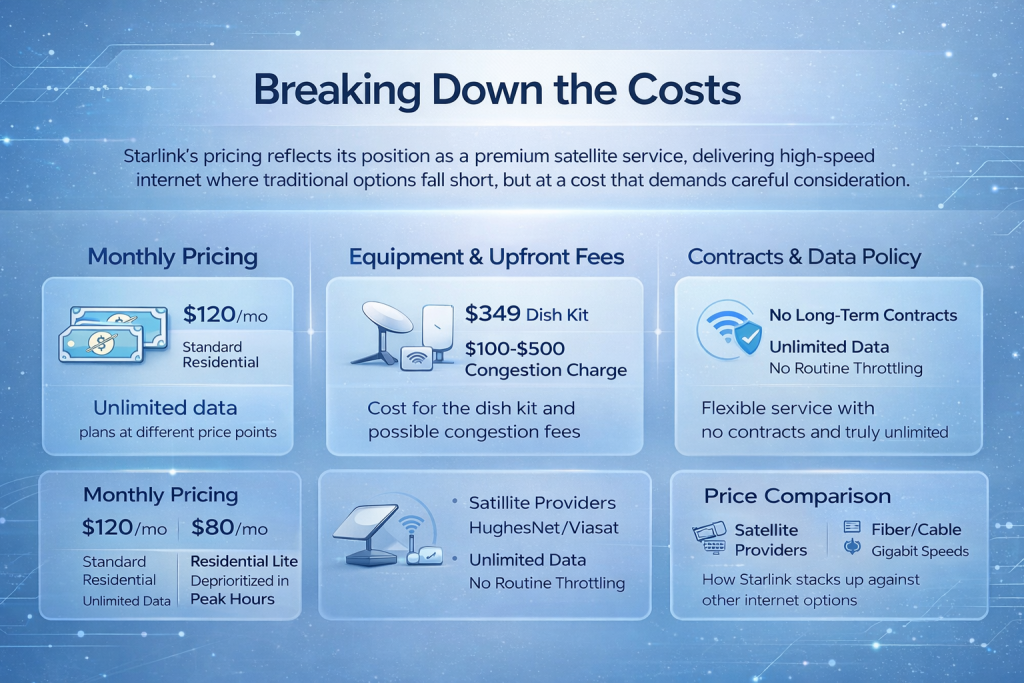
Starlink’s pricing reflects its position as a premium satellite service – delivering high-speed internet where traditional options fall short, but at a cost that demands careful consideration.
Monthly Pricing
The standard residential plan runs $120 per month for unlimited data, which feels steep when compared to urban wired alternatives. For budget-conscious users in select areas, the Residential Lite tier offers a more affordable entry at around $80 per month – though this comes with deprioritization during peak hours, potentially leading to slower speeds when the network is busy.
Equipment and Upfront Fees
Upfront costs have become more reasonable over time. The standard dish kit now costs $349 – a notable reduction from earlier generations. Promotions, refurbished units, or regional deals can drive this lower, and in some markets, committing to 12 months waives the hardware fee entirely. In high-demand areas, however, expect a possible one-time congestion charge between $100 and $500 to secure better performance.
Contracts and Data Policy
One of Starlink’s strengths is flexibility: the main residential plans require no long-term contracts, and you can cancel anytime without penalties. Unlimited data is standard, with no routine throttling for typical household usage. (Note that mobile/roaming and business/priority plans operate under separate, higher-priced structures.)
Price Comparison
When stacked against legacy satellite providers like HughesNet or Viasat, Starlink looks compelling – offering far superior speeds without strict data caps at a comparable or even lower monthly rate. The picture changes dramatically against fiber or cable internet, where gigabit speeds often come at half the price with no upfront hardware investment, making Starlink harder to justify in well-served areas.
Customer Support and Setup
Customer support relies entirely on an online ticket system. There is no phone or live chat option, and response times often range from several days to over a week, depending on volume.
This approach can create delays when service issues arise. Many users report that once a response arrives, the team addresses problems effectively, sometimes issuing credits for extended outages. Hardware failures appear uncommon, so a large portion of customers rarely need to contact support after initial setup.
Installation is self-service. The Starlink app provides guidance for site surveys and mounting, and official accessories are available. Professional installation is not offered directly, though local third-party installers have become widely available in most areas.

A Quick Note for the Data Nerds
On a more professional note, let’s consider using the Starlink connection for some heavy lifting. For example, if you do a lot of land monitoring, and need to run drone imagery through FlyPix AI.
We run a cloud platform that uses AI to automatically count things (like trees or buildings) in aerial shots. The reason why it is mentioned here is that a few years ago, we couldn’t have dreamt of uploading 5GB of drone maps to a cloud AI from a farm. Now, with the Starlink upload speeds finally hitting that 30-40 Mbps sweet spot, we can actually run these types of professional tools from one’s porch. It can turn your “home internet” into a legitimate workstation.
Gaming and 4K Streaming: Can It Actually Keep Up?
This is usually the dealbreaker for anyone moving from a city to the woods. We’ve all heard the horror stories about satellite lag making games unplayable, but in 2026, Starlink has mostly put those ghosts to rest.
For the Gamers:
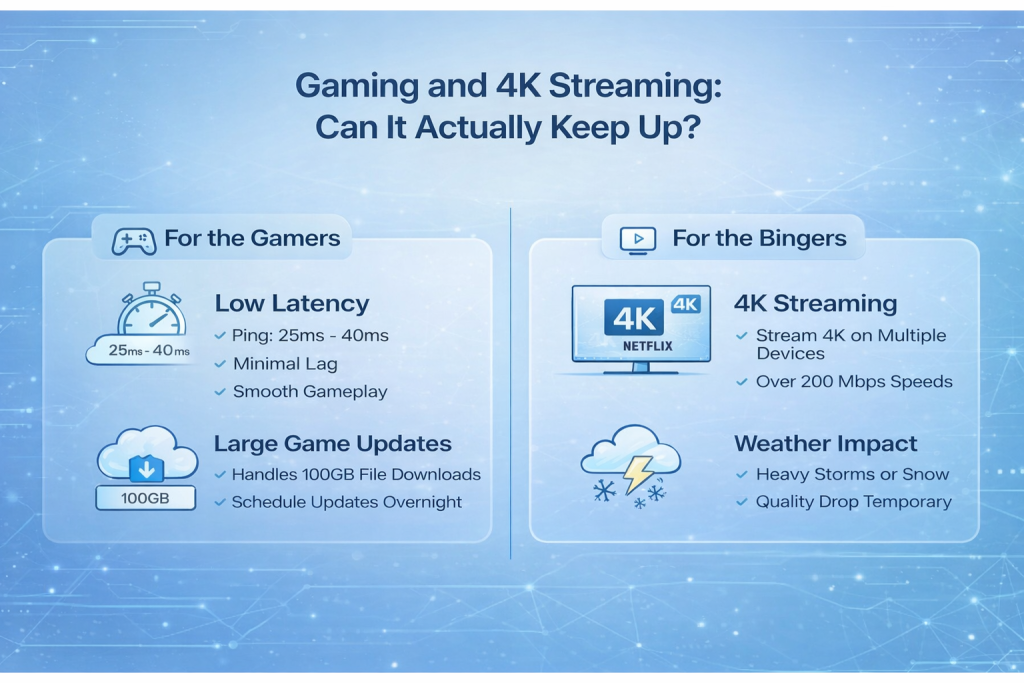
Some Starlink users have spent way too many hours testing this on Call of Duty and Apex Legends. On a typical night, the latency (ping) stays between 25ms and 40ms. Is it as “pro” as a sub-10ms fiber line? No. But is it playable? Absolutely. You won’t feel that “rubber-banding” effect where your character jumps around the screen, though you might see a tiny spike if the dish is transitioning between satellites. The only real headache is the massive 100GB game updates – Starlink handles them fine, but you can still try to schedule those for overnight so youI don’t hog the bandwidth while the rest of the house is awake.
For the Bingers:
Streaming is where Starlink really flexes. We can have two different TVs running 4K Netflix and a couple of kids on YouTube simultaneously without anyone seeing a loading circle. Because the “downpipe” is so wide now – often peaking over 200 Mbps – the system has plenty of overhead.
The only problem is the weather. If a massive summer thunderstorm or a thick blizzard sits right over your house, you will see the quality drop to 1080p or even cut out for a minute. It’s rare, but it’s the one reminder that your data is, in fact, traveling through the atmosphere.
Is It Worth It For You?
You can keep this easy:
- Get it if: You are currently using a hotspot, old-school satellite, or your only other option is a 10 Mbps DSL line. It will change your life.
- Skip it if: You have a fiber or cable line at your house. Don’t let the “cool factor” trick you; a physical wire is always going to beat a signal coming from space.
It’s 2026, and Starlink is no longer an “experiment” – it’s a solid, slightly expensive, but totally necessary tool for those of us off the beaten path.
Wrapping It Up: Is Starlink Worth Your Money in 2026?
After a few years of watching this tech mature, the conclusion is pretty simple. Starlink has moved past the “cool gadget” phase and is now a legitimate utility for anyone off the grid. It’s fast enough for a family of four, stable enough for a professional Zoom call, and powerful enough to run high-end AI tools like FlyPix.
The Verdict:
- If you have Fiber or Cable: Stay where you are. A wire is always king.
- If you’re Rural or Mobile: It’s a no-brainer. The upfront hardware cost is a one-time sting, but the freedom of having 150+ Mbps in the middle of a field is worth every penny of that $120 monthly bill.
What about you? Are you trying to run a remote business, or just trying to watch Netflix without the spinning wheel of death? If you’re on the fence, SpaceX usually offers a 30-day “no questions asked” return policy. It’s worth the test drive.
Frequently Asked Questions
Most folks see downloads between 100 and 250 Mbps, with some hitting over 300 on quiet networks. Uploads usually land around 20 to 50 Mbps. Latency hovers in the 20-40 ms range, which feels close to wired connections for everyday stuff.
Not nearly as much as older satellite services. Light rain or wind barely registers. Heavy downpours or thick snow can cause short dropouts, maybe a few seconds to a minute, but the dish recovers fast and even melts off ice on its own.
Yeah, plenty of users do both every day. Low ping makes competitive gaming workable, and multiple 4K streams run fine in most households. The occasional weather blip is the only real annoyance compared to fiber.
Setup is pretty simple if you’re okay with basic tools. The app helps you find a clear sky view, and mounting options cover roofs, poles, or ground stands. Moving it is easy on roam plans, just pack the dish and plug in wherever, though mobile service costs more.
It’s definitely the weakest part. Everything goes through tickets, and replies can take days when things go wrong. Hardware problems are rare though, and many long-term users rarely need help after the initial setup.
Speeds have kept improving as more satellites launch, so expect that trend to continue. Equipment prices have already dropped over time, and monthly rates might ease in low-demand areas. No guarantees, but the direction looks positive.