
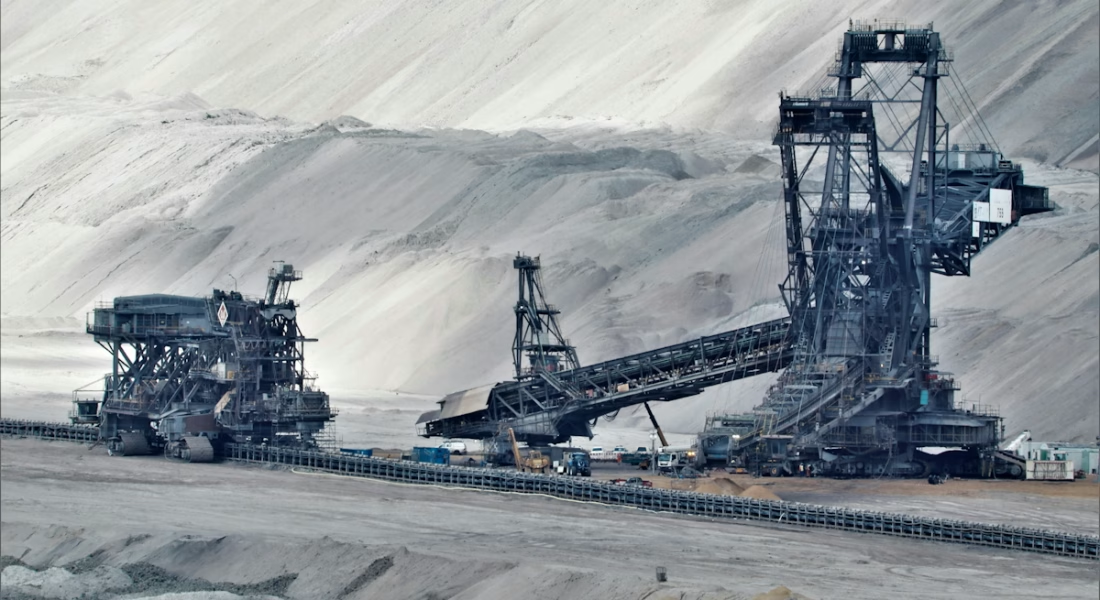
Mining software is a broad umbrella, and it usually comes down to two practical things – who builds the systems, and what tools end up getting used day to day. Some vendors focus on big, end-to-end platforms for operations and reporting. Others ship narrow tools that solve one stubborn problem well, like fleet visibility, maintenance planning, or safety checks that actually get completed. This article keeps both sides in view, with a structured list of companies and a separate list of tools, so the landscape feels readable instead of overwhelming.
Best Mining Industry Software Solutions
These are the tools that show up in daily routines of the mining industry – tracking equipment, managing work orders, monitoring safety steps, mapping deposits, or turning production numbers into something a manager can act on. Seen as a list, it is easier to spot patterns, overlaps, and gaps before choosing what matters for a specific mine or project.
1. FlyPix AI
FlyPix AI sits in the geospatial corner of mining industry software solutions, where the raw material is imagery – satellite, aerial, or drone – and the job is turning it into something teams can actually act on. Instead of having people trace features by hand, our platform relies on AI agents that detect and outline objects in images, then keep monitoring those same patterns over time. It fits situations where scenes get busy fast and manual review becomes a bottleneck.
A practical part of our setup is that custom models can be trained through user-defined annotations, without needing deep AI knowledge or heavy programming. That makes it easier to adapt the workflow to different sites and different inspection needs, whether the focus is on change detection, routine monitoring, or quick checks after a flight.
Key Highlights:
- Mining industry software solutions
- AI-based analysis of geospatial imagery
- Works with satellite, aerial, and drone inputs
- Custom model training without deep coding
- Designed for repetitive monitoring workflows
- Handles dense visual scenes efficiently
Who It Is Best For:
- Teams running routine drone surveys
- Projects tracking land-use change over time
- Groups that need consistent visual inspections
- Analysts who want configuration over coding
Contacts:
- Website: flypix.ai
- Email: [email protected]
- LinkedIn: www.linkedin.com/company/flypix-ai
- Address: Robert-Bosch-Str. 7, 64293 Darmstadt, Germany
- Phone: +49 6151 2776497

2. Deswik MDM
Deswik MDM is built around the unglamorous, but very real mining problem of planning data getting messy – different files, different owners, unclear versions, and approvals that live in inboxes. The platform acts as a spatial data and workflow management layer, giving teams a clearer view of mine planning data so it can be shared, reviewed, and governed without guessing what is current.
The emphasis is on repeatable processes and controlled approvals. Workflows can be standardized to help onboard new staff faster, reduce file sprawl, and keep cross-department collaboration from turning into a coordination headache. It also adds access control and integration options so the system can sit alongside existing tools instead of forcing a full reset.
Key Highlights:
- Centralized spatial planning data control
- Structured approval workflows
- Reduced file version confusion
- Cross-team collaboration support
Who It Is Best For:
- Mine planning teams dealing with version confusion and file sprawl
- Sites that need structured approvals and clearer governance
- Departments that share planning data across multiple teams
- Operations that want access controls without rebuilding the whole stack
Contacts:
- Website: www.deswik.com
- E-mail: [email protected]
- LinkedIn: www.linkedin.com/company/deswik-mining
- Facebook: www.facebook.com/deswik
- Address: Level 9, 348 Edward St, Brisbane, Queensland, 4000, Australia
- Phone: +61 7 3292 2700
3. Seequent
Seequent’s tools focus on geoscience data across the mining lifecycle, starting at exploration and running through operations and closure. The overall idea is simple – take scattered subsurface information and make it usable for decisions, whether that means managing drillhole data, building geological models, running geophysics workflows, or supporting grade control.
A big part of the offering is the way products connect workflows and collaboration. The platform approach is meant to link data, software, and compute in one place, so teams can move from data to interpretation without constantly exporting and reformatting. It reads like an ecosystem built for mining groups that live in geology, geophysics, and resource work, but still need results to land in planning and operations.
Key Highlights:
- Exploration to closure lifecycle coverage
- Strong drillhole data management
- Integrated geological modelling tools
- Collaborative geoscience platform approach
- Built for subsurface decision workflows
Who It Is Best For:
- Exploration and resource teams working with drillhole datasets
- Geoscience groups building and sharing subsurface models
- Operations that depend on grade control inputs staying consistent
- Teams that need connected workflows across tools and stakeholders
Contacts:
- Website: www.seequent.com
- E-mail: [email protected]
- LinkedIn: www.linkedin.com/company/seequent
- Twitter: x.com/seequentglobal
- Facebook: www.facebook.com/seequent.software
- Address: 3827 Lafayette Street, Denver, Colorado, CO 80205

4. Maptek Vulcan
Maptek Vulcan is built for turning technical mining data into something that holds together in 3D – models, designs, and operating plans that can be tested before anyone moves a tonne. The core strength is the 3D visualisation environment, which helps teams make sense of large and complex datasets and keep an up-to-date picture of the deposit as new information lands.
Vulcan also leans into role-based depth through add-ons, so a geology-heavy setup does not have to look the same as a scheduling-heavy one. Across the base platform and extensions, it covers block modelling, survey, drill and blast, grade control, geotechnical analysis, scheduling, optimisation, and geostatistics. There is also a small ecosystem layer around licensing and extensibility, with tools for managing licences, accessing applications, and extending functionality.
Key Highlights:
- Mine planning data governance
- Workflow automation for approvals
- Access control configuration
Who It Is Best For:
- Exploration and resource teams working with drillhole datasets
- Geoscience groups building and sharing subsurface models
- Operations that depend on grade control inputs staying consistent
- Teams that need connected workflows across tools and stakeholders
Contacts:
- Website: www.maptek.com
- E-mail: [email protected]
- Instagram: www.instagram.com/maptek.global
- LinkedIn: www.linkedin.com/company/maptek
- Twitter: x.com/maptek
- Facebook: www.facebook.com/Maptek
- Address: 14143 Denver West Parkway, Suite 200, Golden CO 80401
- Phone: +1-303-763-4919
5. K-MINE
K-MINE combines a mining software platform with consulting and technical reporting, so it reads like a shop built for both delivery and execution. On the software side, the pitch is a connected workflow – one database running from drillhole data through geological modelling and into open pit or underground design, then into scheduling and production planning. It also includes modules for things like pit optimization, slope stability analysis, drill and blast design, and infrastructure planning.
What stands out is the “from geology to schedule” shape of it. Surveying and reconciliation sit alongside design tools, and scheduling includes equipment assignment for different planning horizons. On top of that, the consulting side covers technical reports and resource estimation work tied to common reporting standards, plus custom development around digital twins, production monitoring, and system connections.
Key Highlights:
- Single database from geology to schedule
- Integrated pit optimisation
- Slope stability analysis tools
- Consulting and reporting capabilities
- Infrastructure planning features
Who It Is Best For:
- Teams that need 3D models tied closely to mine designs and plans
- Sites handling large, complex datasets that change often
- Geology, survey, and engineering groups using add-ons by role
- Planners who want scenario testing and practical plan iterations
Contacts:
- Website: k-mine.com
- E-mail: [email protected]
- LinkedIn: www.linkedin.com/company/k-mine
- Address: 1151 Walker Rd, Ste 234, Dover, DE 19904
- Phone: +1 610-234-7255
6. Micromine
Micromine brings a broad mining software ecosystem that tries to keep the whole lifecycle in one connected flow – from early exploration work through design, planning, and day-to-day operations. Instead of treating these as separate islands, their approach is to link teams and datasets so drilling information, models, plans, and operational control do not drift apart as a project moves forward.
The product mix covers geoscience data logging and management, geological modelling and resource estimation, mine design and surveying, plus planning for both open pit and underground. On the operating side, they also include fleet management and mine control, with a cloud layer aimed at connecting teams, data, and technology. Alongside the software, they offer consulting and training so rollouts and handovers do not depend on one or two power users.
Key Highlights:
- Connected exploration and operations ecosystem
- Geoscience data logging tools
- Fleet management modules
- Cloud-based collaboration layer
- Consulting and training offered as part of the ecosystem.
Who It Is Best For:
- Teams that want geology, design, and scheduling in one workflow
- Open pit and underground operations running planning in-house
- Groups doing pit optimisation and slope stability work internally
- Companies that need both software and technical reporting support
Contacts:
- Website: www.micromine.com
- E-mail: [email protected]
- LinkedIn: www.linkedin.com/company/micromine
- Address: 430 Indiana Street, Suite 100, Golden, CO 80401, USA
- Phone: +1 720 593 2888
7. Cat MineStar Solutions
Cat MineStar Solutions is built for the operational layer of mining – tracking, monitoring, and managing what is happening on site, across people and machines. The suite is meant to scale from a single, focused deployment to a more integrated setup, depending on how far a site wants to go with technology and automation.
Functionally, the system is organized around core mining challenges like fleet productivity, safety, equipment health, and automation. It also breaks down into application areas such as drilling, loading and hauling, dozing and grading, and underground hard rock, with options to integrate across different asset types and even across mixed equipment fleets. On top of the platform itself, they also offer safety services and training, which matters when tools touch real operations and real risk.
Key Highlights:
- Focus on operational visibility
- Surface and underground support
- Productivity and safety integration
- Automation capabilities
- Mixed fleet compatibility
Who It Is Best For:
- Sites that need fleet visibility and shift-to-shift control
- Operations managing safety and productivity in the same system
- Mixed-fleet environments that need cross-brand compatibility
- Teams progressing toward automation in steps, not all at once
Contacts:
- Website: www.cat.com
- Instagram: www.instagram.com/caterpillarinc
- LinkedIn: www.linkedin.com/company/caterpillar-inc
- Twitter: x.com/caterpillarinc
- Facebook: www.facebook.com/caterpillarinc
8. Carlson for Mining
Carlson’s mining lineup is a mix of office software, instruments, and machine control – which is a pretty honest reflection of how mining work actually happens across desk and field. On the software side, they cover geology, underground and surface mine design, blast design, reclamation planning, and site management and monitoring. The tooling is framed as versatile enough for everything from permitting and reserves work to active production planning.
What makes Carlson different in feel is the tight pairing between planning tools and measurement or control hardware. They also offer laser measurement devices, scanning systems, and borehole measurement tools, plus machine guidance for dozers, drills, and excavators. The result is a toolkit that can support the full loop – plan it, measure it, execute it, then check what changed.
Key Highlights:
- CAD-based mining workflows
- Integrated hardware and software approach
- Laser and borehole measurement tools
- Machine guidance compatibility
Who It Is Best For:
- Sites that need fleet visibility and shift-to-shift control
- Operations managing safety and productivity in the same system
- Mixed-fleet environments that need cross-brand compatibility
- Teams progressing toward automation in steps, not all at once
Contacts:
- Website: www.carlsonsw.com
- E-mail: [email protected]
- LinkedIn: www.linkedin.com/company/carlson-software
- Twitter: x.com/CarlsonSoftware
- Facebook: www.facebook.com/carlsonsw
- Address: 33 East Second Street, Maysville, KY, USA 41056
- Phone: 606-564-5028
9. GEOVIA Surpac
GEOVIA Surpac is a 3D mine planning and geological modelling environment that covers drillhole data management through to mine designs and mine plans for both open pit and underground. The emphasis is on giving geologists and engineers a single place to quantify a deposit, run statistical and geostatistical work, and translate that into resource models that support real planning constraints.
A useful part of the Surpac setup is the role-based portfolio around specific jobs – block modelling, survey, mine design, drill and blast design, and stope optimisation. These roles map to real site routines like generating surveys from CMS or GPS data, updating as-built geometry, handling reconciliation volumes, and producing outputs that can be used for reporting and feasibility work.
Key Highlights:
- 3D geological modelling environment
- Resource modelling and statistical tools
- Role-based workflow structure
Who It Is Best For:
- Geology teams managing drillhole data and resource models
- Engineers building open pit or underground designs from the same dataset
- Sites that rely on survey integration and reconciliation routines
- Teams that prefer role-based modules for different mine functions
Contacts:
- Website: www.3ds.com
- E-mail: [email protected]
- Instagram: www.instagram.com/dassaultsystemes
- LinkedIn: www.linkedin.com/company/dassaultsystemes
- Twitter: x.com/dassault3ds
- Facebook: www.facebook.com/dassaultsystemesfrance
10. Obzervr
Obzervr is less about geology and design and more about the maintenance reality on a mine site – work orders, field execution, and keeping asset information usable without chasing paper. Their pitch is a digital work management setup that combines a web platform and mobile app, creating something like a remote operating centre for maintenance teams. The practical outcome is consistent information flow between planners, supervisors, reliability engineers, managers, and field crews.
The tool’s description leans heavily on fieldwork automation and mobility, plus analytics dashboards and reporting for visibility into asset condition, work order status, and team performance. One more point is integrating with business systems and aligning maintenance practice with frameworks like ISO 55000 and GFMAM, which signals a focus on structure and repeatability rather than ad hoc fixes.
Key Highlights:
- Drillhole database management
- Resource model development
- Mine design and planning
- Survey integration workflows
- Stope optimisation tools
Who It Is Best For:
- Maintenance teams replacing paper-based work orders and field notes
- Supervisors and planners who need real-time work order visibility
- Reliability engineers looking for dashboards and consistent execution data
- Sites integrating maintenance workflows with business systems and standards
Contacts:
- Website: www.obzervr.com
- LinkedIn: www.linkedin.com/company/obzervr
- Facebook: www.facebook.com/Obzervr
- Address: 345 Ann Street, Brisbane, Queensland Australia 4000
Best Mining Industry Software Solutions Companies
This section pulls together providers that build software for mining operations in one form or another. Some cover the whole chain – planning, production, maintenance, safety, and reporting. Others stay closer to a specific slice of work, like dispatch, asset health, or geology data. Either way, the point of the list is simple: show the kinds of teams behind the platforms mining sites rely on.
1. AI Superior
AI Superior is an AI services and development company that sits a bit upstream from traditional mining software – more about building the intelligence layer than shipping a fixed mine planning package. Their work is framed around end-to-end AI application development and AI consulting, with teams that build custom web and mobile apps and software products using machine learning models. For mining software solutions, that usually translates into projects where the problem is data-heavy and messy: images from site cameras or drones, text from reports, sensor streams, or operational history that needs forecasting.
They describe a fairly structured delivery flow, starting with discovery and dataset review, then moving into MVP builds, scaling, integration, and evaluation. On the solution side, their menu includes computer vision, NLP, predictive analytics, BI, and big data analytics, which can map to mining realities like equipment failure prediction, safety monitoring through image processing, automated document handling, and operational dashboards that do not require manual stitching.
Key Highlights:
- End-to-end AI application delivery
- Structured development process
- Experience with predictive analytics
- Computer vision and NLP expertise
Services:
- Mining industry software solutions
- Custom AI software development
- AI consulting and strategy
- Predictive modelling systems
Contacts:
- Website: aisuperior.com
- E-mail: [email protected]
- Facebook: www.facebook.com/aisuperior
- Instagram: www.instagram.com/ai_superior
- Twitter: x.com/aisuperior
- LinkedIn: www.linkedin.com/company/ai-superior
- Address: Robert-Bosch-Str.7, 64293 Darmstadt, Germany
- Phone: +49 6151 3943489

2. Hexagon
Hexagon comes at mining software from the angle of connected operations, especially where underground work makes visibility and coordination harder. Their underground mining setup is framed as a way to link surface and underground workflows so planning, design, scheduling, and fleet activity do not sit in separate pockets. The underlying theme is real-time reaction to workflow changes, with collaboration and communication treated as core parts of safer operations.
Across the mining lifecycle, their capabilities read like a set of building blocks rather than one single module. They cover drill and blast feedback loops, exploration data handling and modelling, material movement with planning and fleet management, and survey and monitoring tools for slope stability and reality capture. It is the kind of portfolio that usually shows up when a site wants multiple systems to talk to each other without constant manual bridging.
Key Highlights:
- Connected surface and underground workflows
- Drill and blast feedback loops
- Geospatial and survey capabilities
- Fleet and material movement oversight
Services:
- Mine planning and scheduling
- Fleet management systems
- Geotechnical monitoring
- Exploration data handling
Contacts:
- Website: hexagon.com
- Instagram: www.instagram.com/hexagon_ab
- LinkedIn: www.linkedin.com/company/hexagon-ab
- Twitter: x.com/HexagonAB
- Facebook: www.facebook.com/HexagonAB
- Address: Lilla Bantorget 15, SE-111 23 Stockholm, Sweden
- Phone: +46 8 601 26 20

3. Ditstek Innovations
Ditstek Innovations positions itself as a custom software development partner for mining operations, leaning heavily on build-to-fit systems rather than off-the-shelf tooling. Their mining work is described as automation and monitoring focused, with emphasis on production oversight, fleet and equipment integrations, and safety-related features that can be supported through AI and connected devices.
The service lineup covers the full development cycle, from consultation and early MVP work to full-scale builds and ongoing maintenance. They also highlight integration work as a big part of delivery – AI features, IoT sensor inputs, cloud deployments, and API connections for fleet and equipment systems. It reads like a team brought in when a mining operation has specific workflows that do not map cleanly onto standard platforms.
Key Highlights:
- Custom-built mining software for different operational areas
- AI and IoT integration
- Cloud deployment support
Services:
- Mining software consultation
- Full-cycle system development
- IoT sensor integration
- Ongoing maintenance and updates
Contacts:
- Website: www.ditstek.com
- E-mail: [email protected]
- Instagram: www.instagram.com/ditstek_innovations
- LinkedIn: www.linkedin.com/company/ditstek-innovations
- Twitter: x.com/DitsTek
- Facebook: www.facebook.com/ditstekinnovations
- Address: D-140, Phase 7, Industrial Area, Sector 73, Sahibzada Ajit Singh Nagar, Punjab 160055
- Phone: +1 (587) 500-4784

4. Datamine
Datamine frames their mining software around roles and daily tasks, which is honestly how most mines operate anyway – different specialists, different priorities, and a lot of handoffs. Their bundles are mapped to personas like mine geologist, resource geologist, planners, and surveyors, aiming to keep mapping, sampling, modelling, scheduling, and reconciliation in connected workflows rather than scattered tools.
Across the mining value chain, the product set reaches into exploration, geology, planning, production, labs, and sustainability. The platform also wraps in services like implementations, training, and advisory, which matters because these systems tend to fail less from missing features and more from messy rollout and inconsistent use.
Key Highlights:
- Role-based mining tool bundles
- Exploration to production coverage
- Implementation and training support
Services:
- Resource modelling and estimation
- Planning and scheduling tools
- Production analysis workflows
Contacts:
- Website: dataminesoftware.com
- LinkedIn: www.linkedin.com/company/dataminesw
- Address: 7900 E. Union Ave. Ste. 1007, Denver, Colorado, 80237
- Phone: 1 (888) 520-5191
5. Maptek
Maptek covers a mix of mine planning, operational support, and site data management, with an obvious bias toward making survey and spatial information easier to trust and reuse. Their ecosystem includes tools for design and analysis, plus platforms aimed at automation and orchestration – basically, helping teams stop repeating the same setup work every time a decision needs to be made.
There’s also a practical hardware angle in the lineup, like long-range laser scanning for surface and underground survey use, and safety-focused solutions such as proximity awareness underground. Taken together, it feels like a toolkit meant for teams who need their spatial reality to stay current – not just for reports, but for daily operational choices.
Key Highlights:
- Spatial data management focus
- Survey surface control tools
- Automation layer for workflows
- Underground safety solutions
Services:
- Mine planning support with spatial data
- Laser scanning solutions
- Operational workflow automation
- Survey surface management
- Proximity awareness solutions for underground safety workflows.
Contacts:
- Website: www.maptek.com
- E-mail: [email protected]
- Instagram: www.instagram.com/maptek.global
- LinkedIn: www.linkedin.com/company/maptek
- Twitter: x.com/maptek
- Facebook: www.facebook.com/Maptek
- Address: 14143 Denver West Parkway, Suite 200, Golden CO 80401
- Phone: +1-303-763-4919
6. RPMGlobal
RPMGlobal has a long-running footprint in mining software and training, with products that span a wide slice of the value chain. Their capabilities cover mine design, scheduling, simulation, haulage, operations, asset management, and finance, which points to a portfolio built for planning and operational decision support rather than one narrow workflow. They also position training as a core line alongside software, which fits the reality that tools only stick when teams can actually use them consistently.
A recent headline in their updates is the Caterpillar acquisition, which signals a shift in ownership while keeping the same mining software focus. They also highlight AMT Planner as part of their work management direction, with themes around availability, cost control, and extending asset life. The overall picture is an enterprise-style vendor that supports both the technical planning side and the maintenance and operational layers.
Key Highlights:
- Enterprise-scale mining software portfolio
- Scheduling and simulation tools
- Asset and financial modelling coverage
- Training alongside software
Services:
- Enterprise-scale mining software portfolio
- Scheduling and simulation tools
- Asset and financial modelling coverage
- Training alongside software
Contacts:
- Website: rpmglobal.com
- LinkedIn: www.linkedin.com/company/rpmglobal
- Twitter: x.com/rpmmining
- Address: Australia, Level 14, 310 Ann Street, Brisbane, Queensland, 4000
- Phone: +61 7 3100 7200

7. Promine
Promine is a CAD-first mining software company, built around plugins for AutoCAD and BricsCAD, with compatibility also called out for Civil 3D. Instead of asking teams to learn a separate environment from scratch, they put mining and surveying functions inside tools many engineers already live in. Their plugin lineup covers everyday work like project management, resource calculation, geostatistics, block modelling, mine planning and design, drill and blast, scheduling, and surveying.
Basically, they lean on practical workflow features like drawing management, which is basically the routine part of teamwork – avoiding overwrites, tracking changes, and keeping shared files usable. Promine also mentions a mobile angle through an Android app for underground geological mapping that works with DXF files, aimed at capturing field geology information with less friction.
Key Highlights:
- CAD plugin-based approach
- Resource calculation and modelling
- Drawing management tools
- Mobile geological mapping
Services:
- CAD-integrated mine design
- Block modelling workflows
- Drill and blast planning
- Field geology data capture
- Surveying workflows integrated into CAD-based environments
- Project management tooling for mining and survey workstreams
Contacts:
- Website: www.promine.com
- E-mail: [email protected]
- Instagram: www.instagram.com/prominesoftware
- LinkedIn: www.linkedin.com/company/promineinc
- Facebook: www.facebook.com/promineinc
- Phone: +1 418-877-2769

8. IFS
IFS positions its mills and mining software around the always-present problems – keeping assets running, keeping production steady, and keeping safety and compliance processes from becoming a paperwork exercise. Their systems are designed to connect production, maintenance, and supply chain work so planning decisions, work orders, and supply constraints sit in the same operational picture.
In addition, they wrap the software with a service layer that covers consulting, cloud services, support services, and an ongoing success program. In practice, that reads like help for the parts that usually get messy in enterprise rollouts – integration, security, performance, and the day-to-day support after the launch excitement wears off.
Key Highlights:
- Enterprise planning for mining
- Asset-intensive operation focus
- Production and supply chain linkage
- Real-time visibility and operational control themes
- Dedicated services for consulting, cloud, support, and ongoing success
Services:
- Asset management systems
- Maintenance planning tools
- Supply chain coordination
- Cloud-based enterprise deployment
- Success services aimed at long-term adoption and measurable outcomes.
Contacts:
- Website: www.ifs.com
- Instagram: www.instagram.com/ifs.ai
- LinkedIn: www.linkedin.com/company/ifs
- Twitter: x.com/IFS
- Facebook: www.facebook.com/IFSdotcom
- Address: 300 Park Boulevard Suite 350, Itasca, IL 60143, USA
- Phone: + 1 888 437 4968

9. AVEVA
AVEVA’s mining and metals positioning is built around operational data, connectivity, and the systems that keep processing plants and industrial operations stable. A lot of the language revolves around using sensor data, cloud analytics, and digital twins to bridge project and operations teams, improve reliability, and reduce unplanned downtime. In mining terms, this tends to show up around processing, asset health, production management, and engineering collaboration, rather than geology or pit design alone.
Their product set includes data infrastructure like the PI System for real-time operations data, engineering environments like Unified Engineering and E3D Design, and analytics tooling for predictive maintenance and asset performance. They also reference an industrial intelligence platform layer for secure access across industrial SaaS tools. The overall vibe is a connected operations stack, meant to reduce information silos between engineering, maintenance, and operations teams.
Key Highlights:
- Operational data connectivity
- Digital twin alignment
- Predictive maintenance focus
- Engineering collaboration tools for industrial project lifecycles
Services:
- Real-time data management
- Industrial 3D design support
- Asset information systems
- Predictive analytics solutions
Contacts:
- Website: www.aveva.com
- Instagram: www.instagram.com/avevagroup
- LinkedIn: www.linkedin.com/company/aveva
- Twitter: x.com/AVEVAGroup
- Facebook: www.facebook.com/avevasolutions
- Address: AVEVA Group Limited, High Cross, Madingley Road, Cambridge CB3 0HB, UK

10. Mitrais
Mitrais is positioned as a mining software solutions provider with a strong base in Indonesia, mixing software products with implementation, consulting, and training. Their mining solutions cover geoscience database management, strategic mine scheduling, enterprise asset management, spare parts and corporate management, plus transportation scheduling. It reads like a practical vendor for operations that need both planning tools and business systems support across head office and site.
They list specific partner products like Spry Scheduler for scheduling workflows, plus LinkOne for parts information delivery and Ellipse for enterprise asset management and ERP in large mines. On the services side, they highlight system implementation, mine technical services, consulting, and training, including tailored training for more complex ore body situations.
Key Highlights:
- Strong presence in Indonesian mining
- Strategic scheduling solutions
- Enterprise asset systems
- Training and consulting support
Services:
- Mine scheduling tools
- Asset and ERP systems
- Software implementation services
- Technical training programs
Contacts:
- Website: www.mitrais.com
- Instagram: www.instagram.com/mitrais
- LinkedIn: www.linkedin.com/company/mitrais
- Twitter: x.com/mitrais
- Facebook: www.facebook.com/mitraisofficial
- Phone: 1800-755-025
Final Thoughts
Mining software is a wide field, and that is exactly why choices get messy fast. Some tools live close to the rock – geology, modelling, design, and scheduling. Others sit in the middle of the operation and deal with the grind of daily execution – maintenance, inspections, fleet visibility, work orders, and keeping people safe. None of it works in isolation for long. A site can have strong planning and still lose time because maintenance data is scattered, or run tight operations but struggle to trust the resource model. The gaps always show up where systems do not talk.
A useful way to look at the landscape is to separate what needs to be consistent from what needs to be flexible. The consistent part is the data backbone and the basic workflows that should not change every time a new person joins or a shift rotates. The flexible part is where each mine is different – how it plans, how it reports, what it monitors, and where it cannot afford mistakes. The best setups usually start simple, connect the essentials, then expand only when the next addition removes a real bottleneck. Not because it looks modern on a slide, but because it makes the work easier on a Tuesday night when something breaks and the plan has to change.