
It’s not just chatbots anymore. The AI landscape in 2026 looks dramatically different from even six months ago. You’ve got ChatGPT with significant user adoption, Claude commanding substantial enterprise AI deployments, and OpenClaw creating buzz as the autonomous agent that runs on your own infrastructure.
But here’s the thing—most comparison articles don’t tell you what actually matters in real use. They list features and call it a day. I’ve spent time with all three platforms, read through community discussions, and watched how actual developers and businesses are making their choices.
So let’s cut through the hype and figure out which AI assistant actually fits your workflow.
Understanding What Each Platform Actually Is
Before we dive into comparisons, we need to get clear on what we’re comparing. Because honestly? These aren’t three versions of the same thing.
ChatGPT: The Consumer AI Giant
ChatGPT is OpenAI’s flagship product and the gold standard for accessible AI in 2026. Designed for seamless interaction, it has evolved from a simple chatbot into a multi-modal powerhouse. Whether you are using the clean web interface or the exceptionally fluid Advanced Voice Mode, the platform handles everything from casual brainstorming to complex software architecture.
In its current iteration, ChatGPT includes advanced agentic features like ‘Operator’, allowing the AI to navigate computer interfaces and execute tasks directly on your desktop via the GPT-5 framework. This leap in autonomy has narrowed the gap between traditional chatbots and autonomous agents.
Claude: The Enterprise Safety Leader
Claude, developed by Anthropic, took a different path. While ChatGPT raced for consumer adoption, Anthropic focused on building trust with enterprise buyers. That strategy has yielded strong enterprise adoption.
Claude excels at coding tasks. Community feedback consistently ranks it highly among the major platforms for coding work. The platform offers Claude Code for development work, programmatic tool calling, and sophisticated API features for developers. Anthropic has also focused on safety innovations in their approach to AI development.
OpenClaw: The Autonomous Experiment
OpenClaw (formerly Clawdbot and briefly Moltbot) is fundamentally different. It’s not a chatbot interface—it’s an open-source agent framework that runs continuously on your own infrastructure.
Think of it this way: ChatGPT and Claude wait for you to give them tasks. OpenClaw can operate autonomously, researching topics, executing multi-step workflows, and handling tasks without constant human supervision. It uses APIs from providers like Anthropic and OpenAI under the hood.
But that autonomy comes with complexity. As one user who spent a week setting it up described: “The project involved a cloud server, a Mac mini, VPN networking, multiple OAuth integrations, and enough troubleshooting to fill a graduate seminar.”
Real talk: OpenClaw isn’t for everyone. It represents early experimentation in autonomous agent frameworks.
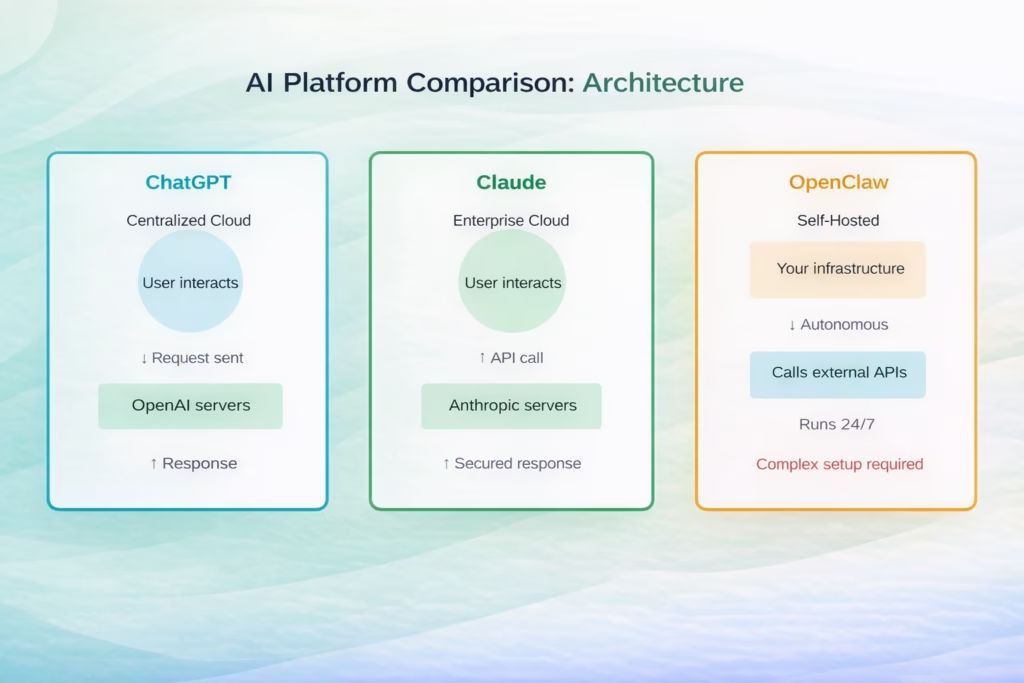
The three platforms use fundamentally different architectural approaches, from ChatGPT’s centralized consumer model to OpenClaw’s self-hosted autonomous framework.
Key Differences That Actually Matter
Okay, so what separates these platforms in practical terms? Let’s break down the differences that affect your daily workflow.
Autonomy and Control
This is the biggest dividing line. ChatGPT and Claude operate on a request-response model. You give them a task, they complete it, they wait for your next instruction.
OpenClaw breaks this pattern. It’s designed to run autonomously. You can give it a high-level goal, and it’ll work through multiple steps without checking back constantly. According to community discussions: “You have to instruct Claude Code per each task—you give it a task, it performs it and comes back to you for further instructions. Whereas agents such as OpenClaw have their own built-in driver.”
But that autonomy is a double-edged sword. Without corporate guardrails, OpenClaw can do much more like automatically research and execute tasks, but it also lacks the safety mechanisms that protect against malicious use.
Hosting and Privacy
ChatGPT and Claude run on their respective company servers. Your data passes through their infrastructure. Both companies have privacy policies and enterprise agreements, but ultimately, they control where your information lives.
OpenClaw runs on your infrastructure. Your Mac mini. Your cloud server. Your network. That means complete data privacy—but also complete responsibility for security, uptime, and maintenance.
For enterprises handling sensitive data, this difference matters enormously. Anthropic’s focus on enterprise trust has created strong market positioning because companies want assurances about data handling. OpenClaw offers maximum privacy but maximum risk if not properly secured.
Coding Performance
Claude performs well for coding tasks based on community feedback. Multiple developers in community discussions ranked Claude highly for coding, praising its ability to produce well-structured solutions rather than just working code.
OpenAI has retired the Codex brand, fully integrating its programming power into primary multi-modal models like GPT-5. The 2026 ecosystem now operates on unified rate limits, meaning your tokens apply to all tasks—from debugging code to writing briefs—without the need to switch between specialized models.
OpenClaw’s coding performance depends entirely on which underlying API it’s using. Since it’s framework software calling external LLM APIs, it’s essentially a framework orchestrating Claude Code or similar tools without the corporate safety guardrails.
Voice and Conversation Quality
ChatGPT dominates voice interaction. Users consistently report that “ChatGPT’s voice/conversation mode is in a different league compared to most other options. The accuracy and ease of everyday use feel genuinely worth the $20/monthly especially if you rely on it daily.”
Claude’s voice mode has received mixed feedback. According to user discussions, voice performance lags behind ChatGPT and other platforms.
Setup Complexity
ChatGPT: Create account, log in, start chatting. Done in 60 seconds.
Claude: Create account, log in, start chatting. Also done in 60 seconds.
OpenClaw: “The project involved a cloud server, a Mac mini, VPN networking, multiple OAuth integrations, and enough troubleshooting to fill a graduate seminar.” The assistant works once configured, but getting there requires significant technical effort.
| Feature | ChatGPT | Claude | OpenClaw |
|---|---|---|---|
| Setup Time | 1 minute | 1 minute | Several hours to days |
| Hosting | OpenAI cloud | Anthropic cloud | Your infrastructure |
| Autonomy | Request-response | Request-response | Continuous autonomous |
| Voice Quality | Excellent | Mixed reviews | None (CLI tool) |
| Coding Performance | Very good | Strong | Depends on API used |
| Enterprise Trust | Moderate | High | Variable |
| Safety Guardrails | Yes | Yes (extensive) | Minimal |
| Cost | $20/month plus API | $20/month plus API | Infrastructure + API costs |
When to Choose ChatGPT
ChatGPT makes sense when you prioritize ease of use and conversational quality. It’s the platform for people who want AI to feel natural and accessible.
Choose ChatGPT if you:
- Rely heavily on voice interaction: The voice mode is highly regarded. If you’re using AI while driving, cooking, or anywhere you can’t type, ChatGPT is known for strong performance.
- Want plug-and-play simplicity: No setup, no configuration, no infrastructure management. Just immediate access.
- Need broad capability: ChatGPT handles everything from creative writing to code to casual conversation.
- Use AI for everyday tasks: Email drafting, brainstorming, research, learning—ChatGPT’s interface supports these well.
- Value the ecosystem: ChatGPT projects let you create customized assistants with specific knowledge and behavior patterns.
One user described it well: “I have set up ChatGPT projects for each one of my classes and they have each been personalized for how I do things.”
However, users have reported concerns with accuracy: some mention experiencing issues with specific information searches. There are also ongoing discussions in the community about ChatGPT’s evolution over time.
When to Choose Claude
Claude is the choice for serious development work and enterprise deployments where safety and reliability matter more than convenience features.
Choose Claude if you:
- Code professionally: Claude consistently produces well-structured code. It approaches problems thoughtfully rather than just generating solutions.
- Work in an enterprise environment: Anthropic has strong enterprise adoption. Their safety focus and approach appeal to corporate buyers.
- Need robust API capabilities: Claude’s programmatic tool calling and developer features are sophisticated.
- Value thoughtful responses over speed: Claude takes more time but produces more considered answers, especially for complex problems.
- Handle sensitive data: Anthropic’s safety-first approach extends to data handling and privacy practices.
Community consensus shows a pattern: developers often test multiple tools and frequently select Claude for pure coding tasks based on code quality.
When to Choose OpenClaw
Here’s where it gets interesting—and controversial. OpenClaw isn’t ready for mainstream use, but it represents something important about AI’s future.
Consider OpenClaw if you:
- Want maximum autonomy: For tasks that genuinely benefit from continuous, autonomous operation, OpenClaw offers capabilities the others can’t match.
- Require complete data privacy: Running on your infrastructure means your data never touches external servers (except API calls).
- Enjoy tinkering and experimentation: If you’re the type who likes building and customizing tools, OpenClaw is fascinating.
- Need to prototype agentic workflows: For understanding where AI agents are headed, hands-on experience with OpenClaw provides valuable insights.
But let’s be honest about the downsides. Multiple users express skepticism about marketing around OpenClaw. And there are real security concerns. According to community discussions about autonomous agents, security risks are a significant consideration.
Anthropic made the decision to protect their brand from association with autonomous agents that lack proper safety mechanisms.
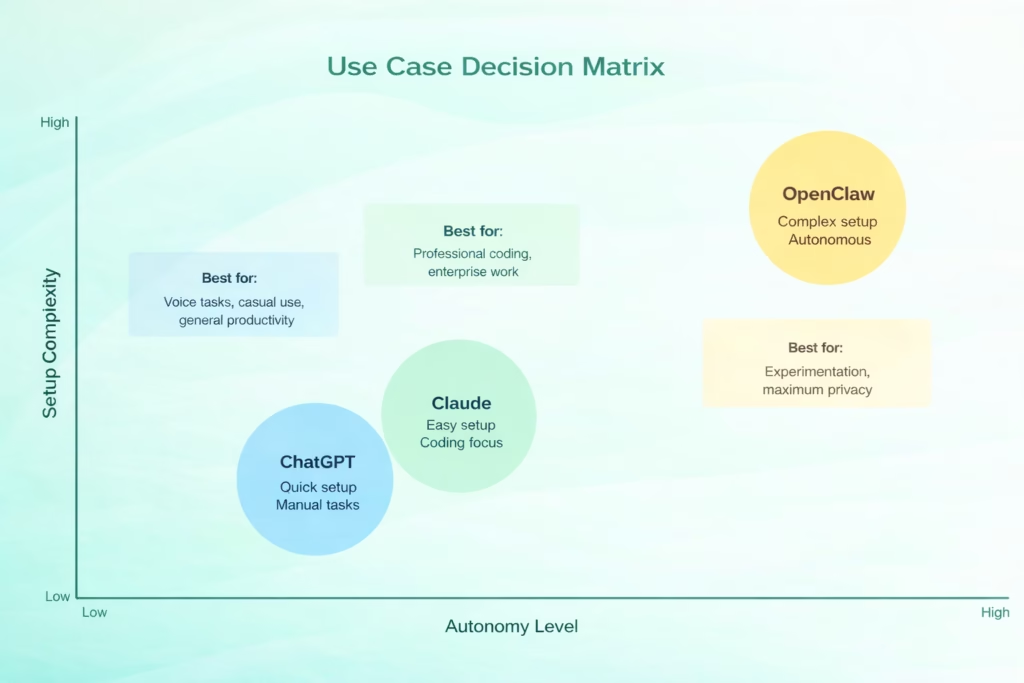
The right platform depends on your tolerance for complexity versus need for autonomous operation.
The Model Choice Affects Everything
Here’s something that doesn’t get talked about enough: with OpenClaw, your experience varies wildly based on which underlying model API you configure it to use.
OpenClaw is framework software. It doesn’t have its own language model. It calls APIs from providers like Anthropic, OpenAI, and others. So when users compare “OpenClaw” to ChatGPT or Claude, they’re actually comparing the framework’s orchestration capabilities, not model quality.
One commenter described it: “OpenClaw is traditional software using OpenAPI, Anthropic Claude APIs… Claude is the tool OpenClaw uses.”
That’s partly true. OpenClaw’s value isn’t in model quality—it’s in autonomous orchestration, memory management, and tool integration. If you configure it to use Claude’s API, you’re getting Claude’s model intelligence plus OpenClaw’s agent capabilities.
But that also means OpenClaw’s performance gains that people discuss aren’t magic—they reflect the underlying configuration, rate limits, and which model tier you’re paying for.
The Cost Nobody Mentions
Let’s talk money. ChatGPT and Claude both cost $20/month for their consumer tiers. Straightforward, predictable.
OpenClaw’s costs are less transparent. Sure, the software is open source and free.
But you’re paying for:
- Cloud server infrastructure (or dedicated hardware like a Mac mini)
- VPN services for secure access
- API calls to whichever LLM provider you’re using
- Your time for setup and maintenance
- Potential security auditing if you’re running this for anything serious
Users in the community have questioned whether the practical benefits justify these additional costs.
What Real Users Actually Say
Community discussions reveal patterns that official marketing doesn’t capture. People switch between tools constantly.
For coding: “I give my first prompts to all of them then who I see is doing the best I stick with it.” This multi-tool approach is common among developers who pay for multiple subscriptions.
- On ChatGPT: Users have diverse opinions about its evolution. Some feel quality remains strong, while others report different experiences with accuracy and performance.
- On Claude’s strengths: Claude ranks highly for coding tasks appears repeatedly. But voice mode receives mixed feedback from users.
- On OpenClaw: Skepticism about marketing claims appears in discussions. But also recognition that autonomous agent concepts represent an interesting direction for AI development.
The truth sits between the hype and the criticism. These tools serve different needs, and the “best” one depends entirely on your workflow.
The Enterprise Perspective
If you’re making decisions for a business rather than personal use, the calculation changes entirely.
Anthropic has strong enterprise adoption reflecting genuine market confidence. Companies prioritize reliability and vendor support over cutting-edge experimental features.
ChatGPT’s broad user base gives it visibility, but enterprise buying often follows different criteria than consumer popularity.
For enterprise deployments, consider:
- Compliance and auditing: Can you demonstrate to regulators how the AI handles data?
- Vendor stability: Will this company exist and support this product in three years?
- Integration capabilities: How does it fit your existing tech stack?
- Support and SLAs: What happens when something breaks?
ChatGPT and Claude offer enterprise plans with proper support. OpenClaw relies on open-source community support, which is appropriate for research but not for production systems handling customer data.
Looking Ahead: Where These Platforms Are Going
The AI landscape shifts fast. What’s true in February 2026 might be outdated by summer.
- ChatGPT continues expanding with tools and expanded capabilities. OpenAI is clearly pushing toward more agentic behaviors while maintaining their polished consumer experience.
- Claude focuses on safety and enterprise trust. Anthropic’s approach to brand protection shows they’re carefully managing how their tools are positioned and used.
- OpenClaw represents experimental territory for autonomous agent research. But the concepts it demonstrates—autonomous agents, self-hosted infrastructure, continuous operation—will influence how AI tools evolve.
Generally speaking, we’re moving toward more agentic AI systems. The question isn’t whether AI will become more autonomous, but how companies balance that autonomy with safety, privacy, and user control.
Practical Recommendations for Different Users
Let me break this down by user type, because your needs determine everything.
For Students and General Users
Go with ChatGPT. The interface is intuitive, voice mode supports multitasking, and it handles the range of tasks you need—writing, research, problem-solving, learning. Claude is also excellent, particularly if you’re taking CS courses and need coding help. But ChatGPT’s ease of use makes it the better starting point.
For Professional Developers
Pay for both Claude and ChatGPT. Use Claude as your primary coding assistant, but keep ChatGPT for documentation writing, explaining code to non-technical stakeholders, and those moments when you want a different approach. The $40/month combined cost is modest compared to the productivity insights gained.
Skip OpenClaw unless you’re specifically researching agent frameworks. It won’t make you more productive in daily development work.
For Enterprise Teams
Start with Claude. Anthropic’s enterprise focus, safety record, and robust API make it a strong choice for production deployments. Evaluate ChatGPT for specific use cases where its strengths align with your needs.
Avoid OpenClaw for production entirely. If you want to explore agentic AI concepts, do it in a properly sandboxed environment separate from business systems.
For AI Researchers and Tinkerers
OpenClaw is educational if you accept it as an experimental framework, not a production tool. Set it up in a properly secured environment, treat it as a learning experience, and don’t connect it to critical systems.
But also maintain ChatGPT and Claude subscriptions for actual work. OpenClaw teaches you about agent architectures, but you’ll need reliable tools for daily use.
| User Type | Primary Tool | Secondary Tool | Skip |
|---|---|---|---|
| Students | ChatGPT | Claude (for coding classes) | OpenClaw |
| Developers | Claude | ChatGPT | OpenClaw (unless researching) |
| Enterprise | Claude | ChatGPT (specific use cases) | OpenClaw |
| Researchers | Claude/ChatGPT | OpenClaw (experimental only) | — |
| Content Creators | ChatGPT | Claude (technical content) | OpenClaw |
| Data Scientists | Claude | ChatGPT | OpenClaw |
The Bottom Line
So which AI should you use? Here’s my honest assessment based on how these platforms actually work and how real people use them.
- ChatGPT is the best all-arounder for most people. It’s incredibly easy to use, the voice mode is well-regarded, and it handles the wide range of tasks that normal humans actually do with AI. If you’re only going to pay for one subscription, this is probably the practical choice.
- Claude is the professional’s choice for coding and enterprise work. If software development is a core part of your job, Claude’s approach to code development justifies the cost. Anthropic’s safety-first approach also makes it the logical choice for businesses deploying AI in production.
- OpenClaw is an experiment, not a solution. It demonstrates where autonomous AI agents might go, but it’s not ready for daily use by most users. The setup is complex, the security concerns are real, and the practical benefits don’t currently outweigh the additional effort. If you’re fascinated by agent architecture and have time to tinker, it’s educational. Otherwise, stick with established tools.
But here’s what matters most: you don’t have to choose just one. Developers successfully use both ChatGPT and Claude, switching based on the task. Students might use ChatGPT for most things but leverage Claude for coding assignments. Enterprise teams can deploy Claude for coding while using ChatGPT for customer service.
The AI landscape in 2026 isn’t about finding the single “best” tool. It’s about understanding what each platform does well and using the right tool for the job. ChatGPT for voice and ease. Claude for code and safety. OpenClaw for learning about autonomous agents.
Start with what works easily. Expand when your needs demand it. And focus on your actual workflow rather than following hype. Use what makes you productive, ignore what doesn’t, and remember that these tools are here to serve your goals, not the other way around.
Ready to try them out? Pick the platform that matches your primary use case, give it a real test for a week, and see how it fits your workflow. That hands-on experience will teach you more than any comparison article ever could.
Frequently Asked Questions
Not inherently. OpenClaw is framework software that calls external LLM APIs—it doesn’t have its own language model. If you configure OpenClaw to use Claude’s API, you’re getting Claude’s coding ability plus OpenClaw’s agent orchestration. The framework itself doesn’t improve code quality; it enables more autonomous, multi-step workflows. For straightforward coding tasks, Claude or ChatGPT’s coding capabilities will be simpler and more reliable.
Realistically, no. Setting up OpenClaw requires managing cloud infrastructure, VPN networking, OAuth integrations, and API configurations. Users report spending hours to days getting it working. If you’re not comfortable with command-line tools and server administration, stick with ChatGPT or Claude—they work immediately with minimal setup.
None of them are perfectly reliable for fact-checking. Users report accuracy concerns with various platforms, and all large language models can generate plausible but incorrect information. For research, use AI as a starting point but verify claims through primary sources. Claude tends to be more careful about expressing uncertainty, while other platforms sometimes present uncertain information more confidently.
If you code professionally, the value depends on your specific needs. Community discussions show developers have varied experiences with different tools for different tasks. Choose based on your primary use case—coding work where code quality is critical may benefit from trying Claude, while general use and voice interaction favor ChatGPT.
Anthropic took brand protection measures regarding OpenClaw, likely due to security and brand association concerns. The company’s focus on safety and reliability means carefully managing which projects receive their backing. OpenClaw’s creator subsequently joined OpenAI. The consensus in discussions is that brand protection decisions reflect reasonable concern about safety and positioning.
Only OpenClaw is designed for autonomous operation—it runs continuously and can execute multi-step tasks without constant human input. ChatGPT and Claude operate on a request-response model where you give them a task, they complete it, and wait for your next instruction. However, both ChatGPT and Claude are expanding with features that move toward more agentic behaviors, though integrated with their respective safety approaches.
OpenClaw offers maximum privacy since it runs on your own infrastructure, meaning your data doesn’t pass through external company servers (except for API calls). However, you’re responsible for security implementation. Between ChatGPT and Claude, both have enterprise-grade security approaches. Anthropic’s focus on safety and their strong enterprise position suggests they place high priority on data handling. For most users, Claude offers a practical combination of security and convenience, while OpenClaw requires you to handle all security responsibilities.