
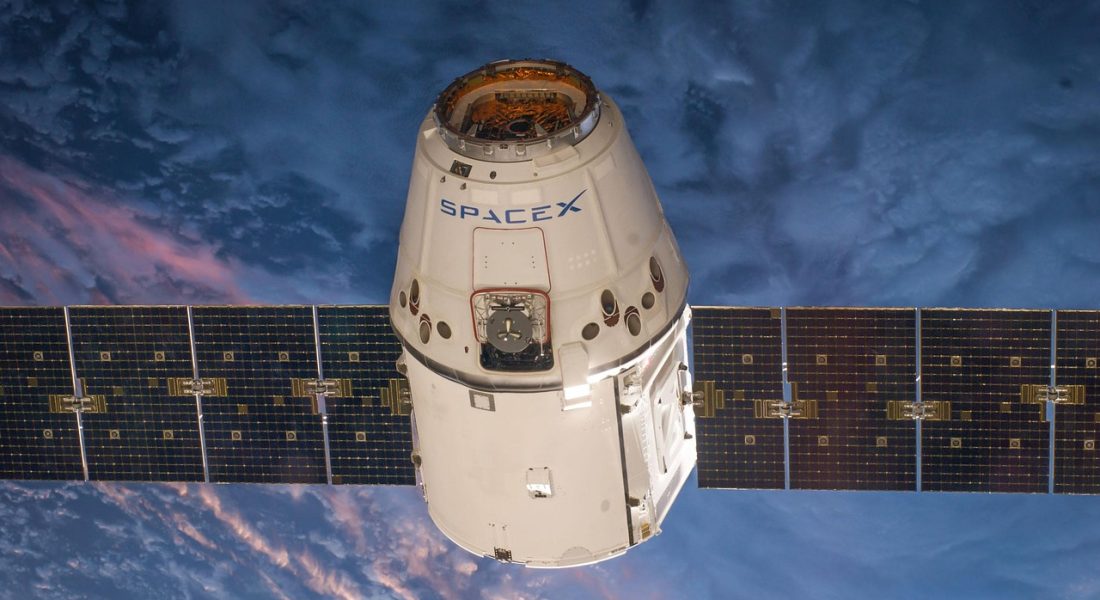
If you have ever seen a neat line of lights quietly sliding across the night sky, chances are it was Starlink. The tricky part is timing. Starlink satellites do not show up at the same hour every night, and they are easy to miss if you are not looking at the right moment. Let’s break down how to figure out when they will be visible tonight and what actually affects those times.
Starlink satellites are usually visible shortly after sunset or just before sunrise. That is when the sky is dark enough, but the satellites are still catching sunlight and reflecting it back toward Earth. On most nights, the best window is somewhere between 30 and 90 minutes after sunset, though early morning passes can happen too, especially in certain seasons.
To get an accurate time for tonight, it is best to check a live tracker rather than guessing. Tools like Heavens-Above or Find Starlink let you enter your city and will show you exact pass times, directions in the sky, and how bright the satellites should be. That last part is important because not every pass is equally visible. Some are faint and easy to overlook, especially near city lights.

How We Use FlyPix AI to Add Context to Starlink Visibility
When people ask what time Starlink satellites are visible tonight, they usually focus on the timing, but at FlyPix AI, we know that timing is only one part of the bigger picture. We leverage our geospatial AI platform to provide a broader spatial context to what’s happening above Earth. Since Starlink satellites rely on sunlight reflection and their orbital paths, satellite imagery and geospatial data play a quiet but important role in analyzing and explaining visibility patterns.
At FlyPix AI, we process satellite and aerial imagery to examine spatial movements, coverage areas, and changes over time. While our platform isn’t a dedicated Starlink tracker, it excels in the kind of geospatial analysis that supports satellite visibility research. By analyzing satellite imagery, surface conditions, and spatial relationships, we make it easier to explain why satellites are more visible in certain regions, seasons, or conditions than others. This adds real depth to timing-based guides, grounding them in actual geospatial data rather than guesswork.
Our platform becomes especially useful when the focus shifts from a single night’s viewing to broader patterns across locations and time periods. Understanding how satellite paths interact with Earth’s surface, lighting conditions, and observation points allows us to connect simple timing tools with real-world geospatial behavior. That combination is what turns a basic question about tonight into a clearer, more comprehensive understanding of how satellite visibility truly works.
Why Starlink Satellites Are Only Visible at Certain Times
Starlink satellites do not produce their own light, which is one of the most important things to understand. What you see from the ground is sunlight reflecting off the satellite as it moves through orbit. If the satellite is not illuminated by the Sun, it will be invisible no matter how clear the sky is.
This creates a narrow viewing window where the ground is already dark but the satellite is still catching sunlight. That overlap usually happens shortly after sunset or shortly before sunrise. Outside of those times, the satellite is often flying through Earth’s shadow and cannot be seen. Because this balance shifts daily, Starlink visibility changes from night to night. That is why checking a tracker is more reliable than assuming the satellites will appear at the same time as before.
Typical Time Windows for Seeing Starlink Tonight
Although exact times depend on location, Starlink satellites usually appear within predictable ranges. Most visible passes happen between 30 and 90 minutes after local sunset. In some cases, especially in certain seasons or latitudes, satellites can also be visible before sunrise.
Even within those windows, not every pass is equally visible. Some passes are low on the horizon, faint, or very brief, which makes them easy to miss. Others pass nearly overhead and remain visible for several minutes. The key takeaway is that Starlink does not have one universal viewing time. Tonight’s best moment depends entirely on your location and the satellite’s specific orbit.
How Your Location Changes the Viewing Time
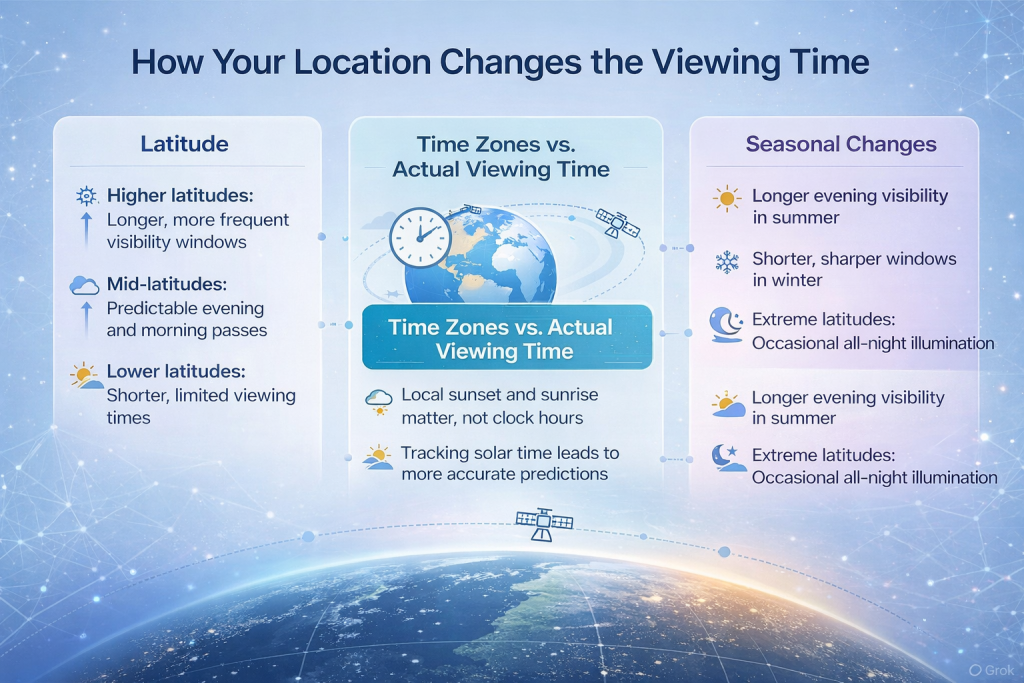
Where you are standing on Earth has a bigger impact on Starlink visibility than most people expect. Even on the same night, two observers can have completely different viewing windows simply because they live in different places. Understanding how location affects timing makes it much easier to predict when it is actually worth going outside.
Starlink satellites follow fixed orbital paths, but the way sunlight hits them changes constantly. Your position relative to the Sun and Earth determines whether those satellites are lit up enough to be seen. This is why location matters more than any single published time.
Latitude and Why North or South Matters
Latitude is one of the strongest factors influencing when Starlink satellites are visible. It affects how long satellites remain illuminated after sunset and before sunrise. The farther north or south you are, the more dramatic this effect becomes.
At higher latitudes, twilight lasts longer, which means satellites can stay sunlit well after the sky appears dark. This often results in longer viewing windows and sometimes multiple visible passes in one night. In lower latitudes, twilight is shorter, which limits how long satellites remain visible.
Here is how latitude typically affects viewing:
- Higher latitudes often have longer and more frequent visibility windows
- Mid-latitudes usually have predictable evening and morning passes
- Lower latitudes tend to have shorter and more limited viewing times
This is why people in northern regions often report easier sightings during certain seasons, while others struggle to see anything at all.
Time Zones vs Actual Viewing Time
Time zones can be misleading when it comes to satellite visibility. Two people in the same time zone might expect to see Starlink at the same hour, but that rarely happens in practice. The reason is that satellites do not care about clock time.
What really matters is local sunset and sunrise. These events can occur at different times within the same time zone, especially across wide regions. A city on the eastern edge of a time zone may reach sunset much earlier than one on the western edge.
Because of this, relying on clock time alone often leads to missed sightings. Tracking tools that adjust for local solar time provide far more accurate predictions.
Seasonal Changes and the Length of Twilight
Seasons quietly shape Starlink visibility in ways that are easy to overlook. As Earth tilts toward or away from the Sun, the length of twilight changes. This directly affects how long satellites remain visible.
During summer months, twilight lasts longer, especially in higher latitudes. Satellites may remain sunlit late into the night, increasing viewing opportunities. In winter, twilight is shorter, and satellites may pass into Earth’s shadow more quickly.
Seasonal effects can lead to noticeable differences such as:
- Longer evening visibility in summer
- Shorter and sharper viewing windows in winter
- Occasional all-night illumination in extreme latitudes
These shifts explain why Starlink sightings can feel abundant one month and rare the next.
What Makes a Starlink Pass Worth Watching
Not every Starlink pass is visually impressive. Some passes are technically visible but too faint to stand out against city lights or light pollution. Others happen so low in the sky that buildings or trees block the view.
The most noticeable passes usually share a few qualities. They pass high overhead, reflect a good amount of sunlight, and move smoothly across the sky for more than a few seconds. These are the passes that catch people’s attention and lead to viral videos. Most tracking tools rate passes by brightness or visibility, which helps set expectations before you step outside.
The Starlink Satellite Train and Why Launch Timing Matters
The famous Starlink satellite train appears shortly after a launch. During this phase, satellites travel in a tight line, evenly spaced, and often much brighter than older satellites. This formation can last for several days before the satellites spread out.
As satellites climb to their operational orbit around 340 miles or 550 kilometers above Earth, they separate and become harder to distinguish individually. Once dispersed, they no longer appear as a clean line and are easier to overlook. If you are hoping to see a satellite train tonight, checking whether there was a recent Starlink launch is essential. Without a recent launch, sightings tend to be subtler.
How to Find the Exact Time for Starlink Tonight
Finding the exact time Starlink satellites will be visible tonight is not something you can do by guessing or relying on yesterday’s experience. Their visibility depends on live orbital data that changes constantly, sometimes even within the same evening. The good news is that modern tracking tools make this process straightforward once you know how to use them properly.
Instead of thinking in terms of fixed schedules, it helps to think in terms of nightly opportunities. Each night has its own set of possible passes, and only some of them are worth stepping outside for. Tracking tools exist to help you identify those moments with precision.
What Good Starlink Trackers Actually Show
Not all tracking tools are equally useful, but the good ones all provide the same core information. Understanding what each data point means helps you decide whether a pass is worth your time. Once you know what to look for, the apps become much easier to use.
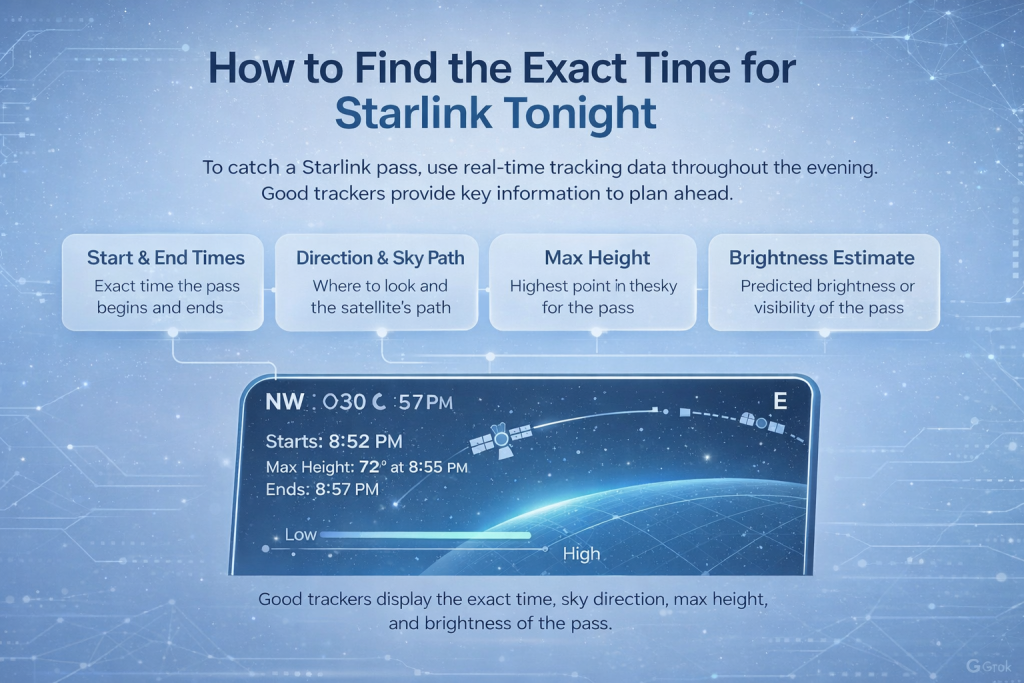
Most reliable trackers will show:
- The exact start and end time of the satellite pass
- The direction where the satellite first appears
- The maximum height of the satellite in the sky
- An estimate of brightness or visibility quality
This information allows you to prepare in advance instead of reacting at the last second. It also helps you avoid watching the wrong part of the sky.
Start and End Times Explained
The start time marks when the satellite first becomes visible above the horizon. This does not always mean it will be easy to see right away, especially if it starts low in the sky. The satellite often becomes more noticeable as it climbs higher.
The end time marks when the satellite either enters Earth’s shadow or drops below the horizon. Once that happens, it disappears quickly. These passes are often shorter than people expect, sometimes lasting only a few minutes. Understanding this window helps you avoid stepping outside too late. Being even two minutes late can mean missing the entire pass.
Direction and Sky Path Matter More Than You Think
Knowing the time is only half the job. Knowing where to look is just as important, especially for first-time viewers. Starlink satellites rarely pass directly overhead unless the tracker specifically says so.
Trackers usually describe direction using compass points like northwest or southeast. Some apps also show a live arrow or sky map to guide your view. Following these directions closely saves you from scanning the entire sky aimlessly. Low-elevation passes near the horizon are especially easy to miss. Paying attention to direction makes these passes far more manageable.
Planning Ahead With Websites
Using websites to plan Starlink viewing is a good option if you like to see the bigger picture before stepping outside. These tools are especially useful when you want to know whether tonight is worth the effort or if a better opportunity is coming up tomorrow or later in the week. Websites focus on advance planning rather than real-time chasing, which makes them ideal for people who prefer preparation over spontaneity.
Unlike mobile apps that are built for quick checks, websites tend to offer more context. You can see how passes change over several days and understand patterns that are easy to miss when you only look at one night at a time.
What Starlink Tracking Websites Are Best At
Web-based trackers shine when it comes to long-range visibility planning. They let you step back and look at multiple upcoming passes instead of focusing on a single moment. This helps you decide when to set aside time rather than reacting last minute.
Most Starlink tracking websites offer:
- Multi-day or week-long pass predictions
- Exact start and end times for each pass
- Brightness or visibility ratings
- Ground track maps showing satellite paths
- Elevation and direction details
This kind of overview is especially helpful if you want to plan photography or coordinate viewing with other people.
Seeing Satellite Paths Before You Go Outside
One major advantage of websites is their visual satellite path maps. These maps show how a Starlink satellite or group moves across the sky relative to your location. For many people, this is easier to understand than compass directions alone.
By studying the path in advance, you can decide where to stand and which part of the sky deserves your attention. This reduces confusion and prevents frantic scanning when the pass begins.
Why Sky Path Maps Matter
Sky path visuals help with:
- Understanding where the satellite will rise and set
- Estimating how high it will get above the horizon
- Planning clear lines of sight around buildings or trees
- Choosing the best camera angle for photos
For anyone who has ever watched the wrong section of sky, these maps quickly prove their value.
What Starlink Satellites Look Like in the Sky
Starlink satellites move smoothly and steadily across the sky. They do not blink or change color like aircraft, and they do not drift slowly like stars. Their motion is consistent and directional.
Once you spot one satellite, it becomes easier to recognize others. During group passes, several satellites may follow the same path within seconds of each other. This is especially common after recent launches. If you see a straight line of lights moving together, you are almost certainly watching Starlink.
Best Conditions for Watching Starlink Tonight
Clear skies help, but viewing conditions involve more than weather. Light pollution can wash out faint satellites, even during a good pass. Finding a darker area significantly improves visibility.
Allowing your eyes a few minutes to adjust to the dark also makes a noticeable difference. Reducing phone brightness and avoiding direct light sources helps maintain night vision. Starlink viewing does not require binoculars or telescopes, and naked-eye observation is usually best.
Common Reasons People Miss Starlink Passes
Many people miss Starlink even when conditions are good. Timing errors are the most common cause, especially stepping outside too late. Directional mistakes also happen when people look straight overhead instead of toward the listed horizon.
Another issue is expecting the satellites to be brighter than predicted. Some passes are subtle and require focused watching. Confusing planes or distant stars for satellites can also lead to missed sightings. Using pass details carefully reduces most of these problems.
How Launch Schedules Affect Visibility
Starlink visibility changes dramatically depending on how recently satellites were launched. This is one of the most overlooked factors, yet it explains why some nights feel spectacular while others feel disappointing even when conditions seem similar. Launch timing directly affects brightness, grouping, and how noticeable the satellites are to the naked eye.
Understanding launch schedules helps you move from random watching to intentional viewing. Instead of hoping tonight will be good, you can predict when the odds are clearly in your favor.
Why Newly Launched Starlink Satellites Are Easier to See
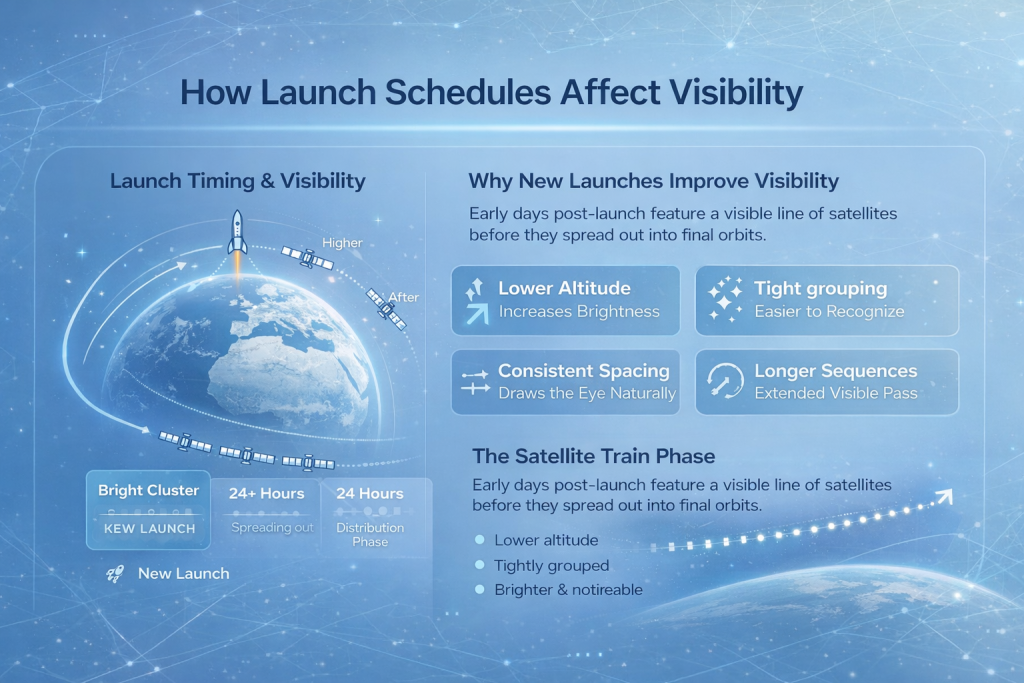
When Starlink satellites are first deployed, they behave very differently from older ones already settled into orbit. Fresh satellites travel close together at lower altitudes, which makes them reflect more sunlight toward Earth. This combination makes them brighter and far more noticeable.
In the days immediately after launch, satellites appear in a tight formation that moves smoothly across the sky. This is what creates the well-known satellite train effect that people often record and share online. Over time, this visual impact fades as satellites spread out.
Key reasons new launches improve visibility include:
- Lower initial altitude increases brightness
- Tight grouping makes motion easier to recognize
- Consistent spacing draws the eye naturally
- Longer visible sequences compared to single satellites
These factors turn an ordinary pass into something that feels intentional and impressive.
The Satellite Train Phase Explained
The satellite train is a temporary phase, not a permanent feature. After launch, all satellites from a batch follow the same orbital path for several days. During this time, they appear as a straight line of evenly spaced lights.
This phase usually lasts anywhere from a few days to a couple of weeks. As each satellite gradually raises its orbit, the line breaks apart and the satellites become independent points of light. Once this happens, sightings become subtler and easier to miss.
What the Train Phase Looks Like in Practice
During the train phase, you might notice:
- A long line of lights moving at the same speed
- No blinking or flashing
- A steady direction across the sky
- Multiple satellites passing within seconds of each other
This is the stage that often leads people to mistake Starlink for UFOs, especially if they are seeing it for the first time.
Final Thoughts
Seeing Starlink satellites is about preparation, not chance. Understanding why they appear at certain times removes most of the mystery. Once you know how to check visibility properly, the experience becomes predictable and enjoyable.
If tonight does not deliver, another opportunity is never far away. With the right timing and a bit of patience, the satellites will eventually put on a show worth watching.
FAQ
Starlink satellites are most often visible shortly after sunset or shortly before sunrise. This is when the sky is dark enough for you to see them, but the satellites are still reflecting sunlight. The exact time depends on your location, so checking a tracker is always more accurate than relying on general estimates.
This usually comes down to lighting conditions and launch timing. On some nights, satellites pass through Earth’s shadow and reflect almost no light, even though they are overhead. Visibility also drops significantly once satellites spread out after launch, which makes sightings more subtle and easier to miss.
No, they do not follow a fixed nightly schedule from a viewer’s perspective. Their orbits shift slightly relative to sunset and sunrise, which changes when they are illuminated. This is why a time that worked yesterday might not work tonight.
Most visible passes last only a few minutes. The satellite usually appears low on the horizon, climbs higher where it is easier to see, and then fades as it enters Earth’s shadow. Being outside a little early helps make sure you catch the full pass.