
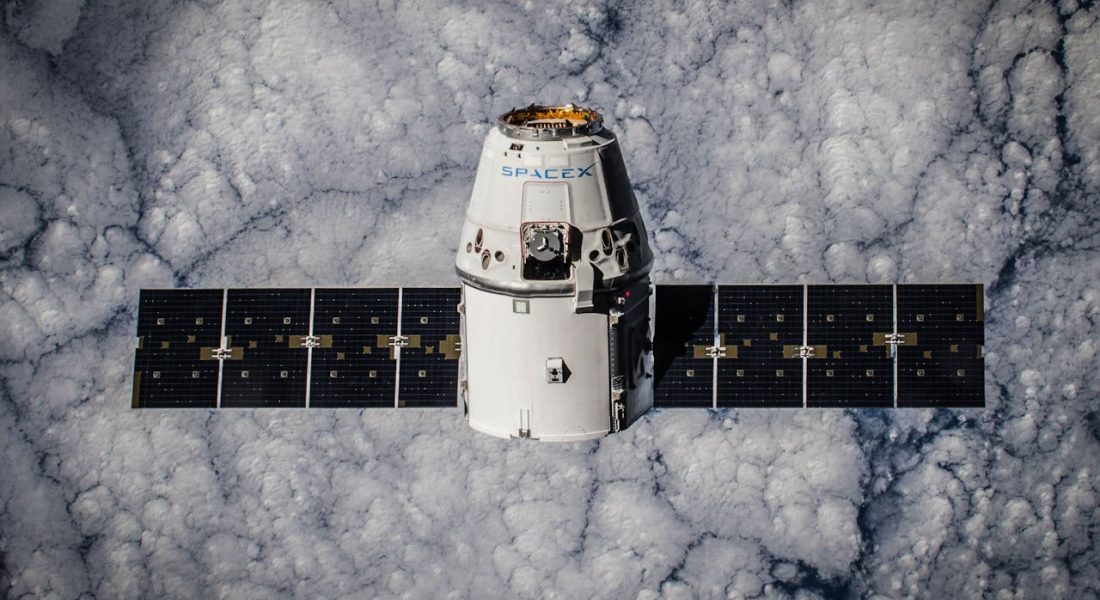
Starlink isn’t just some abstract tech project anymore – it’s a real, growing network of satellites that you can see in the night sky and use to stream a Zoom call from the middle of nowhere. But just how many of these satellites are actually up there? The answer keeps changing, and fast.
SpaceX has been launching them in batches, almost nonstop, to build out what’s known as a “megaconstellation.” It’s a big word for a bigger ambition: global internet from space. In this article, we’ll break down the current satellite count, why it matters, and what’s coming next in Starlink’s massive expansion.
The Short Answer: How Many Starlink Satellites Are There?
As of late December 2025, there are over 9,350 Starlink satellites in orbit. Out of those, around 9,347 are actively functioning. These numbers are tracked and updated by independent astronomers, including Jonathan McDowell, who maintains a live catalog of the constellation. This makes Starlink the largest satellite network in history, by a long shot.
For context, there have only been about 14,000 total satellites ever launched into space since Sputnik. Starlink now makes up more than half of all operational satellites circling Earth.
Why So Many? The Logic Behind the Numbers
Starlink isn’t using one or two big satellites sitting far out in space. Instead, it operates thousands of small ones in low Earth orbit (LEO), usually around 550 kilometers above the surface.
The reason is latency and coverage:
- Traditional satellite internet uses geostationary satellites at 35,786 km altitude.
- These cause major delays in data transmission – latency is usually 600 milliseconds or more.
- Starlink’s LEO network keeps latency down to around 25 milliseconds, which is comparable to fiber in many places.
To make that work, Starlink needs thousands of satellites flying in synchronized orbits to ensure every region has near-constant coverage, even as satellites move rapidly overhead.
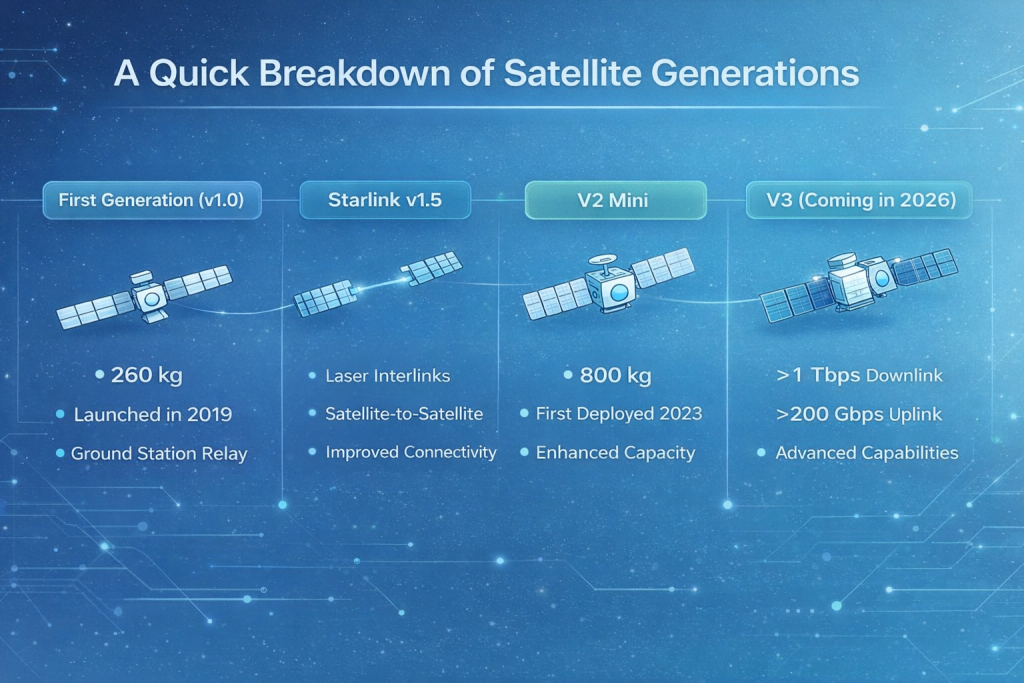
A Quick Breakdown of Satellite Generations
Not all Starlink satellites are built the same. SpaceX has gone through several design iterations as the network has expanded.
Here’s how it breaks down:
- First Generation (v1.0): These launched in bulk starting in 2019. Each satellite weighed around 260 kg and relied on ground stations for signal relay.
- Starlink v1.5: Introduced laser interlinks so satellites could talk to each other directly in space.
- V2 Mini: First deployed in 2023, these satellites are much heavier (around 800 kg) and have more capacity. They include upgraded antennas, new propulsion systems, and higher data throughput.
- V3 (Coming in 2026): Expected to be even more powerful, with each satellite capable of over 1 Tbps downlink and 200 Gbps uplink.
The Pace of Launches: How Did We Get to 9,000+?
The pace at which SpaceX has launched Starlink satellites is unlike anything the space industry has seen before.
- In 2023 alone, SpaceX launched over 60 missions dedicated to Starlink.
- By 2025, they were launching more than 2,300 satellites per year.
- Each week, the network gains roughly 5 Tbps of new capacity, according to internal Starlink data.
No other satellite operator comes close to this cadence. And that’s partly because SpaceX controls both the satellite manufacturing and the launch vehicles. When your factory and rocket company are the same, you can iterate quickly.
Where Are These Satellites?
Starlink’s constellation isn’t randomly scattered. The satellites are arranged in carefully designed orbital “shells” to provide overlapping coverage across the globe.
Some key points:
- Most satellites orbit at about 550 km altitude.
- Some newer launches go into polar orbits to improve coverage in Alaska, the Arctic, and Antarctic regions.
- Each satellite can communicate with others using optical (laser) links, forming a mesh network in space.
- More than 100 ground gateway stations in the U.S. support uplink/downlink functions.
This design allows Starlink to reroute data dynamically. Even if one region experiences a ground outage (like a storm or power cut), satellites can bypass that node and deliver service through another pathway.
Why the Number Keeps Changing
The Starlink network is constantly in motion – not just literally, but in terms of its composition. Satellites have a lifespan of around five years, after which they’re actively deorbited and replaced with newer models. That means two things.
The total number will keep growing, possibly toward the 42,000 total SpaceX has permission to launch. Older satellites will phase out, especially as V2 and V3 designs take over.
SpaceX refreshes the constellation in real-time. Satellites that are degraded or no longer useful are intentionally steered into Earth’s atmosphere where they burn up. This keeps the network efficient and helps limit long-term space debris.
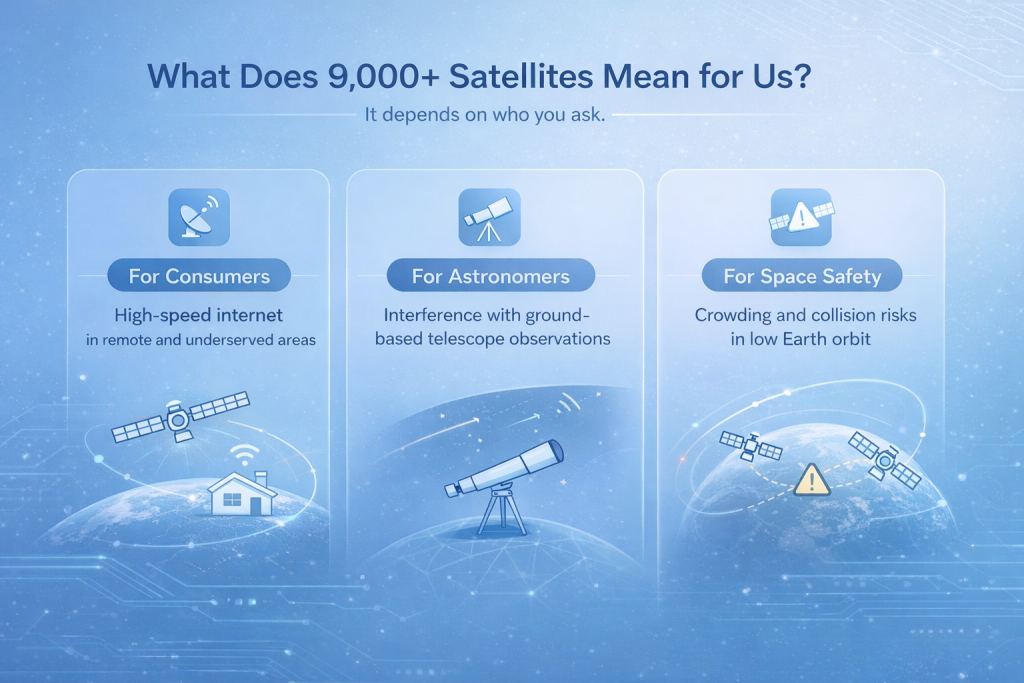
What Does 9,000+ Satellites Mean for Us?
It depends on who you ask.
For Consumers
Starlink has made high-speed internet available in places that never had access to fiber or even reliable 4G. In many areas, users are seeing download speeds between 100 and 200 Mbps, with solid performance even during peak hours. One of the most meaningful benefits, though, is how dependable it is in remote or disrupted environments. Whether it’s a rural property or a disaster zone, Starlink can keep people connected when traditional infrastructure fails.
For Astronomers
The growth of the Starlink network has created a real challenge for astronomers. The satellites are bright enough to be seen with the naked eye, especially shortly after they’re launched, which might be neat for casual observers but frustrating for those trying to study the sky. Long-exposure images taken through powerful ground-based telescopes often show streaks left by passing satellites. That kind of interference can ruin data. And it’s not just visible light – radio astronomers are also running into trouble, since Starlink’s signals sometimes cross into sensitive frequency bands used for deep space observation.
For Space Safety
There’s also a growing concern about how crowded low Earth orbit is becoming. Starlink satellites are regularly involved in potential collision scenarios – about 1,600 close approaches per week, where two objects pass within a kilometer of each other. Agencies like the European Space Agency have already had to maneuver their satellites out of the way. As the number of satellites climbs, managing these risks is becoming more complex and more urgent.
SpaceX does share tracking data and has improved its coordination tools, but the sheer volume of Starlink hardware makes this a complex and ongoing issue.
A Look Ahead: Where the Numbers Are Going
SpaceX isn’t slowing down. Not even close.Here’s what’s coming next:
- V3 satellites with up to 10x more capacity per satellite.
- Global cellular coverage via a partnership with T-Mobile, using Starlink for direct-to-phone service in areas with no cell towers.
- Regulatory filings for as many as 30,000 more satellites in addition to the 12,000 already approved by the FCC.
In other words, we may be looking at tens of thousands of satellites in orbit over the next decade, many of them operated by Starlink.
Satellite Count by the Numbers (as of December 2025)
Here’s a quick overview for easy reference:
- Total Starlink satellites launched: ~9,357
- Currently operational: ~9,347
- New satellites added in 2025 alone: 2,300+
- Weekly capacity growth: 5+ Tbps
- Approved limit: 12,000 (with applications for 30,000 more)

How We Use Starlink Satellite Data at FlyPix AI
At FlyPix AI, we work directly with satellite, aerial, and drone imagery to help people make sense of what they see from the sky. When there are thousands of Starlink satellites moving over Earth, it means there’s more coverage, more images, and more frequent data updates. For us, that opens up new opportunities to detect, monitor, and analyze what’s happening on the ground faster than ever.
Our platform uses AI agents to process this incoming imagery at scale. Whether it’s land-use classification, infrastructure monitoring, or vegetation change detection, we’re focused on turning raw visual data into decisions. And because Starlink reduces latency and improves the speed at which data can be delivered from orbit, it shortens the time between when an image is captured and when our clients can act on it.
We’ve seen firsthand how important satellite connectivity has become, especially when you’re trying to operate in remote locations or during emergencies. Having constant, low-latency access to updated geospatial data is the backbone of what we do, and Starlink’s growing network is a key part of that equation.
Final Thoughts
The scale of Starlink’s satellite network is staggering and growing by the week. Whether you’re a user thrilled with your new high-speed connection in the middle of nowhere, or a scientist trying to preserve a clear view of the night sky, the number of Starlink satellites matters.
It’s not just a number. It reflects the direction space-based infrastructure is heading: faster, denser, and more ever-present. And as long as SpaceX keeps building, launching, and replacing these satellites at the current rate, it’s a number we’ll all be watching.
FAQ
As of December 2025, there are just over 9,350 Starlink satellites in orbit, with about 9,347 of them active. That number can change by the week, depending on new launches and old satellites being retired.
Not exactly. SpaceX has FCC approval for 12,000 satellites and has applied to launch up to 30,000 more. They’re scaling based on demand and performance, so we’re likely to see many more in the sky over the next few years.
Yes, especially right after a new launch. They look like a string of bright dots moving in a line. Over time, they spread out and become harder to spot with the naked eye, but they’re still up there doing their thing.
Not anymore. The network has gone through a few hardware upgrades already. The newer V2 mini satellites are heavier, faster, and more capable than the early models, and a third generation is set to launch soon.
They can, yes. Astronomers have raised valid concerns about light pollution and radio interference. SpaceX has made efforts to reduce the brightness of newer satellites, but it’s still a point of tension in the scientific community.
They don’t just float around forever. When a Starlink satellite reaches the end of its life, it’s deorbited and burns up in Earth’s atmosphere. That said, there are still debates about how much atmospheric pollution that process might cause long term.
Because we work with satellite imagery every day. The more satellites in orbit, the more visual data we can use to train AI, track changes, and deliver results quickly to our clients. Fast, consistent coverage helps us turn raw images into insights without the long wait.