

Artificial intelligence becomes truly useful when it can understand the world as it is, not just as numbers or text. That’s where image recognition comes in. It gives AI the ability to see, interpret, and act on visual information, turning raw pixels into meaning. Without it, many of the AI systems we rely on today would simply not work.
Image recognition isn’t a niche feature or a nice-to-have add-on. It’s one of the core functions that allows AI to move beyond data analysis and into real-world applications, from everyday consumer products to complex industrial systems.
From Data Processing to Perception
Early AI systems were built to process structured data. Numbers, rules, and predefined logic were their comfort zone. If information could not be neatly organized into tables or coded rules, those systems struggled. Images did not fit that mold. A single photo contains millions of pixels, each carrying subtle information about color, texture, shape, lighting, and context.
For a long time, computers could store images but not understand them. They treated images as files, not as representations of reality. Image recognition changed that. It introduced methods that allow AI systems to interpret visual data in a way that is closer to human perception.
This shift matters because perception is the first step toward intelligent behavior. Humans look at the world, recognize what is present, and then decide how to act. AI follows the same logic. Without the ability to recognize objects, patterns, and anomalies in images, higher-level reasoning and decision-making simply cannot happen.
What Image Recognition Enables AI to Do
- Move beyond structured data and interpret real-world visual information
- Identify objects, patterns, and anomalies within complex images
- Convert raw pixels into labels, locations, and meaningful categories
- Understand relationships between visual elements, not just individual features
- Support decision-making by turning visual input into measurable data
Image recognition turns vision into data that AI can use. Once pixels are translated into structured information, AI systems can measure, compare, predict, and optimize based on what they see. This is what allows AI to operate in dynamic, real-world environments rather than remaining confined to static datasets.
Why Visual Understanding Matters More Than Ever
Modern industries generate enormous amounts of visual data. Cameras are everywhere, in smartphones, drones, factories, vehicles, retail stores, hospitals, and public spaces. Satellite imagery and aerial photography capture entire cities and landscapes daily. Video feeds monitor production lines, traffic, shelves, and infrastructure.
All of this visual information is valuable, but only if it can be interpreted at scale. Humans cannot manually review millions of images or hours of video without delays, errors, and fatigue. Image recognition allows AI to step in where human attention becomes a bottleneck.
What makes image recognition especially powerful is speed. AI systems can analyze visual data in seconds, often in real time. They do not get tired, distracted, or inconsistent. When trained properly, they apply the same criteria to every image, every time.
This consistency is critical in environments where small visual differences can have large consequences. A missing product on a shelf, a crack in infrastructure, a medical anomaly in a scan, or an obstacle on a road can all trigger significant outcomes. Image recognition helps AI notice these details reliably and at scale.
How Image Recognition Actually Works
Image Preparation and Preprocessing
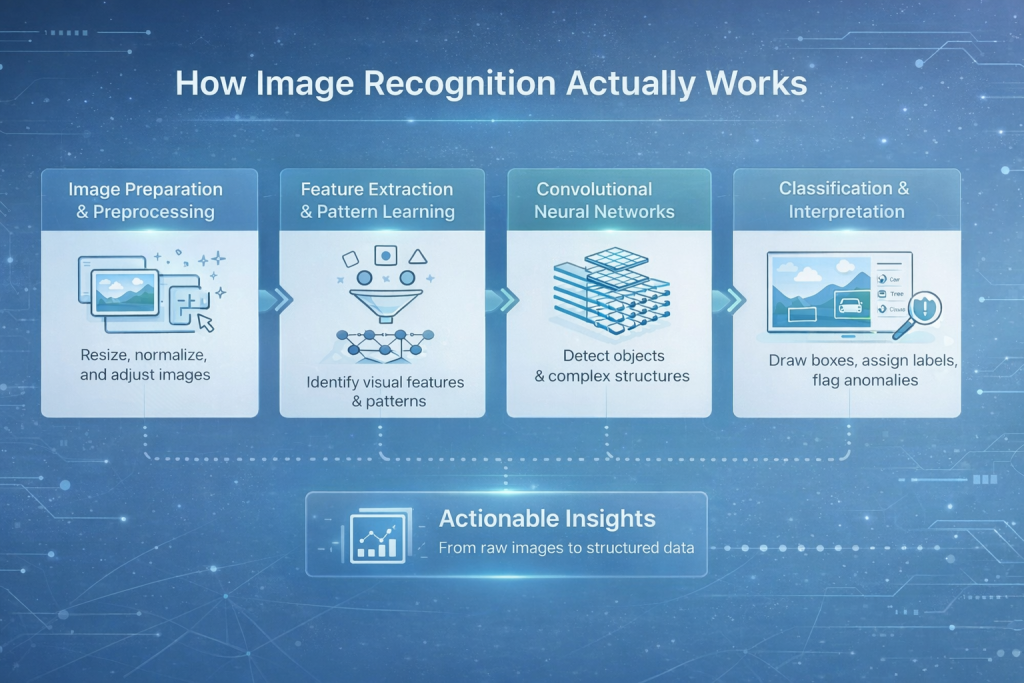
At a high level, image recognition follows a clear process. It begins with preparing images so AI models can analyze them effectively. This preprocessing stage may include resizing, normalization, or adjustments that reduce noise and visual inconsistencies. The goal is simple: present images in a consistent format that the system can learn from without being distracted by irrelevant variation.
Feature Extraction and Pattern Learning
Once images are prepared, the AI moves on to feature extraction. This is where meaningful visual patterns are identified. Early image recognition systems relied on manually defined features such as edges, corners, or color contrasts. Modern systems take a very different approach. Deep learning models learn these features automatically by analyzing large volumes of images. They start with basic visual cues and gradually build an understanding of more complex structures.
The Role of Convolutional Neural Networks
Convolutional neural networks play a central role in modern image recognition. These models process images layer by layer, with each layer focusing on different visual characteristics. Early layers tend to detect simple elements like lines, edges, or textures. As the data moves deeper through the network, later layers begin to recognize shapes, objects, and even relationships between elements within the image.
Classification, Detection, and Interpretation
The final step is classification or detection. The features extracted by the model are used to determine what the image contains. The system may assign labels, draw bounding boxes around objects, segment specific regions, or flag anomalies that require attention. At this point, the image is no longer just a picture. It has been converted into structured, actionable data.
From Raw Images to Actionable Insights
The key point is that image recognition is not a single step. It is a pipeline that transforms raw visual input into structured insights. Each stage builds on the previous one, allowing AI systems to move from pixels to patterns and ultimately to decisions that support real-world actions.

Image Recognition in Action With FlyPix AI
At FlyPix AI, image recognition is not just a technical feature for us. It is the core of how we help teams understand what is happening on the ground, at scale, and in real time. We built our platform to turn satellite, aerial, and drone imagery into clear, actionable insights without the long setup times or manual work that usually slow projects down.
We use AI agents to automatically detect, monitor, and inspect objects in complex geospatial images. What used to take hours of manual annotation can now be done in seconds. By training custom AI models with user-defined annotations, our users can adapt image recognition to their specific industry needs, whether that is construction progress tracking, infrastructure maintenance, agriculture analysis, or environmental monitoring.
Our goal is simple. We want to help teams save time, reduce uncertainty, and make better decisions based on what they can actually see. Image recognition allows us to bridge the gap between raw imagery and real-world outcomes, so our users can focus less on processing data and more on acting on it.
Image Recognition as the Gateway to Real-World AI
Many advanced AI applications depend on image recognition as their entry point into the physical world. Autonomous vehicles are a clear example. Before a vehicle can decide how to navigate, it must recognize roads, signs, pedestrians, and obstacles. All of that begins with visual interpretation.
Robotics follows the same logic. A robot that handles goods in a warehouse must first identify what it is looking at. It needs to recognize objects, estimate positions, and understand its environment before it can act safely and efficiently.
In industrial and enterprise settings, image recognition enables AI to monitor conditions without direct human supervision. Cameras and sensors feed visual data into AI systems that continuously inspect, measure, and detect changes. This allows organizations to respond faster and more accurately to what is happening on the ground.
Without image recognition, AI remains disconnected from reality. With it, AI becomes situationally aware.
The Role of Image Recognition in Business Decision-Making
One of the most important aspects of image recognition is its ability to turn visual information into business intelligence. This is especially evident in industries like consumer goods, logistics, and retail execution, where decisions depend on what is happening on the ground, not what is reported later.
In physical retail environments, what happens on shelves directly affects revenue. Product placement, availability, and compliance with planograms all influence customer behavior. Image recognition allows AI systems to monitor shelves automatically, detect missing or misplaced items, and provide immediate feedback to field teams.
This capability reduces delays between observation and action. Instead of waiting for manual audits or after-the-fact reports, businesses can respond in near real time. That speed improves execution, reduces lost sales, and supports better decision-making at scale.
How Image Recognition Supports Better Business Decisions
- Converts visual data into structured insights that teams can act on immediately
- Detects shelf issues such as out-of-stocks, incorrect placements, and missing labels
- Reduces reliance on manual audits and subjective reporting
- Improves response time by closing the gap between detection and correction
- Supports consistent execution across locations by applying the same visual standards everywhere
- Enhances visibility for managers by showing what is actually happening, not what is assumed
The same logic applies beyond retail. In manufacturing, image recognition supports quality control and safety by identifying defects or deviations early. In logistics, it helps track goods, detect damage, and optimize workflows across complex supply chains.
Image recognition does not just automate tasks. It improves visibility. It gives organizations a clearer, more objective picture of reality, which leads to better decisions and stronger outcomes.
Why Image Recognition Is So Powerful In Modern AI Systems
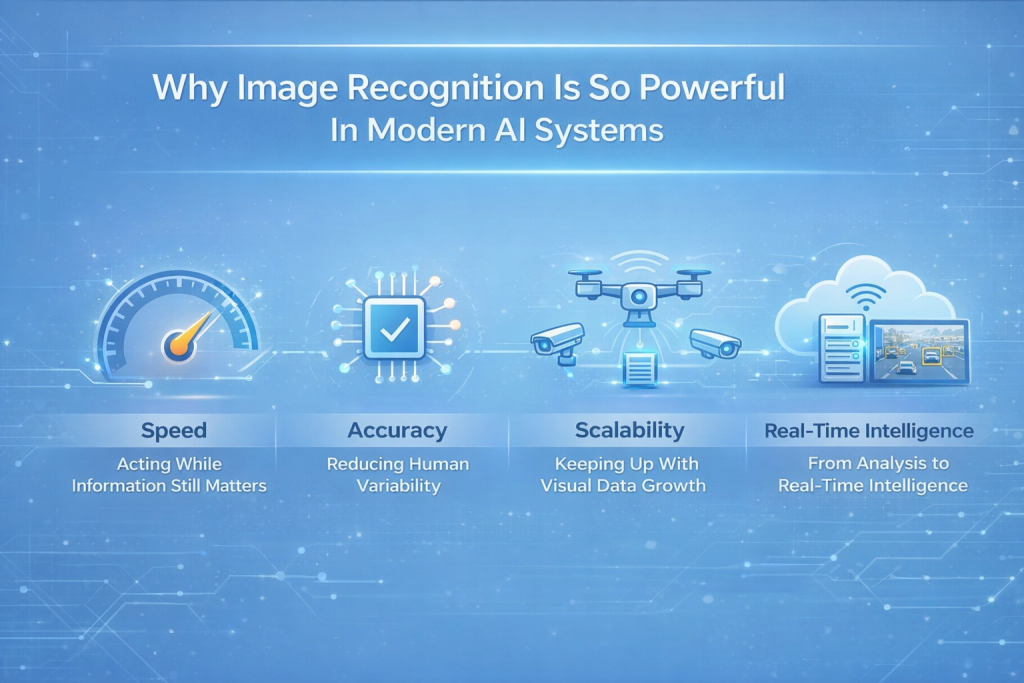
Image recognition has become a core capability in AI not because it is novel, but because it delivers practical advantages that are hard to replicate with other data types.
Speed: Acting While Information Still Matters
Speed matters because many decisions lose value over time. Detecting an issue after the fact is often too late. Image recognition allows systems to analyze visual data as it is captured, flagging problems or opportunities the moment they appear.
This immediacy is critical in environments where conditions change quickly. Whether it is monitoring equipment, tracking movement, or spotting anomalies, faster insight leads directly to better outcomes.
Accuracy: Reducing Human Variability
Visual judgment is inherently inconsistent. Fatigue, bias, and experience level all affect how people interpret images. AI-based image recognition applies the same learned criteria to every input, without distraction or drift.
That consistency improves reliability, especially in high-volume workflows. Instead of relying on subjective interpretation, organizations can enforce uniform standards across large datasets.
Scalability: Keeping Up With Visual Data Growth
Visual data grows fast. As more cameras, drones, and sensors are deployed, image volume increases far beyond what human teams can process. Image recognition allows systems to scale with this growth without a matching increase in manual effort.
This makes AI image recognition essential for long-term operations, not just short-term automation.
From Analysis to Real-Time Intelligence
One of the most transformative aspects of image recognition is its ability to operate in real time. With cloud-based and on-device AI systems, images can be processed immediately at or near the point of capture.
Retail shelves change throughout the day. Traffic patterns shift by the minute. Industrial systems run continuously. Image recognition allows AI to keep pace with these environments and respond as conditions evolve.
Real-time feedback closes the gap between observation and action. Instead of discovering issues during scheduled reviews, teams can address them as they happen. This moves AI from a reporting role into an active decision-support role.
Learning From Visual Data Over Time
Visual data is also a powerful learning source. When models are trained on diverse images, they learn how objects appear under different lighting, angles, backgrounds, and distortions. This exposure improves robustness and adaptability.
Image recognition systems can also be updated continuously. As new data arrives, models can be retrained or fine-tuned to handle new scenarios. This allows AI systems to improve without being explicitly reprogrammed.
The ability to learn from visual feedback is a defining trait of modern AI. It enables systems that adapt alongside the environments they operate in, rather than falling behind them.
Practical Applications Across Industries
Image recognition underpins a wide range of real-world applications by helping AI systems understand visual conditions and respond appropriately. Its value becomes especially clear when applied to industries where speed, accuracy, and consistency matter.
Healthcare and Medical Imaging
In healthcare, image recognition supports diagnostics by analyzing medical images such as X-rays, MRIs, and CT scans. AI systems assist medical professionals by highlighting areas of concern, identifying patterns that may be difficult to spot with the human eye, and reducing the time required for initial analysis. This helps clinicians focus on decision-making rather than manual review.
Agriculture and Crop Monitoring
In agriculture, image recognition is used to monitor crop health, detect stress, and identify early signs of disease or nutrient deficiency. Drones and satellites capture images that AI systems analyze to support better planning and yield management. This allows farmers and agribusinesses to act earlier, reduce waste, and use resources more efficiently.
Infrastructure and Construction
In infrastructure and construction, image recognition enables automated inspection of assets such as bridges, roads, buildings, and industrial facilities. AI systems can detect cracks, corrosion, and structural changes at an early stage, improving safety and reducing maintenance costs. Regular visual monitoring also helps prioritize repairs based on actual condition rather than fixed schedules.
Security and Compliance
In security and compliance, visual recognition supports monitoring, access control, and anomaly detection. AI systems analyze camera feeds to identify unusual behavior, unauthorized access, or deviations from established procedures. While these applications require careful governance and privacy safeguards, they demonstrate how visual intelligence expands the practical reach of AI.
Across all these domains, image recognition plays the same role. It turns visual input into actionable insight, allowing AI systems to support faster, more informed decisions in complex, real-world environments.
Limitations and Challenges
Technical and Data-Related Limitations
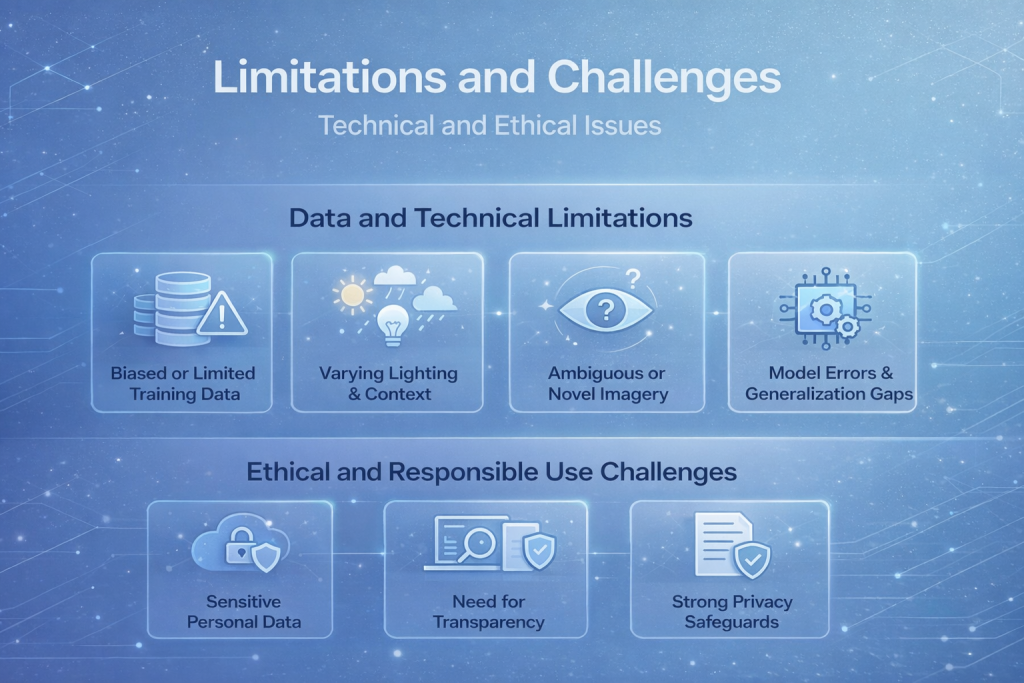
Despite its importance, image recognition is not without limitations. The quality of results depends heavily on the training data used to build the model. If datasets lack diversity, balance, or accuracy, AI systems may struggle when they encounter unfamiliar scenarios in the real world.
Variations in object appearance, lighting conditions, angles, or environmental context can introduce errors. Image recognition models may misinterpret ambiguous visuals or fail to generalize beyond the situations they were trained on. These issues highlight the need for careful model design, continuous validation, and regular monitoring to maintain reliable performance.
Ethical and Responsible Use Challenges
Ethical considerations also play a critical role in image recognition. Visual data often contains sensitive or personal information, especially in areas such as healthcare, security, and public monitoring. Responsible use requires transparency about how data is collected and processed, along with strong privacy safeguards and clearly defined constraints.
Acknowledging these challenges does not diminish the value of image recognition. Instead, it reinforces the importance of using the technology thoughtfully and responsibly as part of broader AI systems that respect both technical limits and societal expectations.
Why Image Recognition Remains Foundational
As artificial intelligence continues to evolve, new capabilities emerge, from language models to autonomous agents. Yet image recognition remains foundational because it addresses a fundamental need: understanding the physical world.
AI can generate text, optimize processes, and predict outcomes, but without perception, those abilities remain abstract. Image recognition anchors AI in reality. It provides the sensory input that makes intelligent behavior possible.
This is why image recognition is not just another application of AI. It is one of the core functions that enable AI to interact meaningfully with the world around it.
Looking Ahead
The future of image recognition lies in deeper integration with other AI capabilities. Vision combined with language, reasoning, and decision-making creates systems that are more context-aware and adaptable.
As hardware improves and models become more efficient, image recognition will move closer to the edge, operating directly on devices in real time. This shift will reduce latency, improve privacy, and expand use cases.
What will not change is its role as a key function of artificial intelligence. As long as AI systems are expected to understand and respond to the real world, image recognition will remain essential.
Final Thoughts
Image recognition matters because it gives artificial intelligence eyes. It allows machines to move beyond abstract data and engage with the environments they are meant to serve.
By transforming visual input into actionable insight, image recognition enables faster decisions, greater accuracy, and scalable intelligence. It connects AI to reality and makes advanced automation possible across industries.
In that sense, image recognition is not just a feature of AI. It is one of the reasons AI works at all.
Frequently Asked Questions
Image recognition is a capability that allows AI systems to analyze images or video and identify what they contain. This can include objects, patterns, text, anomalies, or specific conditions. It turns visual input into structured data that AI can use to support decisions or automated actions.
Image recognition is essential because it allows AI to understand the visual world. Many real-world applications depend on visual input, from medical scans and retail shelves to roads, factories, and infrastructure. Without image recognition, AI would be limited to text and numerical data and disconnected from physical environments.
Computer vision is a broader field focused on enabling machines to interpret visual data. Image recognition is one of its core functions. While computer vision may include tasks like motion tracking or 3D reconstruction, image recognition specifically focuses on identifying and classifying visual elements within images or video.
Neural networks, especially convolutional neural networks, are the backbone of modern image recognition systems. They process images layer by layer, learning visual patterns that range from simple edges to complex objects. This layered learning approach allows AI systems to recognize images with high accuracy.
Image recognition is used across many industries. Common applications include medical diagnostics, retail shelf monitoring, quality inspection in manufacturing, crop monitoring in agriculture, infrastructure inspection, logistics tracking, and security systems. In each case, it helps AI systems interpret visual data quickly and consistently.