
Image recognition is no longer a lab concept or a niche AI trick. It shows up anywhere visual data needs to turn into decisions. Cameras, drones, medical scanners, factory lines, even phones produce more images than people can reasonably review. Image recognition fills that gap. It helps software notice patterns, identify objects, and react faster than manual inspection ever could.
What makes it useful is not the technology itself, but what it replaces. Hours of visual checking. Missed details. Slow responses. When image recognition works well, it fades into the background and quietly speeds everything up.
Turning Images Into Decisions
At its core, image recognition answers one question: what is in this image?
Sometimes that question is simple. Is there a defect on this part? Is a person present in the frame? Is this product on the shelf or missing?
Sometimes it is more detailed. How many objects are there? Where exactly are they located? How are they changing over time?
Modern image recognition systems handle these questions by learning patterns from large datasets. Instead of relying on fixed rules, they learn what edges, shapes, textures, and spatial relationships tend to mean in context. That learning allows systems to work across lighting changes, camera angles, and imperfect inputs.
The value comes when those answers feed into action. An alert triggers. A workflow moves forward. A report updates automatically. Without that connection to action, recognition is just classification. With it, recognition becomes automation.

Image Recognition in Practice at FlyPix AI
At FlyPix AI, we apply image recognition where visual data is heavy, complex, and time-sensitive. Satellite, aerial, and drone imagery hold valuable signals, but only if they can be processed fast enough to support real decisions.
We use AI agents to detect, outline, and classify objects across large geospatial scenes, turning raw imagery into structured insight in seconds instead of hours. Teams can train custom models using their own annotations, without needing deep AI expertise, and adapt analysis to the specific needs of their industry.
Our focus is simple. Make image recognition practical, fast, and easy to fit into existing workflows. When visual data moves smoothly from capture to action, image recognition stops feeling like advanced technology and starts working as part of everyday operations.
Image Recognition Across Industries
Image recognition is used across many industries for different reasons, but the underlying goal is usually the same. Large volumes of visual data need to be reviewed, compared, and understood faster than people can manage manually. Image recognition provides a way to do that consistently and at scale.
In construction and infrastructure projects, it supports site monitoring, progress tracking, and condition assessment over time. In agriculture and forestry, it helps analyze crop health, land use, and environmental change across large areas. Port operations and industrial facilities rely on it to monitor activity, inspect assets, and detect anomalies that could affect safety or efficiency.
Public sector and environmental organizations use image recognition for mapping, planning, and long-term monitoring. In all of these contexts, the technology applies the same logic repeatedly to visual inputs, making it easier to detect patterns, measure change, and act on reliable visual evidence.
What connects these industries is not the type of image, but the scale of the problem. As visual data grows, image recognition becomes a shared layer that allows very different sectors to work with images in a structured and practical way.
Manufacturing and Quality Control
Manufacturing was one of the first areas where image recognition moved from research to production. The problem existed long before AI became mainstream. Human inspectors get tired. Small defects slip through. Consistency varies from shift to shift.
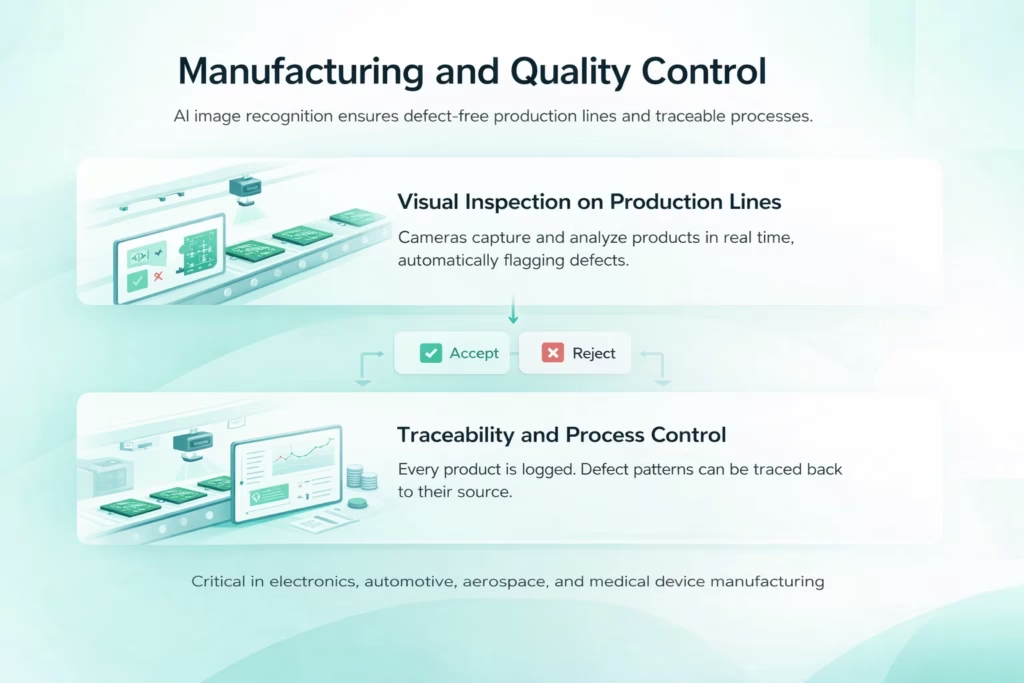
Visual Inspection on Production Lines
Image recognition systems now inspect products at speeds no human team could match. Cameras positioned along production lines capture images of parts as they move past. Models analyze surface texture, shape, alignment, and color in real time. Parts are automatically flagged as acceptable or defective, often before they reach the next production stage.
Traceability and Process Control
Beyond speed, image recognition adds traceability. Every decision can be logged. Every image can be stored. When a defect pattern appears later, teams can trace it back to the exact moment it started.
This is especially valuable in electronics, automotive manufacturing, aerospace, and medical device production, where tolerances are tight and documentation matters.
Medical Imaging and Diagnostics
Healthcare generates massive volumes of visual data. X-rays, CT scans, MRIs, ultrasound images, and pathology slides are produced daily, often faster than specialists can review them.
Supporting Clinical Decision-Making
Image recognition does not replace clinicians. It supports them. Models are trained to identify patterns associated with known conditions, such as tumors, fractures, or internal bleeding.
Systems can highlight areas that deserve closer inspection and help prioritize urgent cases when workloads are heavy.
Consistency Across Large Volumes
Another practical benefit is consistency. Human interpretation can vary, especially with borderline cases. Image recognition systems apply the same criteria every time, which helps standardize screenings and reduce missed findings in early detection workflows.
Security, Surveillance, and Access Control
Security is one of the most visible uses of image recognition, but the reality is more practical than most people expect.
Event Detection in Live Video
In real deployments, the focus is often on behavior rather than identity. Systems detect motion in restricted areas, objects left behind, or vehicles entering zones they should not access.
Image recognition models learn what normal activity looks like in a specific environment and flag deviations automatically.
Identity Verification and Access Systems
Image recognition is also used for access control. Face-based authentication secures phones, offices, and controlled facilities. Facial features are converted into numerical representations and compared against stored references.
Accuracy matters, but so do privacy and bias concerns. Real-world systems must operate within clear legal and ethical boundaries.
Retail, Inventory, and Shelf Monitoring
Retail environments produce visual data constantly, yet for years most of it went unused beyond security footage.
Shelf Availability and Product Placement
Image recognition systems now monitor shelves to detect out-of-stock items, misplaced products, and incorrect facing. This allows staff to react faster and reduce lost sales caused by empty or disorganized shelves.
Warehouse and Inventory Operations
In warehouses, image recognition helps identify packages, track inventory movement, and guide robots through complex layouts. Cameras replace manual barcode scanning in many workflows, reducing errors and speeding up processing.
Autonomous Vehicles and Transportation Systems
Transportation is one of the most demanding environments for image recognition. Decisions must be made in real time, often under unpredictable conditions.
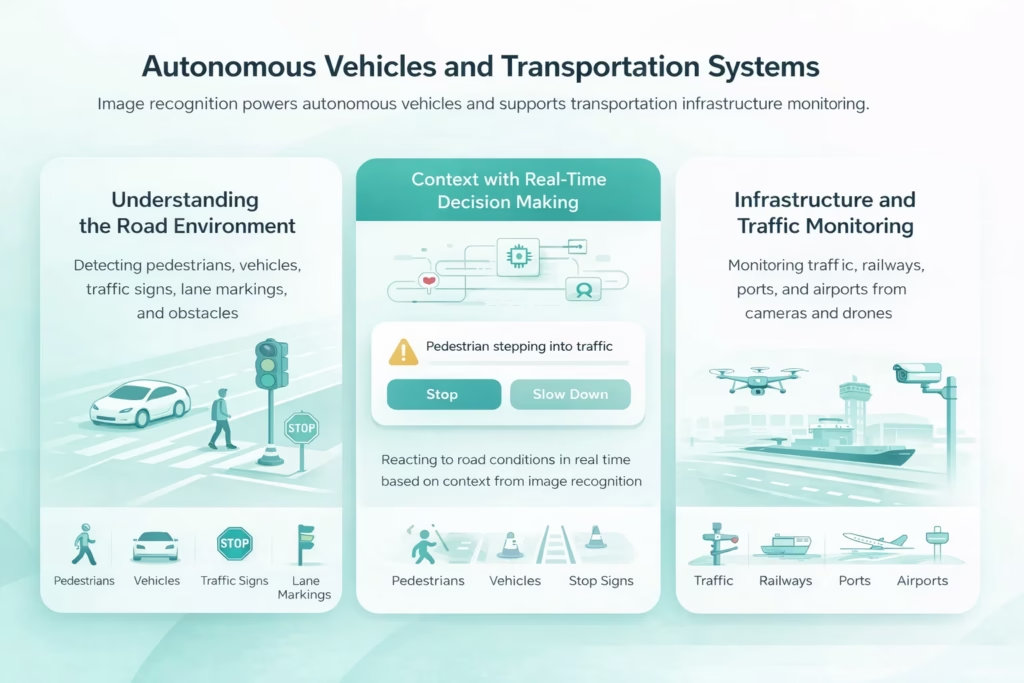
Understanding the Road Environment
Autonomous driving systems rely heavily on image recognition to detect pedestrians, vehicles, traffic signs, lane markings, and obstacles. Recognition is not enough on its own. Context matters.
A pedestrian standing on the sidewalk is different from one stepping into traffic. Image recognition feeds this information into broader decision systems.
Infrastructure and Traffic Monitoring
Beyond vehicles, image recognition supports traffic analysis, railway inspection, port operations, and airport monitoring. Cameras and drones identify wear, damage, and movement patterns that would be difficult to track manually.
Agriculture and Environmental Monitoring
Agriculture generates large volumes of visual data, especially through drones and satellite imagery.
Crop Health and Yield Analysis
Image recognition systems analyze plant color, density, and growth patterns to assess crop health, detect disease, and estimate yields. This reduces the need for manual field inspections and enables earlier intervention.
Environmental Change Tracking
The same techniques are used in environmental monitoring. Forest coverage, water levels, land use changes, and deforestation can be tracked consistently by comparing images over time.
Robotics and Physical Automation
Robots depend on image recognition to operate beyond rigid, pre-programmed paths.
Object Identification and Navigation
In warehouses and factories, robots use image recognition to identify objects, avoid obstacles, and adapt to layout changes. Vision allows robots to handle variation rather than rely on fixed assumptions.
Combining Vision With Other Sensors
In practice, image recognition is often combined with depth sensors, lidar, or motion tracking to improve reliability in complex environments.
Document Processing and Visual Text Recognition
Not all image recognition focuses on physical objects. A significant portion is dedicated to extracting information from documents.
Automating Paper-Based Workflows
Scanned documents, invoices, forms, and handwritten notes contain valuable data locked inside images. Image recognition combined with text recognition allows systems to extract and structure this information automatically.
Reducing Manual Data Entry
This reduces manual input, speeds up processing, and lowers error rates. Financial institutions, insurers, logistics providers, and public agencies rely on these systems to handle large document volumes efficiently.
Media, Content Moderation, and Search
Platforms hosting large volumes of user-generated content depend on image recognition to operate at scale.
Content Classification and Moderation
Recognition systems classify images, detect prohibited material, and flag content for human review. The goal is not perfect accuracy, but reducing the volume of material that requires manual attention.
Visual Search and Asset Management
In creative industries, image recognition helps organize and search large media libraries based on visual features rather than filenames or manual tags.
Industrial Inspection and Infrastructure Maintenance
Large infrastructure systems degrade slowly, making early damage hard to spot.
Automated Visual Inspection
Image recognition enables automated inspection using drones, robots, and fixed cameras. Cracks, corrosion, leaks, and structural changes can be detected by comparing new images against historical data.
Safer and More Frequent Monitoring
This approach improves safety by reducing the need for human inspection in hazardous environments and allows assets to be monitored more frequently.
How Image Recognition Fits Into Larger Systems
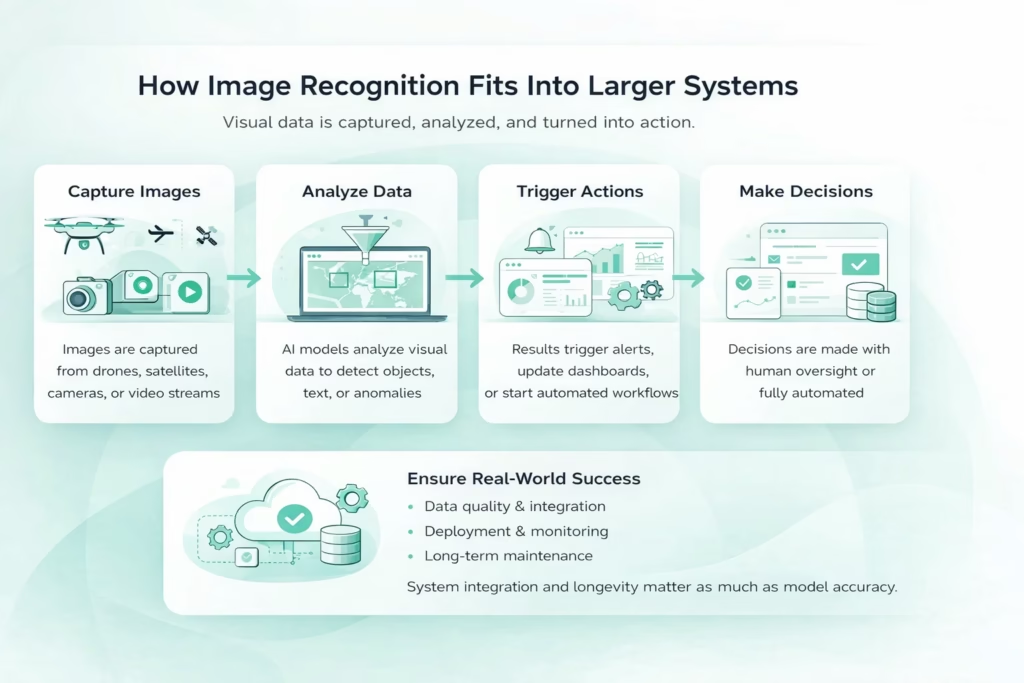
Image recognition rarely works in isolation. It is one step in a broader pipeline where visual data is turned into action.
- Images are captured from cameras, drones, scanners, or video streams and prepared for analysis.
- Models analyze the visual data and extract relevant signals such as objects, text, or anomalies.
- The results are passed to other systems where alerts trigger workflows, dashboards update, or automated actions begin.
- Decisions are made based on those outputs, either automatically or with human oversight.
Real-world success depends on more than model accuracy alone. Data quality, system integration, deployment strategy, monitoring, and long-term maintenance often have a bigger impact on whether image recognition delivers lasting value.
Practical Limitations and Tradeoffs
Image recognition is powerful, but it is not universal. Its performance depends heavily on the quality of the data it receives and the conditions under which images are captured. Poor lighting, low-resolution inputs, inconsistent camera angles, and biased training datasets can all lead to unreliable results. Systems that work well in controlled environments often struggle when moved into real-world settings unless these factors are addressed during design and deployment.
There are also broader considerations that go beyond technical performance. Privacy, transparency, and regulatory requirements play a significant role in determining where and how image recognition can be used. This is especially true in applications involving surveillance, identity verification, or public spaces, where misuse or lack of oversight can erode trust. Successful implementations balance technical capability with clear boundaries and responsible use.
Why Image Recognition Keeps Expanding
Three forces continue to push adoption forward.
- More visual data is being generated every day. Cameras are cheaper, easier to deploy, and embedded into more systems than ever. From phones and drones to industrial sensors, images are now a default data source rather than a special case.
- Computing and tooling have become more accessible. Cloud platforms, edge devices, and modern AI frameworks make it easier to train, deploy, and run image recognition models without deep infrastructure investment.
- The value is practical, not experimental. The applications that last are not driven by novelty. They stick because image recognition reduces cost, improves consistency, and allows teams to operate at a scale where manual review simply breaks down.
Closing Thoughts
Image recognition is not about teaching machines to see for its own sake. It exists to reduce friction in systems that depend on visual information.
When applied thoughtfully, it replaces repetitive inspection, speeds up decisions, and adds consistency where humans struggle to maintain it. When applied poorly, it adds complexity without benefit.
The real-world uses that endure are the quiet ones. The systems that work in the background, support human judgment, and make complex operations run a little smoother every day.
Frequently Asked Questions
Image recognition is used to identify and analyze visual information in images or video. In everyday applications, it supports things like phone face unlock, photo organization, security monitoring, medical imaging analysis, product inspection, and traffic monitoring. Most of the time, it works quietly in the background to speed up tasks that would otherwise require manual visual review.
Image recognition is used to identify and analyze visual information in images or video. In everyday applications, it supports things like phone face unlock, photo organization, security monitoring, medical imaging analysis, product inspection, and traffic monitoring. Most of the time, it works quietly in the background to speed up tasks that would otherwise require manual visual review.
Image recognition focuses on understanding what is present in an image, often at a high level. Object detection goes a step further by identifying where those objects are located within the image. In practice, many real-world systems use both together, depending on whether location and quantity matter for the task.
Image recognition is widely used in manufacturing, healthcare, retail, transportation, agriculture, security, and infrastructure maintenance. Any industry that generates large volumes of visual data and needs consistent analysis can benefit from it, especially when manual inspection becomes slow or unreliable.
Yes, many modern image recognition systems are designed to work in real time or near real time. This is essential for applications like autonomous driving, security monitoring, robotics, and industrial automation, where delayed responses would reduce usefulness or create risk.
Image recognition systems require labeled images that represent the conditions they will encounter in real use. This includes variation in lighting, angles, backgrounds, and object appearance. The quality and diversity of training data have a direct impact on how reliable the system will be once deployed.