

Quick Summary: ACCA Software offers a comprehensive suite of tools for the AEC industry, centered around its openBIM philosophy and the usBIM ecosystem. Its flagship products, like Edificius for architectural design and PriMus for cost estimating, provide powerful, integrated solutions that rival major competitors, often at a more accessible price point. The company strongly emphasizes interoperability through IFC standards, facilitating collaboration across different project phases and among various professional teams in the construction data lifecycle.
The modern Architecture, Engineering, and Construction (AEC) industry demands more than just digital blueprints; it requires complete data integration, workflow flexibility, and seamless real-time collaboration. For years, a handful of tech giants have dominated this space, often locking professionals into proprietary formats and costly subscription models. However, in 2026, the push for open standards and cost optimization has become a top priority for firms of all sizes.
In this comprehensive review, we take a deep dive into the ACCA Software ecosystem—an Italian developer offering a powerful, transparent, and financially accessible alternative to industry-standard heavyweights.
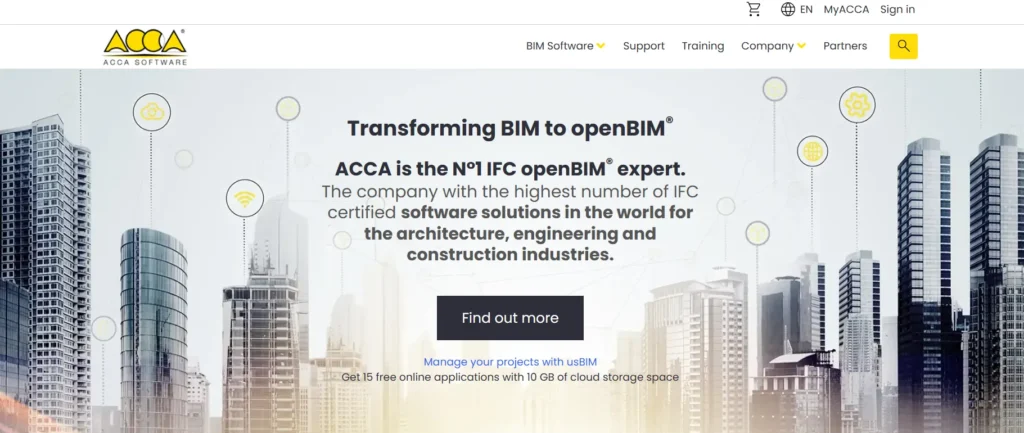
What is ACCA Software? An Overview for the Modern AEC Industry
In the world of Architecture, Engineering, and Construction (AEC) software, a few big names often dominate the conversation. But Italy-based ACCA Software has been quietly building a remarkably comprehensive and mature suite of tools since its founding in 1989. Known for its strong commitment to openBIM standards, ACCA provides an interconnected ecosystem of applications designed to manage a building’s entire lifecycle, from initial design to ongoing maintenance. This isn’t just another collection of standalone programs; it’s a unified platform aiming to challenge the established order.
The company’s philosophy centers on interoperability and collaboration. Instead of locking users into a closed data format, ACCA champions the use of the Industry Foundation Classes (IFC) standard. This focus is so central that ACCA holds the title for the company with the highest number of IFC-certified software solutions in the world. This commitment ensures that data can flow freely between different software, teams, and project stages, which is a significant pain point in many construction projects.
At the heart of its offering is the usBIM platform, a cloud-based Common Data Environment (CDE) that acts as the central hub for project information. This platform integrates the various specialized tools ACCA offers, creating a single source of truth for every stakeholder involved in a project. From architectural design and structural analysis to cost estimation and site safety, the scope of ACCA’s portfolio is extensive, covering over 90 applications.
The usBIM Ecosystem: The Collaborative Core
The usBIM ecosystem is ACCA’s answer to the fragmentation that plagues many construction projects. It’s a cloud-based platform designed to centralize project data and facilitate real-time collaboration among architects, engineers, contractors, and clients. Think of it as the digital backbone for a construction project, accessible from any device.
The platform is built to be scalable and configurable. Users can subscribe only to the specific applications they need, such as clash detection with usBIM.clash or scheduling with usBIM.gantt, and integrate them into a unified workflow. This modular approach allows teams to tailor the environment to their specific project requirements without paying for unnecessary tools. The platform handles a wide array of file formats, including IFC, Revit, DWG, GIS data, and point clouds, making it a versatile hub for managing diverse project information.
Key Features of the usBIM Platform:
- BIM Management: It provides a structured environment for integrating 3D models with all associated project data and documents.
- Real-Time Collaboration: Tools like online chat and video meetings are built into the platform to enhance communication.
- Geospatial Digital Twins: With usBIM.geotwin, users can integrate GIS data with BIM models to create detailed digital replicas of assets for urban planning and infrastructure management.
- Issue Management: Applications like usBIM.resolver help manage and track issues throughout the project lifecycle, ensuring accountability and timely resolution.
This integrated approach helps reduce errors, improve decision-making, and keep projects on schedule and within budget by ensuring all stakeholders are working from the same, up-to-date information.
Flagship Product Deep Dive: Edificius and PriMus
While the usBIM platform provides the collaborative environment, ACCA’s strength lies in its powerful authoring and management tools. Two of the most prominent are Edificius for architectural design and PriMus for cost estimating.
Edificius: The All-in-One BIM Design Tool
Edificius is ACCA’s flagship BIM authoring software, positioned as a direct competitor to tools like Autodesk Revit. It’s designed as an “all-in-one” solution, integrating architectural design, interior design, landscaping, and MEP (Mechanical, Electrical, and Plumbing) systems within a single environment. This multidisciplinary approach is a key differentiator, as it prevents the data silos that can occur when using separate software for different design aspects.
Real talk: the software is fast. Users report that modeling, whether from scratch or by converting 2D drawings, is remarkably quick. Any change made to the BIM model automatically updates all related project documents, including floor plans, sections, and elevations, which significantly reduces manual rework and the potential for errors.
A standout feature is its integrated real-time rendering engine. This allows designers to instantly visualize changes with high-quality, photorealistic results without a lengthy rendering process. It’s a powerful tool for client presentations and internal design reviews, enabling stakeholders to see exactly how the final project will look and feel. Edificius also includes immersive virtual reality (VR) capabilities, allowing for virtual walkthroughs of the model.
| Edificius Feature | Primary Benefit for AEC Professionals |
|---|---|
| Integrated 2D/3D BIM Modeling | Create and manage architectural, landscape, and MEP designs in one unified environment. |
| Real-Time Rendering & VR | Instantly visualize design changes and create immersive client presentations without long wait times. |
| Automatic Drawing Generation | Model updates automatically propagate to all project documents (plans, sections, elevations), ensuring consistency. |
| 4D (Gantt) & 5D (Costing) Integration | Link the BIM model directly to project timelines and cost estimates for comprehensive project management. |
| Strong IFC Interoperability | Seamlessly collaborate with teams using other BIM software thanks to certified IFC support. |
PriMus: Dominating Construction Estimating
Before ACCA developed its BIM tools, it built its reputation on PriMus, its first commercial product for bill of quantities and cost estimating. Launched in the early 1990s, PriMus became a dominant force in the Italian market and remains a cornerstone of ACCA’s portfolio. It’s a specialized tool for quantity surveyors, project managers, and contractors who need to produce precise cost estimates.
PriMus excels at managing price lists, creating detailed bills of quantities, and analyzing costs throughout the project lifecycle. One of its most powerful capabilities is its integration with BIM models via PriMus-IFC. This allows users to automatically extract quantities directly from the 3D model, linking the design data directly to the cost data (5D BIM). This direct link minimizes the manual data entry that is often tedious and prone to error.
While powerful, some users note that PriMus has a steep learning curve and isn’t as intuitive as some other tools. However, for those who master it, it offers robust functionality for handling large, complex projects and provides excellent value for money.
Beyond the Flagships: A Look at ACCA’s Specialized Tools
ACCA’s software library extends far beyond architecture and cost estimation. The company offers a wide range of specialized tools designed to address specific needs within the construction industry. This modular approach allows professionals to build a customized software toolkit that perfectly fits their workflow.
Here’s a brief overview of some other notable products:
- EdiLus: A BIM software for structural analysis and design of reinforced concrete, steel, and masonry buildings. It integrates with Edificius, allowing structural engineers to work directly on the architectural model.
- CerTus: This suite focuses on health and safety management on construction sites. It includes tools like CerTus SCAFFOLDING for designing and documenting temporary scaffolding systems with a focus on safety compliance.
- Solarius PV: A specialized BIM tool for designing photovoltaic systems. It can analyze solar shading from nearby obstacles and optimize the layout of PV modules for maximum efficiency.
- TerMus: Used for energy performance analysis and thermal bridge calculations, helping designers create more sustainable and energy-efficient buildings.
This deep bench of specialized applications highlights ACCA’s strategy: to provide a tool for nearly every aspect of the digital building process, all interconnected through the usBIM platform and openBIM standards.

Use FlyPix AI to Add Geospatial Insight to Project Reviews
ACCA Software and BibLus are often connected with building, design, construction, and technical project workflows. FlyPix AI can add another layer for teams that need to review sites from satellite, drone, or aerial imagery, especially when the work involves land conditions, infrastructure, or visible objects across large areas.
FlyPix AI can support project and site analysis tasks such as:
- Detecting buildings, roads, vegetation, equipment, or other visible assets
- Reviewing site changes from aerial or satellite imagery
- Segmenting land, structures, and surrounding areas for clearer visual context
- Creating custom AI models for project-specific objects or site features
Contact FlyPix AI to discuss how geospatial image analysis can support your project review workflow.
ACCA vs. The Competition: Where Does It Stand?
So, how does ACCA stack up against industry giants like Autodesk? The comparison often centers on Edificius versus Revit. While Revit is the entrenched industry standard in many regions, Edificius presents a compelling alternative, particularly regarding its all-in-one approach and integrated real-time rendering. Users often praise Edificius for having a more intuitive interface and a less steep learning curve compared to its competitors.
But the biggest competitive advantage is often price. Edificius is typically offered at a significantly lower price point than a full Revit subscription, making it an attractive option for smaller firms or professionals looking to adopt BIM without a massive upfront investment.
The core philosophical difference, however, lies in the approach to data. While Autodesk has developed its own ecosystem, ACCA’s unwavering commitment to openBIM and IFC certification is its key selling point. For projects involving multiple firms using different software platforms, ACCA’s open approach can lead to much smoother collaboration and data exchange. This focus on interoperability is a strategic choice that resonates with an industry tired of being locked into proprietary formats.
| Aspect | ACCA Software (e.g., Edificius) | Autodesk (e.g., Revit) |
|---|---|---|
| Core Philosophy | OpenBIM and IFC-centric, emphasizing interoperability. | Primarily a closed ecosystem, though with improving IFC support. |
| Key Differentiator | Integrated real-time rendering, all-in-one design environment. | Market dominance, extensive third-party plugin ecosystem. |
| Pricing Model | Often more affordable, with flexible subscription options. | Higher price point, industry-standard subscription model. |
| Learning Curve | Generally considered more intuitive and easier to learn. | Steeper learning curve but vast amounts of training material available. |
| Collaboration | Strongly facilitated by the usBIM cloud platform and open standards. | Facilitated by Autodesk Construction Cloud (Forma). |
The BibLus Connection: Content and Community
BibLus is the technical blog and knowledge hub run by ACCA Software. It’s an essential part of the company’s ecosystem, providing articles, guides, and news on a wide range of topics relevant to the AEC industry, from BIM and structural calculation to energy efficiency and construction site management. The content on BibLus often showcases how ACCA’s tools can be used to solve real-world design and construction challenges, making it a valuable resource for both current users and professionals evaluating the software. It serves as a content marketing platform that reinforces ACCA’s expertise and commitment to educating the industry.
Frequently Asked Questions (FAQ)
ACCA’s main offerings are centered around the usBIM ecosystem. Its flagship BIM authoring tool is Edificius, for architectural design, and its long-standing cost estimation tool is PriMus.
Yes, for many professionals, Edificius is a strong alternative to Revit. It offers a more integrated, all-in-one design environment with powerful real-time rendering and is often available at a lower cost. Its primary advantage is its foundation in openBIM and IFC standards.
OpenBIM is an approach to collaboration that encourages interoperability through open standards, primarily the IFC file format. It’s central to ACCA’s philosophy, ensuring that data can be exchanged freely between different software applications and project teams, preventing vendor lock-in.
usBIM is ACCA’s cloud-based Common Data Environment (CDE). It acts as a central hub for managing all project information, integrating various ACCA applications and facilitating real-time collaboration among all project stakeholders.
Yes, ACCA offers a wide range of over 90 software tools designed to cover all phases of a building’s lifecycle. This includes architectural design (Edificius), structural analysis (EdiLus), cost estimation (PriMus), scheduling (usBIM.gantt), safety (CerTus), and maintenance/facility management (usBIM.maint).
Yes, ACCA typically offers a one-month free trial for its software, allowing users to test the full functionality before subscribing.
ACCA Software was founded in 1989 and is headquartered in Bagnoli Irpino, Italy.
Final Verdict: Is ACCA Software the Right Choice?
ACCA Software presents a powerful and surprisingly complete alternative to the more established players in the AEC software market. Its dedication to openBIM is not just a feature; it’s the foundation of its entire ecosystem. This makes it an excellent choice for firms that prioritize interoperability and collaboration with a diverse range of partners.
The combination of a comprehensive, integrated toolset, a powerful cloud-based collaboration platform, and a more accessible price point makes ACCA’s offerings highly compelling. While some individual tools may have a learning curve, the overall value proposition is strong. For small to medium-sized firms, or any team looking for a capable and cost-effective BIM solution that doesn’t lock them into a single vendor’s ecosystem, ACCA Software is absolutely worth a serious look in 2026.