

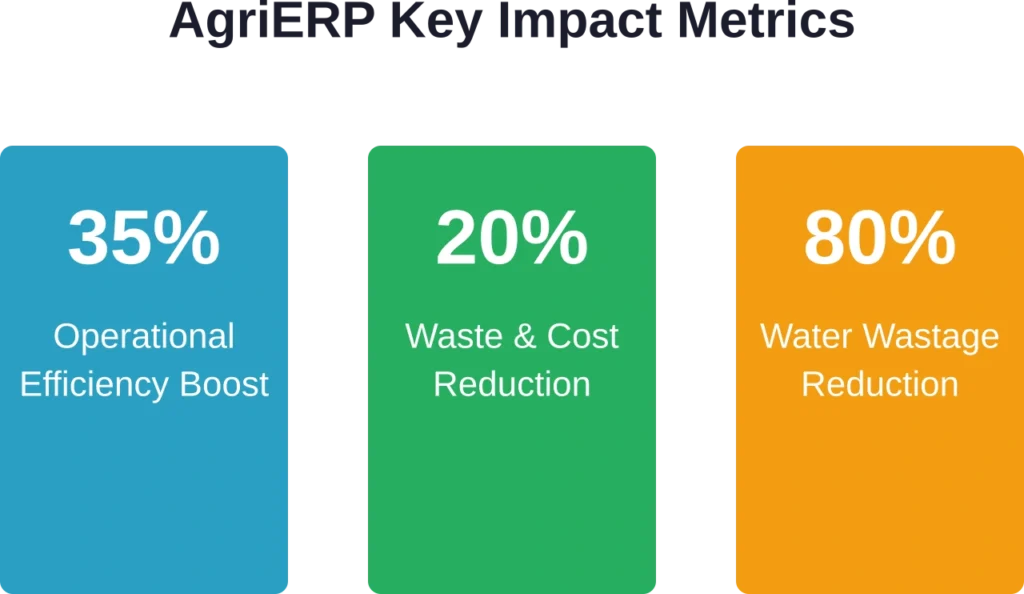
Quick Summary: AgriERP is an AI-powered, all-in-one farm management software built on Microsoft Dynamics 365 ERP, designed by farmers for farmers. It centralizes farm operations—from crop planning and soil monitoring to labor management and inventory tracking—to boost operational efficiency by up to 35%, reduce costs by 20%, and cut water waste by 80%. Based in Сalifornia, AgriERP helps modern farms maximize profitability through automation, real-time data visibility, and predictive analytics.
Modern farming isn’t what it used to be. Spreadsheets, paper logs, and guesswork won’t cut it anymore when every input, every acre, and every labor hour directly impacts the bottom line.
AgriERP emerged from that reality—a team of farmers in California, who turned innovators, built a platform that speaks the language of agriculture. Not generic business software retrofitted for farms, but an ERP solution designed from the ground up for crop management, resource allocation, and farm-level decision-making.
Here’s what makes AgriERP different and why it’s gaining traction among farms looking to scale operations without losing control.
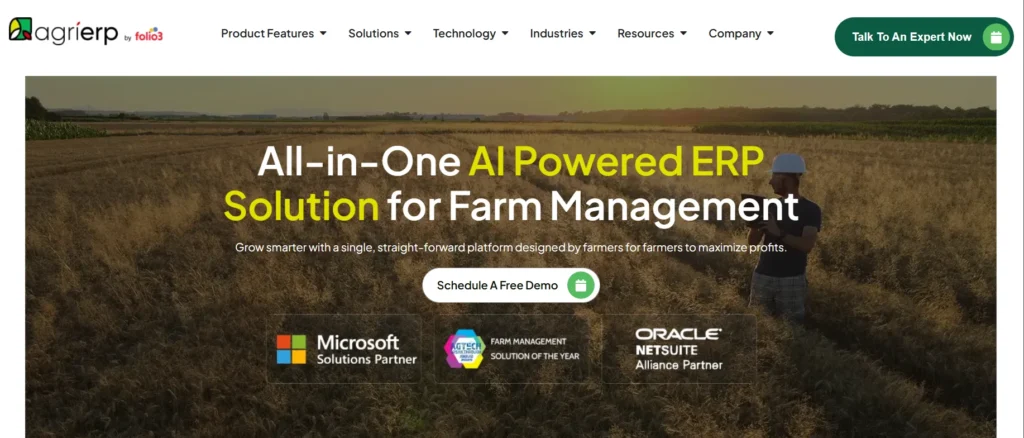
What Is AgriERP and Who Built It?
AgriERP is a comprehensive farm management platform powered by Microsoft Dynamics 365 ERP and enhanced with AI capabilities through Copilot integration. Based in California, it was built by a team of farmers turned innovators who understood firsthand the chaos of managing crops, labor, machinery, and compliance across multiple sites.
The core philosophy? Enable farmers to grow smartly and build future-ready farms. That means consolidating every farm operation—administration, production planning, labor scheduling, inventory tracking, logistics—into a single, centralized system.
Instead of toggling between disconnected tools, farmers get one platform where data flows automatically. Plant a seed in the system, track inputs through the growing season, monitor soil moisture in real time, schedule harvest crews, and analyze yield data—all without leaving the dashboard.
Core Features That Set AgriERP Apart
AgriERP isn’t just software. It’s an integrated ecosystem built to handle the full complexity of modern agribusiness operations. Here’s what’s under the hood.
Crop Management From Seed to Harvest
Crop lifecycle management sits at the heart of AgriERP. Farmers can plan crop rotations, schedule planting windows, allocate inputs by field or block, and track growth stages through harvest.
The system maintains detailed records for every crop variety, tracks seed inventory, monitors fertilizer and pesticide applications, and generates compliance reports for regulatory agencies. That kind of granular visibility helps farms catch issues early—before they escalate into costly problems.
Soil and Water Resource Management
Leveraging Microsoft Dynamics 365 and Copilot, AgriERP tracks soil moisture levels in real time, allocates water resources accurately, monitors usage reports, and helps farms reduce water wastage by up to 80%.
For regions facing water restrictions or farms aiming for sustainability certifications, that level of precision is critical. The platform flags over-irrigation, identifies underperforming zones, and ensures regulatory compliance automatically.
Labor and Workforce Management
Managing farm labor—seasonal workers, equipment operators, harvest crews—requires flexibility. AgriERP handles scheduling, time tracking, payroll integration, and compliance documentation in one place.
Supervisors can assign tasks by field, track hours automatically, monitor productivity, and adjust crew allocations based on real-time conditions. For farms with multiple sites or diverse crop types, centralized labor management eliminates bottlenecks.
Inventory and Supply Chain Tracking
Seed, fertilizer, chemicals, equipment parts—farms run on inventory. AgriERP tracks stock levels, automates reorder alerts, manages supplier relationships, and logs every input application by field and date.
That traceability isn’t just for internal records. Buyers increasingly demand detailed provenance data, and regulatory agencies require compliance documentation. AgriERP generates those reports automatically.
AI-Powered Predictive Analytics
Microsoft Copilot integration brings predictive analytics to farm decision-making. The system analyzes historical yield data, weather patterns, soil conditions, and market trends to recommend optimal planting dates, input levels, and harvest windows.
Farmers still make the final call. But having data-backed recommendations beats intuition alone, especially when margins are tight and weather is unpredictable.
How AgriERP Boosts Farm Profitability
Productivity software is only valuable if it moves the profitability needle. AgriERP delivers measurable results across three core areas.
Operational Efficiency Gains
By centralizing farm management activities, automating repetitive tasks, and providing real-time data visibility, AgriERP boosts operational efficiency by 35%.
What does that look like in practice? Less time spent on data entry, faster decisions during critical windows, fewer missed tasks, and better coordination across teams. Farms do more with the same headcount.
Waste and Cost Reduction
Precision resource allocation cuts waste and costs by 20%. Farmers apply inputs only where needed, eliminate over-application, reduce spoilage through better inventory management, and avoid redundant labor.
For large-scale operations, reducing waste and costs by 20% can significantly impact margins and profitability.
Better Resource Utilization
AgriERP’s water management capabilities alone reduce water wastage by 80%, but the resource optimization extends beyond irrigation. Equipment utilization improves, labor deployment becomes more strategic, and input timing aligns with crop needs.
The result? Farms extract more value from every asset, every input, and every hour worked.
Farm Management Software Landscape: Where AgriERP Fits
Farm management software isn’t new. Tools like AgSquared (a fee-based online software toolkit) offer basic planning and record-keeping.
But AgriERP operates in a different category. It’s an enterprise resource planning system—built to handle the complexity of commercial-scale farms, multi-crop operations, and agribusinesses with supply chain, compliance, and financial integration requirements.
| Feature | Basic Farm Software | AgriERP |
|---|---|---|
| Crop Planning | Manual entry, static plans | AI-driven recommendations, dynamic updates |
| Water Management | Basic logs | Real-time monitoring, 80% waste reduction |
| Labor Tracking | Spreadsheets or separate tool | Integrated scheduling, payroll, compliance |
| Inventory Management | Simple stock counts | Automated reorders, supplier integration |
| Analytics | Static reports | Predictive analytics via Microsoft Copilot |
| Integration | Limited or none | Built on Microsoft Dynamics 365 ERP |
For small-scale hobby farms or operations with simple needs, lightweight tools may suffice. But once a farm crosses into commercial production, handles multiple crop types, employs seasonal labor, or deals with complex supply chains, an ERP-level solution becomes necessary.

Improve Farm and Land Review Workflows with FlyPix AI
AgriERP is connected with farm management, planning, and agricultural business operations. FlyPix AI can add practical visual context by helping teams analyze satellite, drone, and aerial imagery to review fields, land use, infrastructure, and visible site changes.
FlyPix AI can support agricultural planning and monitoring tasks such as:
- Mapping fields, roads, buildings, vegetation, or farm assets
- Reviewing land cover and visible field conditions
- Comparing imagery across seasons or project periods
- Training custom AI models for farm, crop, or land-specific detection
Contact FlyPix AI to see how geospatial image analysis can support agricultural land review and monitoring.
Who Should Consider AgriERP?
AgriERP isn’t for everyone. It’s purpose-built for specific farming operations that need centralized control and advanced capabilities.
Commercial Crop Farms
Large-scale operations growing almonds, potatoes, row crops, or specialty produce benefit most. These farms juggle multiple fields, rotating crops, diverse labor needs, and strict compliance requirements—exactly the complexity AgriERP was designed to manage.
Multi-Site Agribusinesses
Farms operating across multiple locations need consolidated visibility. AgriERP centralizes data from every site, enabling managers to compare performance, allocate resources strategically, and identify underperforming areas.
Farms Focused on Sustainability
Sustainability certifications require detailed documentation—water usage, chemical applications, soil health metrics. AgriERP automates compliance reporting and provides the traceability buyers and regulators demand.
Operations Planning for Growth
Scaling a farm without robust systems leads to chaos. AgriERP provides the infrastructure to add acreage, diversify crops, or expand into new markets without losing operational control.
AgriERP Pricing and Investment Considerations
Pricing for enterprise farm management software varies based on farm size, module selection, user count, and customization requirements. AgriERP doesn’t publish fixed pricing publicly—commercial ERP systems rarely do, because each implementation differs.
For current pricing details, check AgriERP’s official website or schedule a consultation. Expect pricing discussions to center on total cost of ownership: software licensing, implementation services, training, ongoing support, and integration with existing systems.
That said, farms evaluating AgriERP should frame the decision as an investment, not an expense. A system that delivers a 35% efficiency boost and 20% cost reduction pays for itself—often within a single growing season.
Real-World Impact: What Farmers Gain
Operational software lives or dies by results. AgriERP’s value proposition rests on measurable outcomes reported by farms using the platform.
Better decision-making stands out first. With real-time data on soil moisture, weather forecasts, labor availability, and inventory levels, farm managers make informed calls during critical windows—planting, irrigation, pest management, harvest.
Time savings come next. Automating data entry, generating compliance reports automatically, and consolidating operations in one platform frees up hours every week. That time shifts from administration to high-value activities—scouting fields, negotiating contracts, planning next season.
Risk mitigation matters too. Detailed records protect farms during audits, food safety investigations, or insurance claims. Traceability from seed to sale isn’t optional anymore—it’s table stakes for market access.
Integration With Microsoft Dynamics 365: Why It Matters
AgriERP isn’t built from scratch. It’s powered by Microsoft Dynamics 365 ERP—a proven enterprise platform used across industries worldwide.
That foundation brings several advantages. First, reliability. Dynamics 365 is enterprise-grade infrastructure with robust security, regular updates, and Microsoft’s backing.
Second, integration capability. Farms using Microsoft products—Office 365, Power BI, Teams—can connect AgriERP seamlessly. Financial data flows into accounting systems, reports populate automatically, and collaboration happens in tools teams already use.
Third, scalability. As farms grow, Dynamics 365 scales without requiring a platform migration. Add users, expand modules, or integrate additional sites without rebuilding from scratch.
AgriERP vs. Generic ERP: Agriculture-Specific Wins
Some farms consider generic ERP platforms—SAP, Oracle, NetSuite—and wonder if agriculture-specific software is necessary. The answer depends on complexity and priorities.
Generic ERPs offer broad functionality but require extensive customization to handle farm-specific workflows. Crop lifecycle management, soil monitoring, weather integration, compliance documentation for agricultural regulations—none of that comes out of the box.
AgriERP ships with agriculture-specific modules pre-configured. Field mapping, planting schedules, harvest tracking, pesticide application logs, and sustainability reporting are built in, not bolted on.
For farms, that specificity saves implementation time and reduces customization costs. Generic ERPs work, but they demand more upfront investment and ongoing maintenance to bend the system toward agriculture.
Getting Started: Implementation and Support
Adopting new farm management software isn’t plug-and-play. AgriERP implementations typically follow a structured process: initial assessment, system configuration, data migration, team training, and go-live support.
Implementation timelines vary based on farm size and complexity. Smaller operations may deploy in weeks. Larger multi-site farms with legacy systems to migrate might need several months.
Training is critical. Even the best software fails if teams don’t adopt it. AgriERP provides onboarding support, hands-on training, and ongoing resources to help farms get value quickly.
Post-launch, ongoing support ensures farms can troubleshoot issues, adjust configurations as needs evolve, and tap into new features as AgriERP develops.
Frequently Asked Questions
AgriERP is built on Microsoft Dynamics 365 ERP with agriculture-specific modules designed by farmers. It integrates AI-powered predictive analytics through Copilot, delivers 35% operational efficiency gains, and consolidates all farm operations—crop management, labor, inventory, compliance—into one centralized platform. Unlike lightweight farm tools, AgriERP handles enterprise-scale complexity.
AgriERP doesn’t publish fixed pricing because implementations vary based on farm size, user count, and module selection. For current pricing, contact AgriERP directly or request a consultation through their official website. Pricing discussions typically focus on total cost of ownership, including software licensing, implementation, training, and support.
Yes. Built on Microsoft Dynamics 365, AgriERP integrates with Microsoft products like Office 365, Power BI, and Teams. It also connects with accounting systems, IoT sensors, weather data feeds, and other farm technology platforms. Integration capabilities are a core strength of the Dynamics 365 foundation.
Commercial-scale crop farms, multi-site agribusinesses, operations focused on sustainability certifications, and farms planning for growth see the most value. AgriERP is purpose-built for operations that manage multiple crops, employ seasonal labor, handle complex supply chains, and need detailed compliance documentation.
Implementation timelines vary. Smaller farms may go live in 4-8 weeks. Larger operations with legacy data migration, customization needs, and multi-site deployments might require several months. AgriERP provides structured implementation support, training, and post-launch assistance to ensure smooth adoption.
Yes. Modern farm operations require mobility. Field staff can access AgriERP on mobile devices to log activities, update task status, record observations, and view schedules in real time. Mobile access ensures data stays current and decision-makers have visibility from anywhere.
AgriERP offers onboarding support, hands-on training sessions, documentation, and ongoing customer support. Training covers both system administration and day-to-day user workflows. Post-launch, farms can access troubleshooting resources, request configuration adjustments, and stay updated on new features.
Final Thoughts: Is AgriERP Right for Your Farm?
Farm management software is an investment. Not just financially, but in time, training, and operational change. AgriERP isn’t the right fit for every farm—hobby operations or small-scale growers may not need enterprise ERP capabilities.
But for commercial farms dealing with operational complexity, AgriERP offers a proven solution. A 35% efficiency boost, 20% cost reduction, and 80% water waste reduction aren’t marketing claims—they’re measurable outcomes that directly impact profitability.
If managing multiple crops, coordinating labor across sites, ensuring compliance, and scaling operations feel like constant challenges, AgriERP is worth exploring. Schedule a demo, walk through the platform with the team, and evaluate whether the capabilities align with farm priorities.
Modern farming demands modern tools. AgriERP provides the infrastructure to manage complexity, make data-driven decisions, and maximize profits in an industry where margins are tight and conditions are unpredictable.
Ready to see how AgriERP works for your operation? Visit the official AgriERP website to schedule a free demo and talk with the team about your farm’s specific needs.