
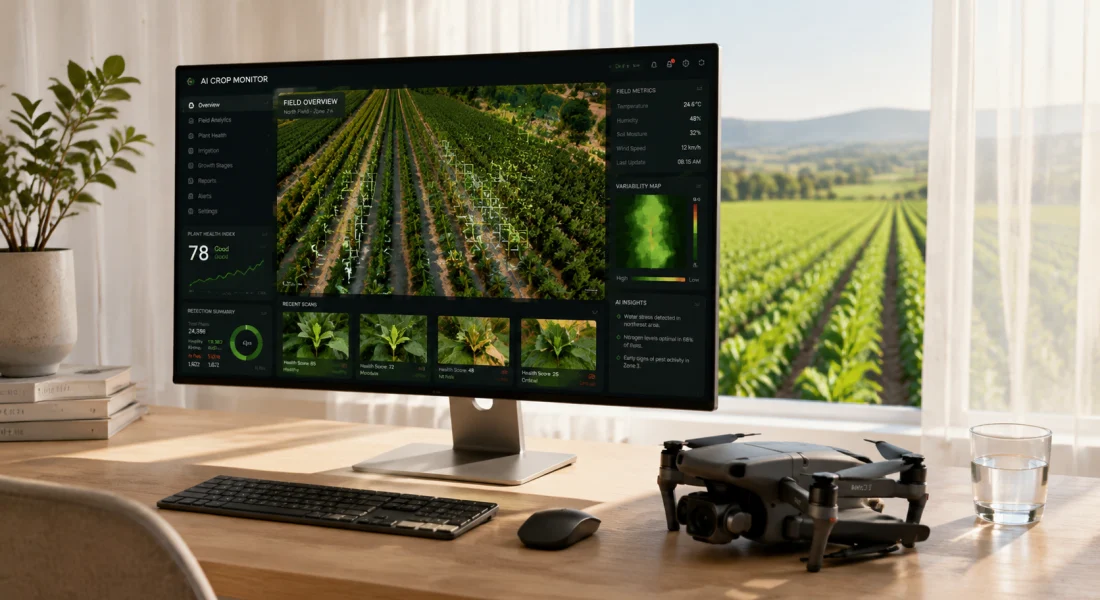
Quick Summary: AgroScout is an AI-powered precision agriculture platform that helps farmers and agronomists detect crop diseases and pests early through mobile scouting and satellite imagery. The tool has scaled from potato disease detection in Latin America to a global multi-crop monitoring system now deployed in 15+ countries, with a global agreement with PepsiCo driving its expansion.
Field scouting hasn’t changed much in decades. Walk the rows, look for trouble, jot notes on a clipboard. But what if you could spot disease before symptoms even show? That’s where AgroScout enters the picture.
This Israeli ag-tech platform combines mobile scouting apps, satellite imagery, and machine learning to detect crop diseases and pests early. The system started narrow—potato diseases in Mexico and Brazil—but quickly expanded into a multi-crop, multi-continent operation. PepsiCo noticed, tested it, and eventually signed a global agreement.
But does it actually work in the field? And more importantly, does it make financial sense for growers who aren’t multinational food companies? This review digs into what AgroScout does, how accurate it is, where it’s deployed, and whether it’s worth adding to your farm’s tech stack.
What AgroScout Actually Is
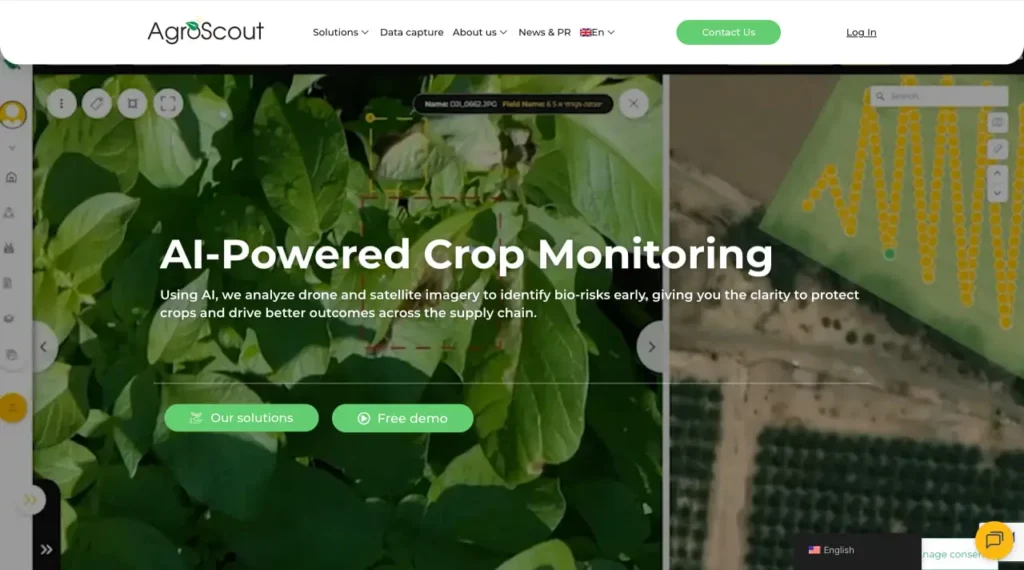
AgroScout isn’t a single tool—it’s a platform with multiple components working together. The core is a mobile app for field scouts and farmers. You walk your fields, snap photos of suspicious plants, and the AI analyzes them for disease or pest signatures.
The mobile app handles the ground truth. Scouts mark GPS locations, photograph symptoms, and tag observations. The AI processes those images and flags potential issues: early blight, late blight, pest damage, nutrient deficiencies.
Behind the scenes, satellite imagery feeds into the system. NDVI and other vegetation indices highlight stress zones before you see visible damage. The platform combines overhead data with ground-level scouting to build a fuller picture of field health.
Now, this is where it gets interesting. AgroScout doesn’t just identify problems—it tracks them over time. Growth patterns, yield forecasts, disease progression. The dashboard consolidates everything: field maps, historical data, multi-language support, and API integrations for supply chain systems.
According to the Google Play Store listing, AgroScout mobile app makes “agronomy services such as early detection of diseases and pests accessible for all farmers all over the world.” That’s the pitch. Whether it delivers depends on crop, region, and how well the AI was trained on local conditions.
The PepsiCo Story: From Niche to Global
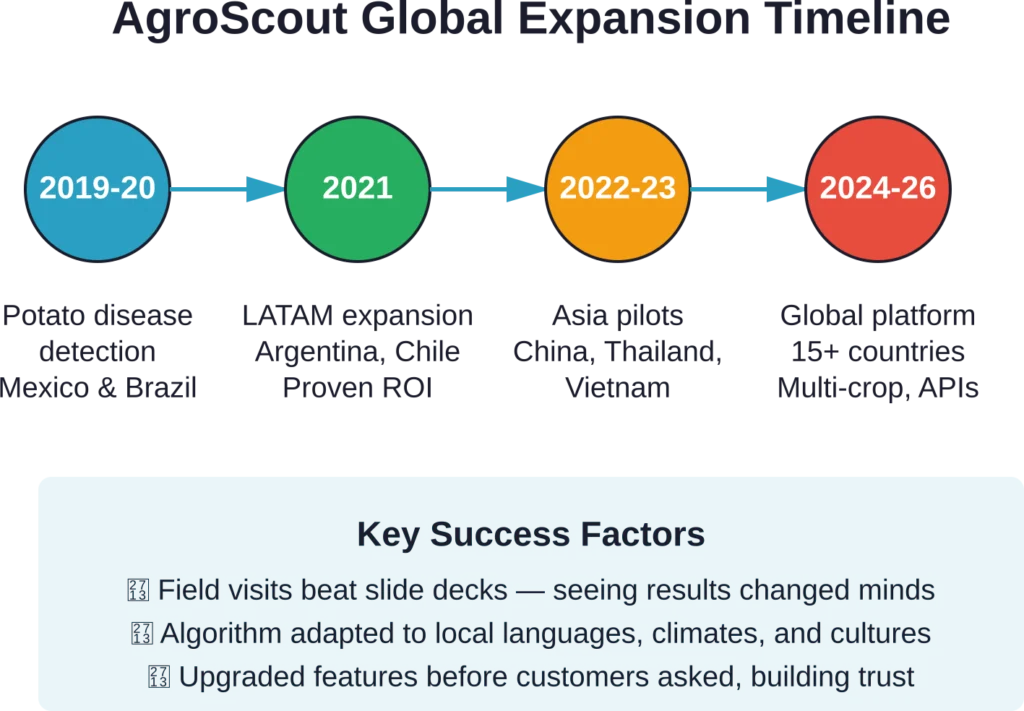
AgroScout’s trajectory tells you a lot about how ag-tech gains traction. The company started with a targeted solution: spotting potato diseases on a handful of farms in Mexico and Brazil. Narrow focus, high stakes—potatoes are PepsiCo’s lifeblood for Frito-Lay products.
PepsiCo’s Latin America team flew to Israel, met the founders, and saw potential beyond the initial scope. They ran a pilot. One growing season proved AgroScout saved money and boosted yields. The data spoke for itself.
Argentina and Chile joined next. Different climates, same results—healthier crops and cleaner data. Then pilots in China, Thailand, and Vietnam showed the model could work across languages, cultures, and farming styles.
AgroScout added yield forecasts, growth tracking, and a multi-language dashboard. No longer “just potatoes.” The platform expanded to handle multiple crops: corn, oats, cassava, and others in PepsiCo’s supply chain.
As of recent updates, AgroScout is running in 15+ countries and feeding live data into PepsiCo’s supply chain APIs. The company inked a global agreement with PepsiCo—from one crop in one country to a platform on every continent.
And in recent developments, AgroScout kicked off real-time pest prediction powered by next-generation AI. At the same time, they’re scaling R&D capabilities and talking to other food giants who saw the PepsiCo results and want in.
Real-World Accuracy: The Cassava Study
Marketing slides say one thing. Independent field trials say another. A 2025 study published in Frontiers in Sustainable Food Systems put an AI diagnostic tool through its paces for cassava viral diseases in Burkina Faso.
The setup: agricultural extension agents used smartphones to survey cassava fields for Cassava Mosaic Disease (CMD) and Cassava Brown Streak Disease (CBSD). Their visual assessments were compared against expert perception and molecular analysis (the gold standard).
Here’s what the numbers showed. The study evaluated participation rates and diagnostic accuracy. The data presented shows the AI tool’s performance was compared against expert perception validated by molecular analysis, with participation rates reaching 60% after workshops and smartphone allocation.
Now, context matters. The tool increased the number of surveyed fields, which matters for early outbreak detection. But the accuracy gap between field AI and lab confirmation is real, highlighting a critical point: AI crop disease detection is improving, yet still lags behind expert human diagnosis backed by molecular testing.
Does this study directly test AgroScout? No—it’s a broader look at AI diagnostic tools in participatory surveillance. For commercial operations like PepsiCo’s, the trade-off makes sense. Speed and scale beat perfect accuracy when you’re monitoring thousands of fields. Catch 80% of problems early, and you’re still ahead of traditional scouting that might miss 50% until it’s too late.
Core Features and Capabilities
What does AgroScout actually let you do? The platform breaks down into several functional layers.
Mobile Scouting App
The app is the front line. Available on Android with 5,000+ downloads according to Google Play Store data, it’s designed for scouts and farmers to log field observations in real time.
Key features:
- Photo capture with automatic GPS tagging
- AI-powered disease and pest identification
- Symptom severity scoring
- Historical comparison of field zones
- Offline mode for remote areas with sync when connection returns
The interface is straightforward. Point, shoot, tag, submit. The AI processes images on the backend and returns a diagnosis within seconds to minutes, depending on connectivity.
Satellite Imagery Integration
AgroScout pulls NDVI and other vegetation indices from satellite sources. These highlight stress zones—areas where plant health is declining before visible symptoms appear.
The system overlays satellite data with ground-level scouting reports. If a stress zone shows up on NDVI and scouts confirm disease on the ground, that’s high confidence. If NDVI flags an area but scouts find nothing, it might be irrigation issues or soil variability rather than disease.
Dashboard and Analytics
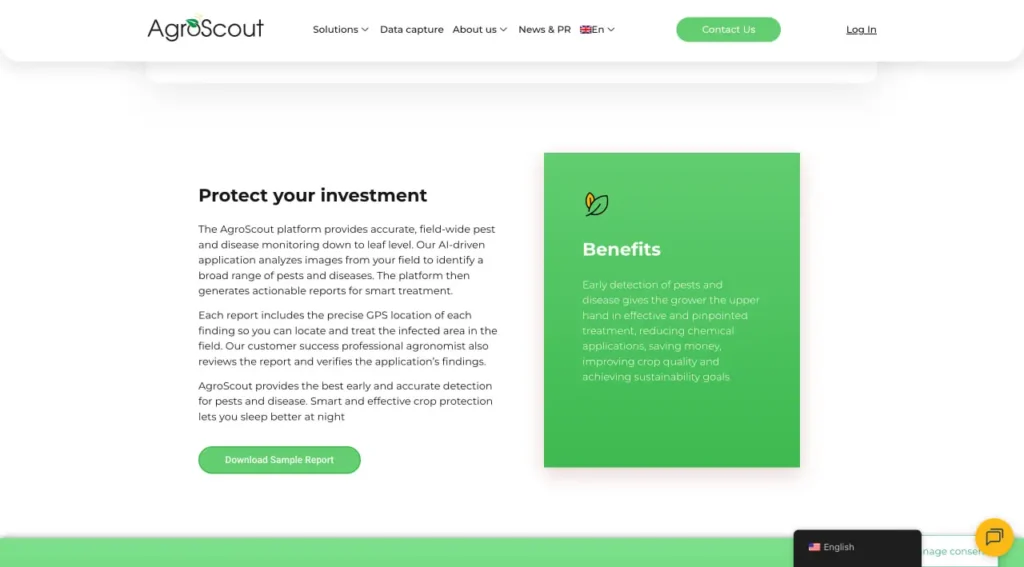
The web dashboard consolidates everything. Field maps with color-coded health zones. Disease pressure trends over time. Yield forecasts based on current conditions. Treatment recommendations.
Multi-language support matters for global operations. A Thai farmer shouldn’t need to read English diagnostics. AgroScout adapted its interface and AI training data to handle regional languages and local disease variants.
API Integrations
For enterprise users like PepsiCo, AgroScout feeds data into supply chain management systems. Real-time field health informs procurement forecasts, logistics planning, and quality control.
This is where the platform shifts from a scouting tool to supply chain infrastructure. If disease pressure spikes in Mexico, the system alerts procurement to source more from Argentina. If yield forecasts drop in Vietnam, production schedules adjust weeks in advance.
Pest Prediction (Gen-2 AI)
Recent updates introduced predictive pest modeling. Instead of reacting to infestations, the system forecasts where and when pests will hit based on weather, crop stage, and historical patterns.
That’s a big leap. Reactive detection saves some crop. Predictive intervention saves more, often at lower cost since you treat before populations explode.
Who Actually Uses AgroScout
The platform has different user profiles, and what makes sense for one won’t necessarily work for another.
Large Growers and Contract Farms
This is AgroScout’s core market. Farms growing for food processors—potatoes for Frito-Lay, corn for Quaker, oats for breakfast products. These operations run hundreds to thousands of acres and can’t physically scout everything daily.
For them, the value proposition is straightforward: catch disease early, reduce fungicide costs, boost yields. A 5% yield gain on 2,000 acres pencils out fast.
Agronomic Service Providers
Independent crop consultants and ag retailers use the platform to serve multiple clients. The mobile app becomes their field inspection tool, and the dashboard gives clients visibility into what’s happening on their farms.
This model scales consultant capacity. One agronomist can cover more farms when AI flags the problem areas and prioritizes site visits.
Food Companies and Processors
PepsiCo isn’t the only one. Any company sourcing agricultural commodities at scale needs crop health visibility. Quality control, yield forecasting, supplier scorecarding—AgroScout feeds data into all of it.
For processors, the platform shifts from a farm tool to a supply chain instrument. Procurement teams get early warnings. Logistics can reroute. Quality assurance catches problems before harvest.
Smallholder Farmers?
This is less clear. The marketing says “accessible for all farmers all over the world,” but the economic model leans toward larger operations. Smallholders in developing regions face connectivity issues, smartphone access, and cost barriers.
The Burkina Faso cassava study showed participation jumped to 60% when extension agents got training and devices. That suggests smallholder access depends more on institutional support—government ag services, NGOs, cooperatives—than individual adoption.
Pricing and Access
Here’s where things get murky. AgroScout doesn’t publish transparent pricing on its website. That’s common in enterprise ag-tech—everything is “contact sales.”
Based on industry patterns and available information, the pricing model likely includes:
- Per-acre or per-hectare subscription fees
- Tiered plans based on feature access (basic scouting vs. full analytics)
- Enterprise licensing for multi-country operations
- API access fees for supply chain integrations
For individual farmers, check the official AgroScout website or app listing for current access options. The platform may offer trial periods or pilot programs, particularly in regions where it’s expanding.
The Google Play Store shows the app is free to install, but that doesn’t mean free to use at full capacity. Freemium models are common—basic features free, advanced analytics paid.
Comparison With Other Crop Monitoring Tools
AgroScout isn’t the only player. The precision ag space has dozens of competitors, each with slightly different angles.
| Platform | Primary Focus | Key Strength | Limitations |
|---|---|---|---|
| AgroScout | Disease/pest detection | Mobile scouting + satellite integration, PepsiCo-backed | Pricing opacity, enterprise-focused |
| FarmLogs / Bushel | Farm management | Comprehensive record-keeping, market data | Disease detection not core feature |
| Taranis | Aerial imagery, high-resolution drone/plane scouting | Ultra-high-res leaf-level imaging | Higher cost, requires aerial operations |
| Climate FieldView | Data platform for precision ag | Equipment integration, broad adoption | Disease ID secondary to yield optimization |
| Semios | Orchard/vineyard pest management | Real-time sensor networks, micro-climate monitoring | Specialty crop focus, not row crops |
AgroScout’s niche is disease and pest detection with mobile-first design. If your primary pain point is catching late blight or corn borer early, it’s purpose-built for that. If you need broader farm management, yield mapping, or equipment integration, other platforms might fit better.
The PepsiCo partnership matters. It signals that the system works at scale under real commercial pressure. Food companies don’t deploy ag-tech globally unless it delivers measurable ROI.
Strengthen Crop Image Analysis with FlyPix AI
Crop monitoring workflows often need fast image review across large fields, repeated scouting cycles, or multiple data sources. FlyPix AI supports geospatial analysis of satellite, drone, aerial, LiDAR, SAR, and multispectral imagery. For workflows related to AgroScout, it can help teams detect visible objects, segment field areas, classify features, and monitor changes from remote sensing or drone-based datasets.
FlyPix AI is created for:
- Object detection in drone, aerial, or satellite imagery
- Field area segmentation for crop monitoring workflows
- Change detection across different image dates
- Custom AI model training for project-specific image analysis
👉Talk to FlyPix AI about AI-based geospatial analysis for your crop monitoring workflow.
Practical Strengths and Weaknesses
Every tool has trade-offs. Here’s what works and what doesn’t with AgroScout based on available information and field deployment data.
What Works Well
- Early detection speed: Catching disease 5-7 days earlier than traditional scouting gives growers time to act before economic thresholds hit. That’s the core value.
- Scalability: The platform handles thousands of fields across multiple countries. For large operations, that’s critical—you can’t physically be everywhere.
- Multi-language and regional adaptation: The AI was trained on diverse climates and disease profiles. A tool built only for Iowa corn won’t work in Vietnam cassava. AgroScout adapted.
- Supply chain integration: API access turns field data into procurement intelligence. That’s a huge win for food companies managing complex sourcing networks.
- Continuous improvement: The system learns from every scouting report. More data makes the AI more accurate over time, especially in regions with dense adoption.
Limitations and Challenges
- Accuracy isn’t 100%: Independent studies show that AI accuracy varies by crop and disease. AI is fast, but not as accurate as lab analysis. That’s fine for screening, risky for treatment decisions without ground-truthing.
- Connectivity dependence: Offline mode exists, but full functionality requires decent internet. Remote fields with poor coverage face sync delays and limited real-time analysis.
- Pricing transparency: The “contact sales” model makes cost comparison difficult. Farmers can’t easily evaluate ROI without a sales conversation.
- Smartphone and training barriers: Smallholder adoption depends on device access and digital literacy. The Burkina Faso study needed workshops and phone distribution to hit 60% participation.
- Enterprise focus: The platform is optimized for large operations and food companies. Independent mid-size farmers might find the feature set overkill or the cost structure unfavorable.
Integration With Broader Agricultural Tech Stacks
AgroScout doesn’t exist in a vacuum. Modern farms run multiple software systems: equipment telematics, yield monitors, soil sampling platforms, weather stations, market data feeds.
The question is whether AgroScout plays well with the rest.
API access is the key. Enterprise customers like PepsiCo integrate AgroScout data into their ERP and supply chain management systems. Field health data flows into procurement forecasts, quality control triggers, and logistics planning.
For independent farmers, integration is less seamless. If you’re running Climate FieldView for yield mapping and John Deere Operations Center for equipment, adding AgroScout means another login, another dashboard, another dataset to reconcile.
Industry reports suggest the future of ag-tech is interoperability—platforms that talk to each other through open APIs and standardized data formats. AgroScout has the APIs. Whether they connect smoothly to smaller-scale farm management systems depends on those platforms opening their side of the integration.
The Bigger Picture: Precision Agriculture’s ROI Problem
Here’s the uncomfortable truth about precision ag: adoption is slow because ROI is hard to prove at the individual farm level.
Large food companies see clear value. PepsiCo didn’t sign a global agreement because it felt futuristic—they signed because the data showed cost savings and yield gains across multiple seasons and geographies.
But for a 500-acre corn and soybean farm in Iowa? The math gets trickier. Subscription costs, learning curve, time spent managing yet another platform. Does early disease detection on 10% of fields in a bad year justify the annual cost?
AgroScout’s model tilts toward contract growers and supply chain-integrated farms where the food company subsidizes or mandates adoption. Independent farmers need to run their own cost-benefit analysis based on crop value, disease pressure history, and current scouting costs.
If disease losses average 5-10% annually and AgroScout cuts that in half, the ROI is obvious. If disease is sporadic and losses are minimal, harder to justify.
Future Trajectory: What’s Next
AgroScout is actively expanding. Recent updates mention scaling R&D capabilities, launching Gen-2 AI for predictive pest modeling, and talking to other multinational food companies beyond PepsiCo.
The predictive shift matters. Reactive disease detection is valuable. Predictive pest and disease modeling is transformative. If the system can tell growers three weeks in advance that European corn borer pressure will spike in Zone 5, that changes spray timing, scouting intensity, and treatment costs.
Expansion into more crops is likely. Potatoes, corn, oats, and cassava are covered. Soybeans, wheat, cotton, and specialty crops are logical next steps. Each crop requires training the AI on new disease signatures, symptom patterns, and regional variants.
Partnerships with other ag-tech providers could broaden reach. Integration with equipment manufacturers, seed companies, or agrochemical suppliers would embed AgroScout deeper into existing farm workflows.
And the smallholder question remains open. If AgroScout wants true global accessibility, it needs models that work in low-connectivity regions with subsidized or shared device access. The Burkina Faso model—extension agents as intermediaries—might be the path.
How AgroScout Fits Sustainable Agriculture Goals
Precision agriculture and sustainability overlap in several areas. AgroScout contributes to a few key goals.
Reduced Chemical Use
Early disease detection means targeted treatment. Instead of blanket fungicide applications, growers can spray only affected zones. That cuts chemical costs, reduces environmental load, and aligns with integrated pest management principles.
Yield Optimization
Healthier crops mean higher yields per acre. That matters for global food security—producing more on existing farmland reduces pressure to convert forests and grasslands to agriculture.
PepsiCo’s Positive Agriculture agenda includes goals like reducing Scope 3 forest, land, and agriculture greenhouse gas emissions by 30% against a 2022 baseline and sustainably sourcing 90% of key ingredients. Tools like AgroScout feed into those metrics by improving crop health and resource efficiency.
Data-Driven Decision Making
Sustainable farming isn’t just about using less—it’s about using smarter. AgroScout’s analytics help growers make evidence-based decisions rather than defaulting to calendar-based spraying or gut-feel scouting.
Supply Chain Transparency
For food companies, tracking crop health from field to processor builds transparency. Consumers increasingly demand proof that products are grown sustainably. Real-time field data provides that proof.
Practical Considerations Before Adopting AgroScout
Thinking about adding AgroScout to your operation? Here are the questions to ask first:
- What’s the disease pressure in your region? If late blight, rust, or other diseases regularly threaten yields, early detection pays off. If disease is rare, the value drops.
- How do you currently scout? If you’re already paying for agronomic services or dedicating significant labor to field walks, AgroScout might reduce those costs. If scouting is informal and infrequent, the comparison is harder.
- What’s your connectivity situation? The platform needs internet access for full functionality. Remote fields with poor cellular coverage will face limitations.
- Are you contract farming? If your buyer is PepsiCo or another large food company, they may subsidize or require AgroScout adoption. That changes the cost-benefit equation entirely.
- Do you have smartphone access and digital comfort? The mobile app is the entry point. Scouts need devices and basic digital literacy.
- What’s the trial option? Check whether AgroScout offers pilot programs or trial periods. Testing the system on a subset of fields before full commitment reduces risk.
- How does it integrate with your current systems? If you’re running other farm management software, understand whether AgroScout data can flow into those platforms or if it’s a standalone silo.
Lessons From the Field: What the PepsiCo Rollout Teaches
The PepsiCo expansion offers lessons for any ag-tech adoption:
- Start narrow, prove value: AgroScout didn’t launch globally. It started with potato diseases in two countries. One growing season of measurable results opened doors.
- Field visits beat slide decks: PepsiCo’s LATAM team flew to Israel and saw the system in action. Watching it work in Brazil fields changed minds faster than presentations.
- Data speaks louder than promises: Yield gains and cost reductions in Mexico and Argentina made the case for Chile, China, and beyond. Hard numbers drive expansion.
- Culture and language matter: Adapting the AI to Thai, Mandarin, Spanish, and Portuguese wasn’t optional. Global tools need local fluency.
- Add features proactively: AgroScout upgraded from disease detection to yield forecasts and growth tracking before customers demanded it. That built trust and stickiness.
- Global deals are starting lines, not finish lines: The PepsiCo agreement opened the door, but real value comes from continuous improvement and expanding capabilities.
Common Misconceptions About AI Crop Monitoring
A few myths persist about platforms like AgroScout:
- Myth: AI replaces agronomists. Wrong. AI flags problems. Agronomists decide what to do about them. The tool augments expertise, not replaces it.
- Myth: It works perfectly out of the box. Nope. AI accuracy improves with local training data. Early adopters in new regions might see lower accuracy until the model learns regional disease patterns.
- Myth: You need expensive equipment. A smartphone is the entry barrier. That’s lower than yield monitors, soil sensors, or drones. But connectivity and subscription costs add up.
- Myth: It’s only for big operations. Large farms see clearer ROI, but mid-size growers in high disease-pressure regions can benefit. Smallholders need institutional support to access it.
- Myth: Satellite imagery catches everything. Satellites see stress zones, not specific diseases. Ground-level scouting confirms what the overhead data flags. Both layers are necessary.
How AgroScout Compares to Traditional Scouting
| Aspect | Traditional Scouting | AgroScout |
|---|---|---|
| Detection Speed | Visual symptoms only, often 7-10 days post-infection | Satellite stress detection 3-5 days earlier, AI confirms |
| Coverage | Limited by scout time/labor, samples ~10% of fields | Satellite covers 100%, ground scouts target AI-flagged zones |
| Accuracy | Depends on scout experience, human error possible | AI around 80-90% accuracy, improves with local data |
| Cost | Labor + vehicle + time, often $5-15/acre/season | Subscription-based, pricing varies by region and scale |
| Data Retention | Paper notes or basic digital logs, hard to analyze trends | Centralized database, historical trends, predictive analytics |
| Scalability | Difficult—more fields = more scouts | Scales easily across thousands of fields/countries |
The comparison isn’t zero-sum. Many operations use both—AI flags zones, scouts ground-truth, and agronomists make treatment calls. Hybrid models often deliver better results than pure AI or pure human scouting.
Frequently Asked Questions
AgroScout operates in 15+ countries as of 2026, with the strongest presence in Latin America, Asia, and regions where PepsiCo sources crops. Availability varies by country. Check the official AgroScout website or contact their sales team to confirm service in your region.
AI accuracy typically ranges from 80-90% for well-trained crop and disease combinations. Independent studies show variability—one cassava virus study found accuracy varies based on methodology and validation approaches. Accuracy improves as the system accumulates more regional training data. It’s best used as a screening tool with agronomist confirmation for treatment decisions.
Technically yes, but economic and infrastructure barriers exist. The platform requires smartphone access, decent internet connectivity, and subscription costs that may not pencil out for small acreages. Field studies in Burkina Faso showed that extension agent-led programs with training and device support achieved 60% smallholder participation. Institutional support—government ag services, cooperatives, NGOs—makes smallholder access more viable.
AgroScout does not publish transparent pricing. The model appears to be subscription-based with per-acre or per-hectare fees, tiered plans by feature access, and enterprise licensing for multi-country operations. The mobile app is free to install on Google Play, but full functionality likely requires a paid plan. Contact AgroScout directly or check their official website for current pricing in your region.
No. AgroScout flags potential problems and prioritizes where scouts should focus attention. It augments agronomic expertise rather than replacing it. Experienced agronomists still make treatment decisions, confirm diagnoses, and adjust recommendations based on field-specific factors the AI can’t capture. Think of it as a force multiplier, not a substitute.
AgroScout started with potatoes and has expanded to corn, oats, cassava, and other crops in PepsiCo’s supply chain. The platform is multi-crop capable, but AI accuracy depends on whether the system has been trained on specific crop-disease combinations in your region. Contact AgroScout to confirm whether your crop and regional disease profile are supported.
The mobile app has offline mode for data capture—scouts can photograph and tag observations without connectivity, and the data syncs when internet access returns. However, real-time AI analysis requires the internet. Full functionality depends on at least intermittent connectivity to upload images and download diagnostics.
Final Verdict: Is AgroScout Worth It?
The answer depends entirely on your operation.
For large growers, contract farms, and food companies managing multi-country supply chains, AgroScout delivers clear value. Early disease detection, yield forecasting, and supply chain integration create measurable ROI. PepsiCo’s global rollout proves it works at scale.
For mid-size independent farmers, the calculation is trickier. If disease pressure is chronic and current scouting costs are high, AgroScout could pay for itself. If disease is sporadic, the subscription might not pencil out. Trial programs or pilot seasons reduce risk.
For smallholders, direct adoption faces barriers. Connectivity, device access, cost, and digital literacy all complicate the picture. Extension agent-led programs and cooperative models show more promise than individual subscriptions.
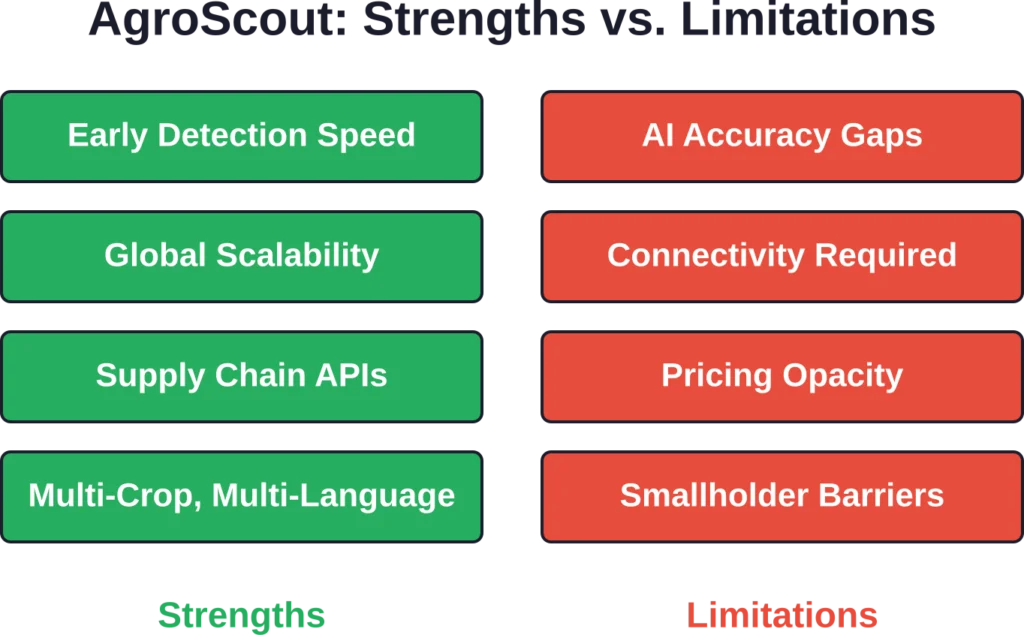
The platform’s strengths are real: speed, scalability, multi-language support, API integrations, and continuous learning. The limitations are also real: accuracy gaps, connectivity dependence, pricing opacity, and enterprise focus.
AgroScout isn’t a silver bullet. It’s a tool—powerful in the right hands, irrelevant in others. The key is matching the tool to the problem.
If early disease detection is your bottleneck, AgroScout solves it. If your challenges lie elsewhere—water management, soil health, market access—other solutions take priority.
The ag-tech landscape is crowded. Not every farm needs every tool. But for operations where crop disease threatens profitability and current scouting falls short, AgroScout is worth serious evaluation.
Start narrow. Test it on high-value fields or crops with chronic disease pressure. Measure the results. Scale if the data justifies it.
That’s the model PepsiCo followed. And it took them from a few potato fields in Mexico to a global platform in five years.