
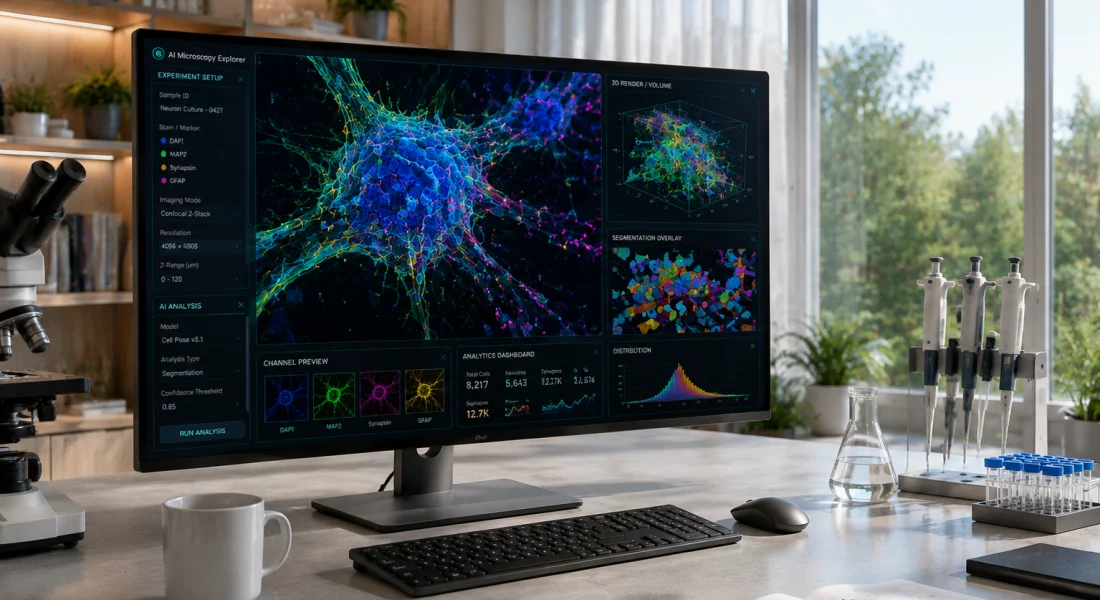
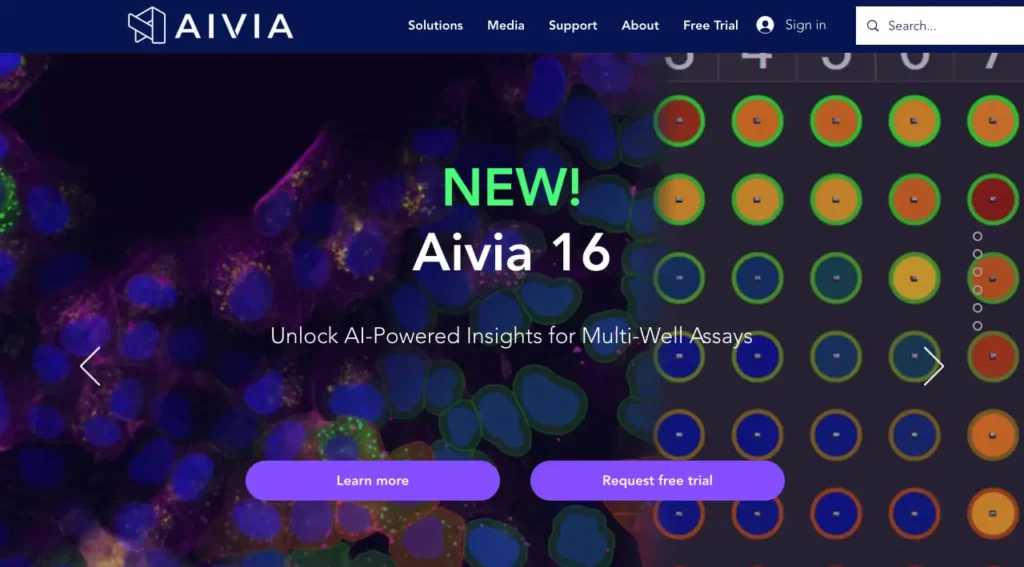
Quick Summary: Aivia is Leica Microsystems’ AI-powered image analysis software designed for 2D to 5D microscopy visualization and analysis. The platform features deep learning tools like Segment by Example, achieving 69% faster 3D analysis pipelines and enabling scientists to extract insights from complex biological images without coding expertise.
Leica Microsystems acquired Aivia in March 2021, integrating two decades of research and development into their microscopy ecosystem. Built on advanced algorithms and state-of-the-art machine learning technology, Aivia has become the company’s flagship AI-enabled solution for scientists handling large, complex biological datasets.
The software tackles a persistent challenge in microscopy: extracting meaningful insights from massive image files without requiring computational expertise. Standard segmentation methods often demand substantial manual curation, introducing human error and reproducibility issues. Aivia changes that equation entirely.
Core AI Features and Segment by Example
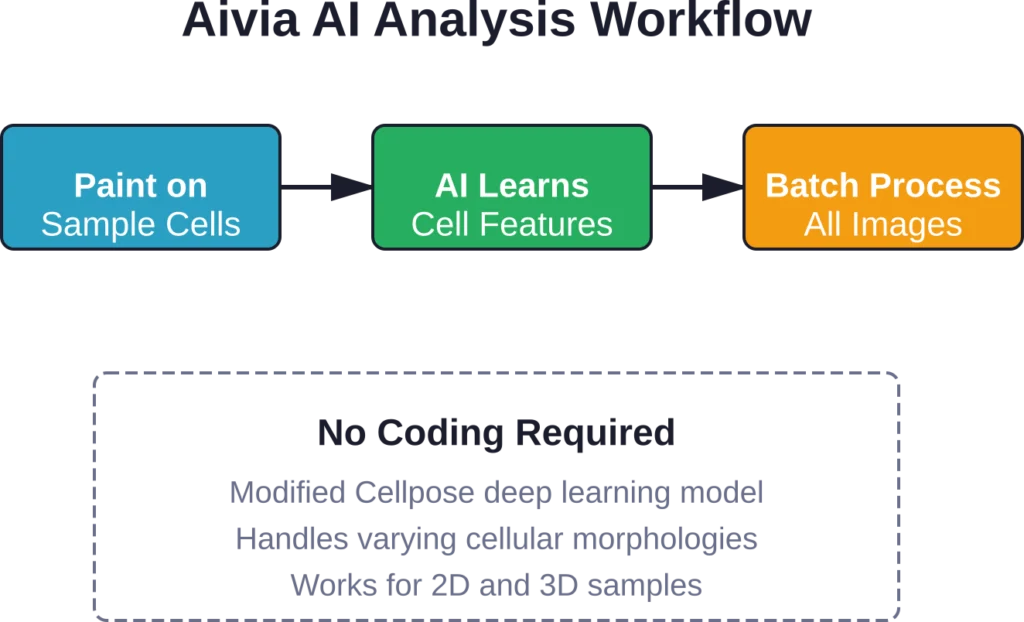
The platform’s most notable capability, introduced in Aivia 15, is Segment by Example. This deep learning-powered tool lets scientists paint directly on sample cells—whether in 2D or 3D—to deploy an AI model modified from Cellpose.
Here’s what makes it different: users don’t write code or train models. Paint on a few example cells, and the deep learning engine automatically segments similar structures across varying cellular morphologies. According to the official release, this approach delivers accurate detection with minimal manual input.
Aivia 12 incorporated the Cellpose deep learning model for neuroscience applications, improving soma detection by as much as 46% in dense neuron images. The software also streamlines AI-enabled 3D tracing of Golgi-stained samples through updated neuron analysis workflows.
Performance Gains and Optimization
Speed matters when analyzing multi-dimensional image stacks. Aivia 15 accelerates 3D analysis pipelines by up to 69%, delivering improved performance on 3D analysis operations. That speedup applies across all 3D analysis operations, from object detection to neuron tracing.
Aivia Launchpad simplifies quantitative analysis with pre-set Guided Sequences and tutorials. The Aivia That Learns feature predicts suitable analysis parameters for 3D Object Analysis and 3D Neuron Analysis recipes. The result? A 74% reduction in analysis time by streamlining parameter optimization—a process that traditionally requires extensive trial-and-error.
| Feature | Performance Improvement | Application |
|---|---|---|
| 3D Pipeline Optimization | Up to 69% faster | All 3D analysis workflows |
| Aivia That Learns | 74% time reduction | Parameter optimization |
| Cellpose Integration | Up to 46% better detection | Dense neuron soma identification |
Platform Architecture and Capabilities
Aivia handles 2D to 5D image datasets—covering X, Y, Z dimensions plus time and channel variations. The software architecture supports high-performance tasks like displaying extremely large images and analyzing complex biological phenomena without performance degradation.
The platform includes pre-trained deep learning models for common analysis tasks. Researchers can access machine learning technology for both image segmentation and object classification without building models from scratch. For imaging facilities serving multiple users with diverse needs, this versatility proves particularly valuable.
Aivia operates locally or via web-based deployment, giving labs flexibility in how they structure their analysis infrastructure. The software integrates with Leica’s microscopy hardware ecosystem, including the STELLARIS confocal platform and Mateo digital microscopes.
Applications Across Research Domains
Neuroscience teams use Aivia for morphological analysis, tracing neuronal structures in 3D with AI assistance. The platform’s Golgi-stain workflow and improved soma detection make it particularly effective for dense tissue samples.
Cancer research applications benefit from high-throughput spatial analysis tools. The software supports Hi-Plex analysis for breast cancer studies, enabling quantitative assessment of tumor microenvironments and cellular interactions.
Cell biology labs leverage Aivia for counting, tracking, and measuring cellular dynamics. Confluency measurement, transfection efficiency analysis, and particle tracking fall within the platform’s standard capabilities.
Move from Lab Image Analysis to Site Review with FlyPix AI
Aivia by Leica Microsystems is built around AI-assisted image analysis for microscopy and scientific imaging. FlyPix AI applies a similar need for visual analysis to a different environment – satellite, drone, and aerial imagery used for land, infrastructure, agriculture, and environmental review.
FlyPix AI can support teams that need to analyze real-world locations from above:
- Detecting visible objects, roads, buildings, vegetation, or infrastructure
- Segmenting land, water, agricultural areas, built zones, or other mapped features
- Comparing satellite, drone, or aerial imagery across different dates
- Training custom AI models for specific geospatial detection tasks
👉Contact FlyPix AI to discuss how geospatial image analysis can support location-based visual review work.
Getting Started and Accessibility
Leica Microsystems offers free trial access to Aivia, allowing researchers to test the platform with their own datasets before committing. The company positions different solutions for individual investigators versus imaging core facilities, recognizing that user needs vary significantly.
The barrier to entry is deliberately low. The interface design prioritizes usability, with relevant tools accessible within one click. Measurement templates reduce manual steps for routine analyses, and batch processing capabilities handle large datasets efficiently.
For teams requiring specialized functionality, custom development options exist. But most researchers find the standard feature set comprehensive enough for their applications without additional development work.
Frequently Asked Questions
Aivia handles 2D to 5D image datasets from various microscopy sources, including confocal, widefield, and digital microscopy systems. The software includes recalibration tools for imported images, providing flexibility across different microscope platforms.
No. The Segment by Example feature and other AI tools operate through intuitive painting and selection interfaces. Scientists without coding experience can deploy deep learning models by marking example cells directly on their images.
Aivia integrates commercial-grade AI models (modified Cellpose), optimized 3D visualization, and predictive parameter tools that aren’t available in most open-source packages. The trade-off is cost versus the time saved through automated workflows and superior performance on large datasets.
Yes. The software accepts images from multiple manufacturers and includes calibration tools to ensure accurate measurements regardless of the original acquisition system.
Subscription plans vary based on user type (individual researcher versus core facility). Check Leica Microsystems’ official website for current pricing and feature tiers, as these details update regularly.
The system analyzes image characteristics and predicts optimal analysis parameters for 3D Object and Neuron Analysis recipes. This eliminates most manual parameter adjustment, which traditionally consumes significant analysis time.
Leica Microsystems provides webinars, tutorial videos, and documentation for Aivia users. Imaging facilities can arrange custom training sessions for their user communities.
Conclusion
Aivia represents Leica Microsystems’ investment in making AI-powered microscopy analysis accessible to working scientists. The platform delivers measurable performance gains—69% faster 3D workflows, 74% time savings through parameter prediction—while eliminating the coding barrier that historically limited AI adoption in biology labs.
For researchers drowning in multi-dimensional image datasets, Aivia offers a practical solution that balances power with usability. The software won’t replace deep computational expertise for highly specialized applications, but it democratizes AI-enabled analysis for the broader scientific community.
Request a free trial from Leica Microsystems to test Aivia with your own datasets and determine whether the platform fits your workflow requirements.