
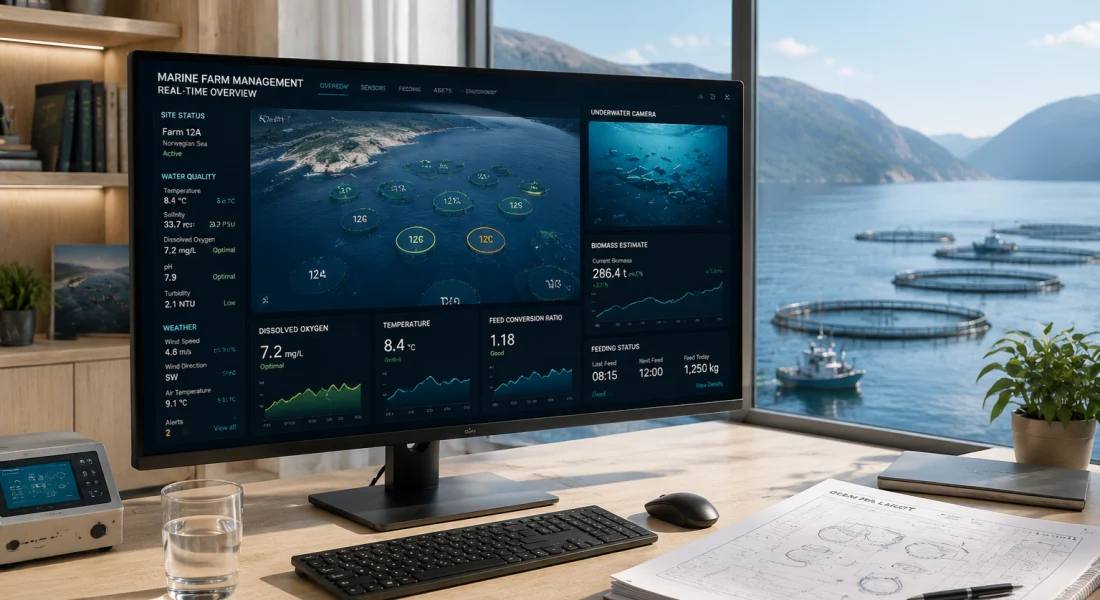
Quick Summary: AKVA group is a Norwegian aquaculture technology provider specializing in sea-based fish farming equipment, digital solutions, and cage systems. The company has partnered with major industry players like Mowi on low-emission farming projects and expanded its digital capabilities through strategic hires, positioning itself as a key supplier in the global aquaculture equipment market.
The aquaculture technology sector has evolved dramatically over the past few years, with Norwegian firms leading the charge in equipment innovation and digital transformation. AKVA group ASA stands out as one of the most established players in this space, supplying everything from cage infrastructure to sophisticated monitoring systems.
But what exactly does AKVA group offer? How do their tools perform in real-world deployments? And where do they fit in the competitive landscape of global aquaculture equipment providers?
This review breaks down AKVA group’s core technology offerings, examines their recent projects and strategic moves, and evaluates how their solutions measure up for modern fish farming operations.
Who Is AKVA Group and What Do They Do?
AKVA group is a Norwegian aquaculture technology company that supplies equipment and systems for sea-based fish farming operations worldwide. The company operates as a comprehensive provider, meaning they handle multiple aspects of the aquaculture production chain rather than specializing in just one component.
Their product portfolio spans cage systems, feeding technology, environmental monitoring equipment, and increasingly, digital management platforms. According to recent industry reports, AKVA group maintains a significant presence in the global aquaculture equipment market, which continues to expand alongside growing demand for farmed seafood.
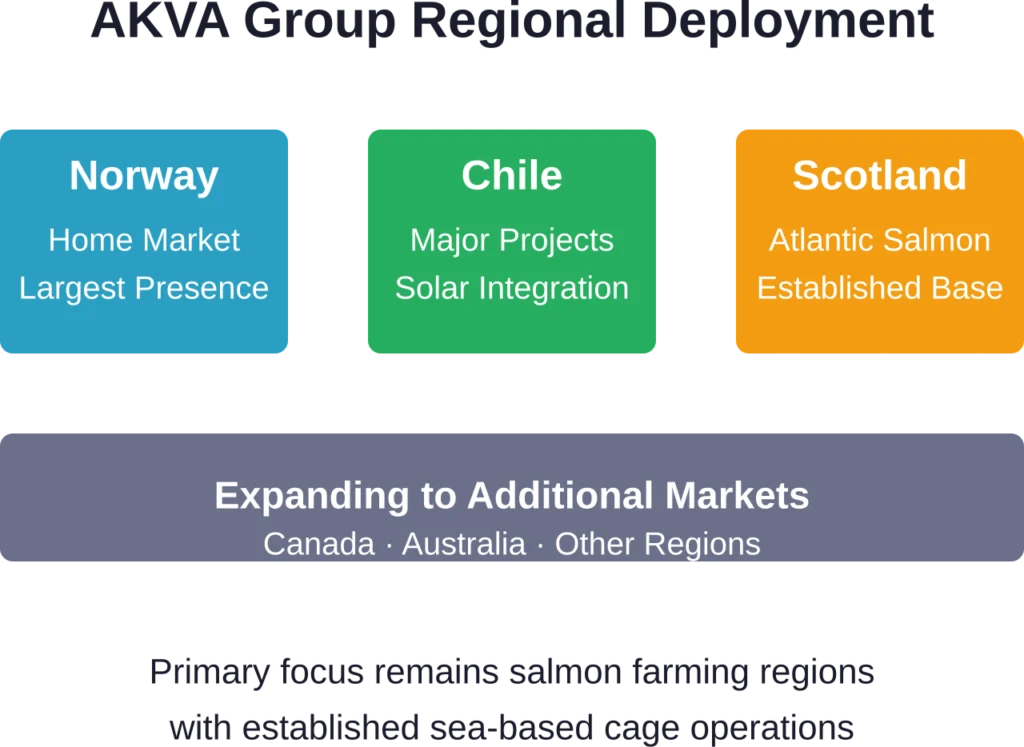
The company’s client base includes major salmon producers and aquaculture operations across Norway, Chile, Scotland, and other key fish farming regions. Mowi, one of the largest salmon producers globally, has worked with AKVA group on multiple projects, including the deployment of innovative low-emission farming infrastructure.
Core Product Categories
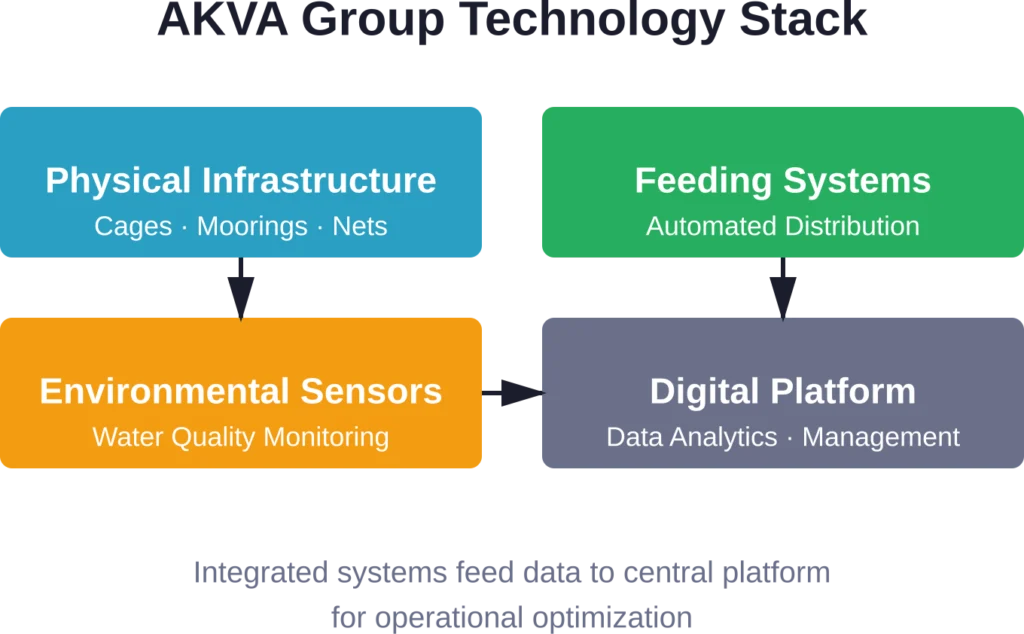
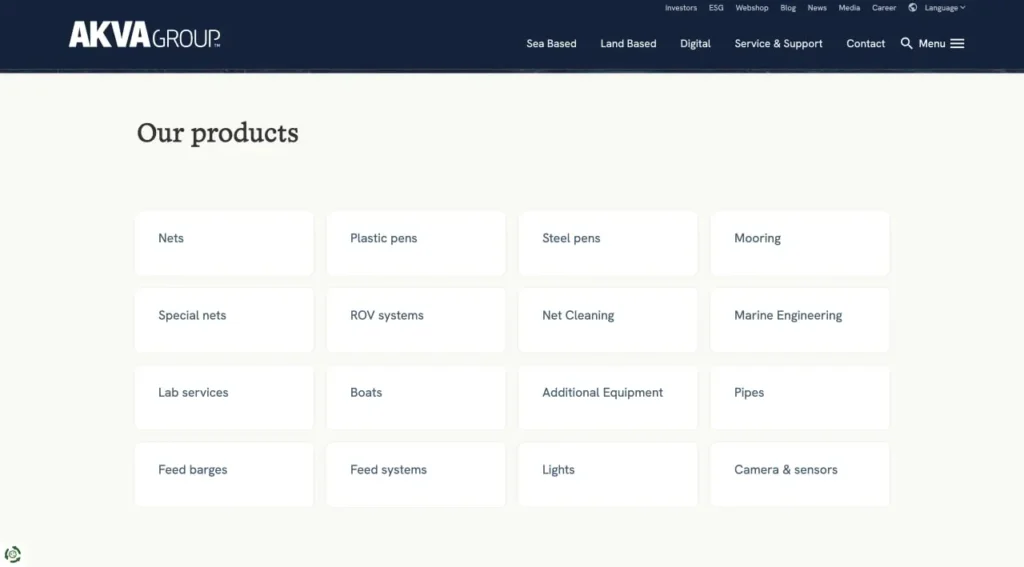
AKVA group’s technology offerings fall into several distinct categories:
- Cage Infrastructure: Physical farming systems including net pens, mooring equipment, and structural components for sea-based operations
- Feeding Systems: Automated feeding equipment designed to optimize feed distribution and minimize waste
- Environmental Monitoring: Sensors and data collection tools that track water quality, oxygen levels, and other critical parameters
- Digital Platforms: Software solutions for farm management, data analysis, and operational optimization
The Norwegian aquaculture technology group has been expanding its digital capabilities, recently hiring Kristine Langaunet from Tidal as product director to work with AKVA’s Digital team. This move signals the company’s strategic shift toward software and data-driven solutions alongside traditional hardware offerings.
Recent Projects and Innovation Highlights
AKVA group’s recent work provides concrete examples of how their technology performs in demanding real-world environments. The company’s collaboration with Mowi on Chile’s first low-emission fish farm represents one of the most significant developments in their portfolio.
This facility features a solar-powered floating cage system at the Huar Norte location. AKVA group provided the cage infrastructure and solar integration for the project, which also involved energy technology providers Alotta Energy and Fjord Maritime.
Christian Schäfer, AKVA group Chile General Manager, noted that the project demonstrates Mowi’s leadership in adopting sustainable farming practices. Full construction was expected to start in 2026 based on initial civil works completion.
Sustainable Farming Focus
The Chile project reflects broader industry trends toward reducing the environmental footprint of aquaculture operations. Research from institutions like the University of Idaho’s Aquaculture Research Institute shows that sustainable practices are increasingly central to aquaculture development.
According to aquaculture research, fish serves as a significant protein source for millions globally. ARI scientists have made progress on low-phosphorus feed formulations that reduce water pollution while supporting higher production levels. These types of innovations complement infrastructure improvements like solar-powered cage systems.
AKVA group’s participation in low-emission projects positions them well as regulatory pressure increases and major producers prioritize sustainability metrics. The Norwegian aquaculture technology sector has generally been ahead of the curve on environmental considerations compared to suppliers in other regions.
Digital Transformation and Software Capabilities
Here’s where things get interesting for AKVA group’s future trajectory. The company’s recent hire of Kristine Langaunet as Director of Product for their Digital team signals serious investment in software and data analytics capabilities.
Traditional aquaculture equipment suppliers have historically focused on hardware — cages, nets, feeders, sensors. But the competitive landscape is shifting as farm operators demand integrated platforms that connect physical equipment with data management and decision support tools.
AKVA group’s Digital division aims to bridge this gap. While specific product details weren’t extensively covered in available sources, the strategic emphasis on digital talent acquisition suggests the company recognizes that future differentiation will come partly from software rather than hardware alone.
Industry Context for Digital Tools
Research initiatives like NTNU’s Aquarisk project demonstrate the growing importance of integrating environmental sustainability with financial risk management in aquaculture operations. These projects work across economics, technology, and environmental science to generate knowledge supporting responsible industry growth.
Digital platforms that can model risk, predict outcomes, and optimize operations based on real-time data will become table stakes for serious aquaculture technology providers. AKVA group appears to be positioning itself accordingly, though the maturity and capabilities of their digital offerings remain somewhat opaque from publicly available information.
The company’s COO Digital, Ole Kristian Sivertsen (whose controlled entity OKS Consulting AS acquired shares in the company at NOK 135.07 per share according to mandatory trade notifications), presumably plays a central role in this digital transformation strategy.
Competitive Positioning in the Aquaculture Equipment Market
The global aquaculture equipment market includes numerous suppliers ranging from specialized niche players to comprehensive technology providers like AKVA group. Understanding where AKVA fits requires looking at market dynamics and competitor approaches.
Norwegian aquaculture technology firms have consolidated in some cases, with companies like OptoScale acquiring fellow firms to expand capabilities. This consolidation trend reflects pressure to offer more complete solutions rather than point products.
| Market Segment | AKVA Group Presence | Key Competitors |
|---|---|---|
| Cage Systems | Strong — core offering | Regional fabricators, integrated producers |
| Feeding Technology | Established player | Specialized feeding system companies |
| Environmental Monitoring | Growing segment | Sensor specialists, tech startups |
| Digital Platforms | Developing capabilities | Ag-tech software firms, data analytics providers |
AKVA group’s comprehensive approach — offering multiple product categories rather than specializing — provides advantages in terms of integration and single-vendor relationships. Farm operators dealing with one primary supplier for cages, feeding, and monitoring can potentially achieve better system coordination.
That said, this breadth also means AKVA competes with specialized firms that may have deeper expertise in specific niches. A company focused exclusively on feeding optimization might offer more advanced algorithms or hardware refinements than a diversified equipment provider.
Geographic Reach and Market Share
AKVA group maintains a significant presence in key salmon-producing regions: Norway (the domestic market), Chile (the second-largest salmon producer), and Scotland. Their work with major producers like Mowi provides both revenue stability and reference projects that validate their technology.
Market share data for aquaculture equipment suppliers isn’t comprehensively tracked in public sources, but AKVA group is consistently mentioned alongside the largest providers in industry discussions. Their stock trades publicly (AKVA group ASA), with financial analysts at firms like Inderes covering the company.
Support Aquaculture Site Monitoring with FlyPix AI
Aquaculture operations often need reliable spatial data around coastal areas, land-based facilities, access zones, and surrounding environmental conditions. FlyPix AI helps teams analyze satellite, drone, aerial, LiDAR, SAR, and multispectral imagery through object detection, segmentation, classification, and change monitoring. For workflows connected to AKVA group, it can support geospatial review of aquaculture sites, nearby infrastructure, land areas, water-adjacent zones, and visible site changes.
FlyPix AI can help aquaculture and site planning teams with:
- Detecting visible infrastructure and site features from imagery
- Monitoring visible changes across repeated image captures
- Training custom AI models for site-specific geospatial analysis
- Preparing geospatial outputs for review, planning, or reporting
👉Reach out to FlyPix AI to discuss geospatial image analysis for your aquaculture site workflow.
Strengths and Limitations of AKVA Group Technology
Real talk: no technology provider excels at everything. AKVA group brings clear strengths to the table, but also faces constraints and competitive pressures that affect their value proposition.
Key Strengths
- Integrated Offering: The ability to source multiple system components from a single vendor simplifies procurement, potentially improves integration, and consolidates support relationships. For farm operators who value coordination over best-of-breed component selection, this matters.
- Established Track Record: Projects with major producers like Mowi provide proof points that AKVA group’s technology works at scale in commercial environments. New aquaculture operations can reference these deployments rather than taking a chance on unproven suppliers.
- Innovation Participation: The Chile low-emission farm and other sustainability-focused projects show AKVA group isn’t just selling legacy equipment. They’re participating in industry evolution toward lower environmental impact.
- Geographic Presence: Established operations in multiple key regions mean local support, faster response times, and better understanding of regional regulatory and environmental requirements.
Potential Limitations
- Digital Maturity: While AKVA group is investing in digital capabilities, specialized software and analytics firms may have more advanced platforms. Farm operators prioritizing cutting-edge data tools might find better options elsewhere.
- Breadth vs. Depth Trade-off: Comprehensive providers sometimes lag specialist competitors in specific categories. A company focused solely on feeding technology might innovate faster in that narrow domain than AKVA group can across their broader portfolio.
- Pricing Transparency: Publicly available information about AKVA group’s pricing is limited. Large aquaculture equipment purchases typically involve custom quotes, but lack of baseline pricing guidance makes initial evaluation harder for potential customers.
- Regional Dependency: Heavy concentration in salmon farming regions means AKVA group’s fortunes correlate with salmon market dynamics. Diversification into other species or farming methods appears limited based on available information.
| Evaluation Criteria | Assessment | Notes |
|---|---|---|
| Product Range | Strong | Covers major equipment categories |
| Innovation | Good | Participating in sustainability projects |
| Digital Capabilities | Developing | Recent talent acquisition signals investment |
| Market Position | Strong | Established with major producers |
| Pricing Transparency | Limited | Custom quotes, no published baseline |
| Global Reach | Moderate | Strong in key regions, less elsewhere |
Evaluating AKVA Group for Your Operation
So how should aquaculture operations evaluate whether AKVA group’s technology makes sense for their specific needs? Several factors come into play:
- Operation Scale: AKVA group’s comprehensive solutions and established infrastructure likely work best for medium to large operations. Smaller farms might find specialized suppliers or regional fabricators more cost-effective for individual components.
- Species Focus: The company’s primary expertise centers on salmon and sea-based cage farming. Operations focusing on other species or farming methods should verify relevant experience and technology adaptation.
- Integration Priority: If system integration, vendor consolidation, and coordinated support matter more than best-in-class individual components, AKVA group’s comprehensive approach offers advantages. Operations pursuing a best-of-breed multi-vendor strategy might mix and match instead.
- Sustainability Requirements: For farms with strong environmental mandates or regulatory pressure, AKVA group’s participation in low-emission and renewable energy projects demonstrates relevant capabilities and commitment.
- Digital Sophistication: Operations with advanced data analytics needs should carefully evaluate AKVA group’s digital platform capabilities against specialized software providers before committing to the integrated approach.
Questions to Ask During Evaluation
When considering AKVA group or any aquaculture technology supplier, potential customers should dig into specifics:
- What local support infrastructure exists in your operating region?
- Can the supplier provide reference customers with similar scale and species focus?
- How do individual components (cages, feeding systems, sensors) compare specification-to-specification with specialized alternatives?
- What does the total cost of ownership look like over a 5-10 year horizon including maintenance and upgrades?
- How mature are the digital platform capabilities and what integration points exist?
These questions help move beyond marketing materials to understand actual fit and performance.
Industry Trends and AKVA Group’s Future Direction
The aquaculture equipment market continues evolving rapidly as farming practices advance and environmental regulations tighten. Several trends shape where companies like AKVA group are headed:
- Environmental Sustainability: Pressure to reduce pollution, minimize ecosystem impact, and lower carbon footprints will only intensify. Equipment suppliers that can demonstrate measurable sustainability improvements will gain competitive advantage.
- Data-Driven Operations: Advanced monitoring, predictive analytics, and optimization algorithms are becoming expected rather than optional. Traditional equipment makers must evolve into data companies or risk commoditization.
- Alternative Farming Methods: While sea-based cage farming dominates today, land-based recirculating aquaculture systems (RAS) and other approaches are gaining traction. Equipment suppliers need strategies for these emerging segments.
- Feed Innovation: Research like the University of Idaho’s work on soybean-based feed for carnivorous fish that maintains nutrition and growth shows how feed technology continues advancing. Equipment must adapt to new feed types and delivery requirements.
AKVA group’s strategic moves — particularly around digital capabilities and sustainable infrastructure — align with these trends. Whether they can execute quickly enough against both established competitors and emerging challengers remains to be seen.
Frequently Asked Questions
AKVA group supplies comprehensive aquaculture technology including cage systems, mooring infrastructure, automated feeding equipment, environmental monitoring sensors, and digital management platforms. Their offering covers most major equipment categories needed for sea-based fish farming operations, with particular strength in salmon production environments.
The Norwegian aquaculture technology company maintains its strongest presence in Norway (their home market), Chile, and Scotland — the three largest salmon-producing regions globally. They’re expanding into additional markets including Canada and Australia, though their primary focus remains established sea-based cage farming regions.
AKVA group offers breadth across multiple equipment categories, providing integration advantages and consolidated vendor relationships. Specialized suppliers focusing on single categories (like feeding systems or sensors) may offer deeper expertise and more advanced features in their specific niche. The choice depends on whether farm operations prioritize best-of-breed components or integrated system coordination.
The company has participated in multiple sustainability initiatives, most notably partnering with Mowi on Chile’s first low-emission fish farm featuring solar-powered cage systems. This project includes integrated renewable energy generation and demonstrates AKVA group’s capabilities in environmentally-focused infrastructure. Their involvement positions them for markets where environmental regulations are tightening.
Yes, AKVA group is developing digital platform capabilities through their Digital division. They recently hired Kristine Langaunet from Tidal as product director to strengthen these offerings. While historically focused on hardware, the company recognizes that data analytics and management software are increasingly important for competitive differentiation in aquaculture technology.
AKVA group’s technology and comprehensive approach appear best suited for medium to large commercial aquaculture operations. Their projects with major producers like Mowi demonstrate capability at significant scale. Smaller farms might find regional fabricators or specialized component suppliers more cost-effective, though this depends on specific requirements and local market conditions.
AKVA group pricing isn’t publicly listed, as aquaculture equipment purchases typically involve custom configurations based on site requirements, scale, and specific component selection. Interested operations should contact AKVA group directly for quotes.
Conclusion: Comprehensive But Evolving
AKVA group occupies a strong position in the global aquaculture equipment market, particularly for sea-based salmon farming operations. Their comprehensive technology offering, established track record with major producers, and participation in sustainability initiatives demonstrate relevant capabilities for modern fish farming.
The company’s breadth across equipment categories provides integration advantages that matter for operations prioritizing vendor consolidation and system coordination. Projects like the Chile low-emission farm show AKVA group isn’t resting on legacy offerings, but rather investing in innovations that align with industry environmental trends.
That said, AKVA group faces real competition from specialized suppliers in individual product categories and from emerging players in digital aquaculture management. Their success will depend partly on how quickly they can mature their software capabilities while maintaining hardware quality and customer relationships.
For aquaculture operations evaluating technology suppliers, AKVA group deserves serious consideration — particularly for medium-to-large salmon farms in established sea-based regions. But thorough due diligence comparing their offerings to specialized alternatives remains essential. Check the official AKVA group website for current product specifications, reach out for custom quotes, and speak with reference customers about real-world performance before committing.
The aquaculture technology landscape continues evolving rapidly. AKVA group has the foundation and market position to remain relevant, but execution on their digital transformation will be critical for maintaining competitive advantage over the next several years.