

Quick Summary: ABF Environmental provides a specialized Baseline Environmental Assessment (BEA) service, not a software tool, designed to protect property buyers in Michigan from liability for pre-existing contamination. This comprehensive review explores their process, which integrates Phase I & II ESAs with state-specific regulatory expertise to deliver critical risk management and legal protection for complex real estate transactions.
Navigating a commercial property transaction is complicated. You’ve got financing, zoning, and a dozen other moving parts to worry about. But lurking beneath the surface—sometimes literally—is a risk that can derail the entire project: environmental contamination. Uncovering hazardous substances on a property after the deal is done can lead to staggering cleanup costs and legal nightmares. Sound familiar?
This is precisely where a Baseline Environmental Assessment (BEA) becomes one of the most powerful tools in a developer’s or investor’s arsenal. And when it comes to executing these critical assessments, particularly in the regulatory landscape of the Midwest, one name that frequently appears is ABF Environmental. While some might be searching for a simple software ‘tool’, what ABF offers is a comprehensive service—a guided process designed to shield clients from liability.
So, this isn’t a review of an app or a downloadable program. It’s a deep dive into the ABF Environmental Baseline Environmental Assessment service. We’ll break down what it is, how it works, and who it’s best for, providing a clear picture of this critical environmental risk management solution.
First Things First: What Exactly is a Baseline Environmental Assessment?
Before we analyze ABF Environmental’s specific approach, it’s essential to understand what a BEA is and, just as importantly, what it isn’t. A BEA is not the starting point of an environmental investigation. Instead, it’s a crucial step that comes into play once contamination has already been identified.
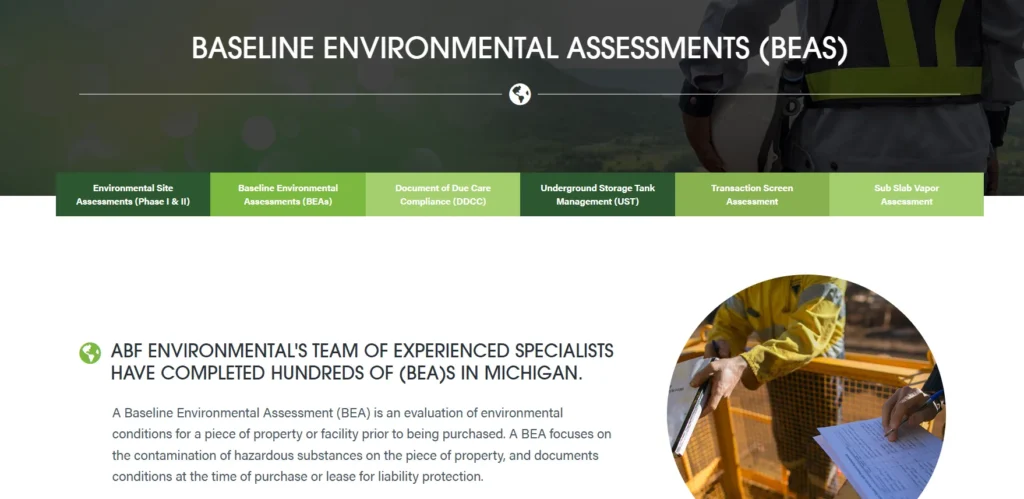
Think of it as drawing a line in the sand. A Baseline Environmental Assessment is a detailed evaluation and documentation of the environmental conditions of a property at the precise moment before it’s purchased, leased, or foreclosed upon. Its primary purpose is to legally define the existing contamination so that the new owner or operator cannot be held liable for cleanup. The purpose of a BEA is to protect the purchaser from liability associated with the previous owners’ actions while holding the new owner accountable for any future contamination.
In Michigan, this process is formalized under state law, specifically Part 201 (Environmental Remediation) and Part 213 (Leaking Underground Storage Tanks) of the Natural Resources and Environmental Protection Act. By conducting a BEA and submitting it to the Michigan Department of Environment, Great Lakes, and Energy (EGLE), a new owner can gain significant liability protection.
The typical environmental due diligence workflow looks something like this:
The Precursors: Phase I & II ESAs
A BEA doesn’t happen in a vacuum. It is almost always preceded by two other assessments:
- Phase I Environmental Site Assessment (ESA): This is a research-based investigation into the property’s current and historical uses to identify potential environmental concerns. It involves record reviews, site inspections, and interviews, but no physical sampling. ABF offers Phase I ESAs that conform to ASTM E1527-21 standards.
- Phase II Environmental Site Assessment (ESA): If a Phase I ESA reveals recognized environmental conditions (RECs), a Phase II is conducted. This involves collecting and analyzing physical samples of soil, groundwater, or building materials to confirm the presence and extent of hazardous substances.
A BEA is only necessary if the Phase II ESA confirms contamination levels that exceed the state’s unrestricted residential criteria. At that point, the property is officially considered a “Facility” under Michigan law, and the BEA becomes the tool for managing liability.
Who is ABF Environmental? A Snapshot
To understand their BEA service, you need to know the company behind it. ABF Environmental is not a software startup; it’s an established environmental consulting and engineering firm headquartered in Farmington Hills, Michigan. Founded over 15 years ago, the firm has built a reputation for providing comprehensive environmental solutions from initial research to project completion.
Their team consists of experienced professionals, including registered professional engineers and certified inspectors, with over 100 years of combined experience in the environmental industry. This expertise is crucial, as the effectiveness of a BEA hinges on a deep understanding of complex state and federal regulations.
ABF Environmental serves a wide range of industries, which gives them a broad perspective on different types of contamination and risk scenarios. Their client list includes:
- Municipalities and government agencies (including HUD, Freddie Mac, and the SBA)
- School systems and healthcare facilities
- Real estate developers
- Financial institutions and attorneys
This diverse client base demonstrates their capacity to handle complex projects, from redeveloping former industrial sites to ensuring schools are safe for children.
A Deep Dive: Reviewing the ABF Environmental BEA Service
Now, let’s get to the core of this review. Since it’s a service, not a product, we’ll evaluate it based on its process, key features, and overall value proposition for property buyers.
The Core Process: How ABF Executes a BEA
ABF Environmental’s approach is methodical and rooted in the legal requirements of Michigan’s environmental laws. An engagement for a BEA service typically follows a clear, multi-stage process.
- Data Synthesis and Analysis: The process begins after a Phase I and Phase II ESA have identified contamination. The ABF team thoroughly analyzes this existing data to understand the nature, extent, and concentration of hazardous substances on the property.
- Site Characterization: They reasonably define the existing conditions and circumstances at the facility. This creates a clear record that can be used to distinguish pre-existing issues from any potential new releases that might occur under the new ownership.
- Regulatory Documentation: A critical part of the service is preparing the written BEA document itself. This report describes the results of the inquiry, sampling, and analysis, formally confirming that the property is contaminated according to state definitions.
- Submission and Disclosure: ABF handles the submission of the completed BEA to the Michigan Department of Environment, Great Lakes, and Energy (EGLE). This formal disclosure is a cornerstone of establishing liability protection for the new owner.
- Engineering and Containment Strategies: Here’s where ABF’s engineering expertise provides significant added value. Beyond just documenting the problem, they can design and engineer practical solutions. This includes designing controls, isolation zones, and other containment strategies to manage the existing contamination and prevent it from worsening.
Key Features of the ABF Environmental Approach
When you engage ABF for a BEA, you’re not just getting a report. You’re accessing a suite of services and expertise designed for risk mitigation. Here are some of the standout ‘features’ of their service.
- Specialized Regulatory Expertise: ABF’s team has completed hundreds of BEAs in Michigan. This deep experience with the state’s specific regulations (Part 201 and 213) is arguably the service’s most valuable feature. They understand the nuances required by EGLE for a successful submission.
- Integrated Engineering Solutions: Unlike firms that only perform assessments, ABF offers remediation and construction services. This means their BEA recommendations are grounded in practical, buildable solutions. They can design containment strategies that work with a developer’s plans, a crucial advantage for redevelopment projects.
- Liability Shield Focus: The entire process is geared toward one primary goal: protecting the client from liability for environmental cleanup. They ensure the documentation is robust and that all legal requirements for the liability exemption are met.
- Full-Service Project Management: ABF can manage the entire environmental due diligence lifecycle, from the initial Phase I ESA to Underground Storage Tank (UST) management and the final Document of Due Care Compliance (DDCC). This provides clients with a single point of contact and ensures a seamless flow of information between assessment stages.
Who is This Service Best For?
The ABF Environmental BEA service is not for every property transaction. It’s a specialized tool for specific, high-stakes situations. The ideal client for this service typically includes:
- Developers Buying Brownfield Sites: Anyone looking to redevelop a former industrial, commercial, or gas station property where contamination is likely.
- Banks and Lenders Foreclosing on Property: Financial institutions need to protect themselves from inheriting massive cleanup liabilities when they take possession of a contaminated asset.
- Municipalities Acquiring Land for Public Use: Cities and counties often acquire derelict properties for redevelopment and must perform due diligence to protect taxpayers.
- Corporations Expanding Their Footprint: A business buying an adjacent property with a questionable environmental history needs a BEA to isolate its liability.
In short, if you are purchasing or taking control of a property in Michigan where contamination is known or strongly suspected, this service is designed for you.
Comparing Environmental Assessment Solutions
The term “environmental assessment tool” can mean many things. To put ABF’s service in context, it’s helpful to compare it to other available options. Each has its place, but they serve very different functions.
| Assessment Tool/Service | Primary Function | Best For | Limitations |
|---|---|---|---|
| AI/Imagery Platforms (e.g., FlyPix AI) | Rapid, large-scale initial screening using satellite or drone data. | Screening large land areas for potential risks; preliminary analysis. | Does not provide legal liability protection; cannot confirm chemical contamination. |
| In-House Assessment | Internal review of property history and obvious risks. | Very small, low-risk transactions where professional opinion isn’t required. | Extremely high risk of missing contamination; offers no legal protection. |
| General Environmental Consultant | Conducting standard Phase I and Phase II ESAs. | Standard due diligence on properties with no major red flags. | May lack deep expertise in specific local regulations or advanced engineering solutions. |
| ABF Environmental BEA Service | Documenting known contamination to secure legal liability protection under Michigan law. | High-risk property transactions in Michigan where contamination is confirmed. | Specialized service; may not be necessary for low-risk properties. |
As the table illustrates, these tools are not mutually exclusive. A developer might use an imagery platform for an initial portfolio screening, hire a consultant for a standard Phase I ESA, and then engage a specialized firm like ABF when a BEA is required. The key is using the right tool for the right stage of the process.

Build a Clearer Site Baseline with FlyPix AI
A baseline environmental assessment starts with understanding what is already present on a site. FlyPix AI helps environmental teams use satellite, drone, and aerial images to review visible conditions, separate key areas, and compare site features over time.
FlyPix AI can support early-stage assessment work where visual evidence matters:
- Identifying visible site objects, waste, debris, or pollutants
- Segmenting land, vegetation, water, or infrastructure areas
- Comparing imagery to track site changes over time
- Creating custom detection models for project-specific environmental features
Contact FlyPix AI to review how geospatial image analysis can support your assessment work.
Frequently Asked Questions (FAQ)
A Phase I ESA is an investigation to identify the *potential* for contamination based on historical records and a site visit. A BEA is conducted *after* contamination has been confirmed (usually via a Phase II ESA) to document the existing conditions and protect the new owner from liability for that specific contamination.
No. A BEA is not mandatory. It is an optional but highly recommended step for a purchaser of property that is known to be contaminated. It provides protection from liability for the cleanup of that pre-existing contamination. If a Phase I and II ESA show no contamination, a BEA is not necessary.
The timeline can vary depending on the complexity of the site and the amount of data available from the Phase II ESA. The process includes report preparation and submission to EGLE. The critical component is that the BEA must be conducted prior to or within 45 days of the earlier of the date of purchase, occupancy, or foreclosure.
The BEA protects the new owner from liability for contamination that existed *at the time of the assessment*. The owner is responsible for any new releases or for exacerbating the existing contamination. This is why ABF’s ability to design containment strategies is so important—it helps prevent the worsening of old problems.
While ABF Environmental is based in Farmington Hills, Michigan, and has extensive expertise in Michigan law, they serve clients throughout the Midwest.
A DDCC is related to a BEA. Owners and operators of contaminated property in Michigan have “due care” obligations to ensure the contamination does not cause unacceptable risks or get worse. A DDCC is the report that demonstrates how they are meeting these ongoing obligations. ABF Environmental also provides DDCC services.
Yes. By defining the presence and pathways of contaminants, a BEA helps in evaluating the potential impact on both human health and ecological receptors. This information is crucial for planning any necessary environmental remediation or controls.
The Bottom Line: A Tool for Legal Protection, Not Just Analysis
Real talk: no one wants to buy a contaminated property. But often, the most valuable land for redevelopment comes with a history. The work of a firm like ABF Environmental isn’t about finding a pristine site; it’s about providing the legal and engineering framework to safely and profitably develop a compromised one.
The “tool” offered by ABF Environmental is not a piece of software but a strategic service. It’s a mechanism that leverages deep regulatory knowledge and engineering skill to transform a high-liability property into a manageable asset. By meticulously documenting the baseline environmental condition, they provide new owners with the confidence to invest, build, and revitalize land that might otherwise sit vacant.
For anyone involved in property transactions in Michigan and the surrounding region, understanding the role of a Baseline Environmental Assessment is critical. And engaging a firm with a long track record of successfully navigating this process is a non-negotiable part of responsible due diligence.