
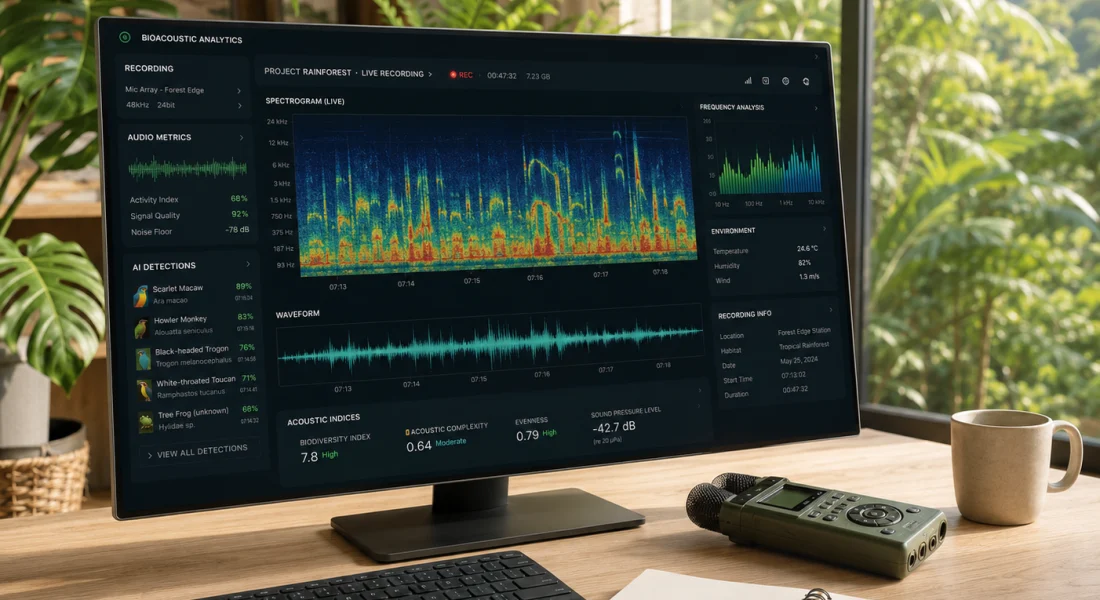
Quick Summary: Arbimon is a free, cloud-based biodiversity monitoring platform developed by Rainforest Connection that enables researchers to upload, visualize, and analyze acoustic data using pattern-matching tools and machine learning. It supports large-scale passive acoustic monitoring projects with collaborative features, APIs, and integration with autonomous recording units, making it accessible to conservation teams worldwide without requiring commercial software licenses.
The biodiversity monitoring landscape has shifted dramatically over the past few years. What used to require expensive commercial software and specialized technical expertise is now accessible through open platforms that democratize conservation research.
Arbimon sits at the center of this transformation. Developed by Rainforest Connection (RFCx), a conservation tech nonprofit, it’s become one of the most widely discussed platforms for passive acoustic monitoring. But does it actually deliver on its promises?
This review examines Arbimon’s capabilities, limitations, and real-world performance based on published research, authoritative data, and documented field deployments. Whether teams should invest time learning this platform depends on specific project requirements, technical capacity, and workflow preferences.
What Is Arbimon and Who Builds It?
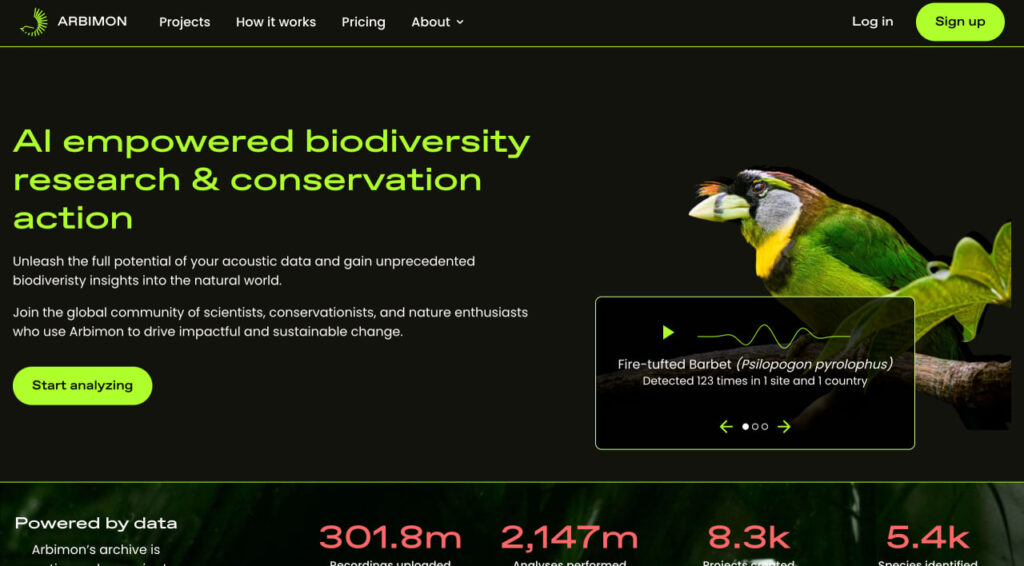
Arbimon is a cloud-based biodiversity monitoring platform that specializes in acoustic data analysis. Rainforest Connection maintains it as part of their broader mission to support the bioacoustics and ecoacoustics communities with open-source tools and technology.
The platform handles the complete passive acoustic monitoring workflow. Teams can upload recordings from autonomous recording units, visualize spectrograms, create pattern-matching templates, run machine learning classifiers, and share results with collaborators.
According to the Terms of Service on rfcx.org, use of the Arbimon platform—including the website (arbimon.org and sub-domains), desktop programs, APIs, and mobile applications—constitutes agreement to RFCx’s service terms. It’s positioned explicitly as a tool to “increase overall impact” for conservation practitioners.
Here’s what matters: Arbimon is fully free to use. A systematic review of passive acoustic monitoring software published in 2026 found that 83% of PAM tools are freely accessible, with only 12% being commercial products and 5% having limited access. Arbimon falls squarely in the free category, which removes cost barriers for researchers operating on limited budgets.
Monitor Environmental Data With FlyPix AI
Collecting environmental data is easier than ever, but turning that information into useful insights can still take significant time. FlyPix AI helps organizations analyze satellite, aerial, and drone imagery to identify patterns, monitor changes, and support data-driven decisions.
Working With Environmental Monitoring Projects?
FlyPix AI can help with:
- land and vegetation analysis
- environmental monitoring
- object detection and classification
- geospatial image processing
👉 Try FlyPix AI to explore AI-powered geospatial analysis.
Core Features and Workflow Components
The platform covers four essential stages of acoustic monitoring: data management, visualization, analysis, and collaboration. Not every tool handles all four—the 2026 systematic review identified 221 passive acoustic monitoring tools, but only 40 covered all workflow components.
Data Upload and Storage
Arbimon accepts standard audio formats from most autonomous recording units. Projects typically involve substantial data volumes. The BioSoundSCape project in South Africa, for instance, deployed autonomous recording units at 521 sites across approximately 119,058 km² and generated recordings over 4–10 days per season.
Managing that scale requires cloud infrastructure. Arbimon handles storage and processing server-side, so researchers don’t need high-performance local machines. This architecture works well for teams without dedicated computing resources but requires stable internet for uploads.
Spectrogram Visualization
Once uploaded, recordings render as spectrograms—visual representations showing frequency on the vertical axis and time horizontally. Brightness indicates amplitude. This visualization allows rapid scanning for target species without listening to hours of audio.
The interface supports zooming, panning, and toggling between different time scales. For projects monitoring specific species, researchers can quickly navigate to time periods when calls are most likely (dawn chorus for birds, evening for many amphibians).
Pattern-Matching and Templates
This is where Arbimon shows its strength. The pattern-matching system lets researchers create templates from known species calls, then search entire datasets for similar acoustic signatures.
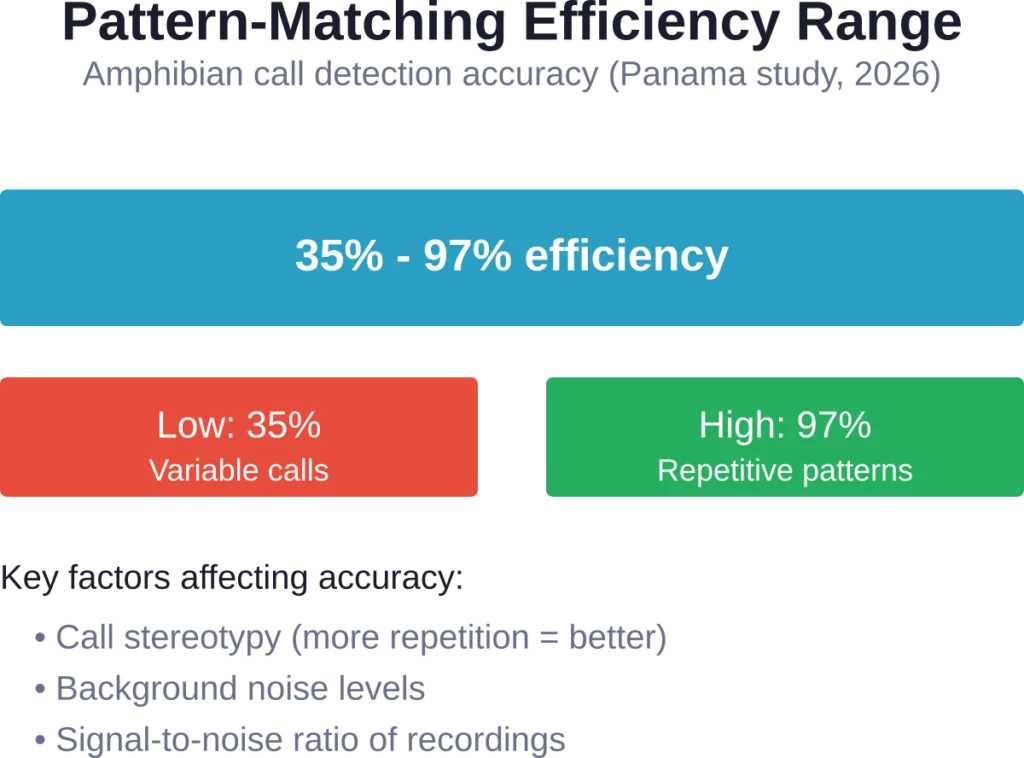
Real-world performance varies substantially. Research published in Frontiers in Amphibian & Reptile Science in early 2026 examined pattern-matching efficiency for amphibian calls detected by autonomous recording units in Panama. Efficiency ranged from 35% to 97% depending on call characteristics, with repetitive patterns performing significantly better than single-note calls.
That’s a wide range. Species with stereotyped, repeated calls hit the upper efficiency band. Species with variable or complex vocalizations fall toward the lower end. Understanding this limitation prevents overconfidence in detection completeness.
Machine Learning Classifiers
Beyond template matching, Arbimon supports training custom machine learning models for species identification. This requires labeled training data—recordings that researchers have already verified as containing (or not containing) target species.
The approach works best when teams have substantial annotated datasets. Small training sets produce unreliable models. And like pattern-matching, performance depends heavily on acoustic distinctiveness. Species with unique calls train more accurate classifiers than those with overlapping vocal characteristics.
Collaboration and Data Sharing
Arbimon includes project-based permissions, allowing multiple researchers to access shared datasets. Team members can annotate recordings, create templates, and review detection results collaboratively.
This matters for multi-institutional projects. The BioSoundSCape deployment, for instance, involved coordination between NASA, CapeNature, and academic institutions. Cloud-based platforms facilitate this kind of distributed collaboration better than desktop software requiring local file management.
How Arbimon Compares to Alternative PAM Software
The passive acoustic monitoring software ecosystem is crowded. The 2026 systematic review found 221 available tools of which 174 were explicitly designed for PAM. Terrestrial research accounted for 476 software mentions in published studies, followed by aquatic research for 319 mentions.
About 45% of tools are built as R, Python, or MATLAB packages. These require programming knowledge and appeal primarily to researchers comfortable writing analysis scripts. Arbimon, by contrast, offers a graphical interface accessible to users without coding experience.
That’s a significant distinction. Many conservation practitioners lack formal programming training. Web-based platforms with visual workflows lower the technical barrier, though they sacrifice some flexibility compared to script-based tools.
| Feature | Arbimon | R/Python Packages | Commercial Software |
|---|---|---|---|
| Cost | Free | Free (open-source) | Varies (typically hundreds to thousands annually) |
| Interface | Web-based GUI | Code/script-based | Desktop GUI |
| Learning Curve | Moderate | Steep (requires programming) | Moderate to low |
| Customization | Limited to platform features | Highly flexible | Varies by product |
| Collaboration | Built-in (cloud-based) | Requires separate setup | Often single-user |
| Offline Use | No (requires internet) | Yes | Yes |
For teams prioritizing cost and collaboration over maximum flexibility, Arbimon occupies a valuable niche. For researchers needing custom analysis pipelines or working in areas with unreliable internet, script-based tools or desktop software may fit better.
Real-World Performance: What Field Studies Show
Theoretical capabilities matter less than actual field performance. How does Arbimon hold up in real biodiversity monitoring projects?
Amphibian Monitoring in Panama
The Smithsonian’s National Zoo and Conservation Biology Institute deployed 19 AudioMoth autonomous recording units (5 at stream sites, 14 terrestrial) in Panama to monitor amphibians of conservation concern. They used 32GB SD cards and AudioMoth devices.
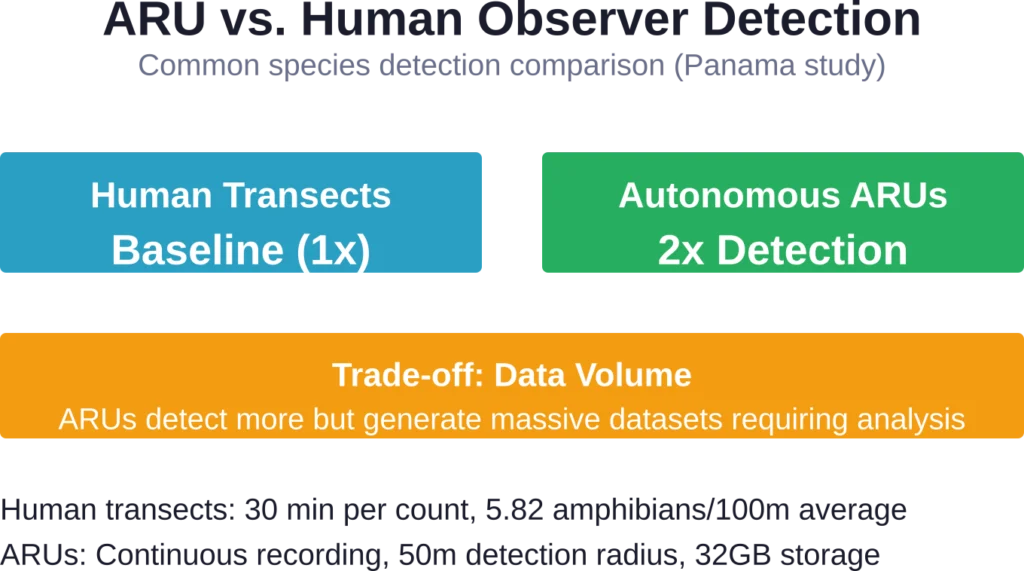
Results showed that autonomous recording units detected common species at twice as many stations compared to traditional observer transects. ARUs found target species at more locations than human surveyors walking 100-meter transects—which averaged 30 minutes per count and yielded a mean of 5.82 amphibians per transect.
But here’s the catch: that 2x detection advantage only holds for common species with distinctive calls. Rare species, species with quiet vocalizations, or those calling sporadically showed less dramatic improvements. And remember that 35-97% pattern-matching efficiency range—teams must account for missed detections when estimating abundance.
The Panama research also rediscovered a species (Pristimantis veraguensis) in a new distribution area using passive acoustic methods. That’s a meaningful conservation outcome enabled by continuous acoustic monitoring that spot-check surveys would likely have missed.
Large-Scale Deployment in South Africa
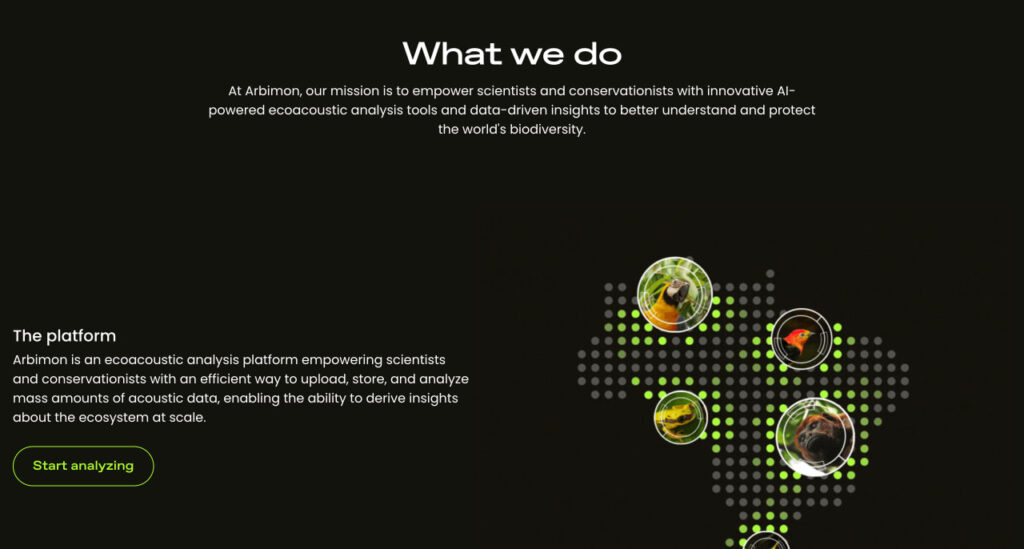
The BioSoundSCape project represents one of the largest passive acoustic monitoring efforts documented. Deploying ARUs at 521 sites over 119,058 km² generated recordings with geolocation accuracy of 20 meters.
Processing this volume of data requires automated tools. Manual review is infeasible—hundreds of thousands of minutes per season represent an enormous dataset. Pattern-matching and machine learning become necessities, not conveniences.
Comparative Detection Efficiency
Autonomous recording units capture everything within range (typically a 50-meter radius), while human observers inevitably miss some detections due to attention limits, hearing variability, and environmental noise masking.
The trade-off: ARUs generate massive datasets requiring computational analysis, while human surveys produce smaller, pre-filtered datasets of confirmed observations. Which approach suits a project depends on species detectability, available analysis resources, and whether the goal is presence/absence data or abundance estimates.
Hardware Integration and Recording Units
Arbimon doesn’t manufacture recording hardware—it analyzes data from autonomous recording units produced by various manufacturers. Understanding hardware options matters because recording quality directly impacts pattern-matching success.
Common Recording Units
AudioMoth devices appear frequently in published research. They’re low-cost, open-source, and widely available. Entry-level autonomous recorders typically cost $150–$300 per unit, with high-fidelity or solar-powered systems exceeding $1,000. The Panama amphibian study used AudioMoth devices with 32GB SD cards.
Recording specifications affect file sizes and storage requirements. Higher sampling rates capture more frequency detail (important for high-frequency bat calls, less critical for low-frequency amphibian calls) but consume storage faster. Teams need to match hardware specs to target species’ acoustic characteristics.
Field Deployment Considerations
Arbimon processes data after it’s retrieved from the field. This post-processing workflow contrasts with emerging edge AI approaches that analyze recordings on-device in real time.
Edge AI offers faster results—detections happen immediately rather than after retrieval, lab upload, and analysis. But it requires more sophisticated (and expensive) hardware plus power for continuous computation. For many projects, the post-processing workflow remains more practical.
According to analysis published on landwildlifereport.com in January 2026, cost and scale remain significant operational considerations. Entry-level recorders ($150–$300) make large deployments financially feasible, but processing the resulting data requires staff time or automated tools like Arbimon’s pattern-matching system.
Limitations and Known Challenges
No platform handles every use case perfectly. Understanding where Arbimon struggles helps teams make realistic implementation decisions.
Internet Dependency
Cloud-based architecture requires reliable internet for uploads and analysis. Research teams working in remote locations often have limited connectivity. Large datasets take substantial time to upload on slow connections, delaying analysis.
Some alternative tools run entirely offline on local machines. For projects in areas with poor internet access, that may be a deciding factor.
Pattern-Matching Variability
That 35-97% efficiency range is a real limitation. Species with variable calls, quiet vocalizations, or those masked by background noise produce unreliable pattern-matching results.
Teams need to validate pattern-matching accuracy for their specific species and recording conditions. Running a subset of recordings through both automated matching and manual review reveals whether the system performs adequately for the target taxa.
Processing Speed for Large Datasets
Cloud processing handles most projects, but extremely large datasets can take time to process. The BioSoundSCape project’s datasets represent a substantial computational load. Processing speed depends on server capacity and how many other users are running analyses simultaneously.
Learning Curve for Advanced Features
Basic uploads and visualization are straightforward. Creating effective pattern-matching templates and training machine learning classifiers requires more expertise. Teams need to invest time learning what makes a good template, how to handle false positives, and how to interpret confidence scores.
Documentation and tutorials exist, but Arbimon isn’t entirely plug-and-play for advanced analytical workflows. Expect a learning period before achieving reliable results on complex projects.
When Arbimon Makes Sense (and When It Doesn’t)
Choosing tools based on project requirements beats following trends. Here’s when Arbimon fits well and when alternatives deserve consideration.
Good Fit Scenarios
Projects monitoring species with distinctive, repetitive vocalizations hit the sweet spot. Birds with stereotyped songs, frogs with regular advertisement calls, and insects with consistent stridulations work well with pattern-matching systems.
Multi-institutional collaborations benefit from cloud-based access and shared project workspaces. Teams can divide annotation work, review each other’s templates, and maintain centralized datasets without coordinating file transfers.
Budget-constrained projects appreciate the free access. With entry-level ARUs costing $150–$300 and Arbimon eliminating software licensing fees, teams can allocate resources to more field deployments rather than commercial software subscriptions.
Large-scale surveys generating hundreds of hours of recordings need automated analysis. Manual review becomes infeasible above a certain data volume. Pattern-matching (despite imperfect accuracy) provides the only practical path forward.
Less Ideal Scenarios
Projects targeting species with highly variable or infrequent vocalizations struggle with pattern-matching efficiency. That 35% lower bound means missing nearly two-thirds of actual occurrences—unacceptable for many conservation applications.
Research requiring custom analysis pipelines may find the web interface limiting. Script-based tools (R packages, Python libraries) offer more flexibility for researchers with programming skills who need specialized processing workflows.
Fieldwork in areas without reliable internet creates upload bottlenecks. Desktop software that processes files locally may be more practical when connectivity is intermittent or nonexistent.
Projects demanding maximum detection accuracy (endangered species monitoring where missing individuals has serious consequences) should supplement automated pattern-matching with manual verification. The efficiency range documented in field studies indicates that fully automated workflows may miss critical detections.
| Project Characteristic | Arbimon Suitability | Consideration |
|---|---|---|
| Limited budget | Excellent | Free access eliminates licensing costs |
| Multi-institution collaboration | Excellent | Cloud-based sharing built-in |
| Large data volumes | Good | Automated pattern-matching necessary but check efficiency |
| Distinctive vocalizations | Good | Pattern-matching works best (up to 97% efficiency) |
| Variable calls | Poor | Efficiency may drop to 35% |
| Limited internet access | Poor | Cloud architecture requires connectivity |
| Custom analysis needs | Moderate | Less flexible than script-based tools |
| Critical accuracy requirements | Moderate | Needs manual validation supplement |
The Broader PAM Software Landscape
Arbimon competes in a space with 221 documented passive acoustic monitoring tools. Understanding the broader landscape helps position where it fits.
The 2026 systematic review found that most tools (83%) are freely accessible, matching Arbimon’s approach. Commercial options represent 12% of the market, with 5% having limited access (academic licenses, beta programs).
Terrestrial research dominates software development, accounting for 476 study mentions compared to 319 for aquatic applications. This reflects bioacoustic monitoring’s stronger adoption for birds, amphibians, and insects versus marine mammals and fish.
Workflow coverage varies dramatically. While 40 tools cover all four PAM components (data management, visualization, analysis, collaboration), many specialize in one or two stages. Some handle only visualization, others only classification. Arbimon’s comprehensive coverage across the full workflow distinguishes it from narrower-scope tools.
The prevalence of R/Python packages (45% of tools) highlights the ecoacoustics community’s programming orientation. But GUI-based platforms serve researchers without coding backgrounds—a substantial portion of conservation practitioners.
Data Privacy and Terms of Use
Uploading project data to cloud platforms raises legitimate questions about ownership, privacy, and access rights. Rainforest Connection’s Terms of Service and Privacy Policy govern Arbimon use.
According to documentation on rfcx.org, use of the platform (websites, desktop programs, APIs, mobile applications) constitutes agreement to their terms. The Privacy Policy describes how RFCx collects, uses, stores, shares, and protects information.
For conservation projects, key considerations include:
- Who owns the acoustic data after upload?
- Can recordings be shared publicly or kept private?
- What happens if project teams want to delete data later?
- Are there restrictions on commercial use of derived analyses?
Teams should review the current terms before committing substantial project resources to the platform. Policies can change, and understanding data rights upfront prevents complications later.
Getting Started: Practical Implementation Steps
For teams evaluating Arbimon, here’s a realistic implementation pathway based on documented project workflows.
1. Hardware Selection and Testing
Choose recording units matched to target species’ acoustic characteristics. Entry-level units ($150–$300) work for many applications, with high-fidelity or solar-powered systems exceeding $1,000. Test hardware in field conditions before large deployments. Recording specifications matter for storage planning—longer deployments or higher sampling rates require greater capacity. Choose storage solutions appropriate to expected deployment duration.
2. Pilot Deployment and Data Collection
Start with a small-scale pilot (5-10 recording locations) rather than immediately deploying hundreds of units. This allows workflow testing, reveals logistical challenges, and validates that recordings capture target species adequately.
The Panama project used 19 AudioMoth deployments (5 stream sites, 14 terrestrial). That scale generates manageable data volumes for initial analysis while providing enough samples to assess pattern-matching performance.
3. Upload and Initial Visualization
Upload pilot recordings to Arbimon and review spectrograms. Verify that target species are present and that recording quality suffices for analysis. Poor recordings won’t improve with sophisticated analysis—address hardware or deployment issues before scaling up.
4. Template Creation and Validation
Create pattern-matching templates from clear, high-quality examples of target species calls. Test templates on known recordings (some with the species present, some without) to measure detection accuracy.
Remember that efficiency ranges from 35% to 97% depending on call characteristics. Validate performance for specific project conditions rather than assuming optimal results.
5. Full Deployment and Analysis
Once pilot testing confirms adequate hardware performance and pattern-matching accuracy, scale to full deployment. Large projects like BioSoundSCape’s 521 sites require substantial logistical coordination, but the workflow remains the same.
Process recordings in batches. For datasets with hundreds of thousands of minutes of recordings, stagger processing to manage computational load and allow incremental review of results.
Future Directions in Acoustic Monitoring
The passive acoustic monitoring field continues evolving rapidly. Several trends affect how Arbimon and similar platforms develop.
Edge AI and Real-Time Processing
On-device analysis using edge AI allows real-time species detection without retrieving recordings. This enables immediate alerts (poaching detection, rare species presence) rather than post-deployment analysis.
However, edge AI requires more sophisticated hardware and power. The trade-off between immediate results and equipment cost/complexity continues shifting as technology improves. For now, post-processing workflows like Arbimon’s remain practical for many projects.
Integration Across Platforms
The 221 documented PAM tools reflect a fragmented landscape. Standardization of data formats and interoperability between platforms would let researchers combine tools’ strengths rather than committing entirely to one ecosystem.
APIs and data export options help, but seamless integration remains limited. Teams often need to move data between platforms manually for different analysis stages.
Improved Machine Learning Models
Pattern-matching and traditional classifiers work well for distinctive vocalizations but struggle with variable calls. Advances in deep learning models may improve accuracy for challenging species.
The constraint: sophisticated models require substantial training data. Common species benefit first, while rare and poorly documented species lag behind—exactly the inverse of conservation priority.
Frequently Asked Questions
Yes, Arbimon is fully free for researchers and conservation practitioners. There are no subscription fees, user limits, or premium tiers. This contrasts with commercial passive acoustic monitoring software that can cost hundreds to thousands annually. The 2026 systematic review found that 83% of PAM tools are freely accessible, and Arbimon falls in this category.
Arbimon accepts standard audio formats from most autonomous recording units. Commonly used hardware includes AudioMoth devices (which cost $150–$300 for entry-level units), Wildlife Acoustics recorders, and custom systems. The platform doesn’t require proprietary hardware—any ARU generating compatible audio files works. Teams should match recording specifications (sampling rate, storage capacity) to target species’ acoustic characteristics rather than platform requirements.
Pattern-matching efficiency varies substantially based on call characteristics. Research published in Frontiers in Amphibian & Reptile Science in 2026 found efficiency ranging from 35% to 97% for amphibian calls, with repetitive patterns achieving the high end and variable single-note calls at the low end. Species with stereotyped, repeated vocalizations produce the most reliable results. Teams should validate pattern-matching accuracy on their specific species and recording conditions rather than assuming optimal performance.
Yes, Arbimon’s cloud architecture supports large datasets. The BioSoundSCape project deployed 521 recording units across 119,058 km² and generated substantial volumes of recordings—enough to demonstrate successful large-scale deployment. The platform processed this volume, though extremely large datasets take time. Processing speed depends on server capacity and simultaneous user load. For projects generating hundreds of thousands of minutes of recordings, automated analysis becomes necessary since manual review is infeasible.
No, Arbimon is cloud-based and requires internet connectivity for uploading recordings and running analyses. This creates challenges for research teams in remote locations with limited or unreliable internet access. Large datasets take substantial time to upload on slow connections, potentially delaying analysis. Alternative tools running entirely on local machines may better serve projects where internet access is intermittent or unavailable.
Arbimon offers a graphical web interface accessible to users without programming experience, while R/Python packages require coding skills. About 45% of PAM tools are built as script-based packages. These offer more flexibility for custom analysis pipelines but have steeper learning curves. Arbimon trades some flexibility for ease of use, making it suitable for conservation practitioners without formal programming training. Researchers comfortable with coding and needing specialized workflows may prefer script-based alternatives.
Key limitations include: (1) Internet dependency—cloud architecture requires reliable connectivity; (2) Variable pattern-matching accuracy—efficiency ranges from 35-97% depending on call characteristics; (3) Less flexibility than script-based tools for custom analyses; (4) Processing time for extremely large datasets; and (5) Learning curve for advanced features like template creation and machine learning classifier training. Teams should assess whether these constraints affect their specific project requirements before committing resources.
Final Verdict: Is Arbimon Worth Using in 2026?
Arbimon occupies a valuable middle ground in the passive acoustic monitoring software landscape. It’s not the most powerful tool (script-based packages offer more flexibility) nor the simplest (some commercial software provides more polished interfaces), but it balances accessibility, capability, and cost effectively.
The free access removes significant barriers for conservation projects operating on limited budgets. When entry-level recording hardware costs $150–$300 per unit, eliminating software licensing fees allows more resources for field deployments.
Cloud-based collaboration features suit multi-institutional projects well. Teams can share data, templates, and results without coordinating complex file transfers or maintaining local servers.
Pattern-matching performance varies considerably (35-97% efficiency), which means teams must validate accuracy for their specific applications. Species with distinctive, repetitive vocalizations work well. Species with variable or quiet calls require supplemental manual verification.
Real-world projects demonstrate meaningful outcomes. The Panama research detected amphibian species at twice as many stations compared to human observers and rediscovered a species in a new distribution area. The BioSoundSCape project successfully managed substantial recording datasets across 521 sites. These results show that, despite limitations, the platform delivers practical conservation value.
The decision to use Arbimon depends on project-specific requirements. For teams monitoring acoustically distinctive species, needing collaborative features, and working within budget constraints, it fits well. For researchers requiring maximum flexibility, working offline, or targeting species with highly variable calls, alternatives deserve consideration.