

For years, data centers quietly grew in the background, hidden behind industrial fences and anonymous buildings. Now they are running into very real limits. Power grids are strained, water for cooling is scarce, and communities are pushing back against new server farms. At the same time, AI models are getting larger, hungrier, and harder to sustain. Against that backdrop, an idea that once sounded like science fiction is starting to feel oddly practical. If Earth is running out of room and energy for computing, maybe the next place to look is orbit.
Why Space? The Real Problem With Earth-Based Data Centers
Data centers were never designed to be popular, just functional. But now they’re on everyone’s radar – for the wrong reasons. They eat up land, stress local grids, and in some regions, burn through millions of liters of water just to stay cool. Add in AI workloads that keep scaling up, and the cracks in the system become harder to ignore. Training next-gen models like Gemini or GPT isn’t just expensive – it’s energy-intensive on a scale most cities weren’t built to support.
Some counties are already pushing back. Local officials are pausing new permits. Communities are asking whether a few megawatts of AI progress are worth the impact on their infrastructure. And that’s before we talk about emissions. Even with renewable energy, terrestrial data centers have a footprint – physically and environmentally. So the idea of moving some of that load into orbit doesn’t just sound bold – it’s starting to sound like a practical way to keep growing without burning through the limits we’ve already hit on the ground.
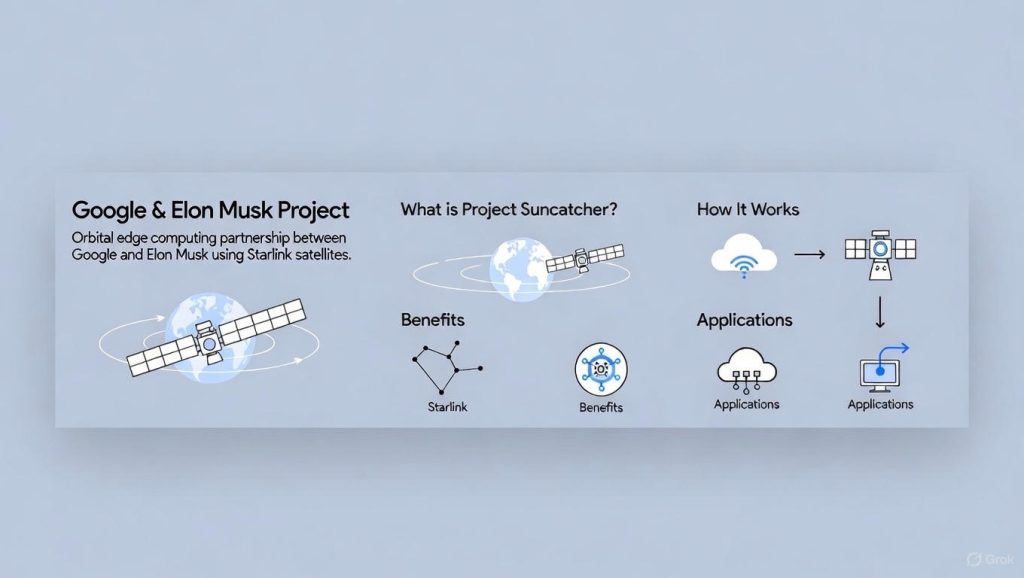
Google, Musk, and the Orbital Compute Arms Race
This isn’t just a wave of experiments or moonshot ideas anymore. What’s unfolding now looks more like the early stages of a real infrastructure race – not about headlines, but about control. As Earth-based data centers run into hard limits – power, water, space, and policy – the question has shifted. It’s no longer whether we can compute in space. It’s who will do it first, at scale, and on whose terms.
Different players are following different strategies. But the shared goal is clear: push compute closer to where data is generated, bypass Earth’s bottlenecks, and build the next layer of infrastructure off the ground.
Google and Project Suncatcher
Google is approaching this like a systems engineer – steady, detailed, and focused on validation. Project Suncatcher is a research moonshot starting with two prototype satellites (in partnership with Planet Labs) planned for launch by early 2027, each equipped with Google TPU chips (specifically, tests involve Trillium-generation TPUs, with early prototypes carrying a small number like four TPUs per satellite in some descriptions). These satellites will operate in sun-synchronous orbit to maximize solar power uptime.
The experiment is built around three core objectives:
- Test whether standard AI chips can survive high radiation and extreme orbital conditions
- Evaluate passive cooling systems that don’t rely on fans or liquid loops
- Trial laser-based networking for high-bandwidth satellite-to-satellite and satellite-to-ground communication
If the results are positive, Google could scale future compute nodes in space without having to redesign its stack from scratch. That gives them a pathway toward modular orbital infrastructure built with hardware they already know inside out.
Elon Musk and the Starlink Compute Trajectory
Musk’s strategy is less formal but potentially more aggressive. He hasn’t published a roadmap – but the direction is visible. Starlink already operates a massive, evolving constellation of satellites. Right now, they act as relays. But Musk has openly hinted that future generations could handle more: computation, filtering, compression – all on orbit.
Turning Starlink into an orbital edge compute platform would offer strategic advantages:
- Local processing of data from sensors, cameras, and systems without routing everything to Earth
- Lower latency for real-time applications in fields like disaster response, environmental monitoring, and defense
- Greater autonomy for orbital systems with less need for constant ground contact
- Scalable compute that grows with each Starlink launch
Unlike others, SpaceX controls the whole pipeline – the launch vehicles, the hardware, the constellation, and the iteration speed. That gives them more flexibility to test, deploy, and upgrade without outside dependencies.
What makes this an arms race isn’t who has the best demo – it’s who will turn orbital compute into working infrastructure first. Google is optimizing for reliability and software continuity. Musk is betting on scale and vertical integration. The winner might define how the future of AI, edge computing, and planetary-scale data flows actually operate – not just on Earth, but around it.

FlyPix AI: Why Geospatial Intelligence Will Need Space-Grade Infrastructure
At FlyPix AI, we design AI tools that help teams quickly understand what’s happening on the ground – using what they see from above. Our platform analyzes satellite, aerial, and drone imagery, turning complex visual data into structured insights. No code, no complicated setup – just clear results, fast.
As satellite imaging expands and data becomes more constant, the real challenge is keeping up with analysis. Processing closer to orbit could reduce delays and make AI-driven monitoring more responsive. For platforms like ours, that shift could be a natural evolution – bringing compute closer to where the data starts.
We’re focused on solving real problems across industries like agriculture, construction, infrastructure, and environmental monitoring. Supported by partners like NVIDIA, AWS, and ESA BIC Hessen, we’re building for scale, flexibility, and reliability. You can find us on LinkedIn to see how we’re working with teams across the world.
Radiation, Cooling, and Launch Costs: Why It’s Still a Moonshot
The idea of putting daata centers in space makes sense on paper – endless solar power, no zoning headaches, and no need to pump water for cooling. But the closer you get to building one, the more complex the picture becomes. Here’s where things get tricky:
- Radiation eats hardware: Standard chips aren’t built for cosmic rays or solar storms. You either shield them (which adds weight) or rebuild them to tolerate damage – which isn’t always possible with off-the-shelf AI components.
- Heat has nowhere to go: On Earth, cooling is straightforward. Fans, water loops, airflow – it works. In orbit, there’s no air to carry heat away. That means building large radiators just to stay within safe temperatures, which adds mass and engineering complexity.
- Launch costs aren’t low enough yet: Even with reusable rockets, getting heavy infrastructure into orbit still costs a lot. Most projections say prices need to drop significantly before orbital compute becomes more than a test case.
It’s one thing to build for speed and scale – it’s another to do it with physical constraints layered in. The hardware might be ready. But the orbit? Still a tough neighborhood.
If Space-Based Data Centers Actually Take Off
If the current tests succeed and space proves to be a viable environment for compute at scale – it could trigger a major shift. Processing could move closer to where data is generated, especially in areas like Earth observation, satellite monitoring, or autonomous orbital systems. That would cut latency, reduce the load on ground-based infrastructure, and make real-time analysis possible in scenarios where every second counts.
But even if it falls short or if the economics never add up – the experiments still have value. Each test advances the understanding of edge computing under extreme conditions. Failed radiator designs reveal thermal limits. AI models exposed to radiation highlight where systems break and how they can be hardened. Whether compute ends up in orbit or not, what’s learned along the way will shape how next-generation systems are built everywhere.
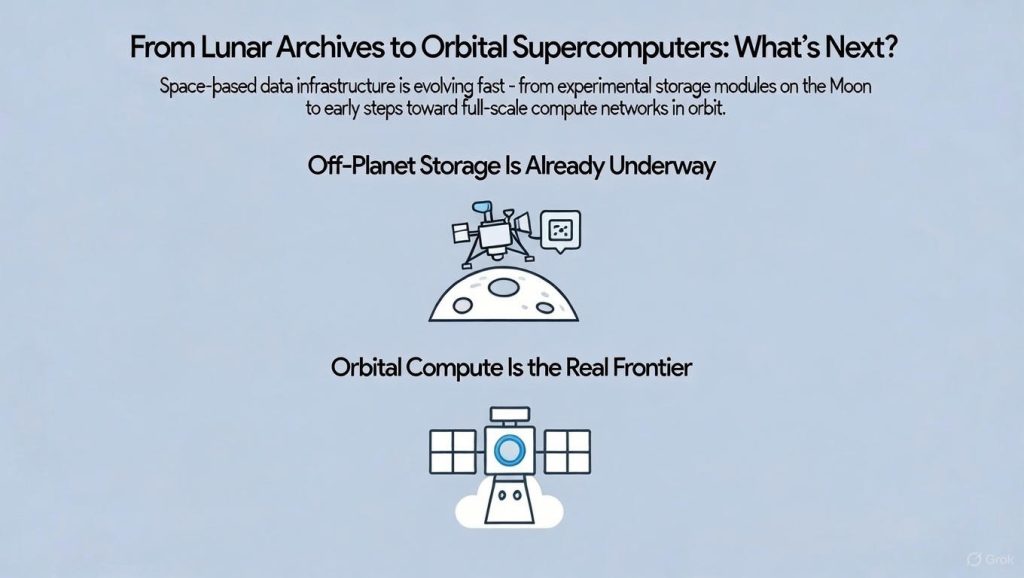
From Lunar Archives to Orbital Supercomputers: What’s Next?
Space-based data infrastructure is evolving fast – from experimental storage modules on the Moon to early steps toward full-scale compute networks in orbit.
Off-Planet Storage Is Already Underway
Lonestar’s recent lunar deployment tested whether digital data can survive and function in harsh, off-Earth environments. While the device was compact and temporary, it marked a shift toward using space not just for communication or observation, but as a long-term digital archive.
Lunar storage could eventually offer a backup layer for critical information – isolated from power outages, climate risks, or physical sabotage on Earth. The Moon won’t replace cloud storage, but it may complement it in ways that weren’t realistic until recently.
Orbital Compute Is the Real Frontier
Low Earth orbit is where things start to scale. Instead of just storing data, satellites could analyze and react to it on the fly. That opens the door to smarter, faster systems that don’t rely on constant ground communication to function.
Potential benefits of in-orbit compute include:
- Processing satellite imagery before it reaches Earth
- Reducing the volume of data needing transmission
- Enabling near real-time AI inference for space systems
- Improving responsiveness for autonomous vehicles and sensors in orbit
The next few years will likely bring a mix of pilot missions, failed attempts, and key breakthroughs. But the direction is clear: computing is going up – literally.
Conclusion
Space isn’t the perfect place to build data centers. Not yet. There’s radiation, heat, cost, and a long list of technical headaches. But it’s getting harder to ignore the pressures on Earth. The growth of AI, remote sensing, and global data flows is outpacing what traditional infrastructure can comfortably support. That’s why companies like Google, Starcloud (NVIDIA-backed startup that has already launched a demonstrator in November 2025 and trained AI models in orbit), and SpaceX are exploring/investing in orbital compute.
The shift won’t happen all at once. Some things will work. Others won’t. But the direction is clear: as our systems grow more distributed and data-hungry, it makes sense to start thinking beyond physical borders. Not everything needs to stay grounded. And if orbital compute can reduce friction, improve speed, or offload pressure from Earth’s grid, it might not be a question of if – it might just be when.
FAQ
Not yet. Most of what’s happening is still experimental – small-scale missions designed to test hardware durability, power efficiency, and communications. But timelines are tightening. We’ll likely see the first functional use cases by the end of this decade.
In some places, we’ve already hit limits. Energy supply, water access, cooling requirements, and public opposition are all becoming real constraints. For high-demand tasks like AI training, Earth-based expansion is starting to get complicated and expensive.
That depends. In theory, they could be cleaner – powered by uninterrupted solar and requiring no water. But launches still burn fuel, and hardware replacement cycles add complexity. If space-based compute scales, sustainability will need to be part of the design, not just a benefit on paper.
Absolutely. That’s one of the strongest near-term use cases. Processing data closer to where it’s captured could reduce transmission lag and enable real-time insight, especially for high-frequency imaging or autonomous space systems.
It’s one of them, yes. Getting heavy, heat-sensitive equipment safely into orbit isn’t cheap, even with reusable rockets. But launch cost isn’t the only factor. Thermal regulation, hardware lifespan, and network reliability are also major hurdles.