

A few years ago, checking your messages mid-flight or joining a Zoom call from a mountain pass sounded like sci-fi. Today, we’re watching rockets deliver internet infrastructure into low Earth orbit – batch by batch. Companies like SpaceX and Amazon aren’t just launching satellites. They’re laying the foundation for a global network where coverage gaps shrink and mobile dead zones slowly disappear. This isn’t about futuristic dreams. It’s about building a communication layer that runs above the clouds and works at scale, in real time.
Why Communication from Space Is No Longer Sci-Fi
It’s easy to forget just how quickly the narrative has shifted. Ten years ago, space-based internet felt like a distant goal, mostly discussed in academic papers or long-view tech talks. Today, thousands of satellites are circling above us, quietly shaping how we stay online – from rural farmland to ships in open water. The reason it no longer feels like science fiction? It’s working. And it’s scaling fast.
We’ve hit a point where space infrastructure is solving real-world problems that traditional ground networks couldn’t touch. Fiber can’t be dropped into every valley or jungle. Cellular towers don’t reach deserts or mountain ranges. But satellites can.
Here’s what’s changing behind the scenes:
- Low Earth orbit is now accessible: Rockets are reusable, launch cadences are increasing, and more private companies are in the game.
- Latency has dropped: LEO networks orbit closer to Earth (under 2,000 km), which means less lag and more real-time communication.
- Coverage is continuous: Instead of relying on a handful of large satellites, we now use constellations with thousands of small ones working together.
- Hardware is shrinking: From palm-sized terminals to chips that fit inside phones, the ground layer is catching up.
- Demand is real: Remote education, disaster zones, maritime logistics, rural agriculture – all of it needs stable bandwidth, no matter the location.
We’re not talking about a luxury add-on. We’re talking about a parallel internet layer – one that runs from orbit and picks up where cables and cell towers leave off. The shift isn’t theoretical anymore. It’s happening at launch sites, in assembly lines, and across places where “no signal” used to be the norm.

How FlyPix AI Helps Decode the Data from Above
At FlyPix AI, we work with the part of satellite infrastructure that starts once the images are captured. Our platform uses AI agents to automatically analyze satellite, aerial, and drone imagery, helping teams skip the slow, manual annotation process. What used to take hours now takes seconds – with results that hold up in complex, high-density scenes.
We’ve built the system so anyone can train custom models without writing a line of code. Our users define what they want to detect, apply it across large image sets, and get precise, repeatable outputs. We support projects in agriculture, construction, infrastructure, ports, forestry, and public sector work – anywhere visual data needs to become something actionable.
We also stay active on LinkedIn, where we share updates from the field, product improvements, and partner collaborations. From AWS GenAI Launchpad to programs with NVIDIA, Google, and ESA BIC Hessen, we’re building FlyPix AI as a platform that scales with the pace of Earth observation.
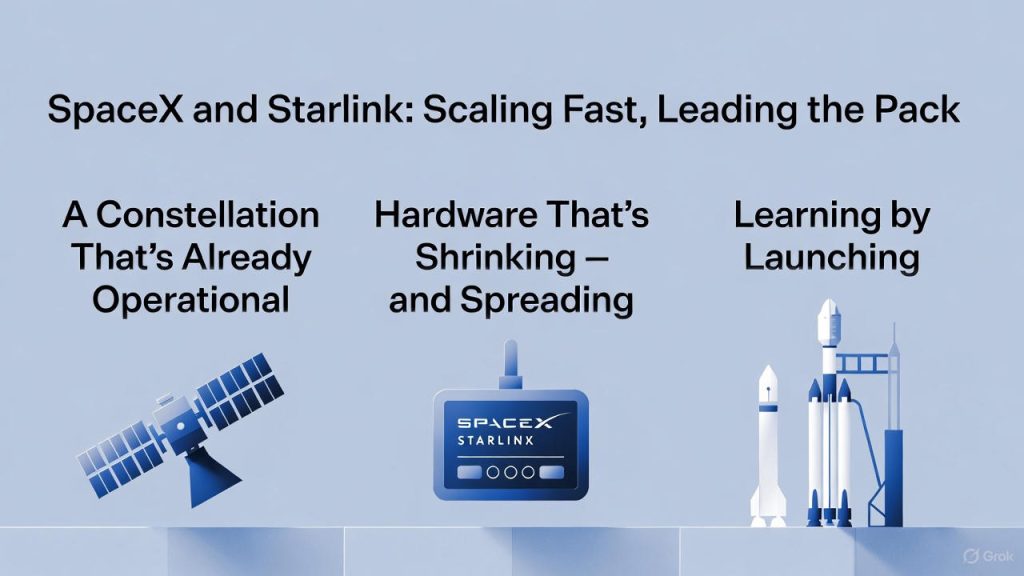
SpaceX and Starlink: Scaling Fast, Leading the Pack
SpaceX isn’t just launching rockets – it’s building a global internet layer from orbit. With Starlink, the company has taken a head start in the low Earth orbit (LEO) connectivity race, not only in size but in how fast it’s learning at scale. While others are still planning constellations, Starlink is already adjusting beam patterns, rolling out mobile support, and integrating with commercial sectors in real time.
1. A Constellation That’s Already Operational
As of now, Starlink operates with more than 9,300 satellites in low Earth orbit (approximately 9,357 in orbit, of which around 9,347 are working). Coverage isn’t limited to one region – it spans continents, oceans, and everything in between. This density allows for low-latency, high-throughput connections even in places traditional networks can’t reach.
That matters for remote sites, moving vehicles, or any environment where fiber or towers simply aren’t an option. With constant launches and rapid satellite replacement cycles, SpaceX is treating Starlink like a software-defined network that evolves in real time.
2. Hardware That’s Shrinking – and Spreading
Starlink started with home and business terminals, but that’s only part of the story. The Starlink Mini – a compact, portable unit that has been available since mid-2024 – is designed for mobility, travel, and lower power use. There’s also growing integration into aviation, maritime, and even mobile backhaul infrastructure.
The strategy is simple: bring the network to the device, not the other way around. As the hardware footprint shrinks, the number of use cases expands – from isolated work sites to delivery fleets and passenger aircraft.
3. Learning by Launching
One of the biggest differences with Starlink is pace. SpaceX launches its own satellites, tests in live environments, and upgrades the system continuously. It doesn’t just plan features – it flies them, watches what breaks, and ships new versions fast. That feedback loop has put Starlink years ahead in real-world performance.
It’s not just about the satellites. It’s about the system that surrounds them: automated manufacturing, vertical launch integration, real-time software updates, and an engineering culture that prioritizes iteration over perfection. That’s hard to replicate.
Amazon Leo: From Kuiper to Global Internet Service
Amazon entered the satellite broadband race with a clear goal: build a network that reaches the parts of the world fiber and 5G can’t. What began as Project Kuiper is now operating under the name Amazon Leo, reflecting its low Earth orbit architecture and long-term ambitions. While the system is still ramping up, its direction is already defined – mass deployment, global scale, and tight integration with Amazon’s existing cloud and logistics backbone.
More Than a Name Change
The shift from Project Kuiper to Amazon Leo in late 2025 wasn’t just cosmetic. It marked a transition from development to deployment. Manufacturing is underway, several launches have been completed (around 180-200 satellites in orbit as of late 2025), and enterprise preview programs with customer terminals are live.
- Headquarters: Redmond, Washington
- Satellite production: Kirkland, Washington (up to 5 per day)
- Ground integration: Kennedy Space Center, Florida
- Launch partners: SpaceX, ULA, Blue Origin, Arianespace
This isn’t a one-off experiment. Amazon is building the infrastructure to scale – and it’s spending billions to do it.
The Network Architecture
Amazon Leo is built around three moving parts: satellites, ground infrastructure, and customer terminals. Each piece has been engineered for global rollout and long-term service.
- Over 3,000 satellites planned for the initial constellation
- Orbit altitude: 590-630 km for low latency
- Three antenna types: Leo Nano, Leo Pro, Leo Ultra
- Gateway and TT&C antennas for data routing and satellite control
- Global fiber connectivity linking the network to internet backbones
Terminals are designed for flexibility. Leo Nano is compact and consumer-friendly, while Leo Ultra targets enterprise deployments with gigabit throughput.
Racing the Deadline
Amazon is under pressure from the FCC to get at least 1,600 satellites into orbit by July 2026 – a target that has shaped its launch schedule and supplier relationships. To hit this, the company has booked over 80 launch missions, including several with direct rival SpaceX.
It’s an unusual move, but it shows how serious Amazon is about delivering a working system on time. For now, enterprise preview programs are live, with broader coverage expected to roll out through 2026.
Blue Origin’s Role in the Infrastructure Race
Blue Origin isn’t building a satellite internet service – at least not yet. But it plays a critical part in how space-based communication infrastructure is starting to take shape. While Starlink and Amazon Leo focus on orbiting hardware and user terminals, Blue Origin is building what gets them there: the launch capacity.
Their New Glenn rocket, designed for heavy payloads and reuse, is aimed at supporting large-scale constellations like Leo. It hasn’t matched SpaceX’s launch cadence yet, but the long-term plan is clear – create a reliable, repeatable pipeline to low Earth orbit. That’s the groundwork every future-facing satellite network depends on.
Beyond launch vehicles, Blue Origin’s role is strategic. It gives Amazon a potential in-house path to orbit, reducing dependency on competitors like SpaceX. And while progress has been slower than expected, Blue Origin’s presence in the market keeps pressure on the launch economy – opening the door for more players, more launches, and eventually, more bandwidth from space.
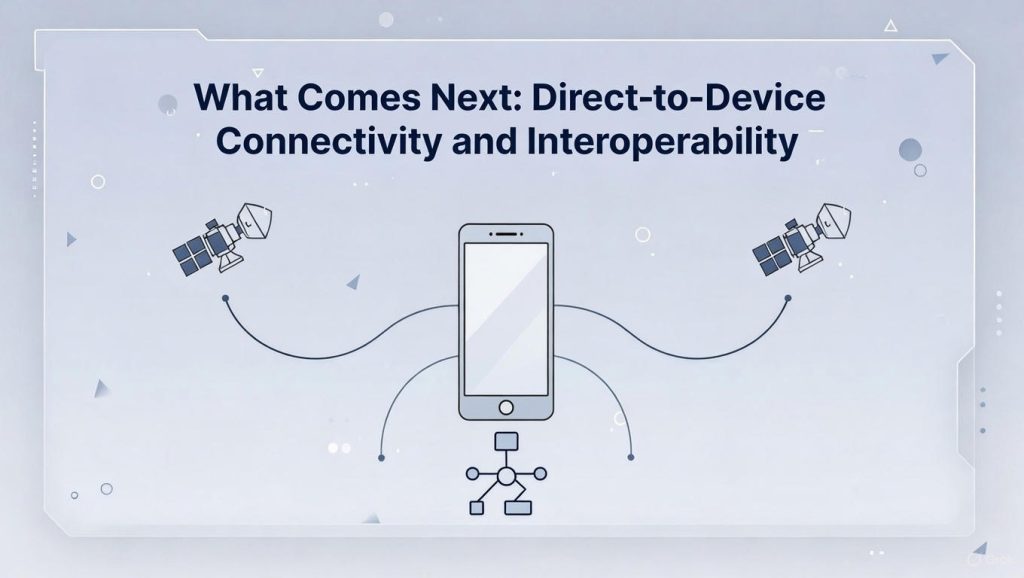
What Comes Next: Direct-to-Device Connectivity and Interoperability
The next stage of satellite connectivity isn’t about terminals or dishes. It’s about shrinking the distance between orbit and the device in your pocket. That shift – from satellite-to-ground station to satellite-to-phone – is already underway, and it’s going to reshape how networks behave, especially in places where infrastructure doesn’t (or can’t) reach.
Phones That Talk to Satellites
A handful of satellite operators are already testing direct-to-smartphone communication, starting with basic text or SOS functionality and moving toward low-bandwidth data. Companies like AST SpaceMobile and Lynk are pushing for broader compatibility with standard phones, while Apple and Android OEMs are slowly adding native satellite support.
The goal is clear:
- No special hardware
- No external antennas
- Seamless fallback when terrestrial networks drop out
This isn’t a sci-fi leap – it’s a quiet evolution, and it’s moving faster than expected.
Making It Work Across Systems
Interoperability is the next hurdle. Right now, most satellite services operate in closed ecosystems. But for direct-to-device communication to scale, we’ll need smarter roaming, clearer standards, and coordination between space and terrestrial carriers.
There’s momentum:
- 3GPP standards are evolving to include non-terrestrial networks (NTN)
- Chipsets are being tested for cross-compatibility
- Some telcos are already running hybrid pilots
It’s early, and there are still plenty of questions around spectrum, regulation, and capacity. But once the technical pieces line up, users won’t care if a message goes through a tower or a satellite – they’ll just expect it to work.
The Ground Layer: Antennas, Data Processing, and Real-Time Routing
The visible part of satellite connectivity happens overhead, but the system’s reliability depends just as much on what’s happening on the ground. Antennas, gateway stations, and processing infrastructure manage the heavy lifting – translating signals from orbit into usable data streams. These ground elements are what bridge the gap between satellite constellations and the networks we rely on every day.
Modern systems use a mix of telemetry, tracking, and control (TT&C) antennas to keep satellites operational, alongside high-throughput gateways that manage data flow to and from the internet. These components are distributed globally and connected through fiber routes, ensuring that even low-latency applications like video conferencing or cloud services can function smoothly.
What happens after the downlink is just as important as the launch. Routing decisions, packet prioritization, and data handoffs now run through increasingly intelligent systems. As satellite traffic grows, so does the complexity of managing it – especially in real time. That’s why many networks are evolving toward edge processing and adaptive routing, aiming to make space-based infrastructure feel as seamless as any ground-based connection.
Conclusion
Satellite connectivity is no longer something we wait for. It’s already here – scaling, evolving, and reaching parts of the world that standard infrastructure never could. SpaceX has proven what rapid iteration and scale can look like with Starlink. Amazon is putting serious weight behind Leo as it turns Kuiper from a concept into a global network. And Blue Origin, while not running its own service, is laying launch foundations that will support much more than just cargo.
What ties it all together is the shift from isolated systems to something more integrated. Signals from space, routing on the ground, and the potential for direct-to-device communication – it’s becoming one environment. Whether it’s for rural access, emergency comms, or simply staying connected on the move, we’re building toward a network that doesn’t stop at the edge of a cell tower. It just keeps going.
FAQ
In most cases, not yet. Some phones support emergency messaging via satellite, and more advanced direct-to-device services are being tested, but widespread support is still in development.
Starlink is already operational with thousands of satellites and consumer service available globally. Amazon Leo is still ramping up – it rebranded from Project Kuiper and expects full deployment in the next few years, with a different infrastructure and customer focus.
No, Blue Origin doesn’t provide internet service. Its role is focused on launch infrastructure. It’s working on reusable heavy-lift rockets like New Glenn that could support future satellite deployments – including Amazon’s.
Yes, especially with low Earth orbit systems. Because the satellites fly closer to Earth, latency drops significantly. Services like Starlink already support video calls, gaming, and HD streaming in real time.
Probably not entirely. Instead, it will extend coverage, fill in hard-to-reach areas, and serve as a fallback or complement in hybrid systems. Think of it more as an extra layer than a full replacement.