

Most of what happens in space isn’t flashy. No launches, no astronauts waving from orbit. Just silent machines doing quiet work: relaying GPS signals, scanning the oceans, tracking wildfires before they grow out of control. That’s space infrastructure – the hidden systems keeping everything from your morning weather app to national defense up and running. And while it might sound abstract, it’s already baked into how modern society functions. The catch? As we depend on it more, we also have more to lose if it fails.
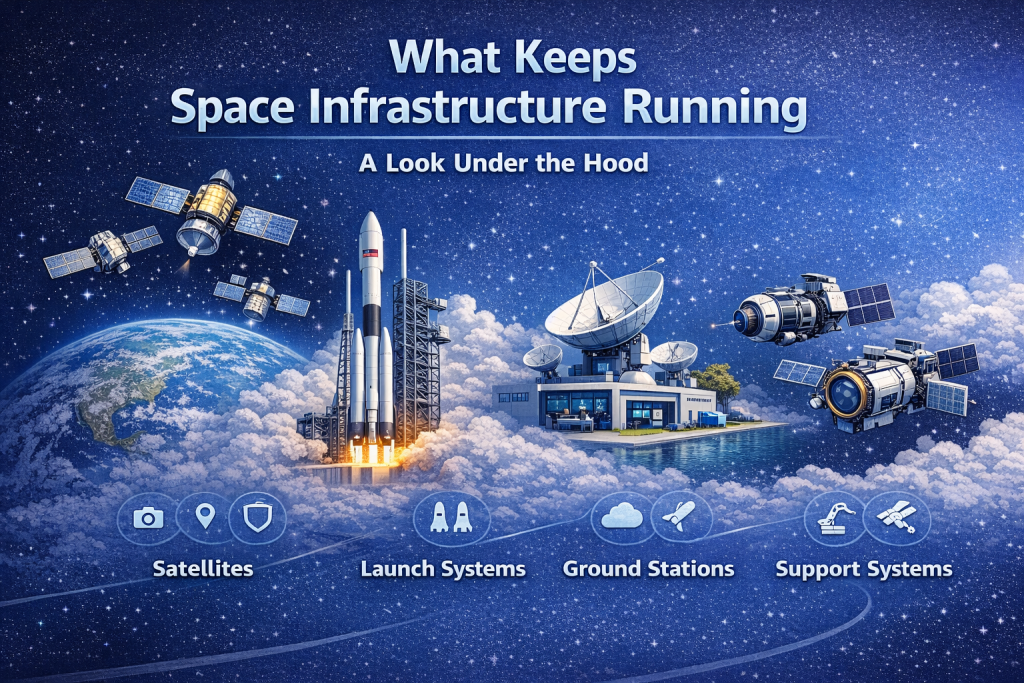
What Keeps Space Infrastructure Running: A Look Under the Hood
Space infrastructure isn’t a single system – it’s a mix of machines, data links, and services that quietly keep Earth connected, informed, and protected. Some parts live in orbit. Others are here on the ground. All of them are working together, even if we rarely notice.
Satellites: The Eyes, Ears, and Signal Carriers
Orbit is full of satellites with different jobs. Some are snapping images of wildfires or tracking climate shifts. Others provide GPS, route internet traffic, or relay signals for military communication. Most of what we call “space infrastructure” starts with these machines and there are tens of thousands of them already in service.
Launch Systems: Getting to Orbit Isn’t Automatic
Getting satellites into space is its own industry. Rockets from SpaceX, Rocket Lab, or China’s Long March series carry everything from telecom giants to tiny cube-sats. The choice depends on weight, purpose, and destination – but every satellite needs a reliable ride, and launch infrastructure has become a critical layer in the ecosystem.
Ground Stations: The Link Between Space and Earth
Once satellites are in orbit, they don’t operate alone. Ground stations handle data transfers, monitor system health, and send instructions back and forth. And now, with services like AWS Ground Station, this part of the stack is becoming more flexible – companies can plug into a global network without building their own antennas.
Support Systems: Extending the Life of What’s Up There
Satellites aren’t meant to last forever, but new tools are emerging to give them more time. Space tugs, orbital refueling systems, and robotic repair services are turning what used to be single-use hardware into longer-term infrastructure. It’s still early, but the shift toward modular, fixable assets is already underway.
Space infrastructure is no longer just about launching and forgetting. It’s about building systems that can adapt, stay useful, and feed data back into decisions here on Earth – whether that’s guiding a ship into port or mapping a damaged bridge after a storm.

Turning Data Into Insight: How FlyPix AI Supports Space Infrastructure
We built FlyPix AI to help teams work faster with satellite, aerial, and drone imagery. Instead of spending days on manual annotation, we use AI agents to automate detection, monitoring, and inspection tasks. The goal is simple: turn raw visual data into clear results in minutes, not weeks, without requiring programming skills or deep AI expertise.
Our platform is already used across construction, infrastructure maintenance, agriculture, government, and environmental projects. Users train custom AI models with their own annotations and apply them to dense, complex scenes where manual analysis quickly breaks down. In real workflows, this approach reduces analysis time by more than 99%, making large-scale geospatial monitoring practical instead of resource-heavy.
We stay closely connected to the wider space and GeoAI community. We regularly share updates, research participation, and real project work on LinkedIn, alongside collaborations like AWS GenAI Launchpad and ESA- and NASA-linked workshops. For us, supporting space infrastructure means one thing: helping people reliably understand what satellites see, and act on it faster.
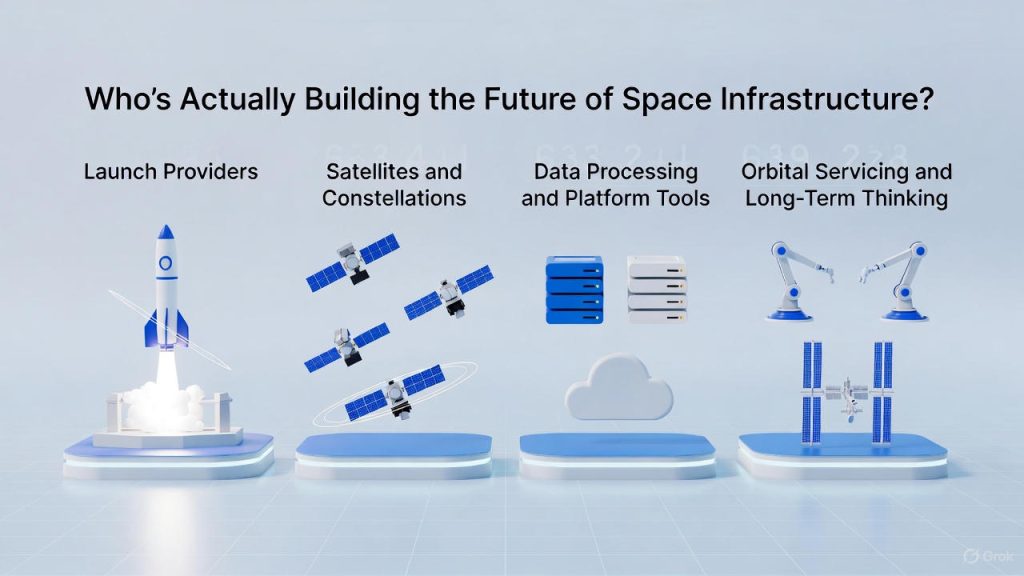
Who’s Actually Building the Future of Space Infrastructure?
Space isn’t abstract anymore. The companies shaping orbital infrastructure today are solving very specific problems – launching satellites cheaper, processing data faster, connecting more people, and keeping fragile systems running longer. It’s no longer about flag-planting. It’s about who can build, scale, and deliver under pressure.
Below is a breakdown of who’s leading in each layer of the space infrastructure stack – from rockets to ground systems, with a few surprising names along the way.
1. Launch Providers: Still a Rocket Game
Getting to orbit is still the first step, and the companies that own the rockets control the pace of everything else. It’s not just about lifting payloads anymore – it’s about doing it often, reliably, and without breaking budgets.
- SpaceX: No one moves faster. Falcon 9 has become the standard delivery van for space, launching almost weekly and reusing boosters like clockwork.
- CASC (China Aerospace Science and Technology Corporation): State-backed and scaling rapidly, CASC supports China’s aggressive space roadmap, including crewed missions, lunar probes, and massive satellite deployments.
- ULA: Backed by Boeing and Lockheed, ULA focuses mostly on high-security defense launches. Its Vulcan Centaur rocket, which has been operational since 2024 with multiple launches including national security missions in 2025, continues to modernize its fleet.
- Rocket Lab: A go-to for smaller payloads and startups. Their Electron rocket is nimble, and their Neutron vehicle, currently in development with first launch targeted for mid-2026, will support larger satellites and potentially human spaceflight in the future.
- Arianespace: Europe’s reliable launcher, now betting big on Ariane 6 after retiring the Ariane 5. It’s slower than SpaceX but remains a key player for ESA missions.
What’s shifting: We’re seeing the move from national space programs to commercial cadence. Whoever controls fast, affordable access to space – controls the tempo of infrastructure growth.
2. Satellites and Constellations: From School Buses to Swarms
There’s been a quiet revolution in satellite design. Instead of one giant satellite trying to do everything, companies now launch fleets of smaller, specialized ones that work together. It’s modular thinking – in orbit.
- Starlink (SpaceX): With over 9,400 satellites in orbit (of which approximately 9,400 are operational), this is the largest LEO constellation ever. It’s changed how we think about global connectivity – and set new standards for satellite deployment speed.
- Planet Labs: Their Dove and SkySat satellites scan the entire Earth daily – a game-changer for agriculture, logistics, disaster response, and more.
- Maxar: Known for ultra-high-resolution Earth imagery. Their satellites feed data into everything from defense mapping to climate tracking.
- Iridium and Viasat: Originally built for voice and broadband, they’re adapting to the LEO model to stay competitive.
- Government fleets: National systems like GPS, BeiDou, Galileo, and GLONASS still form the backbone of navigation, but even they’re getting upgrades.
Why it matters: Constellations allow for redundancy, faster refresh cycles, and real-time global coverage. It’s not just smarter tech – it’s a smarter way to build infrastructure.
3. Data Processing and Platform Tools: The Invisible Layer
Satellites produce raw data. But until it’s processed, cleaned, and visualized – it’s just noise. This is where the real value gets unlocked, and the bottlenecks appear.
- AWS Ground Station: Made it possible to downlink satellite data directly into the cloud, cutting out costly ground hardware.
- Microsoft Azure Orbital: Targets defense and commercial users who need secure, scalable satellite data routing.
- FlyPix AI: That’s where we come in. We help users quickly detect and analyze objects in satellite, drone, and aerial images – using AI agents trained on real-world conditions. Whether it’s land-use classification or post-disaster inspection, we help reduce manual processing time by up to 99.7%.
- Leaf Space and Northwood Space: Offer flexible ground infrastructure and signal relay for growing satellite operators.
The shift: Infrastructure is no longer just about launching hardware – it’s about understanding what that hardware sees. The faster and smarter we can process data, the more valuable that infrastructure becomes.
4. Orbital Servicing and Long-Term Thinking
Space used to be one-way. Launch, operate, die. Now? We’re starting to see the beginnings of orbital logistics – refueling, repositioning, repairing.
- Astroscale: Leading the way in space debris cleanup and satellite deorbiting. Their services aim to make space more sustainable.
- OrbitFab: Building refueling stations in orbit – literally trying to become “the gas station in space.”
- Impulse Space: Designing space tugs to transport or reboost satellites with precision. This saves fuel and extends missions.
- Firefly Aerospace: Besides launching, they’re entering the servicing game with infrastructure-focused orbital platforms.
Why this matters: If we want infrastructure that lasts, it has to be maintainable. Orbital servicing closes the loop – and avoids turning LEO into an unsustainable landfill.
Risks, Resilience, and the Question No One Can Agree On
Space systems today support everything from GPS and banking to military coordination and wildfire alerts – yet in many regions, they’re still not officially treated as critical infrastructure. That status would bring extra protection, but also regulation. Right now, space mostly sits in a legal gray zone: partially covered by telecom and transport laws, but not fully recognized as a standalone critical layer.
At the same time, the risks aren’t hypothetical. Satellites can be jammed, spoofed, hacked, or taken offline by debris. Many still rely on limited processing power and outdated protocols, with little room for fast updates or in-orbit defense. As the number of constellations grows, so does the surface area for attack – both physical and digital.
Some argue that labeling space as “critical” would slow innovation under too much oversight. Others say the risk of doing nothing is worse. There’s no easy answer yet. But one thing’s clear: resilience will likely come from smart design, redundancy, and the tools that help us respond fast – not just from policy.
Where It’s Going: Building Space Systems That Can Actually Keep Up
The future of space infrastructure isn’t just about launching more stuff – it’s about designing systems that can keep working under pressure, adapt quickly, and stay useful without burning through resources. The “bigger is better” era is already fading. What’s replacing it is smarter architecture, modular tools, and flexible design that makes room for change. Here’s where things are heading next:
- Constellations over single satellites: Instead of relying on one massive spacecraft, operators now deploy dozens or hundreds of smaller units. If one fails, the system keeps going. It’s cheaper, faster to update, and easier to scale globally.
- On-orbit servicing and refueling: Startups like OrbitFab and Astroscale are working on tech to keep satellites alive longer – refuel them, move them, or safely deorbit them. It’s a shift from throwaway hardware to infrastructure that evolves.
- AI and edge processing in orbit: As hardware improves, some analytics will happen in space, not just on Earth. That means faster insights, less data transmission, and more autonomy for satellites handling real-time decisions.
- More modular, repairable designs: Companies are starting to think about how parts can be swapped, updated, or reused – not just how fast they can launch.
- Data platforms built for speed and scale: Tools like FlyPix AI are a key part of this. Raw satellite images aren’t useful on their own – they need to be processed, understood, and acted on quickly. That layer is where space infrastructure becomes real infrastructure.
Smarter systems mean less fragility, more uptime, and better decisions down here on Earth. That’s the real direction of space – not just out, but forward.
Conclusion
Space infrastructure used to be something you only heard about in press releases or sci-fi. Now it’s behind weather alerts, food supply chains, high-speed internet, and national security. And while launches and satellites get most of the attention, what happens after deployment – data flow, interpretation, resilience – is where the real work starts.
We’re seeing a shift from one-off hardware to living systems. From isolated missions to connected networks. And from raw imagery to rapid insight – the kind you can actually use. Whether you’re in agriculture, logistics, energy, or defense, the impact of this infrastructure isn’t far away. It’s already part of your day, whether you notice it or not.
The next stage? Smarter tools, faster decisions, and platforms built to keep up. Because infrastructure that can’t adapt – doesn’t last.
FAQ
It’s the combination of satellites, launch systems, ground stations, and data tools that let us use space for practical needs – GPS, communication, Earth imaging, and more. It’s like the internet, but for orbit.
Satellites are a big part of it, but they’re only one piece. Without launch vehicles to get them into space, ground systems to talk to them, and AI tools to process the data they send back, nothing works.
Because we’re using it more – and relying on it for things that affect daily life, like weather prediction, disaster response, precision farming, and military operations. It’s no longer “just in case.” It’s essential.
It’s getting better, but not perfect. Many systems still run with minimal protection against cyber threats or signal disruption. There’s a growing push for smarter design, redundancy, and faster recovery when something fails.
Yes, but growth isn’t the only goal. The real challenge now is scaling responsibly, making systems more resilient, and giving people better ways to use the data that’s already flowing down from orbit every second.