
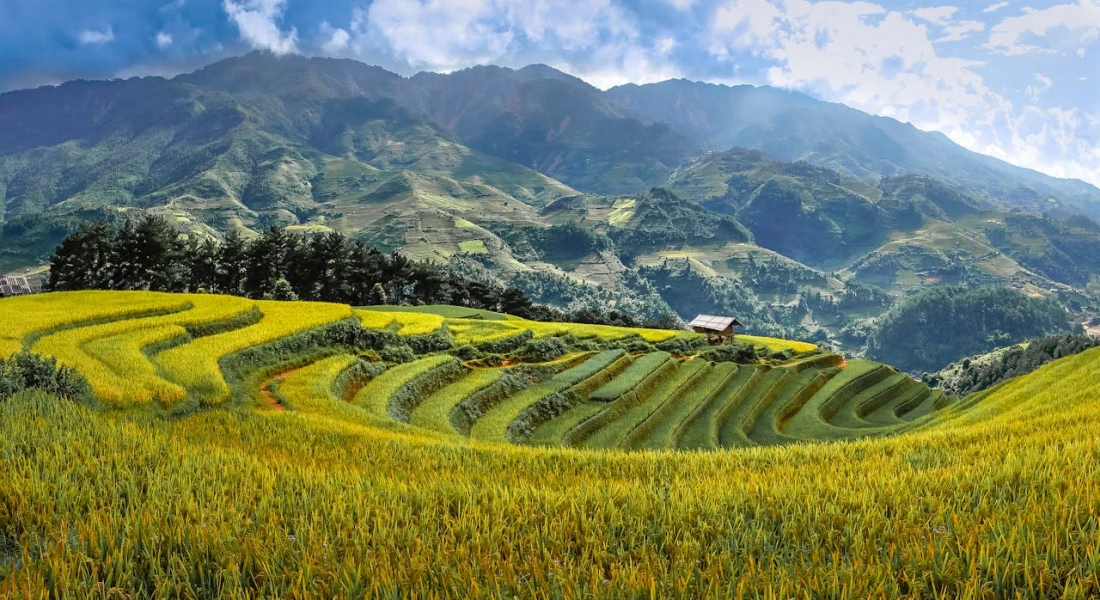
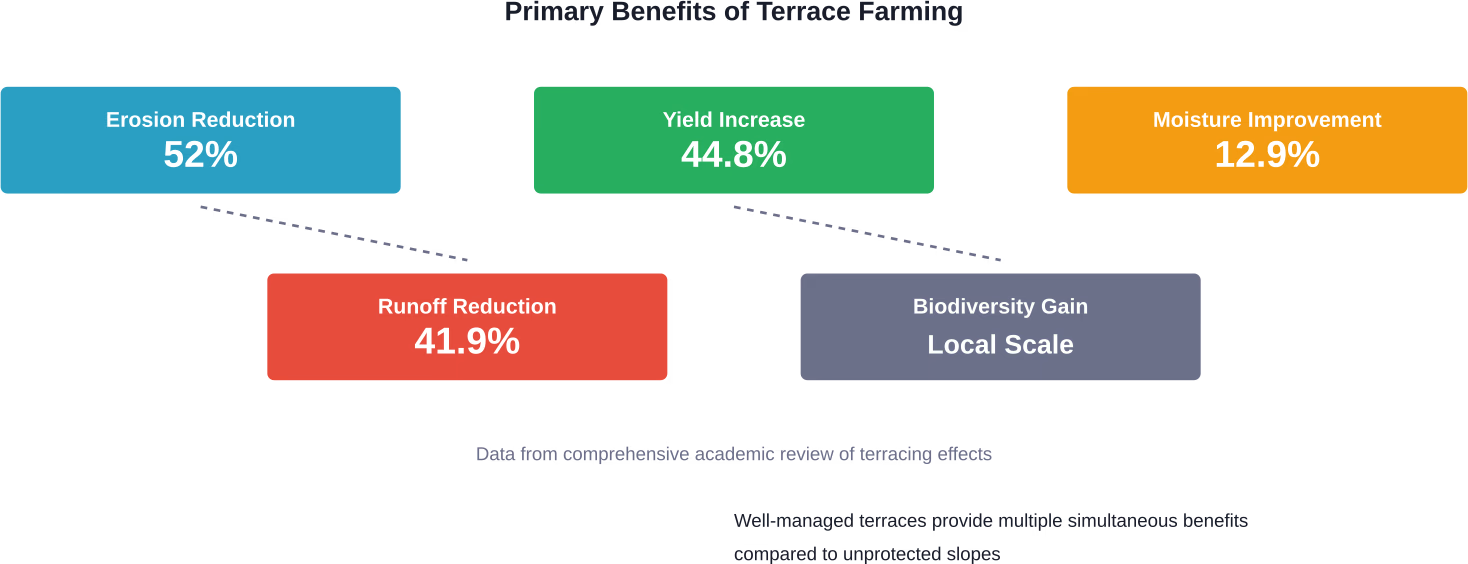
Terrace farming transforms sloped land into productive agricultural space through stepped level construction. This ancient practice reduces soil erosion by over 52%, improves water conservation by 12.9%, and increases crop yields by up to 44.8% according to academic research, making it essential for sustainable agriculture on hilly terrain.
Slopes and steep hillsides present serious challenges for conventional agriculture. Water runs off rapidly, topsoil washes away, and equipment becomes dangerous or impossible to operate.
But what if there was a method that could turn these challenging landscapes into productive farmland?
Terrace farming has been doing exactly that for thousands of years. From the rice terraces of the Philippines to modern mechanized operations in Nebraska, this agricultural technique continues to prove its value. The practice involves creating level platforms on slopes, essentially converting a hillside into a series of flat steps suitable for cultivation.
Here’s the thing though—terracing isn’t just about making hilly land farmable. According to comprehensive academic research, terraces reduce runoff by over 41.9% and sediment by 52% respectively, while improving grain yields by 44.8% and soil moisture content by 12.9% according to comprehensive academic research.
Let’s explore how this ancient technique continues to shape modern agriculture.
What Is Terrace Farming?
Terrace farming is an agricultural method that creates stepped levels on sloped terrain, transforming hillsides into cultivable flat surfaces. Each terrace consists of a level planting area backed by a ridge or embankment that prevents soil and water from cascading downhill.
The technique dates back thousands of years. The Rice Terraces of the Philippine Cordilleras hold UNESCO World Heritage Site status, but this designation specifically excludes the Banaue Rice Terraces. These historical examples demonstrate the long-term viability of well-designed terracing systems.
According to the USDA Natural Resources Conservation Service, a terrace is defined as “a broad channel, bench, or embankment constructed across the slope to intercept runoff and to detain the water or to channel the excess water to protected outlets for disposal from the field.”
But modern terracing goes beyond simple earthworks. Today’s systems incorporate precise engineering calculations, mechanized construction equipment, and often integrate with broader conservation plans that address entire watershed health.
The Core Purpose of Terrace Farming
Why go through the effort and expense of reshaping hillsides? The answer lies in several interconnected agricultural challenges.
Soil Erosion Prevention
Soil erosion represents one of agriculture’s most persistent problems. On unprotected slopes, rainfall doesn’t soak in—it runs downhill, carrying topsoil with it.
Research published in agricultural journals shows that terraces can reduce soil loss by over 52% compared to unprotected slopes. This isn’t just about keeping dirt in place. Topsoil contains the organic matter and nutrients crops need to thrive. Losing it means declining yields and increased fertilizer costs.
The USDA documented a case in Minnesota where farmer Jim Joens worked with the Natural Resources Conservation Service to develop a conservation plan addressing severe erosion. The implementation of terraces not only protected his land but contributed to the health of the entire Kanaranzi Little Rock Watershed.
Water Management and Conservation
Terraces intercept water that would otherwise rush downhill. This interception serves multiple purposes.
First, it reduces the destructive power of runoff. Fast-moving water cuts gullies and strips away soil. Slowing it down prevents this damage.
Second, detained water has more time to infiltrate the soil. According to academic research, terrace farming improves soil moisture content by 12.9% on average. This retained moisture supports crop growth during dry periods and reduces irrigation requirements.
The Kansas Geological Survey notes that terraces can either detain water for infiltration or channel excess water to protected outlets, depending on local precipitation patterns and soil characteristics.
Expanding Cultivable Land
Real talk: many regions simply don’t have enough flat land to support their agricultural needs. Mountainous areas like Tigray, Ethiopia—home to over 4.5 million farmers—rely heavily on terracing to expand food production capacity.
The Ethiopian government has invested significantly in terrace construction and land rehabilitation programs. These initiatives have been particularly successful at providing agricultural opportunities for youth and women, with 50% of rehabilitated land first allocated to young women.
Terracing doesn’t just make more land available—it makes that land productive enough to support livelihoods and food security.
Common Types of Terrace Farming Systems
Not all terraces look or function the same. The design depends on slope angle, soil characteristics, precipitation patterns, and the degree of mechanization required.
Bench Terraces
Bench terraces are the classic stepped structure most people picture when thinking about terracing. They feature level beds separated by steep risers or embankments.
This type works best on steep slopes where other systems won’t function effectively. The flat beds provide stable working surfaces for planting, cultivation, and harvest—even on dramatic inclines.
The risers can be constructed from various materials. Stone walls provide permanence and stability in rocky terrain. Earthen embankments work well where stone isn’t available. Some systems incorporate planted risers using grasses or shrubs that stabilize soil while providing additional benefits like fodder or erosion control.
The famous rice terraces of Asia primarily use bench designs, with some terraces maintained continuously for centuries.
Broad-Base Terraces
Broad-base terracing creates gentle channels and ridges across slopes, rather than dramatic steps. These terraces have wide, gently sloping surfaces that allow farm equipment to cross them at designated passages.
According to agricultural engineering specifications, broad-base terracing works on slopes up to 8%. The system is particularly popular in mechanized agriculture because equipment can operate more safely and efficiently than on steeper terrace types.
One critical rule: crossing the ridges is prohibited except at designated passages. Equipment moves between terraces through these planned access points, preventing ridge damage that would compromise the system’s effectiveness.
Grassed Back-Slope Terraces
This perennial terracing variation incorporates permanent grass cover on the back slopes between level cultivation areas. The grass serves multiple functions.
First, it provides excellent erosion control. Grass roots hold soil in place even during heavy rainfall. Second, the vegetation can serve as livestock fodder, adding economic value beyond crop production. Third, grassed slopes support biodiversity by providing habitat for beneficial insects and other organisms.
The system works particularly well in mixed crop-livestock operations where the grass component integrates naturally with existing farming activities.
Narrow-Base Terraces
Narrow-base terraces feature steeper slopes and more compact construction than broad-base designs. They’re suitable for steeper terrain where broad-base systems won’t work but full bench terraces aren’t necessary.
These terraces typically don’t allow equipment to cross the ridges. Instead, machinery operates within individual terrace sections. This limitation makes them less suitable for large-scale mechanized operations but perfectly functional for smaller farms or regions with limited mechanization.
| Terrace Type | Suitable Slope | Mechanization Level | Primary Advantage |
|---|---|---|---|
| Bench Terraces | Steep slopes | Low to moderate | Maximum erosion control on steep terrain |
| Broad-Base Terraces | Up to 8% | High | Equipment can operate across terraces |
| Grassed Back-Slope | Moderate slopes | Moderate | Dual-purpose: crops and fodder production |
| Narrow-Base Terraces | Moderate to steep | Low to moderate | Compact design for space-limited areas |
Engineering Considerations for Effective Terracing
Successful terracing requires more than just moving dirt around. Proper design accounts for multiple factors that determine long-term performance.
Slope Analysis
Accurate slope measurement is the starting point. Slope percentage indicates how much the land drops over a given horizontal distance. A 15 percent slope drops 15 feet over a horizontal distance of 100 feet.
This measurement determines which terrace type is appropriate and how terraces should be spaced. Steeper slopes require more intensive terracing systems with closer spacing between levels.
Grade and Water Management
Each terrace needs proper grade—the slight slope built into the level surface. This grade determines how water moves across the terrace.
Level terraces have zero grade and are designed to hold all water for infiltration. These work well in drier regions where water conservation is paramount.
Graded terraces have a slight slope that moves excess water to protected outlets. This design prevents waterlogging in areas with higher precipitation while still slowing runoff enough to reduce erosion.
The USDA emphasizes that terraces must channel excess water to protected outlets for disposal from the field. Without proper outlets, water can concentrate and cause catastrophic failures.
Soil Characteristics
Soil type dramatically affects terrace performance. Clay soils hold water well but can become waterlogged if drainage isn’t adequate. Sandy soils drain quickly but may not hold enough moisture for crops during dry periods.
Some community discussions from agricultural regions note that rocky soils present particular challenges. Thin topsoil over rocky substrates may not provide adequate root depth even after terracing. In these situations, terracing alone may not make land agriculturally viable without additional soil improvement measures.

Monitor Terrace Conditions and Spot Issues Early
Terrace farming depends on stability – small changes in soil, structure, or water flow can affect the whole system over time. FlyPix AI helps analyze satellite, drone, and aerial imagery to track these changes, using AI to detect patterns like surface shifts, vegetation gaps, or drainage issues across large areas. Instead of relying only on field checks, teams can monitor terraces remotely and focus on zones that need attention.
This makes it easier to keep track of terrace conditions, compare how they change season to season, and respond before problems become visible. If you’re managing terraced land or working in agriculture, it’s worth reaching out to the FlyPix AI team to see how their platform can support more consistent monitoring and practical decision-making.
Economic and Environmental Benefits
The investment in terrace construction pays dividends across multiple dimensions.
Increased Agricultural Productivity
The 44.8% average yield improvement documented in academic research represents substantial economic value. Higher yields per acre mean more production from existing land without expanding into new areas.
But there’s a caveat. A case study from Hayes County, Nebraska documented significant yield decline in a 99-acre field after terrace construction in 2010. Soil health specialists investigating this case identified potential causes that may have contributed to the yield decline, including design factors, soil management during construction, and compaction issues.
This highlights an important point: terraces must be properly designed and constructed. Poorly executed terracing can actually reduce productivity rather than enhancing it.
Long-Term Soil Conservation
The soil saved by terracing stays on the field where it belongs. This conservation compounds over time. Fields that maintain topsoil depth continue producing, while fields losing soil see declining yields and increasing input costs.
The USDA case in Minnesota illustrates this principle. The conservation plan addressing erosion didn’t just protect Jim Joens’ farm—it contributed to watershed-scale environmental health. Sediment that stays on fields doesn’t clog streams, fill reservoirs, or degrade water quality downstream.
Carbon Sequestration Potential
Analysis of the Chanje Lavi Plantè agricultural development project in Haiti revealed substantial carbon sequestration potential from hillside conservation measures. The project combined terrace construction with reforestation and perennial crop expansion.
According to the low emissions development analysis, reforestation of watersheds could sequester approximately 478,828 tCO2e annually, while perennial crop expansion could sequester around 230,854 tCO2e annually. Together, these hillside stabilization strategies drive 98% of the project’s climate mitigation impact.
Biodiversity Conservation
Comprehensive research reviews indicate that terracing can contribute toward conservation of plant biodiversity on a local scale. The varied microhabitats created by terrace structures—level beds, risers, channels, and buffer strips—support different plant communities.
This diversity extends to beneficial insects, pollinators, and other organisms that contribute to agricultural ecosystem health.
Challenges and Limitations
Now, this is where it gets real. Terracing isn’t a universal solution, and the academic literature acknowledges significant limitations.
Construction Costs and Labor Requirements
Building terraces requires substantial upfront investment. Specialized terracing plows range from $15,000 upward in cost. According to competitor content, the AMCO TJ3-1826 Terracing Plow can build over 1,000 feet of terraces per hour.
Labor costs add up quickly, especially for bench terrace construction that may involve extensive manual work. Community discussions from agricultural regions suggest this economic barrier prevents many farmers from implementing terracing even when they recognize its benefits.
Maintenance Requirements
Terraces don’t maintain themselves. Weather events damage ridges and channels. Vegetation management on grassed slopes requires ongoing attention. Outlets can become clogged or eroded.
Neglected terraces deteriorate, and deteriorated terraces can perform worse than no terraces at all. Research indicates that poorly designed or mismanaged terraces can produce average runoff and soil loss 1 to 5 times that of well-managed terraces.
Potential Water Circulation Problems
As terraces age, issues can emerge. Academic reviews note that terracing can interfere with natural water circulation patterns. In some cases, this interference leads to waterlogging in certain areas while other sections become too dry.
The key lies in proper initial design that accounts for local hydrology and ongoing management that addresses problems as they develop.
Not All Locations Are Suitable
Soil characteristics matter enormously. Community discussions from Appalachian regions note that thin, rocky soils present challenges even after terracing. High clay content can create drainage problems. Extremely steep slopes may not be economically viable to terrace even if technically possible.
In regions with abundant flat farmland—like much of the United States Midwest—the economics simply don’t favor terracing. Why invest in reshaping hillsides when level land is readily available?
Crops Suitable for Terrace Farming
Different crops adapt differently to terraced systems. Rice stands out as perhaps the most famous terrace crop, with thousands of years of cultivation history on Asian terraces.
But terracing supports diverse crops. Grain crops including wheat, barley, and corn grow successfully on terraces when the system is properly designed for mechanized cultivation. Legumes like beans and lentils work well, often fitting into rotation systems that build soil fertility.
The Chanje Lavi Plantè project in Haiti focuses on perennial crops—particularly orchard systems. Fruit and nut trees on terraced hillsides provide multiple benefits: profitable production, hillside stabilization through root systems, and significant carbon sequestration.
Vegetable production works well on smaller-scale terraces, especially bench terraces where manual labor provides most of the cultivation work.
The key is matching crop requirements to what the terrace system provides. Crops needing excellent drainage won’t thrive on level terraces designed for water retention. Crops requiring deep soil won’t perform on shallow terrace beds over rocky substrates.
Terrace Farming in Modern Contexts
Traditional terracing was built with hand tools and animal power. Modern terracing increasingly incorporates technology and mechanization.
Specialized equipment makes construction faster and more precise. GPS-guided machinery can establish exact grades and elevations. Digital elevation models help engineers design optimal terrace layouts before breaking ground.
Precision agriculture tools support terraced farming operations. Satellite monitoring can track crop health across complex terraced landscapes. Variable rate applications adjust inputs based on conditions in individual terrace sections.
Some modern approaches combine terracing with other conservation practices. Integration with cover cropping, reduced tillage, or agroforestry creates systems that address multiple environmental and production goals simultaneously.
The Ethiopian example shows how government programs can scale terracing adoption. Systematic land allocation policies, technical support, and integration with broader development objectives help overcome economic barriers that prevent individual farmers from implementing terracing.
Is Terrace Farming Sustainable?
The short answer? It can be—but sustainability depends entirely on implementation quality.
Well-designed, properly maintained terraces demonstrate excellent long-term sustainability. The thousands-year history of Asian rice terraces proves the concept. These systems have supported continuous cultivation across countless generations without depleting the resource base.
The environmental benefits align with sustainability principles: soil conservation, water quality protection, carbon sequestration, and biodiversity support all contribute to long-term ecosystem health.
Economic sustainability is more variable. Systems that significantly increase productivity relative to construction and maintenance costs prove economically sustainable. Systems with marginal benefits relative to costs may not be maintained, leading to deterioration and eventual failure.
Social sustainability connects to labor availability and community capacity. Labor-intensive terrace systems work well in contexts where family labor is available and valued. They struggle where labor costs are high and opportunity costs favor off-farm employment.
| Sustainability Dimension | Favorable Conditions | Challenging Conditions |
|---|---|---|
| Environmental | Proper design with adequate maintenance | Poor design or neglected maintenance |
| Economic | Significant yield gains, available technical support | Marginal productivity, high construction costs |
| Social | Available family labor, community knowledge | High labor costs, lack of technical expertise |
| Long-term Viability | Strong institutional support, clear land tenure | Uncertain land rights, policy instability |
Moving Forward with Terrace Farming
Terrace farming represents a proven technology with thousands of years of successful application. The quantified benefits—52% erosion reduction, 44.8% yield increases, significant water conservation—demonstrate real value for appropriate contexts.
But terrace farming isn’t plug-and-play agriculture. Success requires proper site analysis, appropriate design selection, quality construction, and ongoing maintenance. The difference between well-managed and poorly managed systems is dramatic, with bad implementation potentially causing more harm than good.
For regions with limited flat farmland, terracing often represents the only viable path to agricultural self-sufficiency. Ethiopia, Haiti, and many other nations with large populations on hilly terrain depend on terracing to meet food security needs.
For regions with abundant level land, terracing makes less economic sense. The United States, for example, solved mountainous agriculture challenges primarily by farming elsewhere rather than extensively terracing Appalachian slopes.
The environmental benefits extend beyond individual farms. Soil saved from erosion doesn’t clog streams or fill reservoirs. Carbon sequestered in terrace vegetation and soils contributes to climate mitigation. Biodiversity supported in terraced landscapes enhances ecosystem resilience.
Looking ahead, technology integration offers opportunities to make terracing more efficient and accessible. Precision design tools, mechanized construction equipment, and satellite monitoring can reduce costs and improve outcomes. Government programs that provide technical assistance and cost-sharing make terracing economically feasible for more farmers.
The key is understanding that terracing is a tool—not a universal solution. Applied appropriately with quality implementation, it transforms challenging landscapes into productive farmland while providing substantial environmental benefits. Applied poorly, it wastes resources and can worsen the problems it’s meant to solve.
For those considering terrace farming, the path forward starts with thorough assessment. Soil analysis, slope measurement, hydrological evaluation, and economic feasibility studies should all precede construction decisions. Consultation with agricultural extension services or conservation districts can provide valuable technical expertise. And planning for long-term maintenance is just as important as initial construction.
Terrace farming has supported civilizations for millennia. With proper application, it continues to offer solutions for sustainable agriculture on sloped terrain in our modern world.
Frequently Asked Questions
The main purpose of terrace farming is to prevent soil erosion on sloped land by creating level platforms that slow water runoff. This allows cultivation of hillsides that would otherwise be unsuitable for agriculture while conserving soil and water resources. According to USDA definitions, terraces intercept runoff to either detain water for infiltration or channel it safely to protected outlets.
Comprehensive academic research shows that terraces reduce soil loss by over 52% on average compared to unprotected slopes. They also reduce runoff by more than 41.9%. However, these benefits depend on proper design and maintenance—poorly managed terraces can actually increase erosion by 1 to 5 times compared to well-managed systems.
Rice, grains (wheat, barley, corn), legumes, vegetables, and perennial crops like fruit trees all grow successfully on terraces when matched to appropriate terrace designs. Rice terraces in Asia have supported production for thousands of years. The Chanje Lavi Plantè project in Haiti successfully uses terraces for orchard systems, achieving both production and conservation goals.
Yes, but it depends on the type. Broad-base terraces designed for slopes up to 8% allow equipment to cross at designated passages, making them suitable for mechanized operations. Specialized terracing plows like the AMCO TJ3-1826 can construct over 1,000 feet of terraces per hour. Steeper bench terraces typically require manual labor or smaller equipment operating within individual terrace sections.
Costs vary significantly based on terrain, design complexity, and equipment availability. Specialized terracing plows range from $15,000 upward. According to available data from 2025, overall costs depend on slope steepness, soil conditions, and whether construction uses mechanized equipment or manual labor. Many government programs provide cost-sharing assistance to make terracing more economically feasible.
Yes, terraces require ongoing maintenance to remain effective. Ridges need repair after heavy weather events, channels require clearing, and vegetation on grassed slopes needs management. Neglected terraces deteriorate and can perform worse than unprotected slopes. The USDA emphasizes that long-term success depends on consistent maintenance and proper management practices.
Academic research documents an average yield improvement of 44.8% on well-managed terraced fields. This increase results from improved soil moisture (12.9% average increase), reduced erosion, and better soil conservation. However, poorly constructed or managed terraces can actually decrease yields, as documented in a Nebraska case where yields declined significantly after improper terrace installation.