
Images are everywhere. Photos from smartphones, cameras on factory floors, satellite imagery, medical scans, security footage. Most companies collect massive amounts of visual data every day, but only a small part of it is actually used. The rest just sits there, unprocessed and untouched.
Image recognition changes that. It gives software the ability to understand what’s happening inside an image and turn visuals into something measurable and useful. Instead of relying on manual review or guesswork, businesses can automatically spot patterns, detect issues, and react faster. That shift is why image recognition is no longer a “nice to have” technology. It’s becoming a practical tool for efficiency, accuracy, and better decision-making across industries.
What Image Recognition Actually Does
At its core, image recognition enables machines to answer simple but powerful questions about visuals.
- What is in this image?
- How many objects are present?
- Where are they located?
- Is something missing, broken, unusual, or out of place?
Modern image recognition systems rely on machine learning and deep learning models trained on large collections of labeled images. Over time, these models learn to identify visual patterns such as shapes, textures, colors, edges, and spatial relationships. This allows them to classify images, detect objects, segment scenes, recognize faces, read text, or track movement.
Unlike traditional image processing, which depends on fixed rules and predefined thresholds, image recognition systems adapt. They improve with data. They learn from new examples. They adjust to different environments, lighting conditions, angles, and contexts.
That adaptability is a big part of why image recognition matters today. The digital world is messy. Images are rarely perfect. Real-world data requires systems that can handle noise, variation, and scale.
Why Visual Data Has Become So Important
Text used to dominate digital systems. Databases, spreadsheets, reports, and documents were the primary source of information. That is no longer the case.
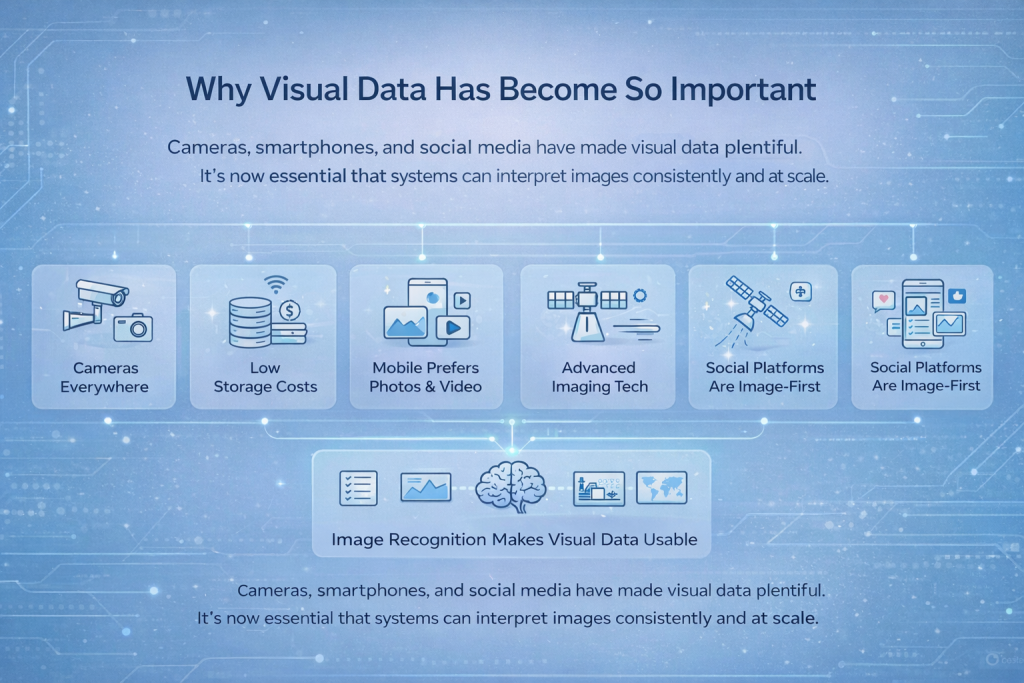
Several trends have shifted the balance toward visuals:
- Cameras are cheap and everywhere
- Storage costs are low
- Mobile devices prioritize photos and video
- Sensors and imaging technologies have improved dramatically
- Social platforms are image-first by design
As a result, images now capture more context than text ever could. A single photo can show condition, behavior, environment, scale, and anomalies at once. A video feed can reveal patterns over time that would never appear in a spreadsheet.
But visual data only becomes valuable when it can be interpreted consistently and at scale. Humans are good at understanding images, but they are slow, subjective, and expensive. Reviewing thousands of images manually is not realistic. Reviewing millions is impossible.
Image recognition makes visual data usable in systems where speed, consistency, and volume matter.

How We Turn Images Into Action at FlyPix AI
At FlyPix AI, image recognition is the engine behind everything we do. We help teams move from raw satellite, aerial, and drone imagery to clear, actionable insight in seconds, not weeks. Instead of manual labeling and endless visual reviews, our AI agents automatically detect, outline, and monitor objects at scale, even in complex and dense scenes.
We designed the platform to be powerful without being complicated. Teams can train custom AI models without deep technical knowledge, simply by defining what matters in their imagery and annotating a small set of examples. From there, FlyPix scales that understanding across thousands of images, delivering consistent and reliable results.
Our customers use FlyPix AI across construction, agriculture, infrastructure, port operations, government, and environmental projects. The challenge is always the same: too much imagery and too little time. By automating image recognition, we help organizations save up to 99.7% of manual effort and turn visual data into decisions they can trust.
For us, image recognition is not just about seeing objects. It is about speed, clarity, and confidence. When image analysis takes seconds instead of hours, teams can act faster, plan smarter, and focus on what actually moves their projects forward.
The Shift From Manual Review to Automated Understanding
For years, many industries relied on human review to interpret images. Inspectors checked photos. Analysts watched video footage. Specialists examined scans. This approach worked when data volumes were small.
That is no longer the case.
A retail chain might generate millions of shelf images every week. A city may operate tens of thousands of cameras. A logistics company processes endless streams of visual data from warehouses and vehicles. A hospital produces large volumes of imaging data daily.
Manual review does not scale to this level. It introduces delays, errors, fatigue, and inconsistency. It also limits how much insight can be extracted, because humans tend to focus on predefined tasks rather than patterns hidden across large datasets.
Image recognition shifts this model. Instead of people scanning images one by one, systems analyze everything continuously. Humans move into oversight roles, reviewing edge cases, validating outputs, and making decisions based on aggregated insights rather than raw visuals.
This shift is one of the main reasons image recognition is now seen as essential rather than optional.
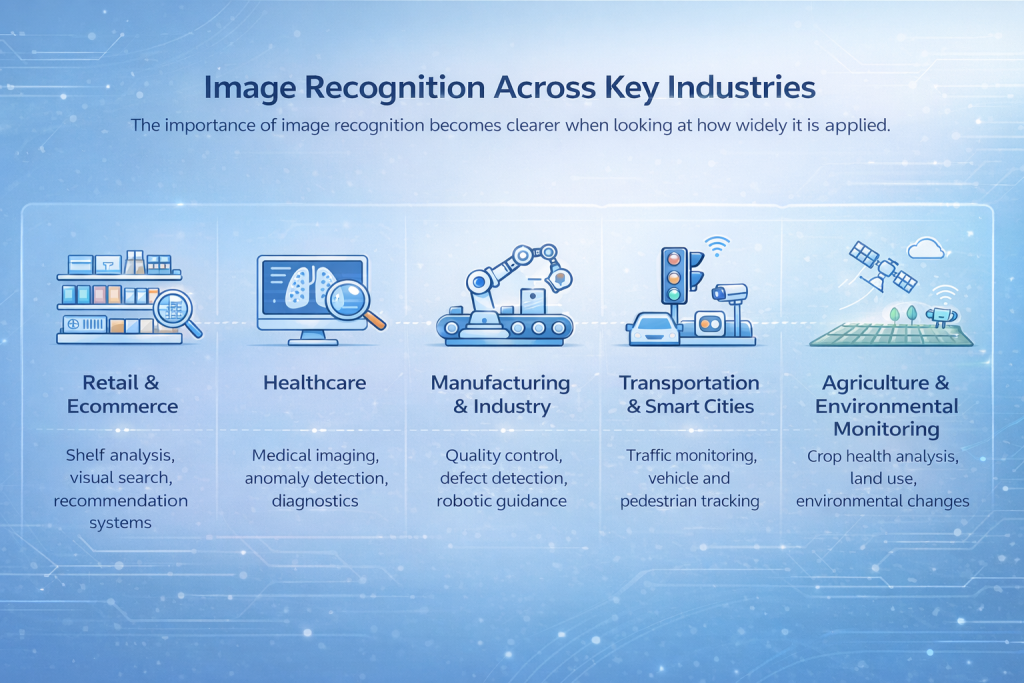
Image Recognition as a Tool for Efficiency
One of the clearest benefits of image recognition is operational efficiency.
Tasks that once took hours or days can now be completed in minutes. Large image collections can be analyzed automatically. Repetitive visual checks can be removed from human workflows.
Examples are easy to find:
- Quality inspection in manufacturing
- Inventory checks in retail and warehouses
- Asset monitoring in infrastructure and utilities
- Document and form processing using visual input
In these cases, image recognition does not replace human expertise. It removes the slow, repetitive part of the work. That allows people to focus on exceptions, decisions, and improvements instead of basic verification.
Efficiency gains are not just about speed. They also reduce costs, minimize errors, and make processes more predictable. That combination is especially valuable in industries where margins are tight or operations are distributed across many locations.
Turning Images Into Business Insight
Beyond automation, image recognition plays a growing role in analytics and decision-making. Images often reveal patterns that are difficult to capture through traditional data sources. Customer behavior, product placement, environmental changes, safety risks, and operational bottlenecks are all visible in images long before they show up in reports or dashboards.
When image recognition systems analyze visual data consistently over time, they turn raw imagery into structured outputs such as counts, categories, measurements, and trends. These results can be fed directly into dashboards, reports, and decision systems, making visual information part of everyday business analysis.
This allows organizations to monitor changes visually instead of relying on manual reporting, spot issues earlier while they are still small, compare performance across locations with consistent criteria, and measure compliance with standards and procedures more objectively. In this sense, image recognition is not just about recognizing objects. It is about transforming visual reality into data that fits naturally into modern business systems.
The Role of Image Recognition in Prediction
Another reason image recognition matters today is its contribution to predictive systems.
When combined with historical data, image recognition outputs can help organizations anticipate what might happen next. Visual patterns often precede measurable outcomes.
For example:
- Equipment wear visible in images before failure occurs
- Changes in customer movement patterns before sales shift
- Early signs of crop stress before yield drops
- Subtle behavioral cues before safety incidents
By identifying these visual signals early, organizations can act proactively rather than reactively. This shifts image recognition from a descriptive tool to a predictive one.
Predictive use cases require reliable data, continuous monitoring, and model updates. But when implemented correctly, they provide a strong competitive advantage.
Image Recognition Across Key Industries
The importance of image recognition becomes clearer when looking at how widely it is applied.
Retail and Ecommerce
Retailers use image recognition to understand shelves, products, and customer behavior. Systems can detect out-of-stock items, incorrect pricing labels, planogram compliance, and product placement effectiveness.
In ecommerce, image recognition powers visual search, automated tagging, content moderation, and recommendation systems. Customers increasingly expect to search with images rather than words.
Healthcare
Medical imaging is one of the most established areas for image recognition. Systems assist clinicians by highlighting anomalies, segmenting anatomical structures, and supporting diagnosis.
The goal is not to replace medical professionals but to reduce workload, increase consistency, and help catch issues earlier.
Manufacturing and Industry
Factories rely on image recognition for quality control, defect detection, robotic guidance, and safety monitoring. Visual inspection is a natural fit for automation because it follows clear criteria and happens continuously.
Transportation and Smart Cities
Traffic monitoring, vehicle detection, license plate recognition, and pedestrian tracking all depend on image recognition. Cities use these systems to improve safety, manage congestion, and plan infrastructure.
Agriculture and Environmental Monitoring
Drones and satellites generate massive amounts of imagery. Image recognition helps analyze crop health, land use, deforestation, and environmental change at scale.
These use cases highlight an important point. Image recognition is not limited to one sector. It is a general capability that adapts to many domains because visual data exists everywhere.
Why Accuracy Alone Is Not Enough
It is tempting to focus only on accuracy metrics when discussing image recognition. Precision, recall, confidence scores. These numbers matter, but they are not the whole story.
Real-world image recognition systems must deal with imperfect conditions. Lighting changes. Objects overlap. Cameras fail. Environments evolve. New patterns emerge.
That is why robustness, monitoring, and continuous improvement are just as important as initial accuracy. A system that performs well in a controlled test but degrades in real conditions quickly loses value.
Human oversight remains essential. Experts must validate outputs, retrain models, and review edge cases. Image recognition works best as part of a broader system, not as a standalone solution.
Ethical and Privacy Considerations
The growing importance of image recognition also raises serious questions.
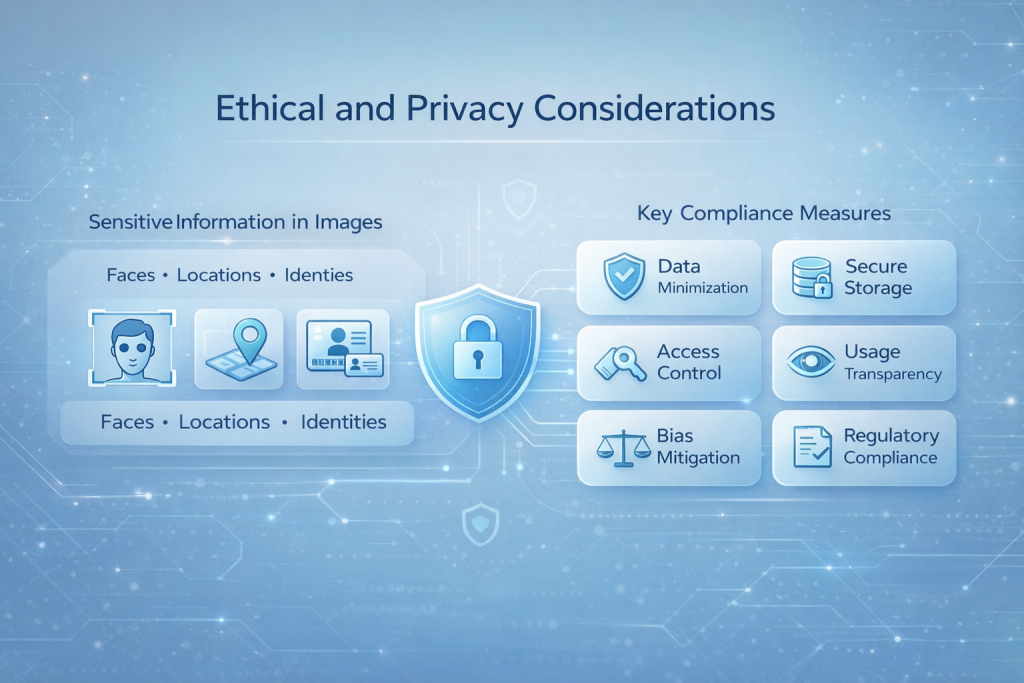
Images often contain personal or sensitive information. Faces, locations, behaviors, identities. Using this data responsibly is not optional. It is a requirement.
Organizations deploying image recognition systems must consider:
- Data minimization
- Secure storage and transmission
- Access control
- Transparency about usage
- Bias in training data
- Compliance with regulations
Regulatory frameworks such as GDPR and emerging AI-specific laws make these considerations unavoidable. Systems must be designed with privacy and accountability in mind from the start, not added later.
Trust is a critical factor. Without it, even the most advanced image recognition system will face resistance from users, employees, and regulators.
The Skills Gap and the Need for Expertise
Despite its growing importance, image recognition is not trivial to implement. Many organizations lack in-house expertise in computer vision, data preparation, model evaluation, and system integration.
This skills gap is one of the main reasons adoption slows down. Buying tools is not enough. Success depends on understanding data, defining realistic goals, and integrating outputs into real workflows.
As a result, image recognition projects often succeed when treated as long-term initiatives rather than quick experiments. They require planning, iteration, and collaboration between technical teams and domain experts.
Image Recognition as Infrastructure, Not a Feature
One of the most important shifts happening today is how image recognition is perceived.
It is no longer seen as a standalone feature or a novelty. It is becoming part of digital infrastructure, similar to databases, analytics platforms, or cloud services.
Once visual understanding is embedded into systems, it supports many functions at once. Automation, analytics, compliance, safety, customer experience. Removing it would mean losing visibility into a large part of reality.
That is why image recognition is becoming harder to ignore. As visual data continues to grow, organizations that cannot interpret it efficiently will fall behind those that can.
Conclusion: Why Image Recognition Truly Matters Now
Image recognition matters today because the world has become visual faster than it has become understandable.
We capture more images than ever before, but without automated understanding, those images remain underused. Image recognition closes that gap. It transforms visuals into data, automation, insight, and foresight.
It improves efficiency, supports better decisions, and enables systems to scale. It allows organizations to see patterns that were previously hidden and to act before problems escalate.
Most importantly, image recognition reflects a broader change in how digital systems interact with the world. They are no longer limited to text and numbers. They can observe, interpret, and respond to what they see.
In a digital world built on images, the ability to understand them is no longer optional. It is foundational.
FAQ
Image recognition is a technology that allows software to understand what appears in an image or video. It can identify objects, people, text, or patterns and turn visual content into structured data that systems can analyze and use.
Image recognition is important because modern businesses generate more visual data than humans can manually process. Cameras, smartphones, drones, and scanners create millions of images daily. Image recognition makes this data usable by automating analysis and revealing insights that would otherwise remain hidden.
Traditional image processing relies on fixed rules and predefined thresholds. Image recognition uses machine learning models that learn from data and adapt to new conditions. This makes it far more flexible and accurate in real-world environments where images vary in quality, lighting, and context.
Image recognition is well suited for tasks that involve visual inspection, monitoring, or classification. Common examples include quality control, inventory checks, medical image analysis, traffic monitoring, security screening, document processing, and visual search in ecommerce.
No. Image recognition supports human decision-making rather than replacing it. It handles repetitive, large-scale visual tasks quickly and consistently, while people focus on validation, interpretation, and complex decisions. Human oversight remains important, especially in sensitive or high-risk applications.