

Quick Summary: Aethair provides a comprehensive environmental intelligence platform that integrates hardware like the Aethair PRO and IAQ monitors with powerful software, including the Environet data platform and the Noesis AI assistant. This suite of tools is designed to streamline environmental data collection, analysis, and compliance reporting for EHS and ESG teams. Aethair’s system turns raw data into actionable, defensible insights, helping organizations enhance safety, ensure regulatory compliance, and make informed operational decisions.
For decades, environmental monitoring involved collecting massive amounts of data and hoping someone had the time to make sense of it. Sensor readings piled up, and compliance reports were painstakingly assembled by hand. By the time an issue was spotted, it was often too late. Sound familiar? This reactive approach to environmental, health, and safety (EHS) management is precisely what modern platforms are designed to solve.
Aethair is a platform built to close the gap between raw environmental data and what the company calls “environmental intelligence.” It’s not just about gathering numbers; it’s about turning those numbers into actionable, defensible decisions that support EHS and Environmental, Social, and Governance (ESG) teams. But does it deliver on this promise? This review breaks down the Aethair ecosystem—from its hardware to its AI-powered software—to see how it stacks up in 2026.
What is Environmental Intelligence, Anyway?
Before diving into the tools, it’s important to understand the core concept Aethair is built on. Environmental intelligence is the process of converting real-world environmental data into verifiable, actionable insights. Think of it as a closed-loop system: you sense the environment, perceive what’s happening through analysis, and then actuate a response based on that intelligence.
The problem with raw data is its sheer volume and lack of context. A sensor might tell you that PM2.5 levels spiked at 3:00 AM, but it can’t tell you why or what to do about it. That’s where intelligence platforms come in. They provide the trend analysis, threshold detection, and contextual interpretation needed to make data meaningful. This is critical for everything from ensuring worker safety to satisfying regulators.
The Aethair Ecosystem: Hardware and Software Synergy
Aethair’s strength lies in its integrated platform, which combines rugged hardware for data capture with a sophisticated cloud-based backend for analysis and reporting. The primary components work together to provide a seamless workflow from the field to the final compliance document.
Hardware: Aethair PRO and Aethair IAQ
The foundation of the system is data collection. Aethair offers specialized monitors for different environments:
- Aethair PRO: This is the industrial-grade workhorse of the lineup. Housed in a robust aluminum alloy enclosure, the Aethair PRO is designed for continuous monitoring in demanding indoor and outdoor settings like construction sites, fencelines, and industrial facilities. It measures key particulates (PM1, PM2.5, PM10) and environmental conditions like temperature, humidity, and pressure. Its key feature is flexibility; it accommodates up to two hot-swappable, pre-calibrated gas sensor cartridges for things like VOCs, CO, NO, and methane, allowing users to customize the device for specific applications without downtime. Connectivity is handled via 4G LTE, eliminating reliance on local networks.
- Aethair IAQ: Purpose-built for commercial indoor spaces like offices, hospitals, and schools, the Aethair IAQ is a more compact unit. It tracks nine key indoor air quality parameters, including PM2.5, CO, VOCs, and formaldehyde. Like the PRO model, it uses 4G connectivity for secure and reliable data transmission. The IAQ is designed for scalable deployments, allowing teams to manage devices across multiple rooms or entire facilities from a central platform.
| Feature | Aethair PRO | Aethair IAQ |
|---|---|---|
| Primary Use Case | Industrial, Outdoor, Perimeter | Commercial Indoor Spaces |
| Enclosure | Robust Metal Alloy | Compact Commercial Housing |
| Gas Sensors | Customizable (2 hot-swappable cartridges) | Fixed (tVOC, Formaldehyde, CO) |
| Key Parameters | PM1, PM2.5, PM10, Temp, Humidity, Pressure + 2 Gases | PM1, PM2.5, PM10, CO, tVOC, Formaldehyde, Temp, Humidity, Pressure |
| Connectivity | 4G LTE Cellular | 4G LTE Cellular |
Software: Environet, Noesis, and Aethair Reports
Raw data from the hardware is streamed to Aethair’s cloud platform, where the real analysis happens. This software suite is what transforms measurements into intelligence:
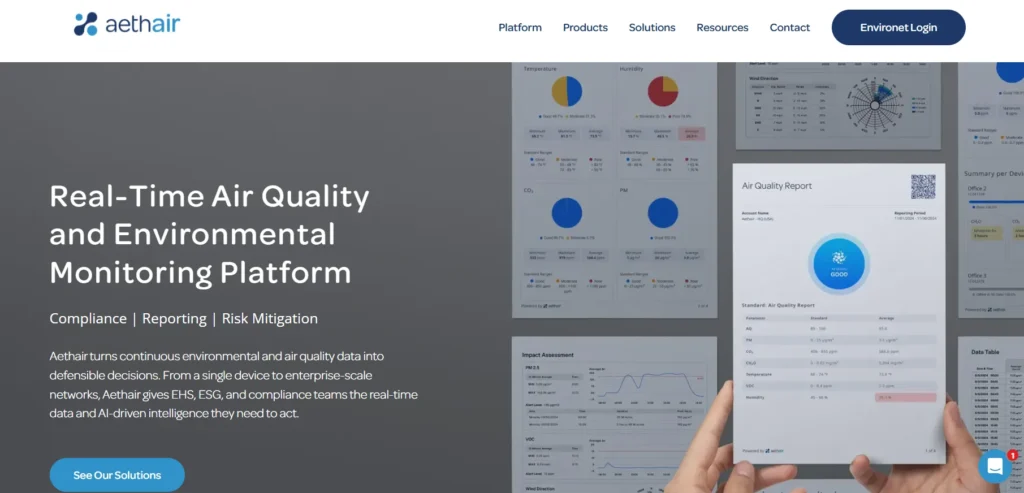
- Environet: This is the central hub—a web-based environmental data management platform where all live and historical data is centralized. From the Environet console, users can monitor conditions in real-time, visualize trends, manage devices, and configure alerts. It provides the core interface for interacting with the data flowing from Aethair PRO, IAQ, and even integrated third-party sensors.
- Aethair Reports: Manual compliance reporting is a major pain point for EHS teams. It’s time-consuming and prone to error. Aethair Reports is designed to automate this process. With a few clicks, it can generate professional, compliance-ready reports for air quality, perimeter monitoring, or other needs. The tool transforms raw data into clear charts, graphs, and tables, saving teams what Aethair claims can amount to thousands of hours annually. Reports can be shared instantly as PDFs or secure links.
- Noesis: The AI Assistant: Now, this is where it gets interesting. Noesis is Aethair’s generative AI tool, designed to act as an intelligent assistant for environmental data analysis. Instead of manually sifting through data, users can ask Noesis natural-language questions like, “Which monitoring sites had the highest PM10 levels yesterday?” The AI analyzes real-time and historical data to detect risks, flag anomalies, and generate compliance-ready summaries. It’s embedded across the platform, from the dashboard to the reporting module, aiming to make data interaction more intuitive and efficient. This approach moves compliance from a reactive exercise to a proactive risk management function.
Building a Defensible and Audit-Ready Workflow
The ultimate goal of any EHS data platform is to produce defensible data—documentation that can withstand scrutiny from regulators, auditors, or legal counsel. This requires more than just collecting numbers; it demands a clear data lineage from the sensor to the final report. Aethair’s integrated system is designed to provide this traceability.
When a report is generated, the platform shows the raw data, the regulatory thresholds applied, and the specific time periods covered. This transparency is key. Automation reduces the risk of human error in data handling, while the AI can surface patterns that a manual review might miss. For example, Noesis can identify subtle trends that precede a major compliance breach, allowing teams to act preemptively.
This focus on creating audit-ready outputs is a significant value proposition. The ability to generate a detailed report in seconds rather than days can be transformative for EHS teams juggling multiple sites and complex regulatory requirements.

Use FlyPix AI to Add Visual Evidence to Environmental Reports
Aethair tools such as Noesis, Environet Reports, and Aethair PRO are connected with environmental reporting, monitoring, and compliance workflows. FlyPix AI can add image-based context by helping teams analyze satellite, drone, and aerial imagery for visible site features and changes.
FlyPix AI can help when environmental reporting needs supporting visual data:
- Reviewing land cover, vegetation, water, roads, or built areas
- Detecting visible objects, debris, site activity, or surface-level changes
- Comparing imagery from different dates to document changes
- Training custom models for project-specific environmental features
Reach out to FlyPix AI to see how imagery analysis can support environmental reporting workflows.
Who is the Aethair Platform For?
Aethair is not a consumer-grade air quality monitor. Its solutions are aimed squarely at professional and industrial users who have a clear compliance or safety need. Key sectors include:
- Construction: For perimeter dust monitoring and ensuring compliance with standards like NYSDEC DER-10 or SCAQMD Rule 1180.
- Healthcare & Labs: For real-time air quality monitoring in sensitive environments like IVF labs and surgical centers.
- Industrial & Mining: For fenceline monitoring, operational efficiency, and ensuring cabin air quality compliance with standards like ISO 23875.
- Commercial Real Estate: For IAQ monitoring to meet healthy building standards like WELL and ASHRAE 62.1.
The platform is built to scale from a single device to a multi-facility enterprise network, with centralized management through Environet. Organizations needing to standardize their environmental data collection and reporting across a large portfolio are a primary audience.
Frequently Asked Questions (FAQ)
Noesis is Aethair’s AI assistant for environmental data analysis. It allows users to ask plain-language questions about their data, helping to identify trends, generate reports, and detect anomalies without manual data review.
Yes, Aethair PRO is designed for both indoor and outdoor use. Its rugged build and customizable sensors make it suitable for demanding indoor industrial environments as well as outdoor perimeter monitoring.
Data is transmitted via a secure 4G LTE cellular connection to the Environet cloud platform. Users can access real-time and historical data 24/7 from anywhere through the web-based Environet console.
Defensible data comes from a transparent and traceable process. Aethair’s platform provides a clear lineage from the calibrated sensor’s raw measurement to the final, structured report, including the thresholds and standards applied.
Yes, through a device called Thiamis, an IoT gateway, third-party sensors can be connected to the Aethair platform, allowing for unified monitoring within the Environet console.
Aethair Reports can generate various customizable compliance and operational reports, including perimeter monitoring, indoor air quality assessments, and cabin air quality reports, complete with data tables, charts, and site maps.
Yes, the platform is designed for scalability. It can support deployments ranging from a single device to a large, multi-facility network, with all devices managed centrally through the Environet platform.
Final Verdict for 2026
The Aethair platform presents a robust, end-to-end solution for environmental intelligence. Its biggest strength is the tight integration of hardware and software. Collecting data is only half the battle; the real value comes from the analysis and reporting capabilities provided by Environet, Aethair Reports, and the Noesis AI assistant.
For EHS, ESG, and compliance teams buried under manual reporting and disjointed data sources, Aethair offers a streamlined, automated workflow. The move toward AI-driven analysis with tools like Noesis is a significant step forward, promising to save time and uncover deeper insights. While the initial investment in hardware is a factor, the potential return—in saved labor hours, avoided fines, and proactive risk mitigation—is substantial.
Real talk: the market for environmental monitoring tools is crowded. But Aethair’s focus on creating a unified *intelligence* platform, rather than just selling monitoring devices, sets it apart. The emphasis on defensible, audit-ready data and AI-assisted analysis makes it a compelling option for any organization serious about its environmental compliance in 2026 and beyond.