

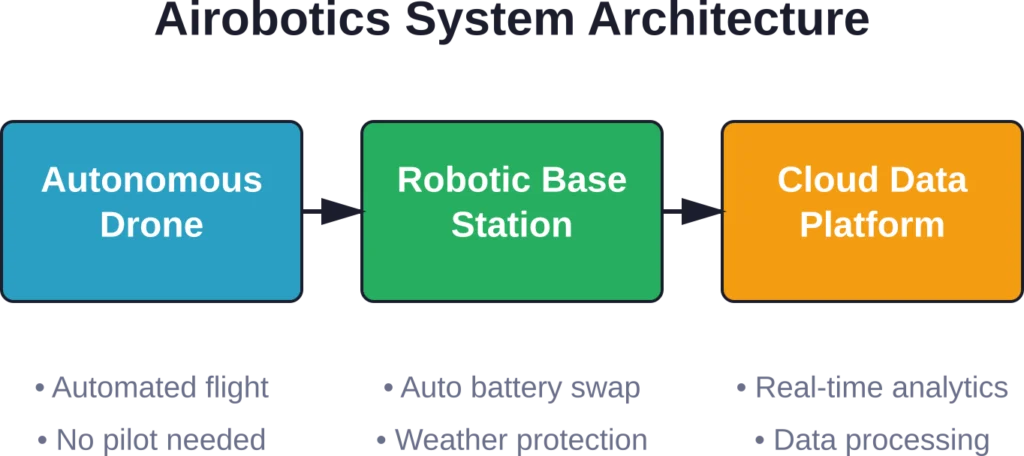
Quick Summary: Airobotics is an Israeli manufacturer of fully automated drone infrastructure systems that operate 24/7 without human intervention. The company’s ‘drone in a box’ platform serves industrial, defense, homeland security, and smart city applications with over 30,000 automated flights logged. Their systems combine autonomous drones, robotic base stations, and cloud-based data processing for mission-critical aerial operations.
Airobotics isn’t just another commercial drone company. It’s fundamentally changing how organizations think about aerial data collection by treating drones as infrastructure rather than tools.
Founded in 2014 in Petah Tikva, Israel, Airobotics has grown to over 250 employees and operates across the United States, Chile, and New Caledonia. The company has raised over $120 million before going public and was subsequently acquired by Ondas Holdings.
What Makes Airobotics Different: Fully Automated Operations
Traditional drone operations require trained pilots, manual battery swaps, and constant supervision. Airobotics eliminates all of that.
Their platform operates completely autonomously. The drone launches from a weatherproof base station, flies preprogrammed missions, returns automatically, and even swaps its own batteries—no human intervention required. This “drone in a box” model has logged more than 30,000 automated flights across industrial, defense, and commercial applications.
Here’s the thing though—full automation means organizations can run aerial surveillance, monitoring, and data collection missions 24/7. That’s particularly valuable for mining operations, construction sites, and security applications where continuous monitoring matters.
Core Applications and Use Cases
Airobotics positions its drone infrastructure across three primary verticals:
Industrial Infrastructure
Mining operations, construction sites, and industrial facilities use Airobotics for continuous monitoring, stockpile measurements, and safety surveillance. The system handles routine inspections without pulling workers from other tasks.
Defense and Homeland Security
Government entities deploy Airobotics systems for perimeter security, threat detection, and emergency response. The trusted autonomous drones provide persistent aerial surveillance for critical infrastructure and border protection.
Smart City Solutions
Urban infrastructure monitoring represents Airobotics’ newest vertical. Municipal networks of drones link to urban control centers, providing automated aerial services for public safety, law enforcement, and traffic monitoring.
| Application | Key Features | Primary Benefits |
|---|---|---|
| Industrial Sites | Automated stockpile surveys, thermal inspections | 24/7 monitoring, reduced safety risks |
| Defense Operations | Perimeter security, counter-drone systems | Persistent surveillance, rapid response |
| Smart Cities | Traffic monitoring, public safety | Municipal infrastructure, automated services |
| Construction | Progress tracking, surveying | Accurate data, project documentation |
Turn Aerial Data into Usable Geospatial Outputs with FlyPix AI
Autonomous drone workflows create value when captured imagery can be quickly reviewed, classified, and prepared for operational use. FlyPix AI supports geospatial image analysis across satellite, drone, aerial, LiDAR, SAR, and multispectral imagery. For workflows related to Airobotics, it can help teams work with aerial data by detecting objects, segmenting mapped areas, classifying visible features, and monitoring changes across sites over time.
FlyPix AI can support aerial data workflows with:
- Object detection from drone or aerial imagery
- Area segmentation for industrial, commercial, or infrastructure sites
- Classification of visible land and surface features
- Change detection across repeated aerial captures
- Custom AI model training for site-specific analysis tasks
- Geospatial data preparation for review, export, or reporting
👉Talk to FlyPix AI about turning aerial imagery into structured geospatial outputs for your project.
The Technology Stack
Airobotics combines aerospace hardware design, robust electronic systems, and cutting-edge software engineering. The company manufactures unmanned aircraft systems specifically designed for autonomous operations.
But wait. What about regulations?
Airobotics has received FAA approval for fully automated commercial drone flights without a human operator onsite. That regulatory milestone enabled industrial deployment at scale.
Industry Context and Competition
The construction technology and robotics sectors have seen significant investment despite broader economic challenges. Industry reports suggest construction-related technology startups secured substantial funding as organizations adopt automated solutions.
Now, this is where it gets interesting. While many drone companies focus on piloted operations or basic automation, Airobotics built its entire business model around zero-touch deployment. That’s mission-critical strategic aerial infrastructure, not just flying cameras.
Real-World Track Record
The company’s operational achievements speak to system reliability. Over 30,000 automated drone flights across industrial environments demonstrate that the technology works beyond controlled testing environments.
That matters. Real talk: plenty of automation companies have impressive demos but struggle with real-world deployment. Airobotics has proven its platform in mining operations, defense installations, and construction sites—environments where downtime costs money and failure isn’t an option.
Future Outlook
The broader adoption of robotics, automation, and mobile unmanned systems continues accelerating across industries. Academic research from institutions like Stanford’s CIFE program highlights how construction and infrastructure sectors increasingly rely on automated technologies.
Airobotics sits at the intersection of several technology trends: autonomous systems, aerial data collection, and infrastructure-as-a-service. As organizations shift from viewing drones as occasional tools to essential infrastructure, platforms designed for fully automated operations gain strategic advantage.
Frequently Asked Questions
Airobotics manufactures and operates fully automated drone systems that function as aerial infrastructure. Their platforms perform surveillance, monitoring, and data collection missions 24/7 without human intervention, serving industrial, defense, and smart city applications.
The drone returns to its robotic base station after each mission. The base station automatically removes the depleted battery, inserts a fresh one, and launches the drone for its next flight—all without human involvement.
Airobotics currently operates in the United States, Chile, and New Caledonia, with headquarters in Petah Tikva, Israel. The company has expanded to over 250 employees supporting global operations.
Primary industries include mining and aggregates, construction, defense and homeland security, industrial facilities, and smart city infrastructure. Any organization needing continuous aerial monitoring benefits from the platform.
No. Airobotics has received FAA approval for fully automated commercial drone flights without a human operator onsite.
The company has logged more than 30,000 automated drone flights across various industrial and commercial applications, demonstrating system reliability and operational maturity.
Traditional drone services require trained pilots, manual battery management, and continuous supervision. Airobotics operates autonomously 24/7 as infrastructure rather than as piloted equipment, eliminating the need for onsite personnel.
Conclusion
Airobotics represents a fundamental shift in how organizations deploy aerial systems. By treating drones as automated infrastructure rather than piloted tools, the platform enables continuous operations that weren’t economically viable with traditional approaches.
The technology has proven itself across demanding industrial environments with over 30,000 automated flights completed. As industries continue adopting robotics and automation, platforms designed for zero-touch operations gain competitive advantage.
Organizations evaluating drone infrastructure for industrial monitoring, defense applications, or smart city initiatives should examine Airobotics’ autonomous approach. Check the official Airobotics website for current deployment options and detailed technical specifications.