
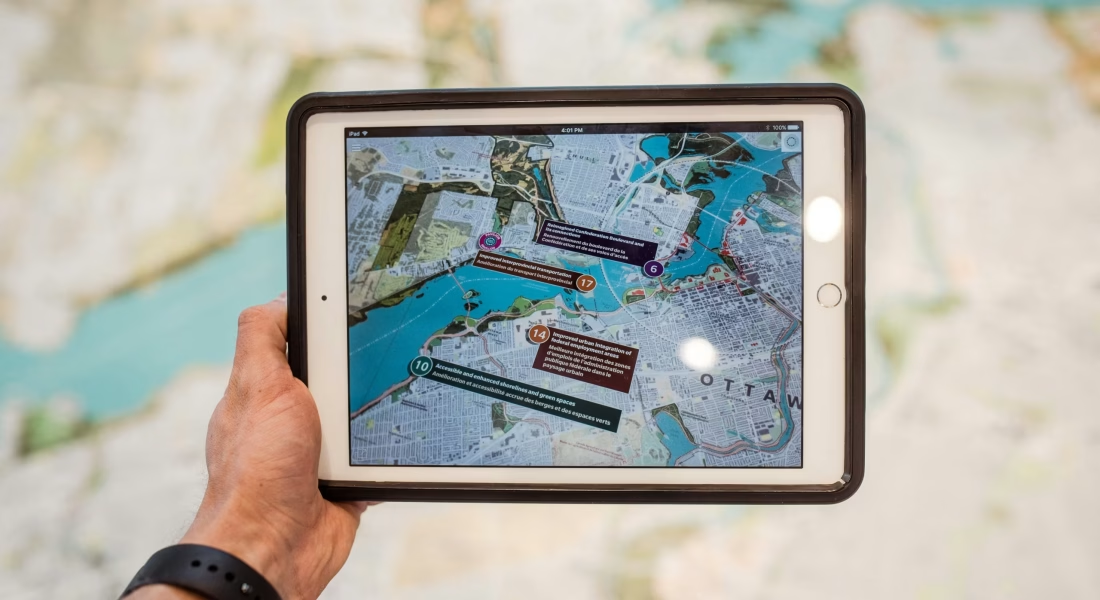
Remote crop monitoring solutions powered by geospatial intelligence are changing the way large fields are monitored. These solutions bring together high-resolution satellite data, drone imagery, and aerial views with AI to create clear and actionable insights about crop conditions. As a result, issues such as water stress, nutrient shortages, or pest activity can be detected much faster, significantly reducing the need for constant manual field visits.
What makes these solutions particularly useful is how they simplify complex geospatial analysis and make it more scalable. The systems help outline crop boundaries, track growth stages, and monitor extensive areas even in dense or varied landscapes. Many solutions also support custom training, allowing the analysis to adapt to specific crop types or local conditions and turn raw imagery into practical, decision-ready information.
Top Geospatial Tools for Remote Crop Monitoring
Powerful remote crop monitoring tools are reshaping agriculture by turning satellite, drone, and aerial imagery into fast, precise insights. These intelligent apps use advanced AI to detect crop health issues, track growth patterns, and analyze vast fields in minutes instead of days. Designed for ease and scale, they help users move from raw geospatial data to clear, actionable decisions with minimal effort.

1. FlyPix AI
FlyPix AI analyzes satellite, aerial, and drone imagery with geospatial AI to detect objects and patterns in fields. The tool outlines different elements visible in the images and supports multispectral data processing. Users can train custom AI models according to specific crop monitoring needs, which makes the analysis fit particular situations on the farm.
Our tool helps with anomaly detection and change monitoring so potential issues in crop conditions become visible earlier. Our platform includes an interactive sandbox for real-time geospatial analysis on uploaded images. Some people find the combination of object outlining and custom model training useful when dealing with dense or varied crop scenes, though it still requires good quality imagery to work well.
Key Highlights:
- Analyzes satellite aerial and drone imagery for agriculture
- Performs object detection and outlining in geospatial images
- Supports multispectral data processing
- Enables anomaly detection and change monitoring
- Allows training of custom AI models for crop needs
Capabilities:
- Remote crop monitoring solutions
- Geospatial image analysis for crop monitoring
- Crop health monitoring
- Anomaly and change detection in fields
- Custom AI model training
- Data integration and analytics support
Contact Information:
- Website: flypix.ai
- Email: [email protected]
- Phone:+49 6151 3943470
- Address: Robert-Bosch-Str. 7, 64293 Darmstadt, Germany
- LinkedIn: www.linkedin.com/company/flypix-ai

2. CropProphet
CropProphet uses NDVI and VHI to keep tabs on crop health and help with yield outlooks. NDVI shows vegetation density and vigor while VHI brings in temperature and stress factors for a wider picture. The tool displays anomalies over different time windows so shifts become visible.
Color-coded maps make it easier to spot healthier zones versus areas under stress. Some users mention the combination of these two indices gives a decent complementary view when paired with other observations although the data comes from independent sources.
Key Highlights:
- Integrates NDVI for vegetation health tracking
- Uses VHI to assess drought and temperature stress
- Shows anomalies across multiple time periods
- Provides color-coded health maps
- Includes crop production-weighted statistics
Capabilities:
- Crop health monitoring with NDVI and VHI
- Yield forecasting support
- Anomaly observation
- Regional vegetation assessment
Contact Information:
- Website: www.cropprophet.com
- Email: [email protected]
- Address: 200 Innovation Blvd Ste 229, State College PA 16803
- LinkedIn: www.linkedin.com/company/cropprophet
- Twitter: x.com/CropProphet

3. Yara
Yara turns satellite images into biomass maps that show where crops are growing differently across a field. The tool helps spot those variations early so adjustments can be made before issues turn into losses. Farmers draw their fields directly or upload a shapefile and then start tracking nitrogen uptake with the improved N-Sensor index that works even in thick vegetation.
The app version makes it convenient to check fields from a phone. Users get in-season nitrogen recommendations and can create variable rate application maps for fertilizer. Sharing those maps with others on the farm is straightforward too.
Key Highlights:
- Converts satellite images to biomass maps
- Uses N-Sensor index instead of standard NDVI
- Creates variable rate nitrogen application maps
- Identifies growth differences in fields
Capabilities:
- Remote crop monitoring via satellite
- Nitrogen recommendation generation
- Biomass growth balancing
- Map export to farm machinery
- Field sharing options
Contact Information:
- Website: www.yara.us
- Phone: (813) 222-5700
- Email: [email protected]
- Address: 100 North Tampa Street, Suite 3800 – Tampa, FL
- LinkedIn: www.linkedin.com/company/yaranorthamerica
- Facebook: www.facebook.com/cropnutrition.yaraUS
- Instagram: www.instagram.com/yaranorthamerica

4. DynaCrop
DynaCrop works with satellite imagery to keep an eye on crop conditions and how they change through the season. The tool breaks down growth stages and picks up differences in soil moisture or reflectance that might affect productivity. It feels practical when someone needs a quick overview of large areas without driving every row.
Prescription maps come together based on those insights so inputs like fertilizer or seed can be adjusted zone by zone. Water status tracking is another part that stands out for catching moisture stress before it spreads.
Key Highlights:
- Analyzes crop growth stages from satellite data
- Supports creation of variable rate application maps
- Monitors crop water status
- Identifies zones with different soil reflectance
- Tracks productivity patterns over time
Capabilities:
- Crop condition observation
- Growth stage analysis
- Prescription map generation
- Soil sampling zone identification
- Moisture stress detection
Contact Information:
- Website: dynacrop.space
- Phone: +420 608 830 841
- Email: [email protected]
- Address: Jiráskova 229/25, 60200 Brno, Czech Republic
- LinkedIn: www.linkedin.com/company/dynacrop
- Facebook: www.facebook.com/dynacrop

5. MapMyCrop
MapMyCrop pulls in high-resolution satellite images and runs them through AI models to highlight differences in crop growth. Daily updates mean changes get noticed fast rather than weeks later. The system also processes photos taken in the field for disease identification and suggests what might help.
Variable rate maps are generated automatically where growth patterns or nutrient needs vary. Hyperlocal weather data feeds into the advisories as well which can make decisions feel a bit more grounded in current conditions.
Key Highlights:
- Delivers daily satellite imagery
- Uses multiple vegetation indices
- Detects diseases from field photos
- Generates variable rate application maps
- Analyzes parameters for real-time advisories
Capabilities:
- Crop growth monitoring
- Disease detection and recommendations
- Low productivity zone identification
- Variable rate map creation
- Weather-based advisories
Contact Information:
- Website: mapmycrop.com
- Phone: +1 917 414 3909
- Email: [email protected]
- Address: One World Trade Center, Suite 8500, New York, NY 10007
- LinkedIn: www.linkedin.com/company/map-my-crop
- Facebook: www.facebook.com/mapmycrop
- Twitter: x.com/mapmycrop

6. CropX Vision
CropX Vision focuses on analyzing canopy images to assess water stress in crops such as vineyards. The tool uses AI to calculate stress levels from individual canopy photos. It also processes satellite imagery, calculates vegetation indices, and handles issues related to cloud cover.
CropX Vision combines direct image analysis from canopy photos with remote sensing elements to provide a combined view of crop health. The single-photo approach for canopy analysis stands out when working with specific crops like vineyards. The system brings together different types of imagery for a more complete picture of field conditions.
Key Highlights:
- Analyzes canopy images for water stress
- Calculates stress levels from single canopy photos
- Processes satellite imagery
- Calculates vegetation indices
- Includes cloud detection models
Capabilities:
- Water stress measurement
- Canopy image analysis
- Satellite data processing
- Remote sensing support
Contact Information:
- Website: cropx.com
- Phone: 1 (888) 832 2767
- Email: [email protected]
- Address: 201 E Center St Ste 112 PMB 237, Anaheim, CA 92805, USA
- Facebook: www.facebook.com/CropXGlobal
- LinkedIn: www.linkedin.com/company/10147582
- Twitter: x.com/crop_x
- Instagram: www.instagram.com/cropx_global

7. FarmiSpace
FarmiSpace processes satellite imagery to track crop growth through biomass index, overall health, and moisture levels. The tool spots changes in plant light spectrum that point to pests, diseases, or water shortages fairly quickly. Some find the AI crop identification part surprisingly reliable across different crop types once fields are set up.
Custom alerts arrive as push notifications when something needs attention in a particular field. The system also flags the best window for harvest and sends reminders for routine field work. It feels handy when managing scattered fields because it highlights exactly where intervention might pay off without checking everything manually.
Key Highlights:
- Monitors biomass index from satellite data
- Tracks crop health and moisture index
- Detects anomalies like pests or water stress
- Identifies fields that require immediate attention
- Provides real-time push notifications
Capabilities:
- Satellite-based crop growth monitoring
- Anomaly detection in plant spectrum
- Customized alert generation
- Harvest timing support
- Field work reminders
Contact Information:
- Website: farmispace.com
- Phone: +886 2794-6400
- Address: Rm. 1, 4F., No. 55, Ln. 258, Ruiguang Rd., Neihu Dist., Taipei City 114036 , Taiwan (R.O.C.)

8. Regrow
Regrow applies remote sensing and AI to collect data on farming practices and environmental factors within agricultural supply chains. The company uses satellite imagery to verify regenerative agriculture practices and track environmental outcomes at scale. It focuses on tracing agricultural inputs and outputs back to specific sourcing areas while providing visibility into sustainability metrics.
Regrow generates heatmaps that compare environmental performance and risk factors across different regions. The platform supports longer-term monitoring of land management practices rather than daily crop health tracking in individual fields. This makes it particularly relevant for companies working with supply chain transparency and sustainability reporting.
Key Highlights:
- Uses remote sensing for supply chain analysis
- Verifies regenerative agriculture practices
- Tracks environmental outcomes with satellite data
- Traces elements to specific sourcing regions
- Creates heatmaps for risk and performance comparison
Capabilities:
- Supply chain visibility through remote sensing
- Regenerative practice verification
- Environmental outcome monitoring
- Risk and emissions tracking
- Sourcing region analysis
Contact Information:
- Website: www.regrow.ag
- Email: [email protected]
- Address: 87 Packers Falls Road, Durham, New Hampshire 03824 USA

9. OneSoil
OneSoil calculates vegetation indices from satellite data and supports remote crop monitoring in a straightforward way. The app automatically detects field boundaries so users can start tracking NDVI changes without much setup. Weekly views of the index help spot areas where crops lag behind the rest of the field.
The mobile version allows adding scouting notes and photos directly from the phone while checking weather forecasts for timing decisions. Some people mention the combination of NDVI charts with growing degree-days and precipitation data gives a more complete picture even if it still needs ground checks to confirm issues.
Key Highlights:
- Calculates NDVI vegetation index
- Automatically detects field boundaries
- Tracks changes in crop development over time
- Identifies low index problem areas
- Integrates weather forecast data
Capabilities:
- Remote vegetation monitoring
- NDVI map analysis
- Scouting note and photo integration
- Field performance comparison
- Optimal action timing support
Contact Information:
- Website: onesoil.ai
- Email: [email protected]
- Address: Churerstrasse 54, Pfäffikon, Schwyz 8808, CH
- Linkedin: www.linkedin.com/company/onesoil
- Twitter: x.com/onesoilplatform
- Instagram: www.instagram.com/onesoil.ai
10. Hexagon Geospatial Agriculture Solutions
Hexagon Geospatial Agriculture Solutions combines GIS and remote sensing for multispectral imagery work in farming. The tools analyze images to pick out stressed crops and extract features with AI assistance. Real-time inspection capabilities let users keep an eye on field conditions as they evolve.
Predictive mapping elements help shape digital farming approaches although the system requires some familiarity with geospatial workflows. The multispectral side stands out when someone already works with different image bands and wants to connect them to crop density or health observations.
Key Highlights:
- Analyzes multispectral imagery for crop stress
- Performs AI-powered feature extraction
- Identifies land parcels
- Tracks crop health and density
- Supports real-time field inspections
Capabilities:
- Multispectral remote sensing analysis
- Crop health and growing condition monitoring
- Predictive digital farming mapping
- GIS-based farm analysis
Contact Information:
- Website: hexagon.com
- Phone: +46 8 601 26 20
- Address: Lilla Bantorget 15, SE-111 23 Stockholm, Sweden
- LinkedIn: www.linkedin.com/company/hexagon-ab
- Facebook: www.facebook.com/HexagonAB
- Twitter: x.com/HexagonAB
- Instagram: www.instagram.com/hexagon_ab
Leading Companies Offering Remote Crop Monitoring Solutions
Several established companies deliver reliable remote crop monitoring solutions built around geospatial intelligence. These providers combine satellite, drone, and aerial imagery with AI to help users detect changes in crop health, spot stress factors early, and make faster decisions across large areas. The result is a practical way to move from raw imagery to clear insights without the usual time sink of manual field checks.
1. AI Superior
AI Superior is a German-based AI services company that specializes in end-to-end AI application development and consulting. The company designs and builds custom software solutions that rely on machine learning models, computer vision, and image processing techniques. It offers services in geospatial AI along with image analysis, object detection, and image segmentation.
AI Superior works with different types of visual data to extract actionable insights. The company also provides AI consulting and R&D support to help organizations implement data-driven approaches. Its projects cover various industries where advanced image processing and geospatial analysis are required.
Key Highlights:
- Specializes in end-to-end AI application development
- Focuses on computer vision and image processing
- Performs object detection and image segmentation
- Offers geospatial AI solutions
- Provides AI consulting and R&D services
Services:
- Custom AI software development
- Computer vision projects
- Image analysis and classification
- Geospatial data processing
- AI strategy consulting
Contact Information:
- Website: aisuperior.com
- Phone: +49 6151 3943489
- Email: [email protected]
- Address: Robert-Bosch-Str. 7, 64293 Darmstadt, Germany
- LinkedIn: www.linkedin.com/company/ai-superior
- Facebook: www.facebook.com/aisuperior
- Twitter: x.com/aisuperior
- Instagram: www.instagram.com/ai_superior

2. Seer Satellite Solutions
Seer Satellite Solutions delivers geospatial intelligence and satellite-powered insights with a focus on agriculture. The company offers a digital platform that uses satellite imagery, vegetation indices, and AI analytics to monitor crop fields. It includes features for early problem detection, field zoning, and weather-related insights.
Growers sometimes note that the daily monitoring capability makes it easier to spot changes quickly during the season. It all depends on whether the focus is on broad coverage or more detailed field-level decisions. The platform also supports scouting and activity logging alongside the satellite data.
Key Highlights:
- Provides satellite-powered insights for agriculture
- Uses vegetation indices and AI analytics
- Supports daily crop field monitoring
- Detects problems early in crops
- Includes field zoning capabilities
Services:
- Crop field monitoring from satellite
- Vegetation index analysis
- Early disease and stress detection
- Weather analytics for fields
- Scouting and activity reporting
Contact Information:
- Website: www.seersatellites.com
- Phone: +639-482-372-021
- Email: [email protected]
- Address: 9/F Filinvest One Building, Northgate Cyberzone, Alabang-Zapote Road corner Northgate Avenue, Filinvest City, Alabang, Muntinlupa City, 1781
- LinkedIn: www.linkedin.com/company/seer-intelligent-solutions

3. Alteia
Alteia focuses on satellite-based crop monitoring and analytics. The company works with satellite imagery to assess vegetation health, estimate yields, and create crop maps. It pays attention to how fields change over time through imagery analysis and change detection.
Many people who have looked into these kinds of solutions say Alteia keeps things fairly straightforward when the main need is following vegetation patterns from space. It all depends on the type of imagery someone already has access to. The approach fits nicely into geospatial crop monitoring without adding unnecessary layers.
Key Highlights:
- Specializes in satellite-based crop monitoring
- Assesses vegetation health from imagery
- Supports yield estimation
- Creates crop maps
- Tracks changes in crop areas
Services:
- Satellite imagery analysis for crops
- Vegetation health evaluation
- Crop mapping
- Yield analytics
- Change detection
Contact Information:
- Website: alteia.com
- Email: [email protected]
- LinkedIn: www.linkedin.com/company/alteia-ai
- Twitter: x.com/Alteia_AI

4. SatSure
SatSure develops satellite analytical solutions for agriculture and crop monitoring. The company turns Earth observation data into decision intelligence by combining satellite imagery with other remote sensing sources to follow in-season crop conditions and estimate yields. It covers aspects like crop health tracking and spatial intelligence across different parts of the agri value chain.
Some people who have looked at these solutions say SatSure’s approach works well when you need a broader view beyond single fields. It feels useful for linking crop monitoring with market or supply chain questions. In practice it comes down to how the geospatial insights fit into someone’s existing workflow.
Key Highlights:
- Develops satellite analytical solutions for agriculture
- Provides in-season crop monitoring
- Supports yield estimation from satellite data
- Creates spatial intelligence for the agri value chain
- Combines satellite imagery with remote sensing
Services:
- Crop health and growth tracking
- Yield estimation analytics
- In-season monitoring support
- Spatial intelligence for agriculture
- Procurement and inventory insights from satellite data
Contact Information:
- Website: www.satsure.co
- Email: [email protected]
- Address: SatSure Analytics India Pvt Ltd, 202, Prestige Loka, Brunton Rd, Craig Park Layout, Ashok Nagar, Bengaluru, Karnataka, India – 560025
- LinkedIn: www.linkedin.com/company/satsure
- Twitter: x.com/sat_sure
5. Hydrosat
Hydrosat specializes in thermal infrared satellite solutions for irrigation and crop stress monitoring. The company integrates satellite data with crop and soil properties to detect variations in crop stress even when plants look fine from regular imagery. It delivers field-level and regional-level analytics focused on water productivity and stress management.
Growers sometimes mention that the thermal approach adds a layer that standard vegetation indices miss. It all depends on how critical precise irrigation timing is for the crops and climate in question. The insights aim to help neutralize water stress and support more efficient crop management decisions.
Key Highlights:
- Specializes in thermal infrared satellite solutions
- Detects crop stress variations across crop types
- Integrates satellite data with crop and soil properties
- Provides field-level and regional analytics
- Focuses on water productivity and stress insights
Services:
- Irrigation management support from satellite data
- Crop stress monitoring with thermal infrared
- Water stress detection and neutralization
- Field-level water and crop analytics
- Regional agricultural insights
Contact Information:
- Website: hydrosat.com
- Address: 1250 Connecticut Ave NW, Suite 700-09 Washington, DC 20036
- LinkedIn: www.linkedin.com/company/hydrosat
- Instagram: www.instagram.com/hydrosat_earth
6. EOS Data Analytics
EOS Data Analytics operates as a provider of satellite data and intelligence for various sectors including agriculture. The company combines imagery from its own EOS SAT-1 satellite with partner constellations and applies AI algorithms to turn raw orbital data into visualizations and analytical reports. In agriculture, it supports tracking of crop conditions and field boundaries throughout the growing season.
Some folks who work with satellite analytics mention that the mix of different data sources helps when trying to get a clearer picture of what’s happening on the land. It all depends on how someone plans to use the reports in daily operations. The company also offers tools like LandViewer for browsing and analyzing imagery directly in the browser.
Key Highlights:
- Provides satellite data and intelligence services
- Operates EOS SAT-1 along with partner constellations
- Uses AI algorithms on imagery
- Supports crop condition tracking in agriculture
- Generates analytical reports from satellite data
Services:
- Satellite imagery analysis
- Crop health and field condition monitoring
- Field boundary mapping
- Data visualization and reporting
- Land use analytics
Contact Information:
- Website: eos.com
- Email: [email protected]
- Address: 800 W. El Camino Real, Suite 180, Mountain View, CA 94040, USA
- LinkedIn: www.linkedin.com/company/eos-data-analytics
- Facebook: www.facebook.com/eosda
- Twitter: x.com/eos_da
- Instagram: www.instagram.com/eosdataanalytics
7. Planet Labs
Planet Labs supplies high-frequency satellite imagery for agriculture and crop monitoring. The company maintains a large constellation that delivers near-daily revisits over agricultural areas with field-level resolution. It provides both raw imagery and derived products such as vegetation indices and biomass estimates.
Many users note that the frequent update cycle makes it easier to catch changes during the season compared to traditional satellite sources. It all depends on whether someone needs broad coverage or very detailed field views. The imagery archive goes back years which some find helpful for comparing seasons.
Key Highlights:
- Delivers high-frequency satellite imagery
- Supports monitoring of crop health
- Provides derived data products like NDVI
- Offers field-level resolution imagery
- Maintains a deep historical image archive
Services:
- Daily crop monitoring from satellite
- Stress detection in crops
- Biomass and vegetation index calculation
- Precision agriculture data support
- API integration for imagery
Contact Information:
- Website: www.planet.com
- Email: [email protected]
- Facebook: www.facebook.com/PlanetLabs
- LinkedIn: www.linkedin.com/company/planet-labs
- Twitter: x.com/planet
- Instagram: www.instagram.com/planetlabs
8. Farmonaut
Farmonaut delivers satellite-based solutions for precision agriculture. The company uses satellite data to provide insights on crop health, soil moisture, and weather conditions that help with farm decisions. It also works with traceability of produce and supports plantation management through growth tracking.
Some people say the satellite approach feels practical when managing larger operations or when ground visits are limited. It all depends on how much someone wants to combine satellite views with other farm records. The company includes tools for carbon monitoring in sustainable farming practices.
Key Highlights:
- Uses satellite data for agriculture insights
- Tracks crop health and soil moisture
- Supports plantation growth monitoring
- Provides traceability for agricultural produce
- Includes carbon footprint analysis
Services:
- Satellite-based crop monitoring
- Soil moisture and weather insights
- Plantation management support
- Produce traceability
- Carbon monitoring for farming
Contact Information:
- Website: farmonaut.com
- Phone: +1 (669)666-6882
- Email: [email protected]
- Address: 2810 N Church St PMB 87609, Wilmington Delaware, USA
- LinkedIn: www.linkedin.com/company/farmonaut
- Facebook: www.facebook.com/farmonaut
- Twitter: x.com/farmonaut
- Instagram: www.instagram.com/farmonaut
9. Latitude Geospatial
Latitude Geospatial develops satellite-based solutions for precision agriculture and crop monitoring. The company combines satellite imagery with climatic data and machine learning models to generate field-level insights on crop health and soil conditions. It processes geospatial information to support decisions related to irrigation scheduling and risk management across agricultural areas.
The solutions focus on converting complex satellite and environmental data into practical outputs for farm planning. Latitude Geospatial works with different data sources to deliver consistent monitoring throughout the growing season. The approach connects broad satellite coverage with more detailed field-level analysis.
Key Highlights:
- Develops satellite-based solutions for agriculture
- Combines satellite imagery with climatic data
- Applies machine learning for field insights
- Tracks crop health and soil conditions
- Supports irrigation and risk management
Services:
- Crop health monitoring from satellite data
- Soil moisture analysis
- Irrigation scheduling support
- Risk detection in fields
- Farm planning with geospatial insights
Contact Information:
- Website: latitudegeospatial.com
- Phone: +5926585332
- Email: [email protected]
- Address: 195 Schoonord, West Bank Demerara, Guyana
- LinkedIn: www.linkedin.com/company/latitudeguyana
- Facebook: www.facebook.com/latitudeguyana
- Twitter: x.com/LatitudeGuyana
- Instagram: www.instagram.com/latitudeguyana
Conclusion
Remote crop monitoring solutions built on geospatial tech have quietly changed how farmers and agronomists keep an eye on fields these days. Instead of relying solely on boots-on-the-ground checks that eat up days, these tools pull insights from satellite passes, drone flights, and aerial shots, then turn the raw data into something you can actually act on. It’s not magic, but it does cut through a lot of the guesswork when spotting stress, uneven growth, or emerging problems across big areas.
What stands out after looking at the options is how much the field keeps shifting toward easier integration and smarter automation. Some solutions feel more hands-on with custom tweaks, while others lean heavier on ready-made analytics. Either way, the real value shows up when the imagery lines up with what you already know about your land. Choosing one ultimately comes down to your specific setup, the crops you’re growing, and how deeply you want to dive into the maps. Geospatial monitoring isn’t replacing human judgment anytime soon, but it sure makes that judgment a whole lot sharper.